NVIDIA has launched a new Spark-branded PC push for local AI, and it is bigger than a normal laptop refresh. At GTC Taipei during COMPUTEX, NVIDIA and Microsoft introduced NVIDIA RTX Spark, a Windows PC platform for personal AI agents that brings Blackwell RTX graphics, Grace CPU cores, up to 128GB of unified memory, and a claimed 1 petaflop of AI performance into slim laptops and compact desktops.
The announcement also connects to two workstation-class machines readers may see in the same conversation: NVIDIA DGX Spark, the compact desktop AI supercomputer that started shipping earlier, and NVIDIA DGX Station for Windows, a much larger deskside enterprise AI workstation coming in Q4 2026.
So if you searched for "NVIDIA Spark workstation laptop," the practical answer is this: RTX Spark is the new laptop and compact desktop platform, DGX Spark is the small desktop AI supercomputer, and DGX Station for Windows is the enterprise deskside workstation tier.
What NVIDIA Actually Launched
NVIDIA's May 31, 2026 announcement centers on RTX Spark, a new class of Windows PCs designed for local AI agents, creative tools, development work, and gaming. NVIDIA says RTX Spark-powered laptops and small desktops will be available this fall from ASUS, Dell, HP, Lenovo, Microsoft Surface, and MSI, with Acer and GIGABYTE models to follow.
The most important RTX Spark hardware details are:
| Feature | NVIDIA RTX Spark claim | Why it matters |
|---|---|---|
| AI performance | Up to 1 petaflop | Gives local agents and model workflows more headroom than mainstream thin laptops |
| Memory | Up to 128GB unified memory | Useful for large local models, long context, video, and 3D workloads |
| GPU | Blackwell RTX GPU with 6,144 CUDA cores | Brings CUDA, RTX, Tensor Cores, DLSS, OptiX, and TensorRT into one mobile platform |
| CPU | 20-core NVIDIA Grace CPU | Arm-based CPU design tied to the GPU through NVLink-C2C |
| Form factors | Slim laptops and compact desktops | Targets portable and desk-friendly AI work instead of only tower workstations |
| Availability | Fall 2026 | Hardware is announced, but real buyer decisions should wait for model pricing and benchmarks |
NVIDIA is positioning RTX Spark as a machine for "personal agents," meaning local assistants that can reason over files, automate workflows, generate media, code, and interact with Windows apps while staying on the user's device.
RTX Spark Laptops: Why They Are Different
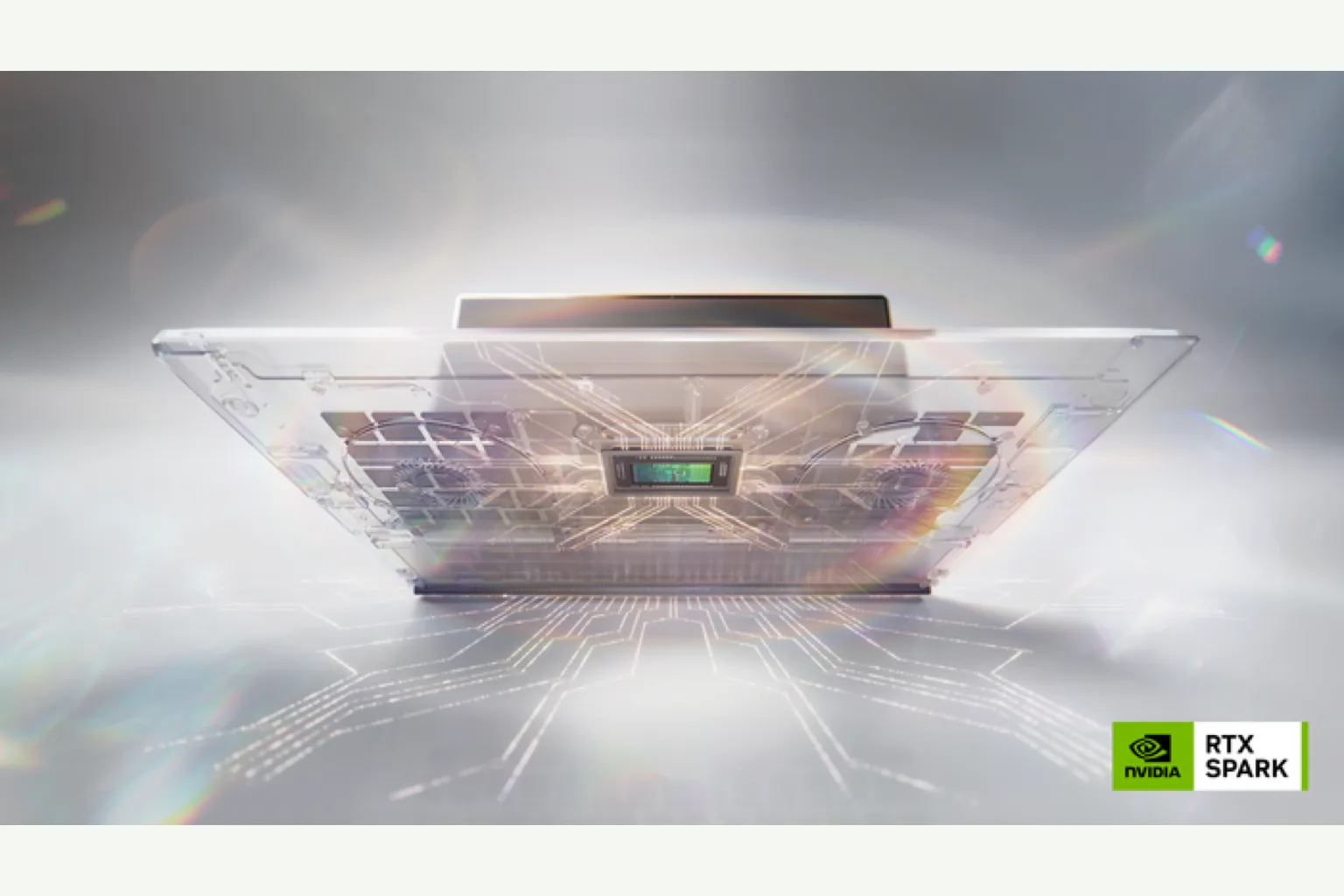
The laptop side of the announcement is the most interesting part. NVIDIA says RTX Spark laptops can be as slim as 14 millimeters, as light as three pounds, and available in 14- to 16-inch sizes with premium displays. That is a very different pitch from the heavy mobile workstations that AI developers usually associate with local model work.
NVIDIA's performance claims are ambitious. The company says RTX Spark can run 120-billion-parameter LLMs with up to a 1 million token context locally, edit 12K 4:2:2 video, render very large 3D scenes, and play AAA games at 1440p at over 100 frames per second.
For developers and creators, the key change is not just raw speed. It is memory. A typical creator laptop might have 16GB or 32GB of RAM and a separate GPU with much less VRAM. RTX Spark's 128GB unified memory target means the CPU and GPU can draw from a much larger shared pool, which is more relevant for large AI models and long-context agents.
That does not automatically make every RTX Spark laptop a perfect local LLM machine. Buyers still need to check:
- whether the exact laptop ships with the full 128GB memory configuration
- how Windows on Arm support works for their favorite AI tools
- how CUDA, TensorRT, llama.cpp, ComfyUI, Blender, Adobe tools, and local inference frameworks behave on retail hardware
- thermals, noise, battery life, and sustained performance under long inference loads
- price compared with RTX PRO workstations, Mac Studio-class machines, or cloud GPU access
The headline is exciting, but the buyer checklist still matters.
How DGX Spark Fits In
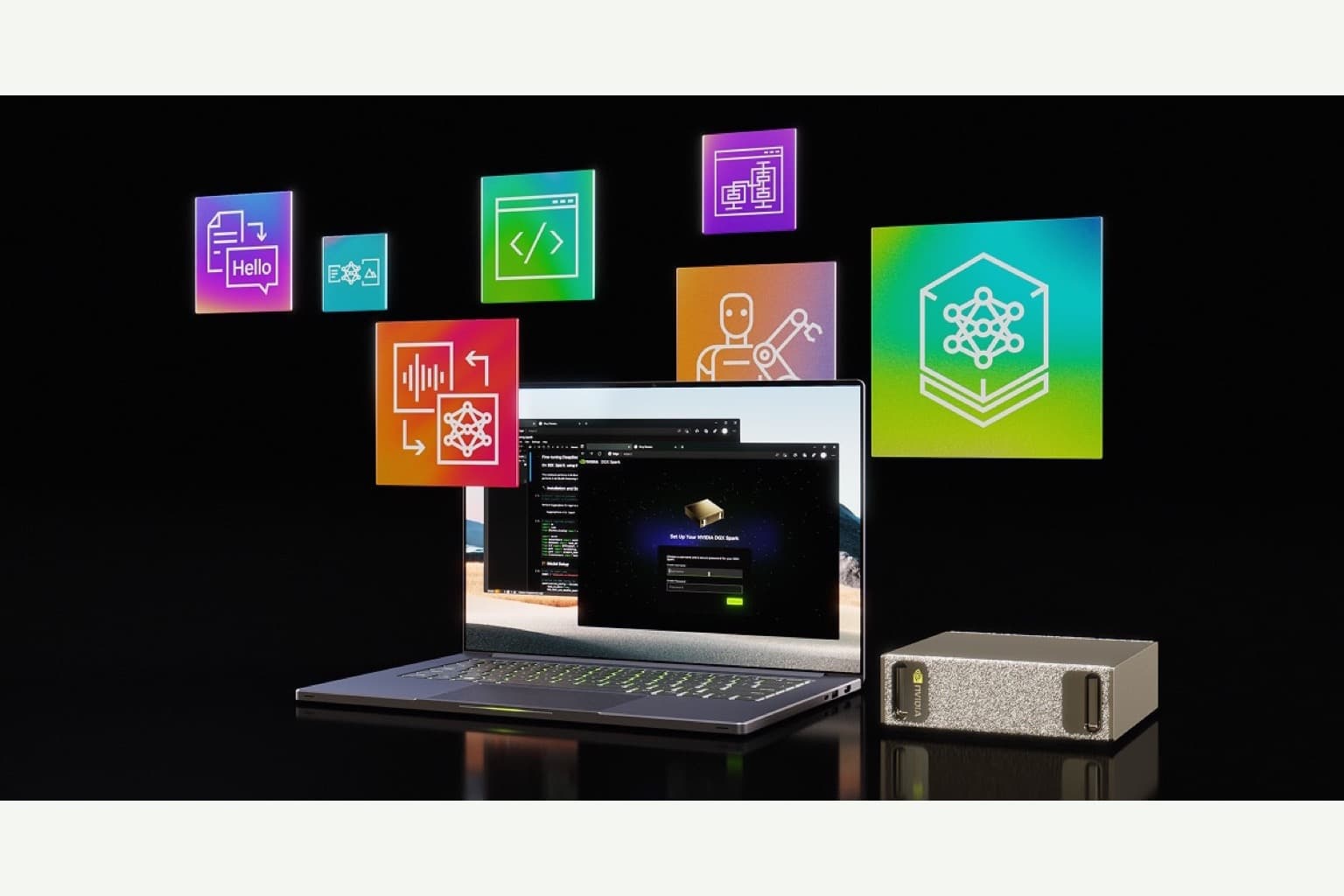
DGX Spark is the compact desktop AI supercomputer that NVIDIA started shipping in October 2025. It uses the NVIDIA GB10 Grace Blackwell Superchip and delivers up to 1 petaflop of FP4 AI performance with 128GB of coherent unified memory.
NVIDIA pitches DGX Spark as a desktop system for developers, researchers, data scientists, robotics teams, and students who want to prototype and run AI locally. The company says DGX Spark can run inference on AI models up to 200 billion parameters and fine-tune models up to 70 billion parameters locally.
That makes DGX Spark more of a dedicated local AI box than a daily driver laptop. It is the sort of machine you would put on a desk to run agents, model experiments, fine-tuning jobs, or private inference without renting cloud GPUs for every test.
DGX Station for Windows Is the Enterprise Workstation Tier
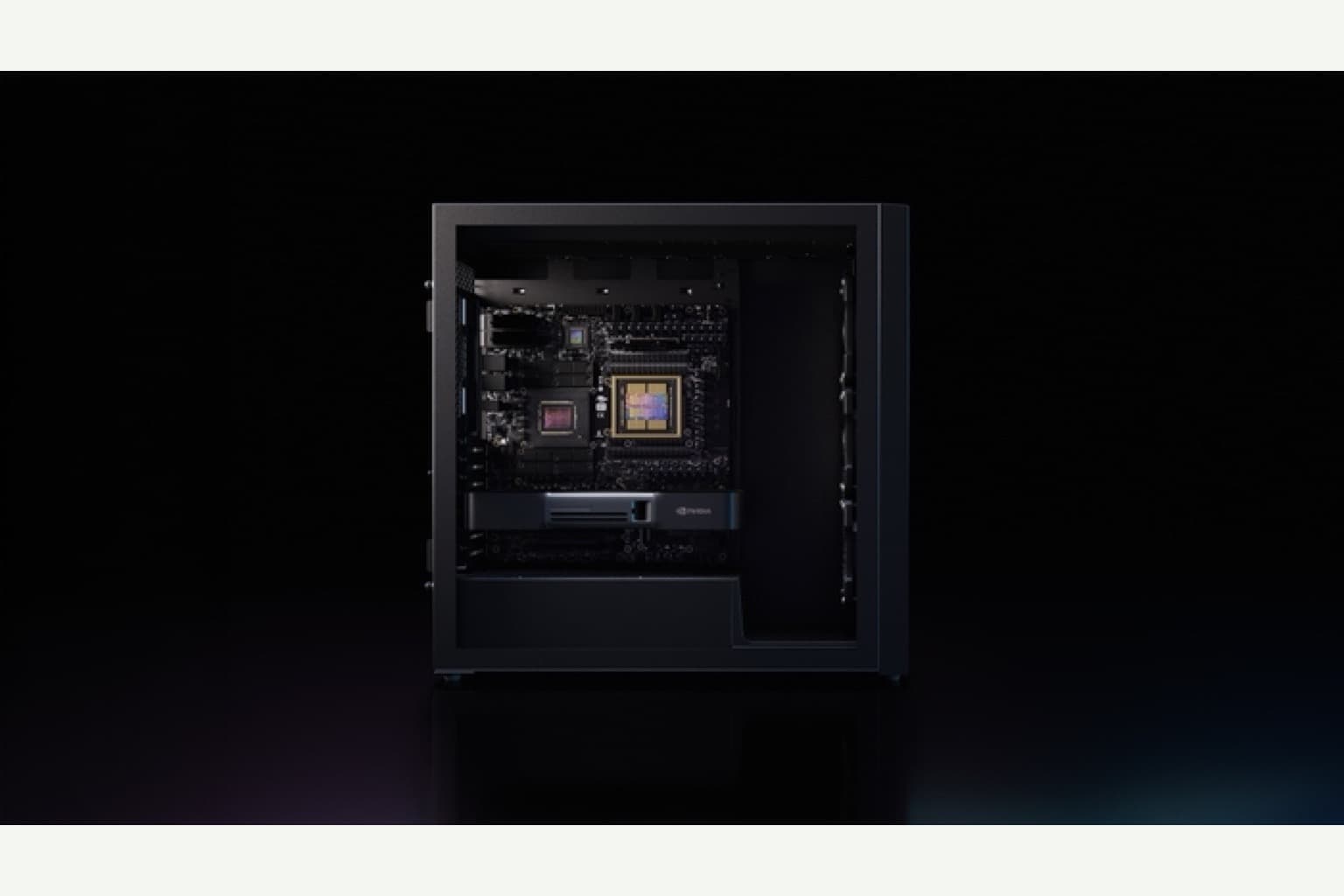
DGX Station for Windows is the bigger announcement for enterprise developers and AI infrastructure teams. NVIDIA says it is coming in Q4 2026 and is built on the NVIDIA GB300 Grace Blackwell Ultra Desktop Superchip.
This is not a normal laptop replacement. It is a deskside AI supercomputer for frontier agents, local inference, data science, fine-tuning, and Windows-managed enterprise workflows.
Key DGX Station for Windows specs include:
| Feature | DGX Station for Windows |
|---|---|
| Processor platform | NVIDIA GB300 Grace Blackwell Ultra Desktop Superchip |
| CPU | 72-core NVIDIA Grace CPU |
| AI performance | Up to 20 petaflops FP4 |
| Memory | Up to 748GB coherent memory |
| Model target | Up to 1 trillion-parameter AI models |
| Networking | NVIDIA ConnectX-8 SuperNIC, up to 800Gb/s |
| Optional GPU pairing | NVIDIA RTX PRO 6000 Blackwell Workstation GPU |
| Availability | Coming in Q4 2026 |
The big idea is that enterprises can keep powerful AI agents close to the Windows applications, files, workflows, and security systems their employees already use. Instead of sending every agent workflow to a cloud endpoint, teams can run large local workloads on managed deskside infrastructure.
RTX Spark vs DGX Spark vs DGX Station
Here is the clean comparison:
| Product | Best fit | Memory | Performance target | Practical role |
|---|---|---|---|---|
| RTX Spark laptop | Creators, developers, gamers, mobile agent workflows | Up to 128GB unified memory | Up to 1 petaflop AI | Daily laptop that can run local AI agents and creative workloads |
| RTX Spark compact desktop | Desk users who want Spark in a small PC | Up to 128GB unified memory | Up to 1 petaflop AI | Small AI PC for local agents, media, and productivity |
| DGX Spark | AI developers, labs, researchers, robotics teams | 128GB coherent unified memory | Up to 1 petaflop FP4 | Dedicated compact desktop AI supercomputer |
| DGX Station for Windows | Enterprises and frontier AI developers | Up to 748GB coherent memory | Up to 20 petaflops FP4 | Deskside workstation for 1T-parameter agents and heavy local workloads |
The naming is close, but the buyer intent is different. RTX Spark is for AI-native PCs. DGX Spark is a compact AI supercomputer. DGX Station is a deskside enterprise system.
Why This Matters for Local AI
The biggest trend here is not only that NVIDIA made another powerful chip. It is that AI hardware is moving closer to ordinary workstations and laptops.
Local AI has usually forced a compromise:
- use a cloud model and accept API costs, latency, and data-sharing limits
- use a gaming GPU and carefully fit models into limited VRAM
- use a workstation GPU and spend significantly more
- use a Mac or unified-memory machine but lose some CUDA-specific ecosystem depth
RTX Spark tries to change that middle category. If the platform works as NVIDIA claims, developers could run larger local agents on a laptop while still using NVIDIA's software stack. That matters for private coding agents, local document search, creative media generation, RAG testing, and offline prototyping.
For ToolMintX readers, it also makes VRAM planning more important, not less important. Unified memory can help with model size, but you still need to estimate model weights, quantization, KV cache, context length, batch size, and concurrent users. Before buying any Spark-class device, compare expected workloads with the AI VRAM Calculator and the local LLM VRAM guide.
Should You Buy One?
Most users should wait for retail pricing, independent benchmarks, thermals, and software compatibility reports. RTX Spark looks promising, but the first wave will likely target premium buyers, developers, creators, and AI enthusiasts rather than casual laptop shoppers.
You should watch RTX Spark laptops if you:
- want a portable machine for local AI agents and creative AI workflows
- need more memory headroom than ordinary gaming laptops provide
- use CUDA, TensorRT, ComfyUI, Blender, Adobe, or local inference tools
- want one laptop for development, media, and gaming instead of separate systems
You should watch DGX Spark if you:
- want a small desk machine dedicated to AI experiments
- care more about local model work than laptop portability
- need a more appliance-like NVIDIA AI software stack
You should watch DGX Station for Windows if you:
- are building enterprise AI agents tied to Windows workflows
- need very large local model capacity
- need managed deskside AI infrastructure rather than a personal laptop
For everyone else, the smarter move is patience. NVIDIA has announced the direction, but the real buying decision depends on prices, OEM configurations, software support, and actual sustained workloads.
The Bottom Line
NVIDIA's Spark push is one of the clearest signals yet that local AI is moving from hobbyist desktop builds into premium everyday PCs and enterprise workstations. RTX Spark brings the idea to laptops and compact desktops. DGX Spark keeps the dedicated compact AI computer lane alive. DGX Station for Windows pushes the same theme into enterprise deskside infrastructure.
The important question for buyers is not "is Spark powerful?" The better question is "which Spark-class machine matches the workload?" For local agents, model testing, creative AI, and private inference, that answer will depend on memory configuration, software support, thermals, and cost.
For more context, read ToolMintX on best local AI models in 2026, LM Studio vs Ollama, and NVIDIA's AI infrastructure demand.
FAQ
What is NVIDIA RTX Spark?
NVIDIA RTX Spark is a new Windows PC platform for local AI agents, creative work, development, and gaming. It combines a Blackwell RTX GPU, a 20-core Grace CPU, up to 128GB unified memory, and up to 1 petaflop of AI performance.
Is RTX Spark the same as DGX Spark?
No. RTX Spark is the new laptop and compact desktop PC platform. DGX Spark is NVIDIA's compact desktop AI supercomputer built around the GB10 Grace Blackwell Superchip.
When will RTX Spark laptops launch?
NVIDIA says RTX Spark laptops and compact desktops will be available in fall 2026 from ASUS, Dell, HP, Lenovo, Microsoft Surface, and MSI, with Acer and GIGABYTE models to follow.
What is DGX Station for Windows?
DGX Station for Windows is a deskside AI supercomputer powered by NVIDIA GB300 Grace Blackwell Ultra. It is designed for enterprise AI agents, large local models, data science, fine-tuning, and Windows-managed workflows.
Should local AI users buy RTX Spark or a normal GPU workstation?
It depends on workload and price. RTX Spark may be better for portable local agents and large unified-memory workflows, while RTX PRO workstations may still be better for users who need discrete workstation GPUs, mature desktop thermals, and established professional configurations.
Sources
- NVIDIA Newsroom: NVIDIA and Microsoft reinvent Windows PCs for the age of personal AI
- NVIDIA Investor Relations: RTX Spark announcement
- NVIDIA Blog: Faster local AI agents on RTX PCs and DGX Spark
- NVIDIA Newsroom: DGX Station for Windows
- NVIDIA product page: DGX Spark
- NVIDIA Newsroom: DGX Spark arrives for world's AI developers