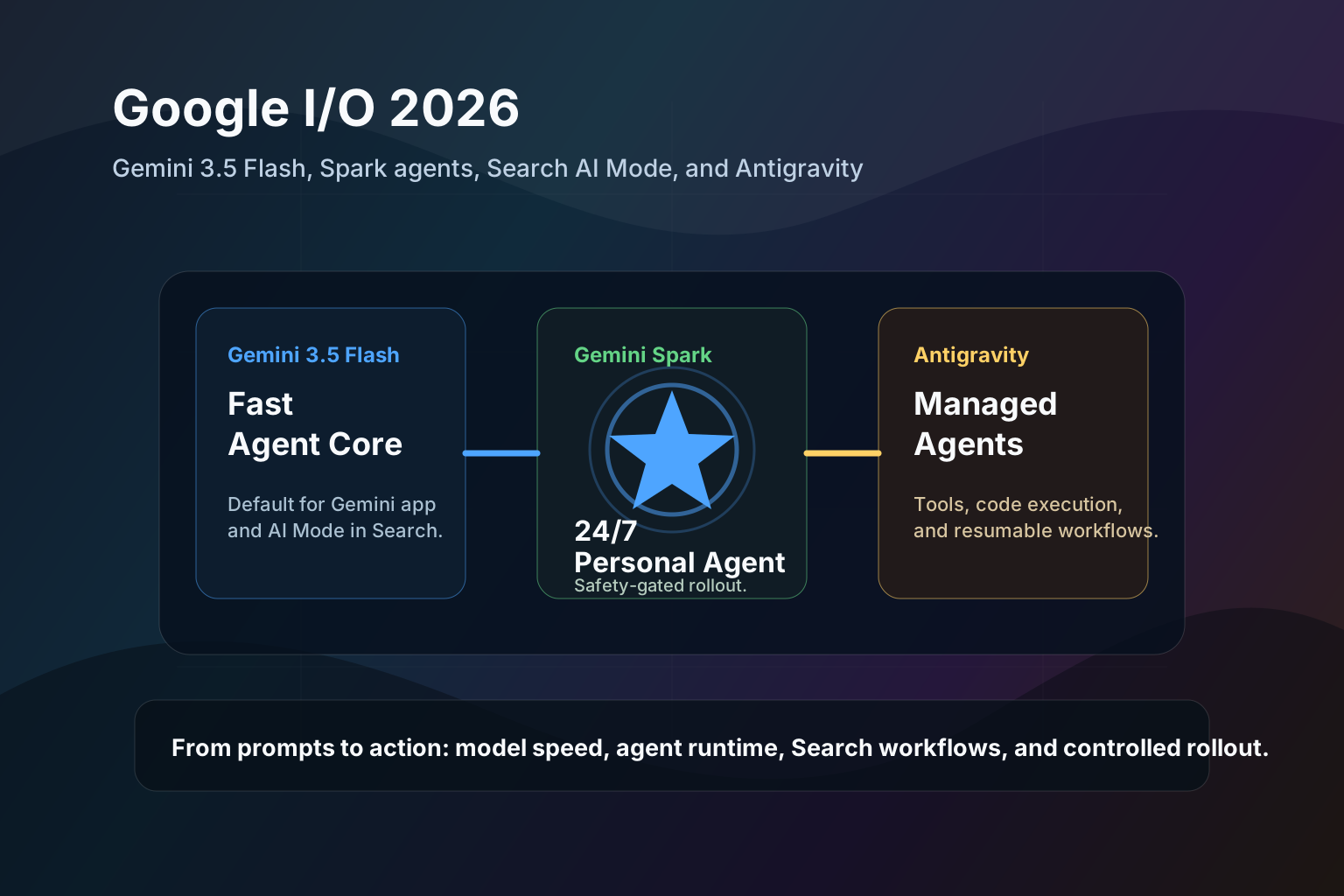
Google I/O 2026 made one message hard to miss: Google wants AI to move from answering prompts to carrying out longer tasks. The center of that shift is Gemini 3.5 Flash, a faster model family built for agentic workflows, and Gemini Spark, a 24/7 personal agent being rolled out carefully after the keynote.
This May 26, 2026 roundup pulls together the most important official announcements for users, developers, and teams deciding whether to build around Google's new agent stack.
The short version
| Announcement | What changed | Why it matters |
|---|---|---|
| Gemini 3.5 Flash | New Gemini model focused on speed, action, and agentic workflows | It becomes the engine behind several consumer and developer experiences |
| Gemini app updates | New design language, Daily Brief, Gemini Omni, Gemini Spark, and Mac app plans | Gemini is being positioned as a proactive assistant, not just a chatbot |
| AI Mode in Search | 3.5 Flash powers more agentic Search features | Search moves closer to task help and interactive generated interfaces |
| Google Antigravity 2.0 | Desktop app, SDK, managed agents, and deeper AI Studio links | Developers get a more complete agent-building workflow |
| Managed Agents in Gemini API | Agents can reason, use tools, and execute code in isolated environments | Google is packaging agent infrastructure behind developer APIs |
The important detail is availability. Gemini 3.5 Flash is broadly available across several surfaces. Gemini Spark is more limited: Google said it was starting with trusted testers and planned a Beta for Google AI Ultra subscribers in the U.S. the following week.
Gemini 3.5 Flash: speed becomes the product feature
Google describes Gemini 3.5 Flash as the first model in its latest Gemini 3.5 family, built to combine frontier intelligence with action. The company says it is generally available through Google Antigravity, the Gemini API in Google AI Studio and Android Studio, Gemini Enterprise Agent Platform, and Gemini Enterprise. It is also available in the Gemini app and AI Mode in Search.
The developer framing is especially direct. Google's I/O developer post says Gemini 3.5 Flash is designed for real-world agentic workflows, with the speed needed for agents that call tools, coordinate subtasks, and respond quickly enough to feel usable.
That is the difference between a model that can answer one question and a model that can sit inside a working product. For agents, latency is not cosmetic. Every tool call, browser action, code execution step, or file operation adds delay. A faster model gives the product more room to plan, verify, and recover without making the user wait forever.
Gemini Spark: the 24/7 personal agent
Gemini Spark is Google's biggest consumer-agent signal from I/O 2026. Google describes it as a personal AI agent that can run around the clock, help navigate digital life, and take action under the user's direction.
The cautious rollout matters. Google's own Gemini 3.5 post says Spark started with trusted testers and was planned for a U.S. Google AI Ultra Beta the following week. Google's "100 things" I/O roundup also says Spark is early in its product journey and that the first release is safety-focused.
That wording is worth preserving. Spark is not just another chat tab. It is an agent that may monitor context, coordinate tasks, and act across apps. That makes permissions, audit trails, user confirmation, and rollback behavior more important than raw model quality.
What Spark might actually do
Based on Google's I/O framing, Spark is meant to handle ongoing digital tasks instead of waiting for single prompts. Practical examples include:
- Tracking a project plan and reminding you before deadlines slip.
- Preparing a daily context brief from calendar, email, and workspace activity.
- Coordinating travel or event planning across multiple steps.
- Watching for changes in a topic and summarizing what matters.
- Helping move work between mobile, desktop, and Workspace surfaces.
The promise is ambient assistance. The risk is ambient noise. A good agent should know when to act, when to ask, and when to stay quiet.
Google Antigravity 2.0 and the developer angle
For builders, the biggest I/O 2026 news was not just Spark. It was the broader Antigravity and Gemini API stack around it.
Google announced Antigravity 2.0 as a standalone desktop application for orchestrating agent workflows. It also introduced an Antigravity SDK and Managed Agents in the Gemini API. Google's developer post says Managed Agents can reason, use tools, and execute code in an isolated Linux environment through the Interactions API and Google AI Studio.
That points to a clearer product direction:
| Old pattern | New Google pattern |
|---|---|
| Prompt a model once | Start an agent with tools and state |
| Copy output into another app | Let the agent operate inside connected workflows |
| Manually maintain context | Resume interactions with environment state |
| Build all infrastructure yourself | Use managed agent runtime pieces |
For more developer-specific context, read our earlier breakdown of Google Antigravity 2.0 at I/O 2026.
Search is becoming more agentic too
Google also connected Gemini 3.5 Flash to Search. Its Gemini 3.5 announcement says the model is the default for the Gemini app and AI Mode in Search globally. It also connects 3.5 Flash to more dynamic Search experiences, including information agents and generated interactive interfaces.
That is a major shift for SEO and product teams. Search intent may no longer end at a list of links. For some tasks, the search experience can become a generated workflow, a comparison interface, or an agent that continues watching a topic.
For publishers and tool sites, the response should be practical:
- Make pages answer a specific task clearly.
- Include structured steps, tables, definitions, and source links.
- Keep metadata precise and unique.
- Build tools users can act on, not only explanatory pages.
- Expect more searches where users want an outcome, not just an article.
What users should check this week
If you are trying Gemini features after I/O, check availability by account, country, and plan. Rollouts can differ across free, Plus, Pro, Ultra, Workspace, Enterprise, and developer accounts.
Use this checklist:
| Feature | What to verify |
|---|---|
| Gemini 3.5 Flash | Whether it appears in Gemini app, AI Mode in Search, AI Studio, or your developer console |
| Gemini Spark | Whether your account is eligible for trusted tester or U.S. Google AI Ultra Beta access |
| Daily Brief | Whether your subscription and region show the new proactive brief |
| Antigravity 2.0 | Whether the desktop app, CLI, SDK, or managed-agent tools are available to your account |
| Gemini API | Whether your project has access to the latest model and Interactions API features |
Do not assume every keynote demo is available to every user on the same day. For agent products, staged rollout is a feature, not a footnote.
What developers should test first
Developers should evaluate 3.5 Flash and Managed Agents with boring, measurable tasks before handing them important workflows.
Good first tests:
- Convert a support ticket into structured fields.
- Summarize a long issue thread and propose next actions.
- Generate a small app prototype and inspect the file changes.
- Run a code-analysis task inside an isolated environment.
- Compare latency and cost against your current model.
Track these metrics:
| Metric | Why it matters |
|---|---|
| Latency per step | Agents multiply small delays |
| Tool-call accuracy | Bad tool choices create user-visible failure |
| Recovery behavior | Agents must handle errors without looping |
| State persistence | Long tasks need memory without confusion |
| Human approval points | Risky actions need confirmation |
The agent era will reward teams that can evaluate workflows, not just prompts.
The real takeaway
Google I/O 2026 was not only about a new model name. It was about a stack: Gemini 3.5 Flash as the fast model, Gemini Spark as the personal-agent concept, Antigravity as the builder environment, Managed Agents as infrastructure, and Search as a more active interface.
That does not mean every user should hand over their calendar and inbox on day one. It means the industry direction is clear. AI products are moving from "answer this" toward "help me finish this." The winners will be the agents that earn trust through speed, control, transparency, and useful restraint.
For a deeper look at Spark's consumer positioning, see our companion post: Gemini Spark Is Google's Biggest AI Assistant Bet Yet.