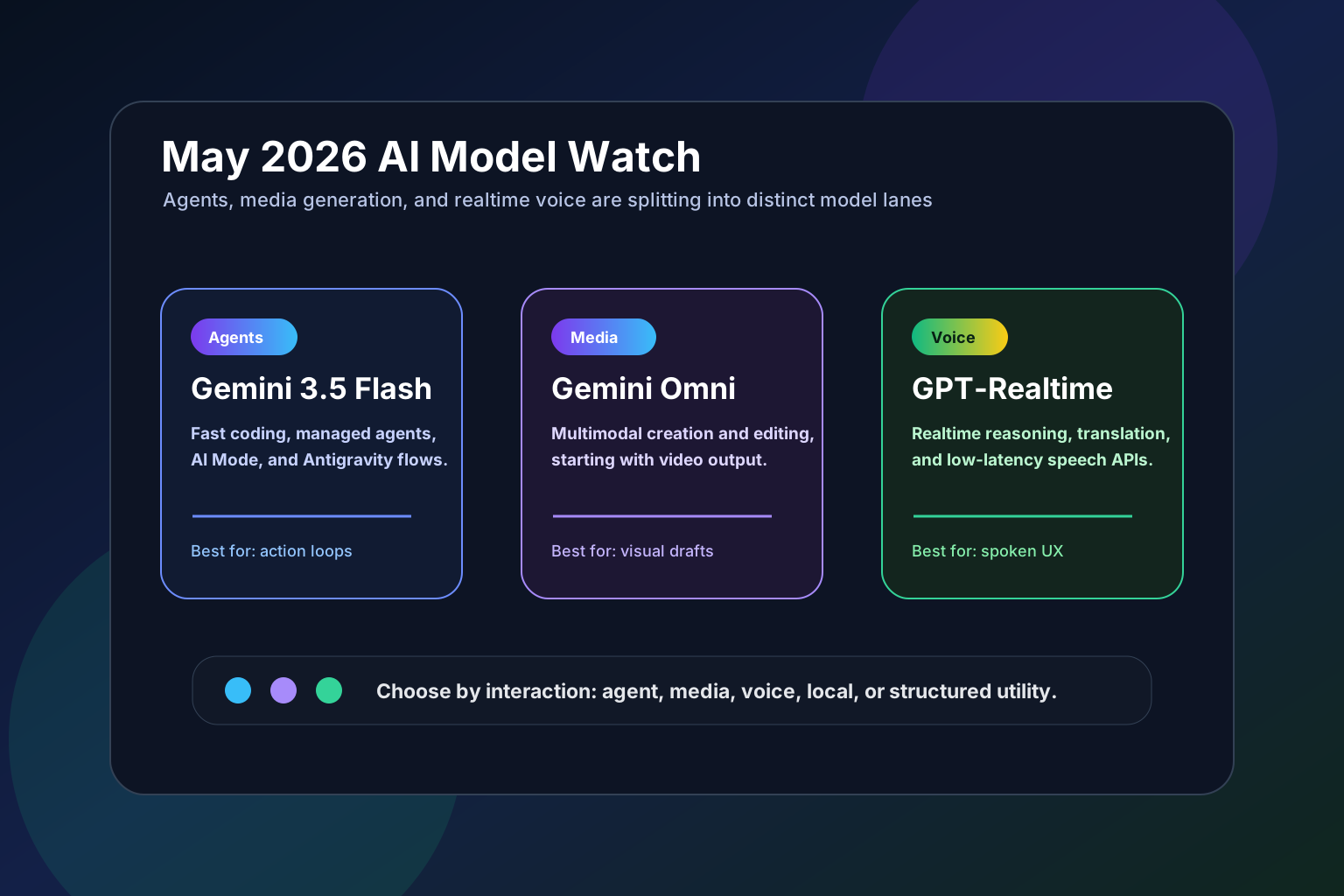
The May 2026 AI model cycle is not just about higher benchmark numbers. The interesting pattern is specialization. Google is pushing fast agent models and multimodal generation with Gemini 3.5 Flash and Gemini Omni. OpenAI is pushing realtime voice models for reasoning, translation, and live transcription.
This May 27, 2026 model watch focuses on the models builders should actually track right now: Gemini 3.5 Flash, Gemini Omni, GPT-Realtime-2, GPT-Realtime-Translate, and GPT-Realtime-Whisper.
The short version
| Model | Provider | Main job | Why it matters |
|---|---|---|---|
| Gemini 3.5 Flash | Fast agentic reasoning and coding workflows | Powers Gemini app, AI Mode, Antigravity, Gemini API, and managed agents | |
| Gemini Omni | Multimodal creation and editing, starting with video | Blends Gemini intelligence with generative media models | |
| GPT-Realtime-2 | OpenAI | Voice interaction with GPT-5-class reasoning | Makes voice agents more capable than command-and-response bots |
| GPT-Realtime-Translate | OpenAI | Live speech translation | Turns multilingual voice support into an API-level capability |
| GPT-Realtime-Whisper | OpenAI | Low-latency streaming transcription | Lets captions, meeting notes, and voice agents react while people speak |
Image source: Google AI Blog.
The important shift: models are becoming product infrastructure. Instead of choosing one "best model," teams are choosing a model for each interaction type.
Gemini 3.5 Flash: the agent model to test first
Google describes Gemini 3.5 as a family built for frontier intelligence with action. The practical release today is Gemini 3.5 Flash.
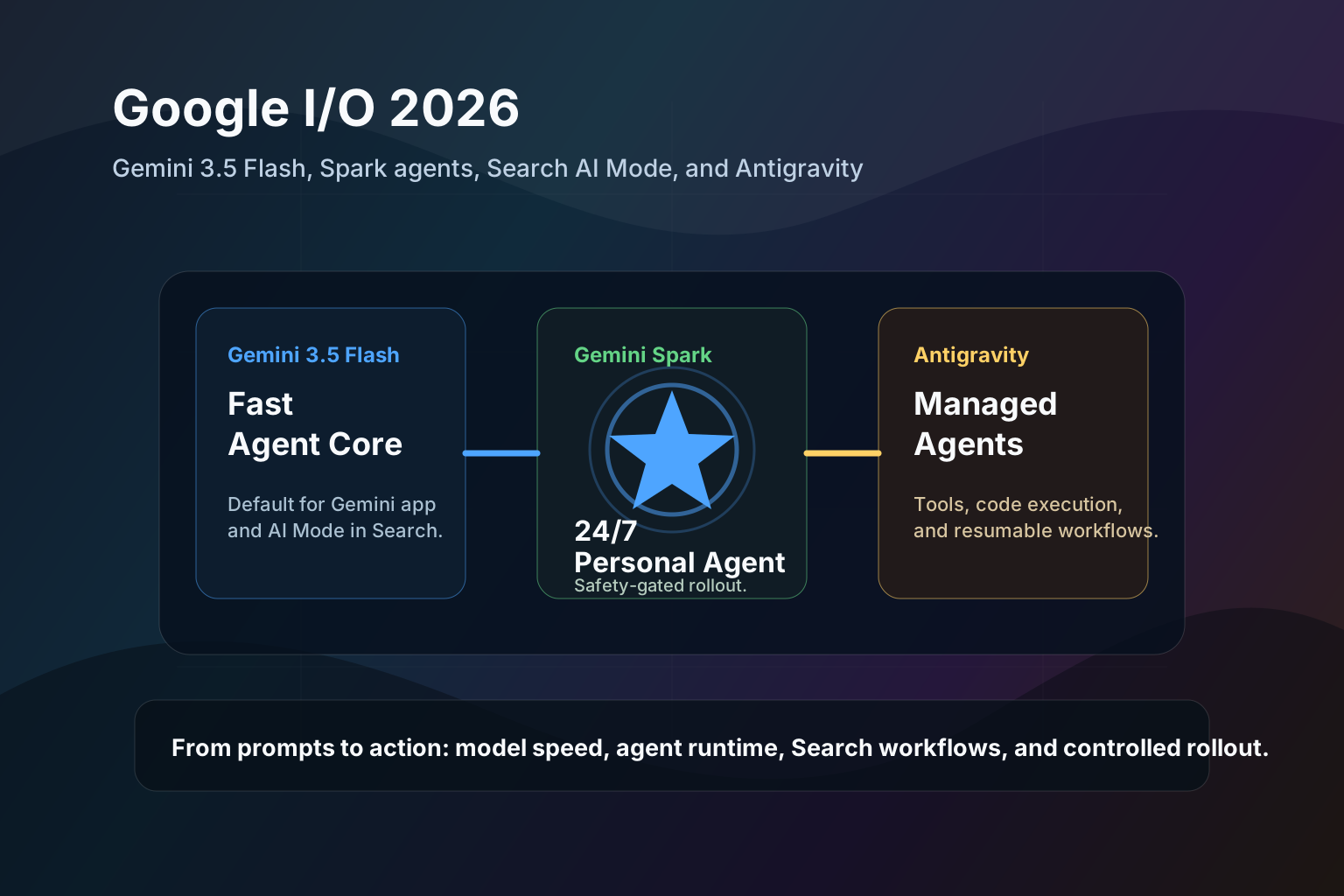
According to Google's I/O developer post, Gemini 3.5 Flash combines frontier intelligence with speed and is designed for real-world agentic workflows. Google also says it powers Managed Agents in the Gemini API and is available across Google Antigravity, Google AI Studio, Android Studio, Gemini Enterprise Agent Platform, Gemini Enterprise, the Gemini app, and AI Mode in Search.
That matters because agents multiply latency. A coding agent may plan, read files, call tools, edit code, run checks, recover from errors, and summarize changes. If each step is slow, the product feels broken even when the reasoning is good.
Gemini 3.5 Flash is Google's answer to that product problem: keep enough intelligence for complex workflows while making each step fast enough for interactive use.
Where Gemini 3.5 Flash fits
Use Gemini 3.5 Flash when the task has:
- Multiple steps.
- Tool calls.
- Code or file operations.
- Need for low latency.
- A user waiting for progress.
- A workflow that benefits from resumable state.
Good examples:
- Generate and revise a small app prototype.
- Turn an issue description into code changes.
- Summarize a folder and propose next actions.
- Power a search agent that watches a topic.
- Run a managed agent in an isolated environment.
Be more cautious with:
- High-stakes advice.
- Financial transactions.
- Autonomous publishing.
- Tasks where a hallucinated tool call creates real damage.
Fast agents still need guardrails.
Gemini Omni: multimodal creation becomes a model category
Gemini Omni is different. It is not just a chat model with image upload. Google says Omni can create from many input types, starting with video, and edit using conversational language. Google's I/O roundup describes it as combining Gemini's intelligence with generative media models for world understanding, multimodality, and editing.
Image source: Google AI Blog.
That is the bigger trend: model families are becoming media engines.
A builder should think of Gemini Omni as useful for:
- Video generation from text, image, or video context.
- Video editing through natural language.
- Storyboard-to-scene workflows.
- Creator tools that need better world understanding.
- Product demos, explainer clips, and visual drafts.
Google also says Omni-generated videos include SynthID watermarking and can be verified through Gemini app, Gemini in Chrome, and Search. That detail matters because generation quality is rising faster than user trust.
GPT-Realtime: OpenAI's voice model split
OpenAI's May 7 release went in a different direction. Instead of one general model announcement, OpenAI introduced three realtime voice models in the API:
Image source: OpenAI Developer Docs.
- GPT-Realtime-2 for realtime voice reasoning.
- GPT-Realtime-Translate for live speech translation.
- GPT-Realtime-Whisper for streaming transcription.
That split is useful. Voice products do not all need the same model.
| Voice workflow | Best-fit model direction |
|---|---|
| Conversational support agent | GPT-Realtime-2 |
| Live multilingual event or training | GPT-Realtime-Translate |
| Meeting captions and notes | GPT-Realtime-Whisper |
| Voice interface for an app | GPT-Realtime-2 plus transcription fallback |
| Call center summaries | GPT-Realtime-Whisper plus a text reasoning model |
OpenAI says GPT-Realtime-Translate supports speech translation from more than 70 input languages into 13 output languages, while GPT-Realtime-Whisper is built for low-latency speech-to-text. It also says all three are available in the Realtime API.
Why voice models matter now
Voice AI used to feel like a thin layer over speech-to-text plus a chatbot. The new model pattern is different.
A strong voice system needs:
- Low-latency listening.
- Turn-taking that handles interruptions.
- Accurate transcription.
- Translation that keeps pace with speech.
- Reasoning strong enough to solve the task.
- Safety controls that can stop misuse.
That is why realtime voice models are becoming their own stack. A user does not experience voice as "tokens." They experience delay, corrections, interruptions, accent handling, and whether the system remembered what was just said.
Model choice by product type
Here is the practical decision table for builders:
| Product idea | Model family to test first | Why |
|---|---|---|
| Coding assistant or app builder | Gemini 3.5 Flash | Optimized for agentic workflows and speed |
| Search or monitoring agent | Gemini 3.5 Flash | Good fit for repeated reasoning and task updates |
| Video creator workflow | Gemini Omni | Built around multimodal generation and editing |
| AI video editing assistant | Gemini Omni | Natural language media editing is the core value |
| Voice customer support | GPT-Realtime-2 | Needs live reasoning in spoken conversation |
| Live translation app | GPT-Realtime-Translate | Translation is the model's direct purpose |
| Meeting captions or live notes | GPT-Realtime-Whisper | Streaming transcription is the core requirement |
| Offline mobile utility | Gemini Nano path, not these frontier models | Privacy and latency may matter more than capability |
The trap is using a frontier chat model for everything. That can work in demos, but production products usually need narrower model choices.
What to benchmark before switching models
Do not migrate because a model is trending. Build a small evaluation set that reflects your actual product.
For agent models, test:
- Task completion rate.
- Tool-call accuracy.
- Latency per step.
- Recovery after tool failure.
- Whether the model asks for confirmation at the right time.
For media models, test:
- Prompt adherence.
- Edit control.
- Character and object consistency.
- Watermark and provenance requirements.
- Whether outputs are suitable for your brand or policy surface.
For voice models, test:
- Time to first response.
- Word error rate on your user accents.
- Interruption handling.
- Translation lag.
- Background noise behavior.
- Safety behavior for sensitive requests.
Benchmarks are useful, but your users are the real benchmark.
A simple evaluation workflow
Use this lightweight workflow before adding any new model to production:
- Pick 30 real tasks from your product.
- Label the expected outcome, not just the expected answer.
- Run the same tasks through your current model and the candidate model.
- Score success, latency, cost, and failure severity.
- Add five adversarial tasks that should trigger refusal or confirmation.
- Ship behind a feature flag.
- Log failures in a reviewable format.
For local model planning, pair this process with hardware estimates from the AI VRAM Calculator and the Local LLM VRAM Guide.
What changed in the model market
The model market is becoming less like one leaderboard and more like a toolbox:
- Fast agent models for doing work.
- Multimodal generators for creating and editing media.
- Realtime voice models for speech-first products.
- Small on-device models for private mobile tasks.
- Domain-specific models for specialized accuracy.
That is healthy for builders. It means the question is no longer "which model is smartest?" The better question is "which model has the right failure mode for this workflow?"
The real takeaway
Gemini 3.5 Flash, Gemini Omni, and GPT-Realtime point in the same direction from different angles. AI models are moving closer to the interface: agents that act, media models that create, and voice models that listen while people speak.
For users, that means AI will feel less like a blank chat box. For developers, it means model selection becomes product architecture.
Choose the model by the interaction: agent, media, voice, local, or structured utility. Then test it with the messy tasks your users actually bring.