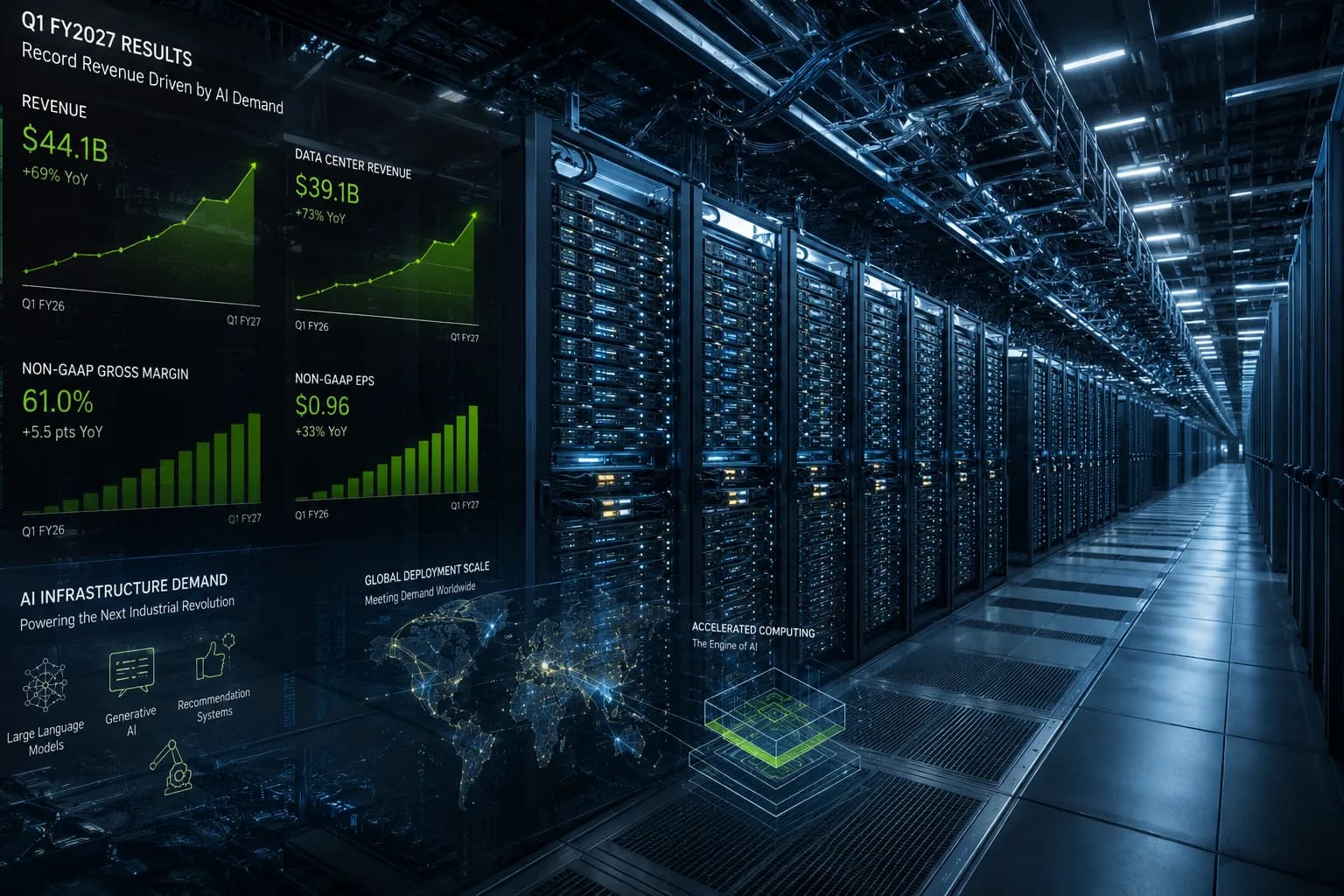
NVIDIA Q1 fiscal 2027 results are the reason NVIDIA is trending today, and the headline numbers explain why. On May 20, 2026, NVIDIA reported record quarterly revenue of $81.6 billion, up 20% from the previous quarter and 85% from a year earlier. It also reported record Data Center revenue of $75.2 billion, up 92% year over year, while CEO Jensen Huang said the buildout of AI factories is accelerating at extraordinary speed.
That combination matters far beyond Wall Street. If you build AI products, buy GPUs, deploy inference systems, or follow the economics of model platforms, these results are a direct signal about where spending is still flowing and where NVIDIA sees the next phase of growth.
Why NVIDIA Is Trending Today
The short answer is simple: the company posted another enormous beat at a time when many people were asking whether AI infrastructure demand could keep climbing at this pace.
Instead of showing a slowdown, NVIDIA’s latest quarter reinforced several themes:
- hyperscale and enterprise AI spending is still rising fast
- Blackwell-era infrastructure is moving from announcement mode into production reality
- networking and full-stack systems matter almost as much as chips themselves
- the AI market is broadening from cloud labs to enterprise and industrial deployments
The results also came with other attention-grabbing moves, including an additional $80 billion share repurchase authorization and a sharp increase in NVIDIA’s quarterly dividend. Those are investor-facing details, but they help explain the surge in broader public interest around the earnings release.
The Most Important Numbers in NVIDIA Q1 Fiscal 2027 Results
Here is the quick scan version of the quarter:
| Metric | Q1 FY2027 result | Why it matters |
|---|---|---|
| Total revenue | $81.6 billion | Shows AI infrastructure demand is still expanding at massive scale |
| Year-over-year growth | 85% | Confirms NVIDIA is still growing from an already huge base |
| Sequential growth | 20% | Suggests demand did not stall after the last big ramp |
| Data Center revenue | $75.2 billion | Proves the business is overwhelmingly driven by AI infrastructure |
| Q2 FY2027 outlook | $91.0 billion +/- 2% | Indicates NVIDIA expects more near-term momentum |
That $91 billion revenue outlook for the next quarter is especially important. It tells the market that NVIDIA is not presenting this quarter as a one-off spike. It is framing current demand as part of an ongoing build cycle.
What the Earnings Say About AI Demand
The most useful way to read this report is not just “NVIDIA made a lot of money again.” The better reading is that AI demand is spreading across more layers of the stack.
NVIDIA said it is moving to a new reporting framework with two market platforms: Data Center and Edge Computing. Within Data Center, it will now break out Hyperscale and ACIE, which covers AI Clouds, Industrial, and Enterprise. That change is revealing because it highlights how much growth NVIDIA expects outside the classic public-cloud narrative.
In plain English, the company wants investors and builders to understand that the AI buildout is no longer just about a few giant model labs. It is also about:
- national AI infrastructure projects
- industry-specific AI factories
- enterprise deployments with custom data and workflows
- edge systems for robotics, PCs, networking, and vehicles
That matters for software teams because it points to a longer runway for demand in inference, orchestration, networking, and deployment tooling.
Blackwell, Networking, and the Full-Stack Story
Another reason NVIDIA is trending today is that its quarter was not only about revenue. It also reinforced the company’s full-stack strategy.
The press release highlighted several points that developers and infrastructure teams should notice:
- NVIDIA Dynamo 1.0 entered production, with the company saying it can boost generative and agentic inference on Blackwell GPUs by up to 7x.
- NVIDIA positioned Blackwell as central to the next phase of AI inference, not only training.
- The company highlighted NVLink Fusion and its strategic partnership with Marvell.
- It announced multi-year optics agreements with Coherent, Corning, and Lumentum.
This is a reminder that the AI bottleneck story is increasingly about systems, not just accelerators. The valuable unit is not merely a chip anymore. It is the complete AI factory: compute, networking, memory movement, cooling, optics, software, and utilization.
That is also why developers should care. If the economics of AI improve through faster inference and better infrastructure efficiency, downstream app builders get more room to ship complex products.

What It Means for AI Builders and Buyers
If you build applications on top of large models, NVIDIA’s results point to a few practical conclusions.
First, GPU scarcity is no longer the only lens that matters. The next question is whether organizations can turn expensive infrastructure into productive, high-utilization AI systems.
Second, the center of gravity is shifting toward inference and production workflows. Training still matters, but much of the new value is tied to how fast companies can serve models, support agentic workloads, and keep costs under control.
Third, enterprise and sovereign AI demand still looks healthy. NVIDIA’s language around AI factories and the new Data Center sub-markets suggests the company expects more countries and industries to keep building dedicated AI capacity.
For buyers, this means planning decisions should increasingly focus on total system fit:
- inference software maturity
- networking design
- deployment location
- workload utilization
- long-term upgrade path
The Real Reason This Trend Matters
Many “why is this company trending” stories are mostly market gossip. This one is more useful than that. NVIDIA Q1 fiscal 2027 results offer a real snapshot of the AI economy.
When revenue rises to $81.6 billion and Data Center revenue alone reaches $75.2 billion, the signal is hard to ignore. The AI boom is not fading into a niche infrastructure cycle. It is still reshaping capital spending, software roadmaps, and competitive strategy across the tech industry.
That does not mean every AI company wins automatically. It does mean the compute and deployment race is still fully on, and NVIDIA remains at the center of it.
For more infrastructure context, read ToolMintX on NVIDIA MLPerf v6 token economics, NVIDIA Nemotron 3 Nano Omni, and why TSMC is trending around AI chip supply.
Conclusion
NVIDIA Q1 fiscal 2027 results are why NVIDIA is trending today, but the deeper story is about AI demand staying intense across cloud, enterprise, and industrial markets. Record revenue, a strong next-quarter outlook, and continued Blackwell-era momentum all suggest the AI infrastructure buildout still has room to run.
For ToolMintX readers, the takeaway is practical: watch inference software, networking, and system design as closely as you watch model launches. That is where the next wave of AI performance and cost advantage will be won.
FAQ
Why is NVIDIA trending today?
NVIDIA is trending because its May 20, 2026 earnings report showed record Q1 fiscal 2027 revenue of $81.6 billion and record Data Center revenue of $75.2 billion, both driven by AI demand.
What was the biggest takeaway from NVIDIA’s quarter?
The biggest takeaway was that AI infrastructure demand still looks extremely strong, with NVIDIA also guiding for about $91.0 billion in revenue for Q2 fiscal 2027.
What are AI factories in NVIDIA’s framing?
NVIDIA uses the term to describe large-scale AI infrastructure systems that combine compute, networking, software, and deployment capacity to produce useful AI work at scale.
Why should software developers care about NVIDIA earnings?
Because these results reveal where infrastructure investment is flowing. That affects model availability, inference pricing, deployment options, and the pace of enterprise AI adoption.