Meta released Muse Spark Open on 15 October 2026. It's the open-weights version of Muse Spark: an 816B-parameter mixture-of-experts model with about 42B parameters active per token, a 1M-token context window, and text, image, video and audio input. Meta trained it for agentic coding, and on its own benchmark table it posts the top MCP-Atlas score among the open models it compares.
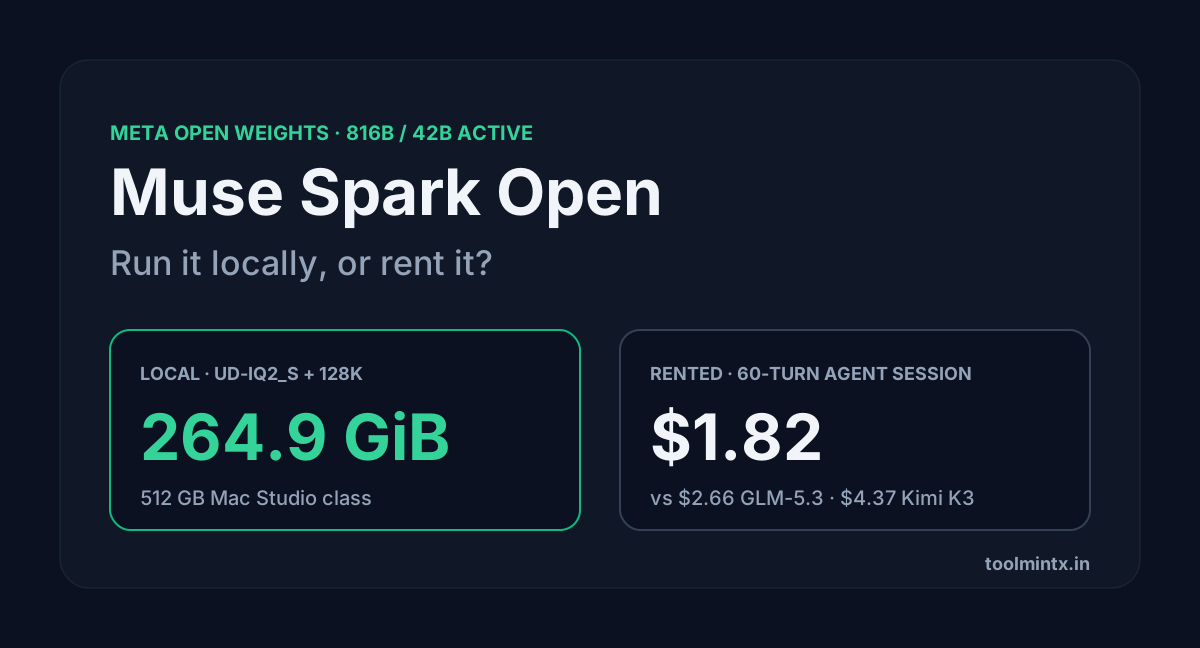
Two questions matter if you want to use it. Can you actually run it, and what does it cost if you rent it instead? I worked out both from the model's config.json, the GGUF file sizes and the hosted price list. Short version: the 2-bit file that Unsloth says fits in 256 GB is below Unsloth's own minimum for agent work, so plan on about 265 GiB at 128K context. Rented, our standard 60-turn coding-agent session costs $1.82, the same as Muse Spark 1.3 on Meta's API.
Table of Contents
- What Muse Spark Open is
- Why the KV cache stays small
- Memory by quant and context
- What hardware that means
- Renting it: one agent session, priced
- Benchmarks against GLM 5.3 and Kimi K3
- Four catches before you switch
- FAQ
- Conclusion
- Sources
What Muse Spark Open is
| Muse Spark Open | |
|---|---|
| Released | 15 October 2026 |
| Parameters | 816B total, 42B active per token |
| Layers | 62: 16 full attention, 46 sliding window (2,048 tokens) |
| Attention | 128 query heads, 16 KV heads, head dimension 64 |
| Experts | 256 per layer, top-8 routing, no shared expert |
| Context | 1,048,576 tokens |
| Vocabulary | 202,048 tokens |
| Input | text, image, video, audio (text output) |
| Reasoning effort | low, medium, high, xhigh (model card default: xhigh) |
| License | Muse Model License |
Meta ships BF16 and NVFP4 checkpoints on Hugging Face. Unsloth has Dynamic GGUF quants for llama.cpp, and mlx-community has 3-bit and 4-bit MLX builds. Meta's developer post lists Baseten, Fireworks AI, Groq, Modal, Nebius, OpenRouter and Together AI as hosts at launch.
If you know Muse Spark from the Meta AI app, this is the same family. Our Meta AI app guide covers the consumer side.
Why the KV cache stays small
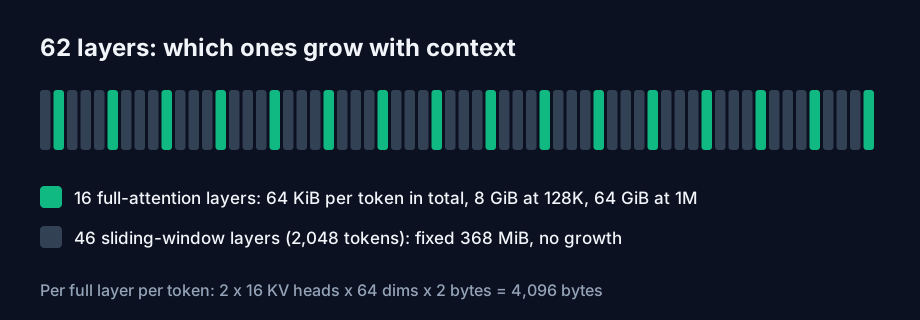
Only 16 of the 62 layers use full attention. The other 46 use a 2,048-token sliding window, so their cache stops growing once a conversation passes 2,048 tokens.
From the config: 16 KV heads with a head dimension of 64. Per token, a full-attention layer at BF16 stores:
2 (key and value) x 16 KV heads x 64 x 2 bytes = 4,096 bytes
Across the 16 full-attention layers that's 64 KiB per token. At 128K tokens of context the cache is 8 GiB, and at the full 1M it's 64 GiB. The 46 sliding-window layers add a fixed 368 MiB on top.
For a model of this size, that cache is small. The weights are what make it hard to run.
Memory by quant and context
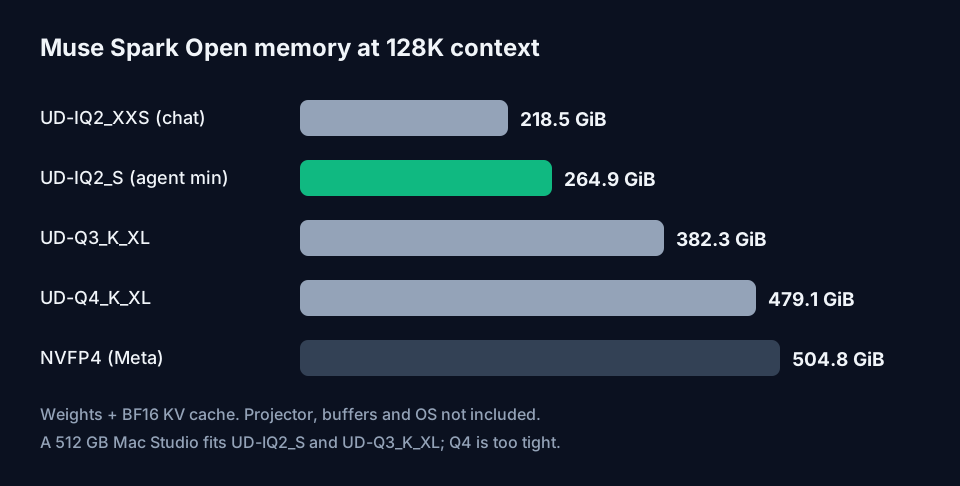
The table lists the Hugging Face file sizes, converted to GiB because that's how GPU and system memory are counted. Each total adds the KV cache at BF16.
| Build | Download | Weights (GiB) | + 128K context | + 1M context |
|---|---|---|---|---|
| UD-IQ1_S | 175.6 GB | 163.5 | 171.9 GiB | 227.9 GiB |
| UD-IQ2_XXS | 225.6 GB | 210.1 | 218.5 GiB | 274.5 GiB |
| UD-IQ2_S | 275.5 GB | 256.6 | 264.9 GiB | 320.9 GiB |
| UD-Q2_K_XL | 311.2 GB | 289.8 | 298.2 GiB | 354.2 GiB |
| UD-Q3_K_XL | 401.5 GB | 373.9 | 382.3 GiB | 438.3 GiB |
| MLX 4-bit | 461.7 GB | 430.0 | 438.4 GiB | 494.4 GiB |
| UD-Q4_K_XL | 505.5 GB | 470.8 | 479.1 GiB | 535.1 GiB |
| NVFP4 (Meta) | 533.0 GB | 496.4 | 504.8 GiB | 560.8 GiB |
| BF16 (Meta) | 1,644.4 GB | 1,531.4 | 1,539.8 GiB | 1,595.8 GiB |
These numbers cover weights and cache only. The multimodal projector (2.2 GB at Q8_0), compute buffers and the OS come on top.
The UD-IQ2_XXS row is the one Unsloth headlines: "fits on 256GB". The same guide says quants below UD-IQ2_S lose accuracy on general tasks, and recommends UD-IQ2_S as the minimum for agentic work. Chat works fine on the smaller files. If you want this model for what Meta built it for, start at UD-IQ2_S, which needs 264.9 GiB at 128K context.
What hardware that means
- One 512 GB Mac Studio (M5 Ultra): UD-IQ2_S or UD-Q3_K_XL fits with context to spare. Q4 doesn't: UD-Q4_K_XL plus 128K is 479.1 GiB, and macOS keeps part of unified memory for itself.
- 256 GB of RAM plus a GPU: UD-IQ2_XXS runs through llama.cpp with experts offloaded to system RAM. That's fine for chat but below the agentic minimum.
- Two 512 GB Mac Studios: Meta's Mac setup. MLX splits every layer across both machines over Thunderbolt 5 with RDMA and holds the NVFP4 checkpoint.
- One four-GPU Blackwell node: Meta's SGLang, vLLM and TensorRT-LLM recipes serve NVFP4 with tensor parallelism of 4. The model card says NVFP4 needs at least 700 GB of VRAM and BF16 needs 2 TB.
To check other context lengths, the AI VRAM Calculator now has a Muse Spark Open preset that counts only the 16 full-attention layers. Its lowest weight setting is INT4, so it matches the Q4 rows, not the 2-bit ones. The method is in our local LLM VRAM guide.
Renting it: one agent session, priced
Most people will rent it. Together AI lists Muse Spark Open at $1.25 per 1M input tokens, $0.15 cached input and $4.25 output. Those are the same three rates Meta charges for muse-spark-1.3 in Standard mode on Meta Model API.
We use the same session as our Muse Wonder vs Opus 5.5 breakdown, so the numbers compare directly:
- 60 turns
- a 120,000-token prefix (system prompt, tool schemas, files read), written on turn 1 and read from cache on the other 59
- 3,000 new input tokens and 1,500 output tokens per turn
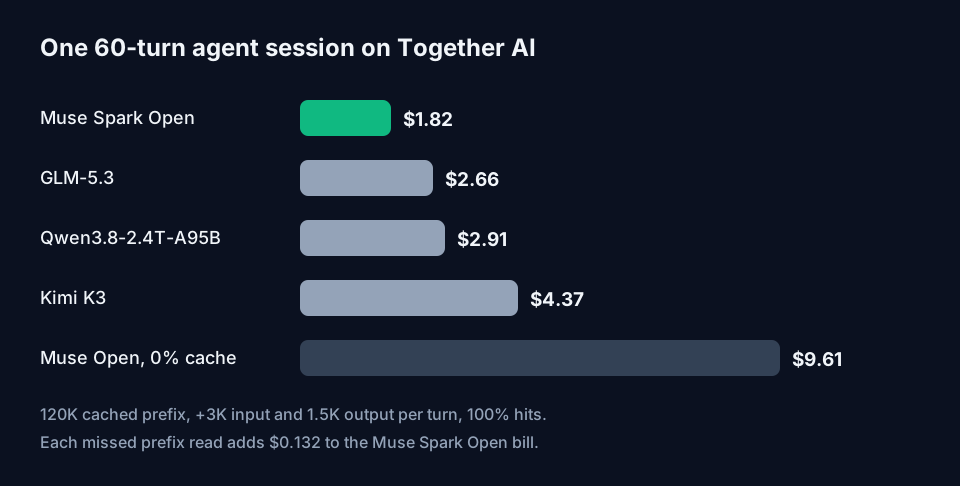
That comes to 7.08 million cache-read tokens, 300,000 fresh input tokens and 90,000 output tokens. The rivals are the two strongest open models in Meta's table, at Together's listed rates.
| Model (on Together AI) | Cache reads | Fresh input | Output | Session |
|---|---|---|---|---|
| Muse Spark Open ($1.25 / $0.15 / $4.25) | $1.062 | $0.375 | $0.383 | $1.82 |
| GLM-5.3 ($1.40 / $0.26 / $4.40) | $1.841 | $0.420 | $0.396 | $2.66 |
| Qwen3.8-2.4T-A95B ($2.00 / $0.25 / $6.00) | $1.770 | $0.600 | $0.540 | $2.91 |
| Kimi K3 ($3.00 / $0.30 / $15.00) | $2.124 | $0.900 | $1.350 | $4.37 |
| Muse Spark Open, no cache hits | $8.850 | $0.375 | $0.383 | $9.61 |
At 20 sessions a day for 22 working days, 440 sessions, Muse Spark Open costs $800.58 a month against $1,169 for GLM-5.3.
The last row matters most. Cache reads are 58% of the bill, and the price assumes every read lands. Each missed read of the 120K prefix bills at $1.25 instead of $0.15 and adds $0.132 to the session. At zero hits the session costs $9.61, more than five times as much. Log cached_tokens against input tokens on every turn.
To run your own token mix, use the API Cost Calculator. It now lists Muse Spark Open at Together's rates.
Benchmarks against GLM 5.3 and Kimi K3
These are Meta's own figures. Muse Spark Open ran at xhigh effort, GLM 5.3 and Kimi K3 at max.
| Benchmark | Muse Spark Open | GLM 5.3 | Kimi K3 |
|---|---|---|---|
| Artificial Analysis Intelligence Index | 39 | 45 | 44 |
| MCP-Atlas | 89.2 | 84.2 | 82.3 |
| JobBench | 61.8 | 61.4 | 54.3 |
| Toolathlon Verified | 72.8 | 73.0 | 76.5 |
| Terminal-Bench 2.1 (Terminus 2) | 76.4 | 83.9 | 85.0 |
| DeepSWE 1.1 | 60 | 67 | 68 |
| SWE-Atlas-QnA | 58 | 59 | 66 |
| HLE (with tools) | 61.0 | 62.5 | 56.0 |
| GPQA Diamond | 89.0 | 91.7 | 93.5 |
Muse Spark Open leads on MCP tool use (MCP-Atlas) and on the JobBench work tasks. It trails both rivals on terminal work and repository coding: DeepSWE 60 against 67 and 68, Terminal-Bench 76.4 against 83.9 and 85.0. That makes its "coding-optimized" label harder to take at face value.
So the $1.82 isn't the full comparison. If your agent mostly runs shell commands and patches repos, GLM-5.3 may finish a task in fewer turns, and that can cancel the 84-cent gap. If your agent mostly calls MCP tools, Muse Spark Open is both cheaper and higher scoring.
Four catches before you switch
The default reasoning effort is xhigh. The model card sets the default to xhigh and says any value other than low, medium, high or xhigh returns an error. Thinking tokens bill as output. If your agent averages 1,500 more thinking tokens a turn than our 1,500, the session gains 90,000 output tokens, $0.38 on Together. Set reasoning_effort per request, and drop to medium for routine steps.
Check which host you're routed to. On OpenRouter, at the time of writing, Together listed a $0.15 cached-input rate, and the Nebius FP4 endpoint showed no cached rate and no implicit caching. A session routed to an endpoint with no caching bills like the $9.61 row. Pin the provider when your agent depends on cache hits.
The weights are gated. You accept the Muse Model License on Hugging Face before you can download the Meta checkpoints. The model card says the model isn't intended for people under 18, and puts the risk assessment on deployers whose systems minors might use.
Meta wants guardrails around it. The card asks for human confirmation before irreversible actions in agent setups, and says you shouldn't show raw chain-of-thought to users. For a coding agent, keep it on least-privilege tools.
FAQ
How much memory does Muse Spark Open need? The UD-IQ2_S GGUF, Unsloth's minimum for agent work, needs 256.6 GiB for weights and 264.9 GiB with 128K of context. The smallest 2-bit file, UD-IQ2_XXS, needs 218.5 GiB at 128K. Meta's NVFP4 checkpoint needs 504.8 GiB at 128K.
Can it run on one Mac Studio? A 512 GB Mac Studio fits the UD-IQ2_S and UD-Q3_K_XL GGUFs. Meta's NVFP4 setup uses two 512 GB machines linked over Thunderbolt 5.
How much does Muse Spark Open cost on the API? Together AI charges $1.25 per 1M input tokens, $0.15 cached input and $4.25 output. Our 60-turn agent session costs $1.82 with a fully cached prefix and $9.61 with no cache hits.
Is it better than GLM 5.3 for coding? Not on Meta's own coding numbers. GLM 5.3 scores 67 on DeepSWE 1.1 and 83.9 on Terminal-Bench 2.1, against 60 and 76.4. Muse Spark Open leads on MCP-Atlas, 89.2 to 84.2, and costs less per session.
What context length does it support? 1,048,576 tokens. At BF16 the full context adds 64 GiB of KV cache, plus a fixed 368 MiB for the sliding-window layers.
Conclusion
Muse Spark Open is an 816B model that most people will rent, not run. Its attention layout keeps the cache at 64 KiB per token, but even the 2-bit file Unsloth recommends for agents needs about 265 GiB at 128K context, which means a 512 GB Mac Studio or a multi-GPU server. Rented on Together AI, it does our 60-turn agent session for $1.82, cheaper than GLM-5.3, Qwen3.8-2.4T and Kimi K3, as long as the cache holds. It leads on MCP tool use and trails on repository coding, so pick it for tool-calling agents and test it against GLM-5.3 before moving a coding agent over.
Sources
- Hugging Face,
unsloth/Muse-Spark-Open-816B-A42B-GGUFmodel card (copy of Meta's card): release date, parameters, layers, heads, experts, context, vocabulary, reasoning efforts, hardware notes, benchmark table, safety and limitations. - Hugging Face,
mlx-community/Muse-Spark-Open-816B-A42B-4bitconfig.json: 62 layer types (16 full, 46 sliding), sliding window 2,048, 16 KV heads, head dimension 64, 256 experts, top-8. - Hugging Face API file lists for
unsloth/Muse-Spark-Open-816B-A42B-GGUF,meta-models/Muse-Spark-Open-816B-A42B, its NVFP4 repo and the mlx-community 4-bit repo: download sizes and safetensors parameter total. - Meta for Developers, "Build with Muse Spark Open" (dev.meta.ai/resources/blog/build-with-muse-spark-open, 15 October 2026): runtimes, hosting partners, precisions, Mac Studio and Blackwell setups.
- Unsloth, "Meta Muse Spark Open - Run Locally Guide" (unsloth.ai/docs/models/muse-spark-open): memory table, UD-IQ2_S agentic minimum.
- Together AI pricing (together.ai/pricing, read 16 October 2026): Muse Spark Open, GLM-5.3, Qwen3.8-2.4T-A95B and Kimi K3 rates.
- Meta Model API, Pricing and rate limits (dev.meta.ai/docs/pricing-rate-limits, read 16 October 2026): Muse Spark 1.3 Standard rates.
- OpenRouter model endpoints listing for
meta/muse-spark-open(read 16 October 2026): per-host cached-input and caching flags. - KV cache, GiB conversions, hardware fits and session costs are calculated by ToolMintX from those sources. Runtime buffers and the vision/audio projector are not included.