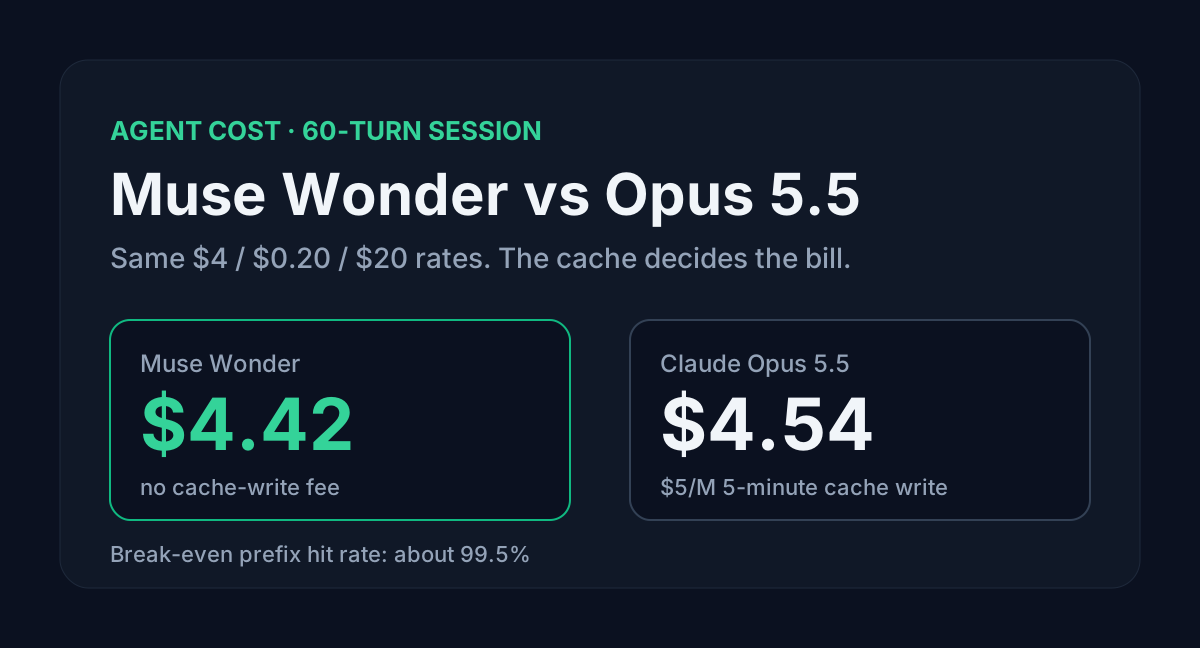
Meta released Muse Wonder (muse-wonder-1.0) on 12 October 2026 and priced it at $4 per million input tokens, $0.20 for cached input and $20 for output. Those are exactly Claude Opus 5.5's rates. Both models have a 1M-token context window and neither charges a long-context premium.
The bills still come out differently, because the two providers cache in different ways. Muse Wonder has no cache-write fee, so on our standard 60-turn coding-agent session it costs $4.42 against $4.54 for Opus 5.5. That 12-cent lead lasts only while the cache holds. Meta's cache is automatic and gets evicted under memory pressure, and one missed read of the agent prefix adds $0.46. That's nearly four times the saving.
This post costs the session line by line, shows how the bill moves when the cache hit rate falls, and covers what to set up before you point an agent at Muse Wonder.
Table of Contents
- The rates, side by side
- One agent session, priced
- The cache hit rate decides it
- Setting up the cache on Meta Model API
- Two catches the launch post leaves out
- Benchmarks: Wonder vs Wonder Full
- FAQ
- Conclusion
- Sources
The rates, side by side
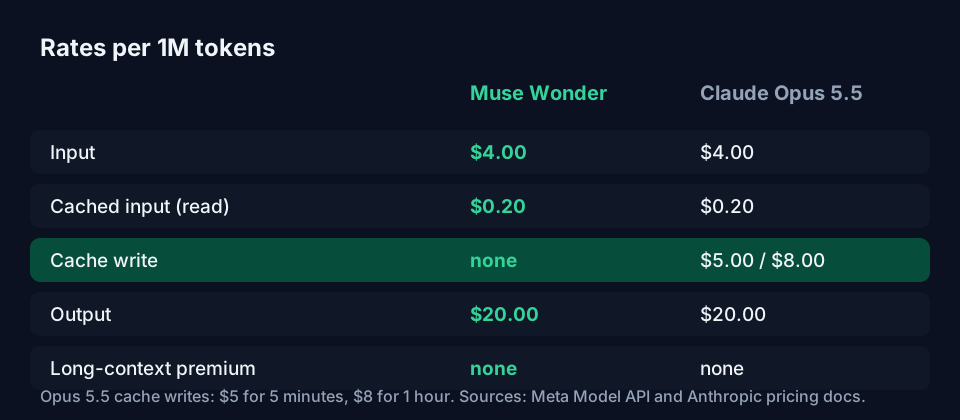
Per million tokens, from Meta's Pricing and Rate Limits page and Anthropic's pricing docs:
| Muse Wonder | Claude Opus 5.5 | |
|---|---|---|
| Input | $4.00 | $4.00 |
| Cached input (read) | $0.20 | $0.20 |
| Cache write | none (billed as input) | $5.00 (5 min) / $8.00 (1 hour) |
| Output | $20.00 | $20.00 |
| Context window | 1,048,576 tokens | 1M tokens |
| Long-context premium | none | none |
Meta's page lists only three rows for Muse Wonder: cached input, input and output. Its prompt caching docs say the cache "runs on every request with no action from you". Your first request with a new prefix pays the normal $4.00 input rate and the prefix gets cached anyway. Anthropic charges 1.25x the input price to write a 5-minute cache entry and 2x for a 1-hour entry, then 5% of input on every hit.
Two other Meta details affect cost. Web search grounding is $2.50 per 1,000 queries on top of tokens, and Meta's injected system scaffolding isn't billed. Contributor mode, where Meta discounts usage in exchange for training on your content, isn't available for Muse Wonder on the API. Every Muse Wonder API call bills at Standard rates.
One agent session, priced
This is the same session we used for Sonnet 5.5 vs GPT-6.1 Sol and Step 5 Preview, so the rows compare directly:
- 60 turns
- a 120,000-token prefix (system prompt, tool schemas, files read), written to the cache on turn 1 and read back on the other 59 turns
- 3,000 new input tokens and 1,500 output tokens per turn
That is 7.38 million input tokens, 7.08 million of them cache reads, plus 90,000 output tokens. Every row below assumes a 100% hit rate on the prefix.
| Model | Cache write | Cache reads | New input | Output | Session | Per month* |
|---|---|---|---|---|---|---|
| Muse Spark 1.3 | $0.15 | $1.06 | $0.23 | $0.38 | $1.82 | $801 |
| Claude Sonnet 5.5 | $0.30 | $0.71 | $0.36 | $0.90 | $2.27 | $998 |
| Muse Wonder | $0.48 | $1.42 | $0.72 | $1.80 | $4.42 | $1,943 |
| Claude Opus 5.5 (5-min cache) | $0.60 | $1.42 | $0.72 | $1.80 | $4.54 | $1,996 |
| Claude Opus 5.5 (1-hour cache) | $0.96 | $1.42 | $0.72 | $1.80 | $4.90 | $2,154 |
*20 sessions a day for 22 working days (440 sessions). For Meta models the "cache write" column is the first pass of the prefix at the normal input rate. Totals use unrounded figures, so a row can be a cent off its rounded columns.
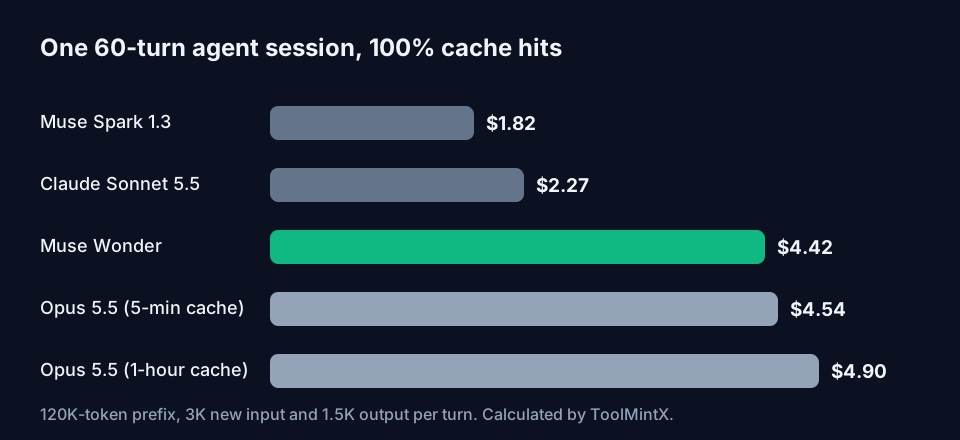
Cache reads, new input and output cost the same on both models to the cent. The whole gap is the cache-write line: $0.48 against $0.60, or $0.96 if you pay Anthropic for the 1-hour cache. Over a month that adds up to $53 with the 5-minute cache and $211 with the 1-hour cache.
The cache hit rate decides it
On Anthropic you mark cache breakpoints, and you can buy the 1-hour cache when an agent pauses for review. Meta's docs describe something looser. The default in_memory retention is "evicted under pressure or after inactivity". The 24h option exists, but it's "a hint, not a guarantee", and the server "may evict entries early under load".
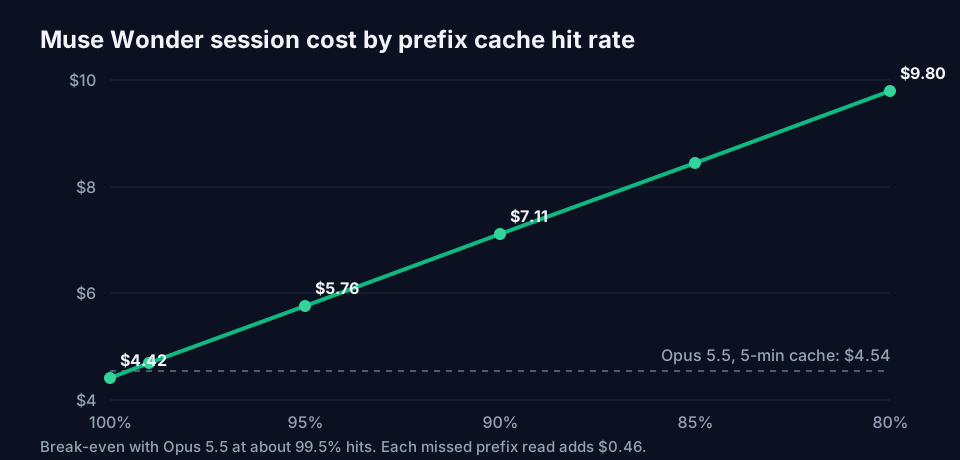
When a prefix read misses, those 120,000 tokens bill at $4.00 instead of $0.20. That's $0.48 for the turn instead of $0.024. Each percentage point of missed prefix reads across the 59 reads adds $0.27 to the session.
| Prefix hit rate | Muse Wonder session |
|---|---|
| 100% | $4.42 |
| 99% | $4.69 |
| 95% | $5.76 |
| 90% | $7.11 |
| 80% | $9.80 |
The break-even against Opus 5.5 with its 5-minute cache sits at about 99.5%. In practice, one missed prefix read in a 60-turn session makes Muse Wonder the more expensive model. Opus 5.5 caches can miss as well, for example when a 5-minute entry expires during a long tool call. The difference is that Anthropic gives you settings to prevent the miss, while Meta's cache is mostly out of your hands.
Setting up the cache on Meta Model API
Model API is OpenAI-compatible. Meta's launch post says it's "one base_url change away", and the docs list Responses, Chat Completions and Messages endpoints. On the Responses API, a long agent session wants three settings:
import os
from openai import OpenAI

client = OpenAI(
    base_url="https://api.meta.ai/v1",
    api_key=os.environ["MODEL_API_KEY"],  # YOUR_API_KEY, never hard-coded
)

resp = client.responses.create(
    model="muse-wonder-1.0",
    prompt_cache_key="code-agent-v1",   # one stable key per shared prefix
    prompt_cache_retention="24h",       # a hint; the server may still evict
    input=history,                      # system prompt + tools first, new turn last
)

u = resp.usage
print(u.input_tokens, u.input_tokens_details.cached_tokens)
What the settings do, per Meta's prompt caching docs:
prompt_cache_keyroutes requests that share a key to the same backend, which raises the hit rate at volume. Name it after the app or use case. A per-user or per-session key splits the cache and lowers the hit rate.prompt_cache_retention: "24h"is the only lever for agents that sit idle between turns. It's accepted on the Responses API only.- Order is the main control. Caching matches from the first token forward, so a timestamp or a changed tool list near the top of the prompt cuts off the reusable prefix.
Log cached_tokens against input tokens on every turn. On Chat Completions the field is usage.prompt_tokens_details.cached_tokens. If the ratio drops below the high 90s during your working hours, that's the cache being evicted, and on this workload Opus 5.5 is now the cheaper option. The JSON Formatter makes a raw usage object easier to read while you check this.
Two catches the launch post leaves out
Chaining with previous_response_id hides your hit rate. Meta's docs say that when the server rebuilds earlier turns from stored history, a follow-up "reports only the new turn's input_tokens and cached_tokens, not the full reconstructed prefix". Agent frameworks often chain this way, and if yours does, the usage numbers can't tell you whether the 120K prefix hit. The docs suggest managing the input array yourself when you need accounting across the whole prefix. Do that for at least a test week.
The rate limit is per team, not per key. muse-wonder-1.0 gets 3,000 requests and 4,000,000 tokens per minute, shared by every API key in the team. One turn of our session sends about 124,000 input tokens, so 4M TPM covers roughly 32 such turns a minute if cached tokens count toward the limit. The page doesn't say whether they do. Ten parallel agents each taking a turn every 15 seconds would send about 5M tokens a minute and go over it. Meta's suggested handling is exponential backoff with jitter, starting around 500 ms, and reading the x-ratelimit-remaining-tokens header.
Benchmarks: Wonder vs Wonder Full
Meta's launch table compares two models, and only one of them is on the API. Muse Wonder Full is "available exclusively by subscription in Muse Code" on the Power Usage and Maximum Usage plans. Setting reasoning effort to max on muse-wonder-1.0 doesn't select it. These are coding rows from Meta's own table, all at max effort:
| Benchmark | Wonder Full | Wonder (API) | Opus 5.5 |
|---|---|---|---|
| Terminal-Bench 4.0-AA | 57.1 | 52.0 | 59.6 |
| DeepSWE 1.1 | 79.0 | 78.8 | 74.2 |
| SWE-Marathon | 57.5 (xhigh) | 53.1 | 46.3 |
| ProgramBench | 59.0 | 50.0 | 70.5 |
| Artificial Analysis Index | 56 | 52 | 58 |
At the same price, the API model leads Opus 5.5 on the two long-horizon repo benchmarks and trails it on terminal work, from-scratch programming and the composite index. If your agent spends most of its turns in a shell, expect more turns per finished task on Muse Wonder, and cost those extra turns before you compare sessions. Meta's docs also call Muse Wonder a preview.
FAQ
How much does Muse Wonder cost? $4.00 per million input tokens, $0.20 per million cached input tokens and $20.00 per million output tokens on Meta Model API. There is no cache-write charge and no long-context premium. Web search grounding adds $2.50 per 1,000 queries.
Is Muse Wonder cheaper than Claude Opus 5.5? Only slightly, and only with a near-perfect cache. Our 60-turn agent session costs $4.42 on Muse Wonder and $4.54 on Opus 5.5 with the 5-minute cache. Below about a 99.5% prefix hit rate, Muse Wonder costs more.
Can I use Muse Wonder Full through the API?
No. Muse Wonder Full is only available inside Muse Code on the Power Usage and Maximum Usage subscription plans. The API model is muse-wonder-1.0.
Does Muse Wonder work with the OpenAI SDK?
Yes. Set base_url to https://api.meta.ai/v1, use a Model API key and set the model to muse-wonder-1.0. Responses and Chat Completions are both supported.
How do I check Muse Wonder's cache hit rate?
Read cached_tokens in the usage object and divide it by input tokens. Avoid chaining with previous_response_id while you measure, because those responses report only the new turn.
Conclusion
Muse Wonder matches Opus 5.5's three headline rates and skips the cache-write fee, which saves 12 cents on our 60-turn session and about $53 a month at 440 sessions. The saving is real but small, and one missed read of a 120K prefix cancels it. Set a stable prompt_cache_key, put the system prompt and tools first, ask for 24h retention, and log cached_tokens with the input array managed yourself. If your hit rate stays in the high 90s, Muse Wonder is the cheaper of the two. Otherwise, choose between them on the benchmark rows that match your agent's work. For lighter agents, Muse Spark 1.3, the model behind the Meta AI app, does the same session for $1.82. Plug in your own token counts with the API Cost Calculator, which now lists Muse Wonder and Muse Spark 1.3.
Sources
- Meta Model API, Pricing and rate limits (dev.meta.ai/docs/pricing-rate-limits): Muse Wonder $4.00 / $0.20 / $20.00, Contributor mode not available for Muse Wonder, no long-context premium, $2.50 per 1,000 web searches, Muse Spark rates, per-team rate limits, backoff guidance.
- Meta, "Put your ideas to work with Muse Wonder and Muse Wonder Full" (dev.meta.ai/resources/blog/build-with-muse-wonder, 12 October 2026): launch pricing, Wonder Full subscription-only, OpenAI SDK base_url note, benchmark table.
- Meta Model API, Models (dev.meta.ai/docs/models):
muse-wonder-1.0, 1,048,576-token context, preview status, Wonder Full availability, reasoning effort note. - Meta Model API, Prompt caching (dev.meta.ai/docs/prompt-caching): automatic prefix caching,
prompt_cache_key,prompt_cache_retention,cached_tokensfields,previous_response_idaccounting. - Meta Model API, Subscriptions (dev.meta.ai/docs/muse-code/subscriptions): Muse Code plan tiers and Contributor mode default.
- Anthropic, Claude pricing docs (platform.claude.com/docs/en/about-claude/pricing): Opus 5.5 cache write multipliers (1.25x and 2x), $0.20 cache reads, 1M context at standard pricing.
- Claude Sonnet 5.5 rates are from the ToolMintX API Cost Calculator dataset, read from Anthropic's pricing page. Session, hit-rate and monthly figures are calculated by ToolMintX from those rates.