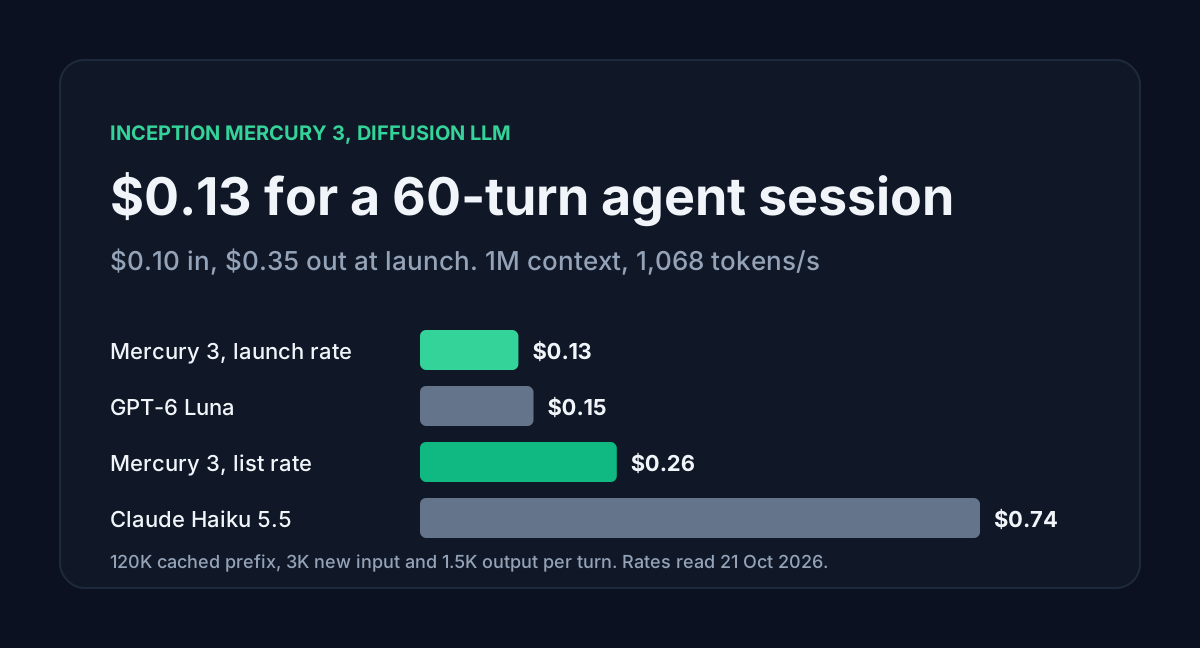
Inception released Mercury 3 on 19 October 2026. It's a diffusion language model: it writes a block of tokens in parallel and refines them, instead of predicting one token at a time. Inception quotes 1,068 tokens per second on NVIDIA GPUs and a 1M-token context, up from 260K on Mercury 2.5.
The price is the part that caught my eye. The list rate is $0.20 per million input tokens and $0.70 output, and at launch it's half that: $0.10 and $0.35, with cached input at $0.01. Neither the blog post nor the docs give an end date for the discount. I ran our standard 60-turn agent session at both rates, then set it up in Claude Code and Hermes Agent the way Inception documents it.
Table of contents
- Mercury 3 prices and limits
- One agent session at launch and list price
- The cache has no published TTL
- Claude Code through a LiteLLM bridge
- Hermes Agent with no proxy
- Mercury 2 and 2.5 shut off for new users
- FAQ
- Sources
Mercury 3 prices and limits
Everything here is from Inception's models page and API docs, read on 21 October.
| Mercury 3 at launch | Mercury 3 list | Mercury 2.5 | |
|---|---|---|---|
| Input, per 1M | $0.10 | $0.20 | $0.20 |
| Cached input, per 1M | $0.01 | $0.02 | $0.02 |
| Output, per 1M | $0.35 | $0.70 | $0.75 |
| Context | 1M | 1M | 260K |
| Max output tokens | 131,072 | 131,072 | 65,536 |
| Model ID | mercury-3 | mercury-3 | mercury-2.5 |
The API is OpenAI-compatible, at https://api.inceptionlabs.ai/v1/chat/completions. It supports tool calling, parallel tool calls and structured outputs. reasoning_effort takes instant, low, medium or high, and Mercury 3 defaults to low when you leave it out. Mercury 2.5 defaulted to medium, so a straight model swap also changes how hard the model thinks. Temperature only goes from 0.5 to 1.0. A client that sends temperature: 0 for deterministic tool calls needs changing.
New accounts get a one-time 100 million free tokens, shared across all models. The free tier caps output at 100,000 tokens a minute, and Pay As You Go raises that to 300,000.
On quality, Inception's claim is that Mercury 3 is "on par or better" than GPT-6 Luna and Claude Haiku 5.5. Those are its own benchmarks, and I haven't run any. Its launch post also quotes TinyFish AI saying Mercury 3 finished 50% of 50 live Mind2Web navigation tasks, more than GPT-6.1 Sol did in the same harness.
One agent session at launch and list price
This is the session we cost for every model: 60 turns, a 120,000-token prefix sent once and read from cache on the other 59 turns, then 3,000 new input tokens and 1,500 output tokens per turn.
| Line | Tokens | Launch rate | List rate |
|---|---|---|---|
| Prefix, first send | 120,000 | $0.012 | $0.024 |
| Cache reads | 7,080,000 | $0.071 | $0.142 |
| New input | 180,000 | $0.018 | $0.036 |
| Output | 90,000 | $0.032 | $0.063 |
| Session | 7,470,000 | $0.13 | $0.26 |
Against the models nearest on price, using the same session:
| Model | Session cost |
|---|---|
| DeepSeek V4.1 Flash, off-peak | $0.12 |
| Mercury 3, launch | $0.13 |
| GPT-6 Luna | $0.15 |
| Nemotron 3.5 Super VL on Together AI | $0.23 |
| DeepSeek V4.1 Flash, peak hours | $0.24 |
| Mercury 3, list | $0.26 |
| Claude Haiku 5.5 | $0.74 |
| Claude Sonnet 5.5 | $2.27 |
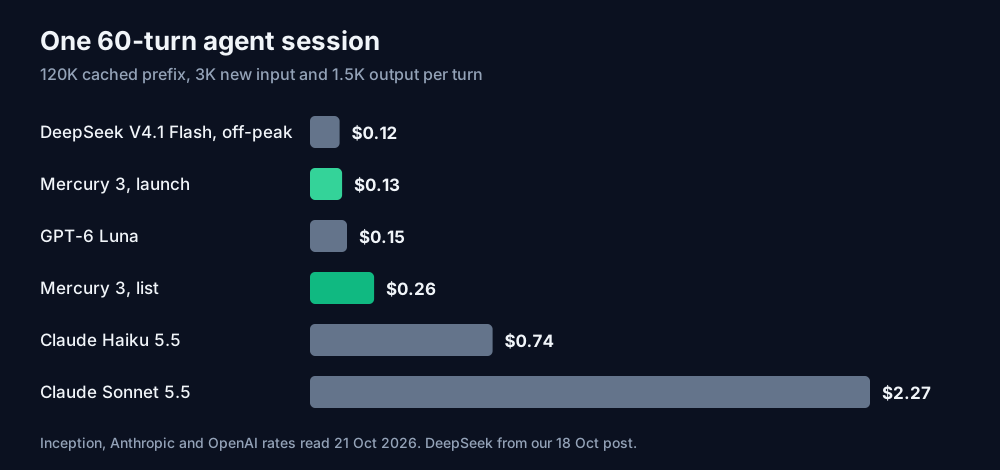
The other rows come from our earlier posts on DeepSeek Flash in Claude Code, Haiku 5.5's 100K line and Nemotron 3.5. I rechecked the Anthropic and OpenAI rates on their pricing pages today and none had moved. Haiku 5.5 lands at $0.74 because a 120K prompt is over its 100K line, where every rate goes up five times. Mercury 3 bills the same rate across the full 1M window, and Inception's pricing doesn't mention a long-prompt tier.
Two things move the Mercury number. At the launch rate, four sessions a workday for 20 days is $10.58 a month. At list it's $21.17. Output is the other lever. Mercury bills reasoning tokens as output, and if high effort triples output to 4,500 tokens a turn, the launch-rate session goes from $0.13 to $0.20.
The 100 million free tokens cover about 13 of these sessions, since each one moves 7.47 million tokens. Most of that is cache reads, and cache reads count against the free credit like any other token.
You can change the turn counts or prefix size in the API Cost Calculator, which now lists Mercury 3 at both rates.
The cache has no published TTL
Prefix caching on Mercury 3 is automatic: you don't send a parameter. Cached tokens show up in usage.prompt_tokens_details.cached_tokens and bill at a tenth of the input rate. Inception's FAQ is blunt about what you can't do. There's no documented TTL, and you can't pin, invalidate or inspect cache entries.
That leaves you exposed on agent sessions with long pauses. If you step away for lunch and the prefix is evicted, every turn after that pays full input. The whole session on cache misses costs $0.77 at launch rates, almost six times the $0.13 figure, and $1.54 at list. Log cached_tokens per turn for your first few sessions before you trust the estimate.
Inception's prompt guide gives the usual advice for raising hit rates: static content at the top, dynamic content at the end. In a coding agent that means keeping the system prompt and tool list identical between turns, which Claude Code and Hermes both already do.
Claude Code through a LiteLLM bridge
Claude Code speaks Anthropic's Messages API, and Mercury speaks OpenAI's Chat Completions. Inception's fix is a launcher called mercury-cc that starts a local LiteLLM proxy and points Claude Code at it. Inception's own warning says it plainly: Anthropic doesn't support routing Claude Code to non-Claude models, and LiteLLM is a third-party bridge you should review before using it on sensitive code.
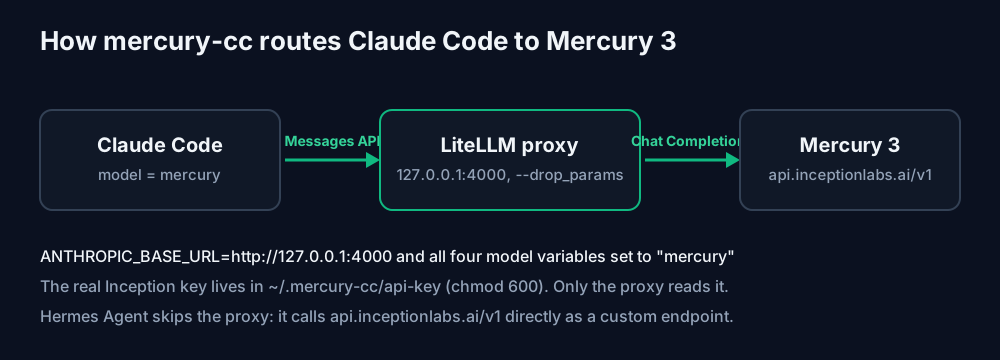
Setup needs Python 3.11 or later on macOS or Linux. Install the LiteLLM version Inception tested into its own virtualenv, then save your key to a file only you can read:
mkdir -p "$HOME/.mercury-cc" "$HOME/.local/bin"
chmod 700 "$HOME/.mercury-cc"
python3 -m venv "$HOME/.mercury-cc/.venv"
"$HOME/.mercury-cc/.venv/bin/pip" install 'litellm[proxy]==1.99.0'

bash -c 'read -rsp "Inception API key: " key; printf "\n"; printf "%s" "$key" > "$HOME/.mercury-cc/api-key"'
chmod 600 "$HOME/.mercury-cc/api-key"
The launcher script in Inception's docs starts the proxy on port 4000 and then sets these variables before running claude:
export ANTHROPIC_BASE_URL="http://127.0.0.1:4000"
export ANTHROPIC_AUTH_TOKEN="mercury-local"
unset ANTHROPIC_API_KEY

export ANTHROPIC_MODEL="mercury"
export ANTHROPIC_DEFAULT_HAIKU_MODEL="mercury"
export ANTHROPIC_DEFAULT_SONNET_MODEL="mercury"
export ANTHROPIC_DEFAULT_OPUS_MODEL="mercury"
export CLAUDE_CODE_SUBAGENT_MODEL="mercury"
export CLAUDE_CODE_MAX_CONTEXT_TOKENS=1000000
The proxy itself runs as litellm --model inception/mercury-3 --alias mercury --drop_params --host 127.0.0.1 --port 4000. --drop_params matters here: it silently strips Anthropic parameters Mercury doesn't accept, so a setting you thought applied may never reach the model. Binding to 127.0.0.1 keeps the proxy off your network. The ANTHROPIC_AUTH_TOKEN value is a dummy, since the real key sits in the file and only the proxy reads it.
All five model variables point at mercury, so every role in Claude Code, including subagents, runs on the same model. Your normal claude command keeps its own settings. Inside a session, /status should show http://127.0.0.1:4000 as the base URL. Inception notes Claude Code may log unrecognized_model for the alias and that requests still go through. mercury-cc --stop shuts the proxy down.
Hermes Agent with no proxy
Hermes Agent talks to OpenAI-compatible endpoints directly, so you skip the bridge. Run hermes model, choose "Custom endpoint (enter URL manually)" and fill in:
| Setting | Value |
|---|---|
| API base URL | https://api.inceptionlabs.ai/v1 |
| API key | YOUR_API_KEY |
| API compatibility mode | Chat Completions |
| Model name | mercury-3 |
| Context length | 1000000 |
Then check it with hermes chat --oneshot -q "Reply with exactly: Mercury 3 is connected.". If discovery doesn't list the model, type mercury-3 by hand. The two things Inception's troubleshooting calls out are a base URL that doesn't end in /v1 and the wrong compatibility mode.
Mercury 2 and 2.5 shut off for new users
The models page says Mercury 2 and Mercury 2.5 are no longer available to new users. Accounts that used them before 19 October keep access until 15 November 2026, and enterprise contracts stay supported. If you have an app on mercury-2.5, the migration is cheaper on paper: input stays at $0.20 at list, output drops from $0.75 to $0.70, and at launch rates you pay half. Check two behaviour changes before you switch the model ID. The default reasoning effort drops from medium to low, and the context limit grows from 260K to 1M.
FAQ
When does the 50% launch discount end? Inception hasn't said. The models page and the docs show the struck-through list price and the launch price with no date. Budget at list price, $0.20 in and $0.70 out, and treat the launch rate as a bonus.
Is Mercury 3 open weights? No. It's available through Inception's API, OpenRouter, Baseten and Vercel, with enterprise deployments on dedicated capacity. There's nothing to download, so the AI VRAM Calculator doesn't apply.
What is Mercury Decide?
A separate classification model on v1/decisions that returns typed answers with probabilities. Only input is billed, at $0.02 per million during the launch (list $0.04). It doesn't do chat or tool calls.
Sources
- Inception, "Diffusion at Scale: Introducing Mercury 3" (inceptionlabs.ai/blog/introducing-mercury-3, 19 October 2026, read 21 October 2026): release date, speed, context, list and launch prices, quality claims, TinyFish Mind2Web quote, availability.
- Inception, Models page (inceptionlabs.ai/models, read 21 October 2026): launch and list rates, cached input rate, 100 million free tokens, Mercury 2 and 2.5 availability and the 15 November 2026 cutoff.
- Inception docs: Models, Reasoning Efforts, Rate Limits, Tool Use, FAQ, Prompt Guide (docs.inceptionlabs.ai, read 21 October 2026): max output, temperature range, reasoning defaults, rate limits, usage fields, cache behaviour.
- Inception docs: Claude Code and Hermes Agent integration pages (docs.inceptionlabs.ai/integrations, read 21 October 2026):
mercury-cclauncher, LiteLLM 1.99.0, environment variables, Hermes settings. - Anthropic, Claude pricing (platform.claude.com/docs/en/about-claude/pricing, read 21 October 2026): Haiku 5.5 and Sonnet 5.5 rates.
- OpenAI, API pricing (developers.openai.com/api/docs/pricing, read 21 October 2026): GPT-6 Luna rates.
- Session costs, monthly totals and the free-token session count are calculated by ToolMintX from those sources.