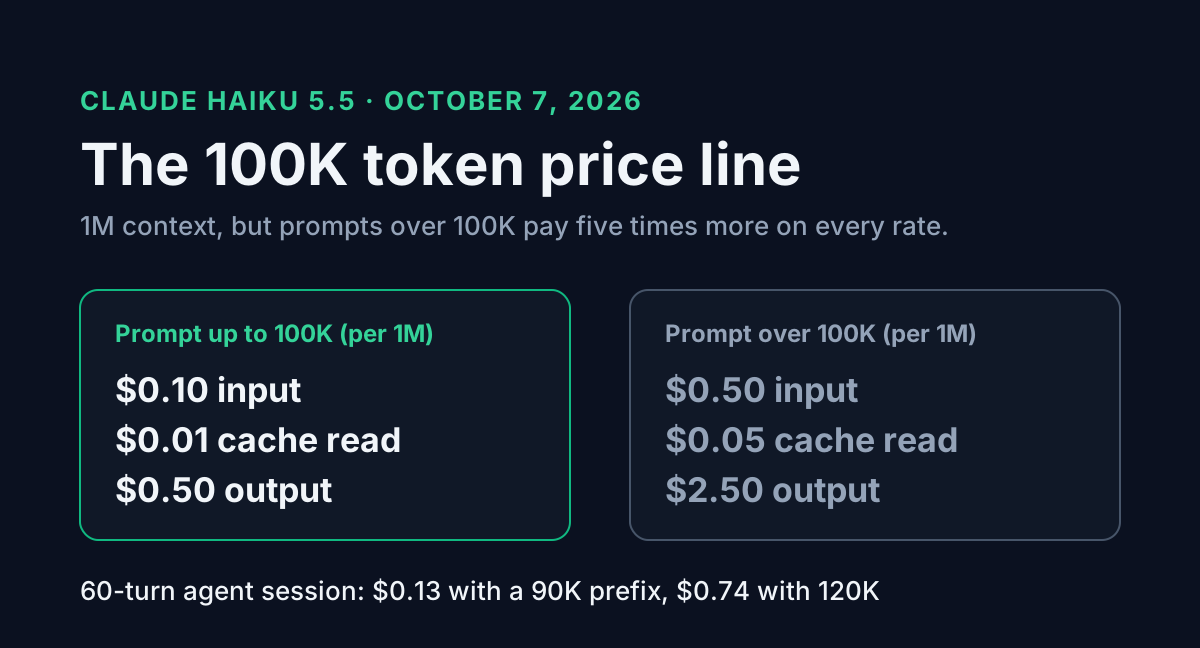
Anthropic released Claude Haiku 5.5 on 7 October 2026. The headline price is $0.10 per million input tokens and $0.50 per million output, a tenth of Haiku 4.5's $1 and $5. It has a 1M-token context window, 128K max output and, for the first time on a Haiku model, an adjustable effort setting. The API ID is claude-haiku-5-5.
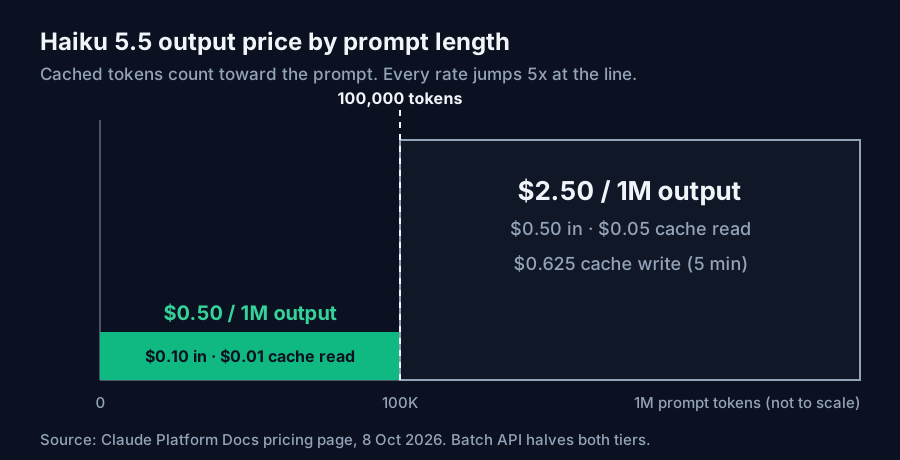
That $0.10 only holds while the prompt stays at or under 100,000 tokens. Once a single request goes over that line, every rate on it is five times higher: $0.50 input, $2.50 output, and the cache rates go up by the same factor. No other current Claude model works this way. Anthropic's pricing page says Claude 4.6 and later models bill the full 1M window at the standard rate, "except Claude Haiku 5.5".
This post costs the same agent session on both sides of the line, puts Haiku 5.5 next to Haiku 4.5, GPT-6 Luna and Sonnet 5.5, and shows how to set up a workflow that stays under 100K. Anthropic also cut Sonnet 5.5's cache-read price in the same announcement, which changes some numbers we published last week.
Table of Contents
- The two price tiers
- One agent session on each side of the line
- Where Haiku 5.5 is good value
- A workflow that stays under 100K
- Sonnet 5.5 cache reads are now $0.10
- What the benchmarks say
- FAQ
- Conclusion
- Sources
The two price tiers
Per million tokens, from Anthropic's pricing page:
| Rate | Prompt up to 100K | Prompt over 100K | Haiku 4.5 | Sonnet 5.5 |
|---|---|---|---|---|
| Input | $0.10 | $0.50 | $1.00 | $2.00 |
| Output | $0.50 | $2.50 | $5.00 | $10.00 |
| Cache write (5 min) | $0.125 | $0.625 | $1.25 | $2.50 |
| Cache write (1 hour) | $0.20 | $1.00 | $2.00 | $4.00 |
| Cache read | $0.01 | $0.05 | $0.10 | $0.10 |
| Batch input / output | $0.05 / $0.25 | $0.25 / $1.25 | $0.50 / $2.50 | $1 / $5 |
Three details matter here.
First, the line is based on prompt length, and the output rate moves with it. A request with a 101K-token prompt pays $2.50 per million on its output too, even if it only writes 200 tokens.
Second, cached tokens count toward the prompt. Anthropic's prompt caching docs define total input as cache reads plus cache writes plus uncached input. An agent with a 90K cached prefix and 12K of new context has a 102K prompt and lands in the higher tier, even though most of it bills at the cache rate.
Third, the jump is sharp. A 99K prompt with 1K of output costs about $0.0104. A 101K prompt with the same output costs about $0.053, roughly five times as much for 2K more tokens.
Anthropic says prompts up to 100K make up "around 90% of requests to our previous Haiku model". For the other 10%, Haiku 5.5 over the line costs half of Haiku 4.5, not a tenth.
One agent session on each side of the line
This is the same session we used in our Sonnet 5.5 vs GPT-6.1 Sol comparison: 60 turns, 3,000 new input tokens and 1,500 output tokens per turn, and a cached prefix written once and re-read on the other 59 turns. The only change is the prefix size. One run uses a 90K prefix, which keeps every prompt around 93K. The other uses the original 120K prefix, which puts every turn over the line.
| Model and prefix | Cache write | Cache reads | New input | Output | Total |
|---|---|---|---|---|---|
| Haiku 5.5, 90K prefix | $0.01 | $0.05 | $0.02 | $0.05 | $0.13 |
| GPT-6 Luna, 120K prefix | $0.02 | $0.07 | $0.02 | $0.05 | $0.15 |
| Haiku 5.5, 120K prefix | $0.08 | $0.35 | $0.09 | $0.23 | $0.74 |
| Haiku 4.5, 120K prefix | $0.15 | $0.71 | $0.18 | $0.45 | $1.49 |
| Sonnet 5.5, 120K prefix | $0.30 | $0.71 | $0.36 | $0.90 | $2.27 |
Rounded per column. Totals are computed from unrounded values.
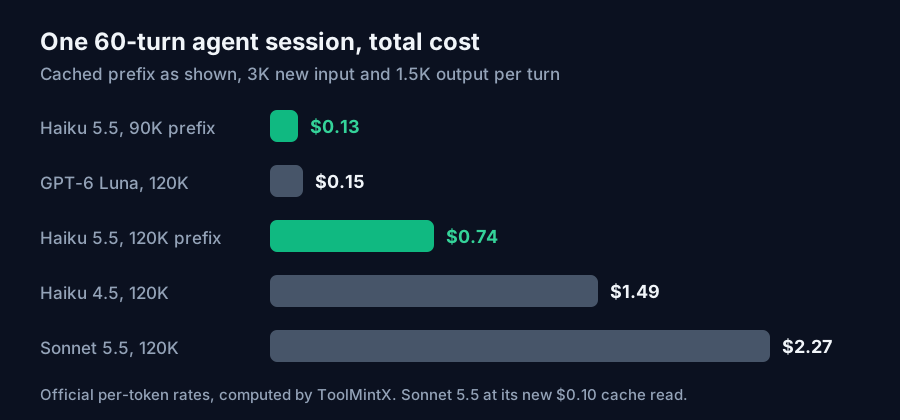
Moving the prefix from 90K to 120K makes the session 5.8 times more expensive. Part of that is the extra 30K tokens per turn. Most of it is the tier change. At 20 sessions a day for 22 working days, that is about $56 a month under the line and $327 over it.
GPT-6 Luna is the closest rival on price. Its rates under 272K tokens are the same as Haiku 5.5's lower tier: $0.10 input, $0.01 cached, $0.50 output, $0.125 cache write. OpenAI's surcharge starts much later, at 272K, and only raises input to 2x and output to 1.5x. So with a 120K prefix, Luna costs $0.15 and Haiku 5.5 costs $0.74. If your prompts often go between 100K and 272K, Luna's pricing fits better. Whether its output is good enough for your task is a separate question (see the benchmarks below).
You can put your own token counts into the API Cost Calculator. It now has Haiku 5.5 at its lower-tier rate, and the over-100K rates are in the model note.
Where Haiku 5.5 is good value
Anthropic positions Haiku 5.5 for classification, extraction, routing, summaries, compaction and subagent work. These tasks usually have short prompts, which is where its price is lowest.
Take a support desk that classifies 100,000 tickets a month. Each request has a 2,000-token cached instruction block, 500 tokens of ticket text and 50 tokens of output:
- Haiku 5.5: $2.00 cache reads + $5.00 input + $2.50 output = $9.50
- Haiku 4.5, same tokens: $95
- Sonnet 5.5, same tokens: $170
With the Batch API, Haiku 5.5's input and output rates drop by half again, to $0.05 and $0.25. That works for overnight tagging jobs where nobody is waiting on the answer.
Long documents are where it gets more expensive. A 150K-token contract summarised in one call costs about $0.078 on Haiku 5.5 because it pays the higher tier. Splitting it into two 75K chunks and summarising each costs about $0.016 in total. You do have to merge two summaries afterwards, and sometimes a chunk boundary cuts through a clause. For most document pipelines that is still worth it at a 5x price difference.
A workflow that stays under 100K
Anthropic's launch post suggests pairing Haiku 5.5 with Opus 5.5 or Sonnet 5.5 as a subagent, and Cognition says it runs it that way in Devin. The pattern looks like this:
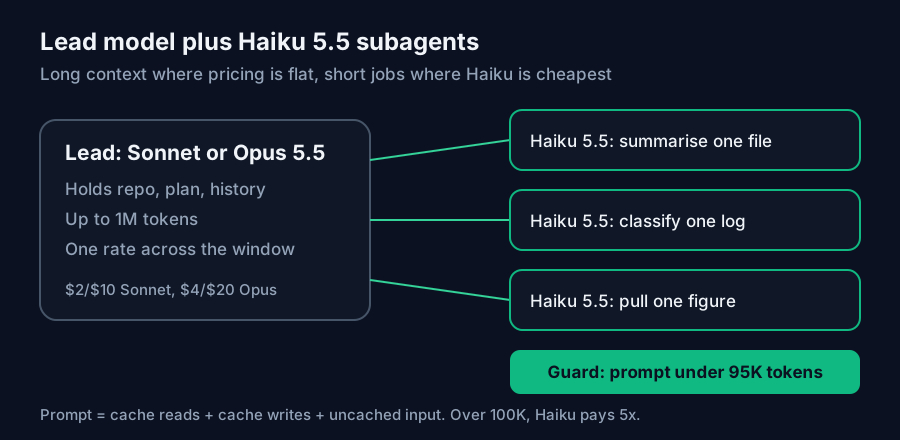
- Give the large context to the lead model. Sonnet 5.5 and Opus 5.5 bill the full 1M window at one rate, so a 300K-token repository context costs the same per token as a 3K one.
- Send Haiku 5.5 narrow jobs with only what they need: one file to summarise, one log to classify, one 10-K section to pull a number from.
- Cap the subagent prompt yourself. Count tokens before sending (the Messages API has a token-counting endpoint), and if a job goes over about 95K, split it or send it to the lead model.
- Watch compaction. Compacting a long conversation is a listed Haiku use case, but the transcript you send for compaction is often the thing that's over 100K. Compact earlier, at around 80-90K, rather than waiting for the context to fill.
- Log
cache_read_input_tokens + cache_creation_input_tokens + input_tokensfor every Haiku call, and alert when it passes 100,000. That sum is what decides the tier.
In Python, the guard looks like this:
# Route a job to Haiku 5.5 only while the whole prompt stays under the 100K price line.
HAIKU_LIMIT = 95_000  # leave headroom below 100,000 for tool results

def pick_model(prompt_tokens: int) -> str:
    if prompt_tokens <= HAIKU_LIMIT:
        return "claude-haiku-5-5"
    return "claude-sonnet-5-5"  # flat pricing across the 1M window

# response = client.messages.create(model=pick_model(n), ...)
usage = response.usage
billed_prompt = (
    (usage.cache_read_input_tokens or 0)
    + (usage.cache_creation_input_tokens or 0)
    + usage.input_tokens
)
if billed_prompt > 100_000:
    print(f"Haiku call crossed the line: {billed_prompt} prompt tokens")
Haiku 5.5 also has an effort setting now, with a default of medium. Lower effort means fewer thinking tokens, and those bill as output. For routing and tagging, try low effort first and only raise it if accuracy drops on your own eval set.
Sonnet 5.5 cache reads are now $0.10
The same announcement cut Sonnet 5.5's cache-read price from $0.20 to $0.10 per million tokens. Input, output and cache writes didn't change. The pricing table and prompt caching docs both show $0.10 now. Anthropic says this makes Sonnet 5.5 about 20% cheaper on most agentic work.
In our 3 October session, Sonnet 5.5's cache reads cost $1.42. At the new rate they cost $0.71, and the session drops from $2.98 to $2.27. That is exactly GPT-6.1 Sol's cost for the same session, since the two models now have identical rates on every line we costed. The difference we reported a week ago is gone. What still separates them is OpenAI's 272K long-context surcharge and its Responses API requirement for tool calls. We've updated the API Cost Calculator to match.
Anthropic also announced monthly Claude Platform API credits for subscribers: $100 on Max 5x, $200 on Max 20x and up to $500 pooled for Team plans. At the 90K-prefix rate above, $100 covers roughly 780 Haiku 5.5 agent sessions.
What the benchmarks say
These are Anthropic's numbers from the launch post. They aren't independent tests.
| Benchmark | Haiku 5.5 | Haiku 4.5 | GPT-6 Luna | Sonnet 5.5 |
|---|---|---|---|---|
| Terminal-Bench 4.0 | 39.2% | 0.0% | 16.4% | 70.6% |
| FrontierCode 1.1 (Main) | 46.4% | n/a | 42.4% | 52.1% (xhigh) |
| OSWorld 2.1 (offline subset) | 72.4% | 15.7% | 48.9% | 83.9% |
| Humanity's Last Exam, no tools | 45.9% | 10.2% | n/a | 56.9% |
Haiku 5.5 beats GPT-6 Luna on every benchmark where both are listed, sometimes by a wide margin. Anthropic also says clearly that it is not a replacement for Sonnet or Opus on complex agentic coding: on Terminal-Bench 4.0 it scores 39.2% against Sonnet 5.5's 70.6%. A cheap model that needs twice as many turns, or fails half the tasks, ends up costing more than it saves. Use it where tasks are short and success is easy to check.
FAQ
How much does Claude Haiku 5.5 cost? $0.10 per million input tokens and $0.50 per million output for prompts up to 100,000 tokens. Above that, $0.50 and $2.50. Cache reads are $0.01, or $0.05 over the line.
Do cached tokens count toward Haiku 5.5's 100K limit? Yes. The prompt length is cache reads plus cache writes plus uncached input. A large cached prefix can push a request over 100K even when the new input is small.
Is Haiku 5.5 cheaper than Haiku 4.5? Always, per token. It is 90% cheaper under 100K and 50% cheaper above. Anthropic's "around 75% less" is an average across real workloads, so your saving depends on how often you cross the line.
Haiku 5.5 or GPT-6 Luna? Under 100K tokens the rates match, and Haiku 5.5 scores higher on Anthropic's published benchmarks. Between 100K and 272K, Luna is about five times cheaper per token.
Did Sonnet 5.5 get cheaper? Its cache reads did, from $0.20 to $0.10 per million tokens, on 7 October 2026. Input and output rates are unchanged.
Conclusion
Claude Haiku 5.5 is priced well for short, high-volume calls. A support classifier costs a tenth of what it did on Haiku 4.5, and a tightly scoped agent session costs about 13 cents. The 100K line is the catch, because it counts cached tokens and multiplies every rate by five, output included. Keep Haiku jobs small, count prompt tokens before you send, and give the long-context work to Sonnet 5.5, which now costs $2.27 for our standard session. Check your own workload in the API Cost Calculator, and if you're comparing it with a local model, the AI VRAM Calculator covers the hardware side.
Sources
- Anthropic, "Introducing Claude Haiku 5.5" (7 October 2026): positioning, effort setting, benchmark table, customer quotes, pricing comparison, the "around 90% of requests" figure, the Sonnet 5.5 cache-read cut and Max/Team API credits.
- Claude Platform Docs, Pricing: Haiku 5.5 rates for prompts up to and over 100,000 tokens, cache write and read rates, Batch API rates, and the long-context note excluding Haiku 5.5 from flat 1M pricing.
- Claude Platform Docs, Models overview:
claude-haiku-5-5API ID, 1M context, 128K max output, adaptive thinking and medium default effort. - Claude Platform Docs, Prompt caching: Sonnet 5.5 cache read at $0.10 and the definition of total input tokens.
- OpenAI GPT-6 Luna rates as recorded in the ToolMintX API pricing dataset from OpenAI's pricing page.
- Session, ticket and document costs are calculated by ToolMintX from those rates.