DeepSeek upgraded its Flash model to DeepSeek-V4.1-Flash-1017 on 17 October 2026. The API name stays deepseek-flash, the price didn't change, and the weights are on Hugging Face under MIT. DeepSeek also publishes a nine-line setup that points Claude Code at its Anthropic-compatible endpoint.
The price on the table is the off-peak price. On weekdays every rate doubles for seven hours, and for anyone in India most of that falls inside the working day. Below: the setup, one coding session costed at both rates against Claude, and the places where the Anthropic compatibility stops.
Table of contents
- What changed on 17 October
- Claude Code setup
- Peak hours in IST
- One 60-turn session, priced
- Where the Anthropic compatibility stops
- Web search billing from 31 October
- FAQ
- Sources
What changed on 17 October
| DeepSeek-V4.1-Flash-1017 | |
|---|---|
| API model name | deepseek-flash |
| Context | 1M tokens |
| Max output | 384K tokens |
| Modes | thinking (default) and non-thinking |
| Vision | yes |
| Endpoints | OpenAI format, Anthropic format, Responses API |
| Weights | Hugging Face, MIT license, 763B parameters in 48 safetensors shards |
| Price | unchanged from V4.1 Flash |
DeepSeek calls it a minor update with gains across reasoning, coding and agent benchmarks, plus shorter outputs and faster task runs. Its own table, which nobody else has reproduced yet:
| Benchmark | V4.1 Flash 1017 | V4.1 Flash | Opus 5 |
|---|---|---|---|
| Terminal-Bench 4.0 | 42.3 | 31.2 | 51.8 |
| DeepSWE v1.1 | 77.0 | 74.2 | 74.0 |
| ProgramBench | 29.1 | 20.3 | 37.0 |
| Automation-Bench v1.0.6 | 60.5 | 54.8 | 50.3 |
DeepSeek ran Terminal-Bench 4.0 inside the Claude Code harness, which makes it the most relevant row for this post. On that row Opus 5 still leads by 9.5 points. The comparison is against Opus 5, not the current Opus 5.5.
The old names deepseek-v4-flash and deepseek-v4-flash-vision-exp still work. Requests sent to them are served by the 1017 model at the Flash price.
Claude Code setup
From the integration page, for Linux and macOS:
export ANTHROPIC_BASE_URL=https://api.deepseek.com/anthropic
export ANTHROPIC_AUTH_TOKEN=YOUR_API_KEY
export ANTHROPIC_MODEL=deepseek-flash[1m]
export ANTHROPIC_DEFAULT_OPUS_MODEL=deepseek-flash[1m]
export ANTHROPIC_DEFAULT_SONNET_MODEL=deepseek-flash[1m]
export ANTHROPIC_DEFAULT_HAIKU_MODEL=deepseek-flash
export CLAUDE_CODE_SUBAGENT_MODEL=deepseek-flash
export CLAUDE_CODE_EFFORT_LEVEL=max
export CLAUDE_CODE_AUTO_COMPACT_WINDOW=786432
Then cd into the project and run claude. Windows users set the same variables with $env:.
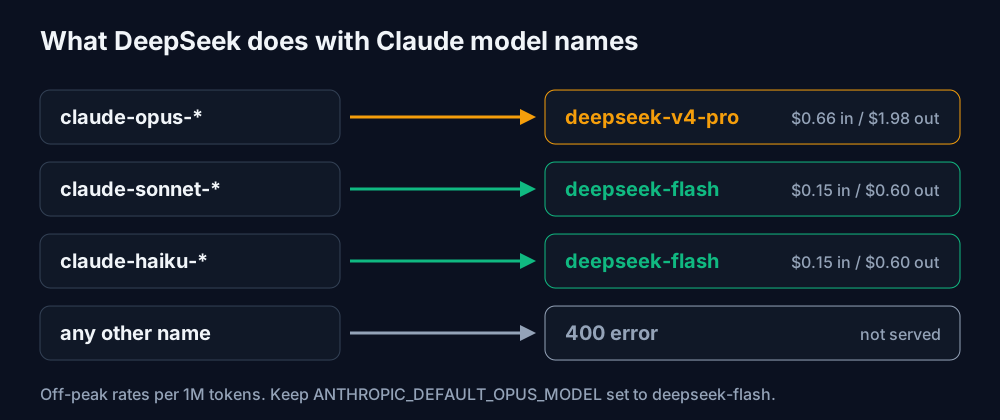
Keep the ANTHROPIC_DEFAULT_OPUS_MODEL line. DeepSeek maps any model name starting with claude-opus to deepseek-v4-pro, billed at the V4 Pro price. Per token that's 4.4 times Flash on input and 3.3 times on output. Names starting with claude-sonnet or claude-haiku go to deepseek-flash. If you drop that line and pick Opus in /model, or a subagent asks for Opus, you're paying for V4 Pro without seeing it in the model name.
CLAUDE_CODE_AUTO_COMPACT_WINDOW=786432 tells Claude Code to compact at 768K tokens, three quarters of the 1M window. The [1m] suffix asks for that window.
Peak hours in IST
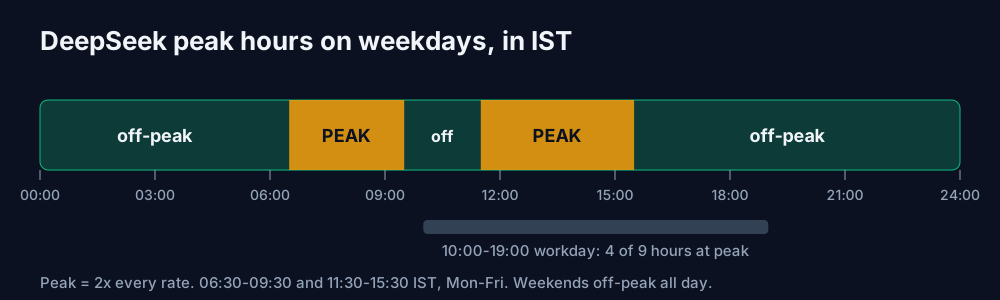
All DeepSeek rates double during peak hours: 01:00 to 04:00 and 06:00 to 10:00 UTC, Monday to Friday, except Chinese public holidays. Weekends and those holidays are off-peak all day.
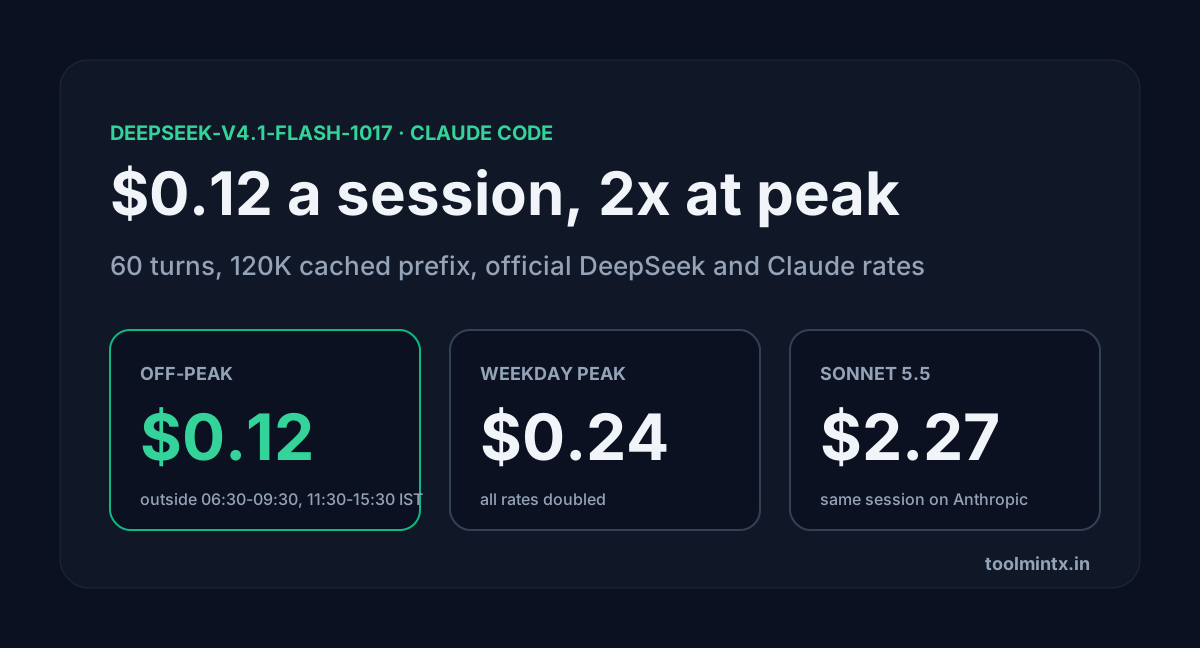
In India that's 06:30 to 09:30 and 11:30 to 15:30 IST. A 10:00 to 19:00 workday spends 4 of its 9 hours at peak rates, right through lunch. The cheap windows are 09:30 to 11:30 IST and everything after 15:30.
| Per 1M tokens | Flash off-peak | Flash peak | V4 Pro off-peak | V4 Pro peak |
|---|---|---|---|---|
| Input, cache hit | $0.003 | $0.006 | $0.022 | $0.044 |
| Input, cache miss | $0.15 | $0.30 | $0.66 | $1.32 |
| Output | $0.60 | $1.20 | $1.98 | $3.96 |
There's no separate cache-write rate. The first send of a prefix bills as a cache miss.
One 60-turn session, priced
This is the same session we used for Sonnet 5.5 against GPT-6.1 Sol:
- 60 turns
- a 120,000-token prefix (system prompt, tools, files read), sent fresh on turn 1 and read from cache on the other 59
- 3,000 new input tokens and 1,500 output tokens per turn
That's 7.38 million input tokens, 7.08 million of them cache reads, and 90,000 output tokens. Claude rates come from Anthropic's pricing page. Haiku 5.5 bills the whole request at its higher tier once a prompt passes 100,000 tokens, and a 120K prefix is past that line on every turn.
| Model | Prefix, first send | Cache reads | New input | Output | Session |
|---|---|---|---|---|---|
| DeepSeek Flash, off-peak | $0.018 | $0.021 | $0.027 | $0.054 | $0.12 |
| DeepSeek Flash, peak | $0.036 | $0.042 | $0.054 | $0.108 | $0.24 |
| DeepSeek V4 Pro, off-peak | $0.079 | $0.156 | $0.119 | $0.178 | $0.53 |
| DeepSeek V4 Pro, peak | $0.158 | $0.312 | $0.238 | $0.356 | $1.06 |
| Claude Haiku 5.5 (over 100K) | $0.075 | $0.354 | $0.090 | $0.225 | $0.74 |
| Claude Sonnet 5.5 | $0.300 | $0.708 | $0.360 | $0.900 | $2.27 |
| Claude Opus 5.5 | $0.600 | $1.416 | $0.720 | $1.800 | $4.54 |
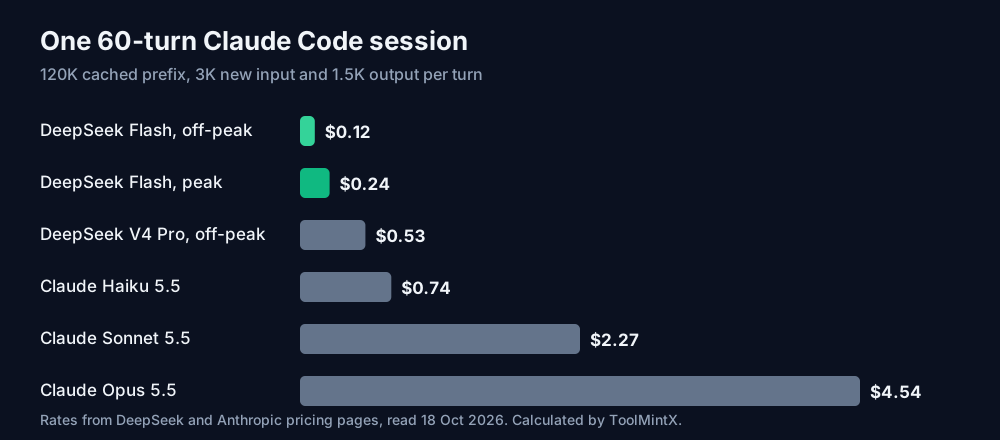
Sonnet 5.5 costs 18.9 times Flash off-peak on this session. Four sessions a workday for 20 days comes to $9.62 a month on Flash off-peak, $19.24 if every one runs at peak, and $181.44 on Sonnet 5.5. Moving the long runs out of the 11:30 to 15:30 slot halves the DeepSeek line and nothing else changes.
Unlike Anthropic, the output line is the biggest item on Flash. Cache reads at $0.003 are close to free, so on DeepSeek a model that writes less saves more than a better cache hit rate would. DeepSeek says the 1017 update cut output length, which is the one claim here that would lower your bill directly. Measure it on your own tasks before counting on it.
Two things can push these numbers up. The table assumes every turn after the first hits the cache. The cache only hits when a request fully matches a stored prefix unit, so a system prompt that changes between turns (a timestamp, say) means misses at $0.15 or $0.30. Without any cache hits the same session costs $1.16 off-peak and $2.32 at peak. And CLAUDE_CODE_EFFORT_LEVEL=max from DeepSeek's setup makes the model think longer, so expect more output tokens than a lower effort setting would give.
To rerun this with your own turn counts, the API Cost Calculator has DeepSeek Flash and V4 Pro with their cache rates.
Where the Anthropic compatibility stops
The compatibility page lists what the endpoint accepts. The gaps a Claude Code or SDK user runs into:
cache_controlis ignored everywhere. Caching happens automatically on disk, so the cache breakpoints you set for Anthropic do nothing here, and they don't break anything either.thinkingworks butbudget_tokensis ignored. Use effort instead:output_configaccepts onlyeffort.mcp_servers(Anthropic's server-side MCP connector) is ignored, andmcp_tool_useandmcp_tool_resultblocks aren't supported.documentcontent blocks aren't supported, so PDFs sent as documents fail. Images work: base64, URL, or a Files API reference.top_k,service_tier,containerandanthropic-versionare ignored.disable_parallel_tool_useis ignored too, so the model may call several tools at once whatever you set.is_erroron a tool result is ignored. If your harness relies on that flag to tell the model a tool failed, put the error in the result text.- Temperature accepts 0.0 to 2.0.
Any model name that doesn't start with claude and isn't a DeepSeek name returns a 400.
Web search billing from 31 October
DeepSeek opened its own Search and Fetch APIs on 17 October at $0.75 per 1,000 successful requests each. When Claude Code, Codex or DeepSeek Harness runs a web search through the DeepSeek API, it uses those endpoints. That's free for now. Billing starts at 16:00 UTC on 31 October 2026, which is 21:30 IST.
At that rate, 30 searches in a session cost $0.0225. That's small next to the $0.12 session, but the model also reads and summarises each result, and DeepSeek's Claude Code page says those summaries are extra LLM requests billed as tokens. A search-heavy session costs more in tokens than in search fees.
FAQ
Do I need to change the model name after the 1017 update?
No. deepseek-flash now serves DeepSeek-V4.1-Flash-1017, and the older deepseek-v4-flash names are routed to it at the same price.
Is 01:00 UTC peak on Saturday? No. Peak hours apply Monday to Friday only. All of Saturday and Sunday bills off-peak.
Can I run V4.1 Flash 1017 locally? Not on a normal GPU. The Hugging Face repo holds 763B parameters across 48 safetensors shards. Our AI VRAM Calculator shows what a model that size needs. For a single machine, a small open model is the realistic option.
Does it work with Codex too? There's a separate Codex integration page, and the API supports the Responses API. This post only covers the Claude Code setup.
Sources
- DeepSeek API Docs, Models & Pricing (api-docs.deepseek.com/quick_start/pricing, read 18 October 2026): model version, context, max output, features, peak and off-peak rates, peak hours, legacy names, Search and Fetch prices.
- DeepSeek API Docs, Change Log (api-docs.deepseek.com/updates), 17 October 2026 entry: 1017 update, unchanged pricing, benchmark list, Search API launch.
- DeepSeek API Docs, news post "DeepSeek-V4.1-Flash-1017" (api-docs.deepseek.com/news/news261017): Search and Fetch billing start of 31 October 2026, 16:00 UTC, open weights links.
- DeepSeek API Docs, Integrate with Claude Code (api-docs.deepseek.com/quick_start/agent_integrations/claude_code): environment variables, model mapping, web search token note.
- DeepSeek API Docs, Using the Anthropic API (api-docs.deepseek.com/guides/anthropic_api): field-by-field compatibility table.
- DeepSeek API Docs, Context Caching (api-docs.deepseek.com/guides/kv_cache): prefix-unit hit rules.
- Hugging Face,
deepseek-ai/DeepSeek-V4.1-Flash-1017model card and repository metadata: benchmark table, MIT license, parameter count, shard count. - Anthropic, Claude pricing (platform.claude.com/docs/en/about-claude/pricing, read 18 October 2026): Haiku 5.5, Sonnet 5.5 and Opus 5.5 rates.
- Session costs, monthly totals, IST conversions and ratios are calculated by ToolMintX from those sources.