Thinking Machines Lab released Inkling 2 Mini on 20 November 2026 under Apache 2.0. It's a 26.4B-parameter MoE with 3.4B active per token, image input, a 1M-token window, and a recommended Unsloth quant of 17.63 GB. On the lab's own benchmark table it ties or beats Qwen3.8-27B on most coding rows, which makes it the obvious thing to try on a 24 GB card this weekend.
Most VRAM estimates for it will be wrong by a factor of two on the KV cache. The model runs its middle 12 layers three times, and each pass keeps its own cache. Below is the memory math from config.json, what fits on 16, 24 and 32 GB, and the commands to run it.
Table of contents
- How the loop works
- Where the KV cache goes
- Quant sizes next to Qwen3.8-27B
- Context that fits on 16, 24 and 32 GB
- Benchmarks and the agent warnings
- Running it with llama.cpp or vLLM
- FAQ
- Sources
How the loop works
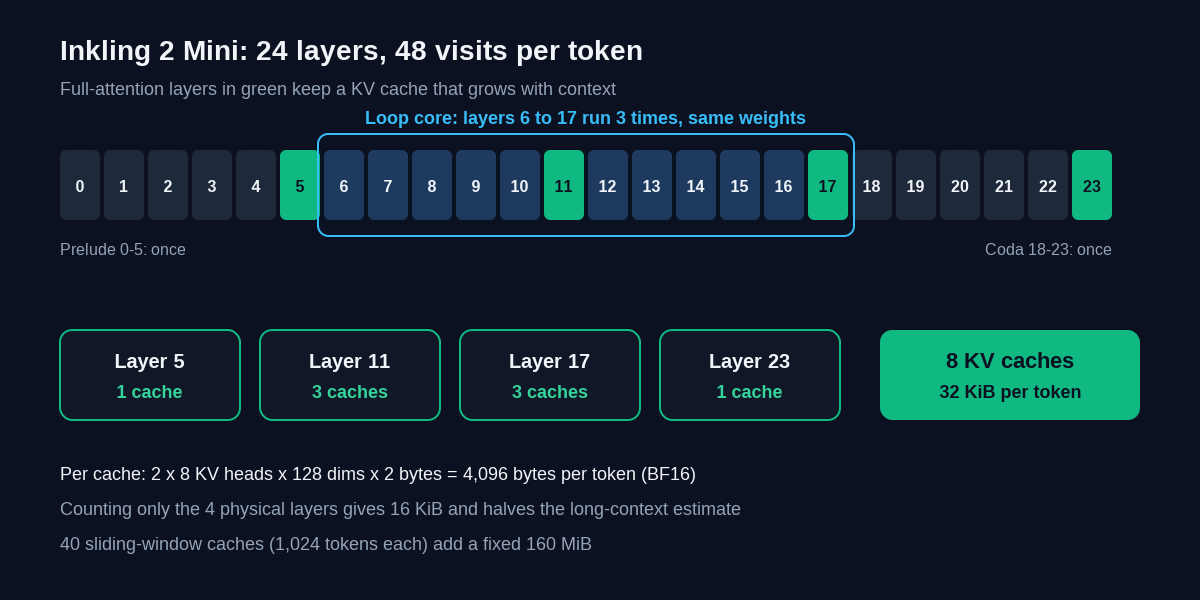
The text decoder has 24 physical layers. Layers 0 to 5 run once, layers 6 to 17 run three times with the same weights, and layers 18 to 23 run once. Every token makes 48 layer visits from 24 layers of stored weights. From the second pass on, each looped layer reads a message from the previous pass through a gated rank-64 controller, so later passes refine earlier ones instead of starting cold.
The model card puts the cost of this at about 1.0B extra effective active parameters per extra pass. Three passes take the 3.4B active count to 5.4B effective. Each layer routes a token to 8 of 128 experts. Hidden size is 2,304, and every attention layer has 24 query heads and 8 KV heads of 128 dimensions.
Attention is mostly local. Each six-layer block has five sliding-window layers with a 1,024-token window and one full-attention layer. In the config, the full-attention layers are 5, 11, 17 and 23.
Where the KV cache goes
Two of the four full-attention layers, 11 and 17, sit inside the loop. The vLLM recipe spells out what that means: every core layer keeps a KV cache and a conv-state cache per pass, 48 of each in total. So the cache that grows with context isn't four layers deep. It's eight:
- layer 5 once, layer 23 once
- layer 11 three times, layer 17 three times
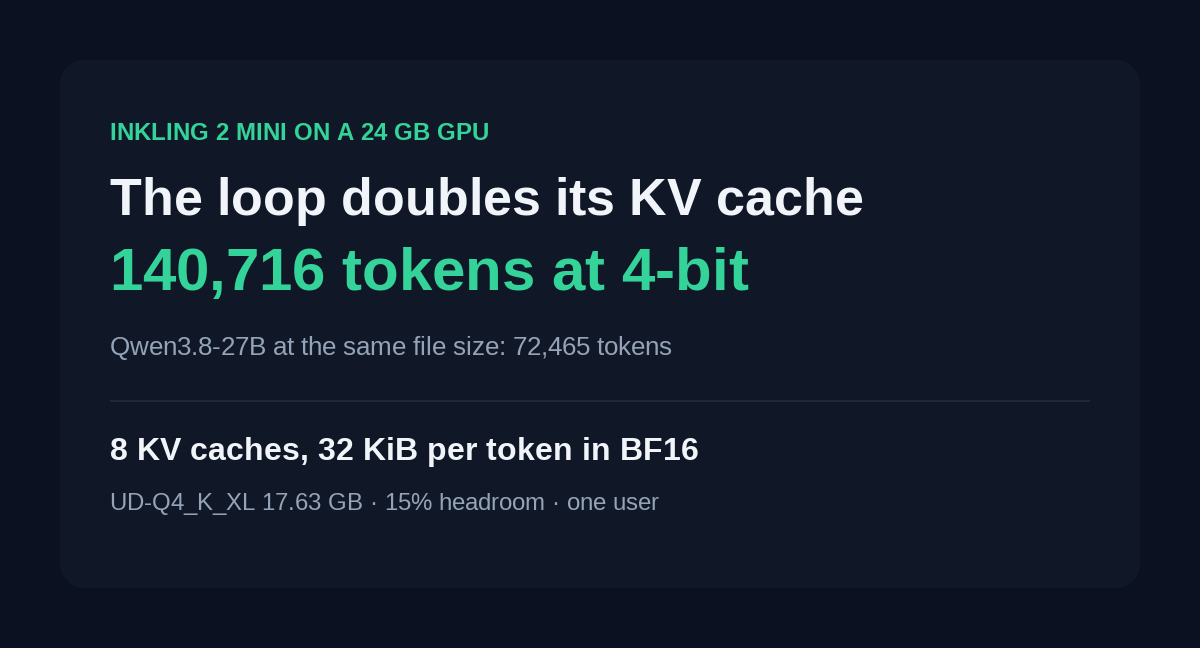
Per layer, one token costs 2 (K and V) x 8 heads x 128 dims x 2 bytes = 4,096 bytes in BF16. Eight caches make 32 KiB per token. If you count the four global layers and stop, you get 16 KiB and underestimate long-context memory by half. At 262,144 tokens the real figure is 8 GiB, and at the full 1,048,576 it's 32 GiB.
The 40 sliding-window caches (20 layers, 12 of them looped, 40 instances) never hold more than 1,024 tokens. Together they take a fixed 160 MiB no matter how long the prompt gets.
Qwen3.8-27B, the model Thinking Machines compares against, keeps KV on 16 of its 64 layers with 4 KV heads of 256 dimensions. That's 64 KiB per token, twice Inkling 2 Mini's. Even with the loop doubling its cache, Mini is the lighter model on long prompts.
Quant sizes next to Qwen3.8-27B
Unsloth's GGUF repo sizes, in decimal GB as Hugging Face lists them:
| Quant | Inkling 2 Mini | Qwen3.8-27B |
|---|---|---|
| UD-Q3_K_XL | 13.63 GB | 13.15 GB |
| UD-Q4_K_XL | 17.63 GB | 17.66 GB |
| UD-Q8_K_XL | 22.87 GB | 31.46 GB |
At 4 bits the two files are almost the same size. At 8 bits Mini is 8.59 GB smaller, because Thinking Machines ships the expert weights in NVFP4 and Unsloth's "full precision" build keeps them at 4 bits. Only the non-expert weights go up to BF16. Unsloth measures UD-Q4_K_XL at 0.0107 mean KL divergence and 98.0% top-token agreement against UD-Q8_K_XL, so the 4-bit file gives up very little.
The vision projector mmproj-F16.gguf adds 639 MB if you want image input. The DSpark drafter used for speculative decoding is a separate 402 MB file.
Here's what each model needs at a 32K context, text only, before any runtime overhead:
| Quant | Inkling 2 Mini | Qwen3.8-27B |
|---|---|---|
| UD-Q3_K_XL | 13.85 GiB | 14.24 GiB |
| UD-Q4_K_XL | 17.58 GiB | 18.45 GiB |
| UD-Q8_K_XL | 22.45 GiB | 31.30 GiB |
Context that fits on 16, 24 and 32 GB
The numbers below use the same rule as the GPU panel in our AI VRAM calculator: the GGUF file, the 160 MiB window cache and the KV cache must fit in the card's memory with 15% left over for CUDA buffers and the desktop. KV is BF16, one user.
| Card | Quant | Inkling 2 Mini | Qwen3.8-27B |
|---|---|---|---|
| 16 GB | UD-Q3_K_XL | 34,773 tokens | 27,353 tokens |
| 24 GB | UD-Q4_K_XL | 140,716 tokens | 72,465 tokens |
| 24 GB | UD-Q3_K_XL | 262,725 tokens | 141,328 tokens |
| 32 GB | UD-Q4_K_XL | 368,667 tokens | 186,441 tokens |
| 32 GB | UD-Q8_K_XL | 208,825 tokens | does not fit |
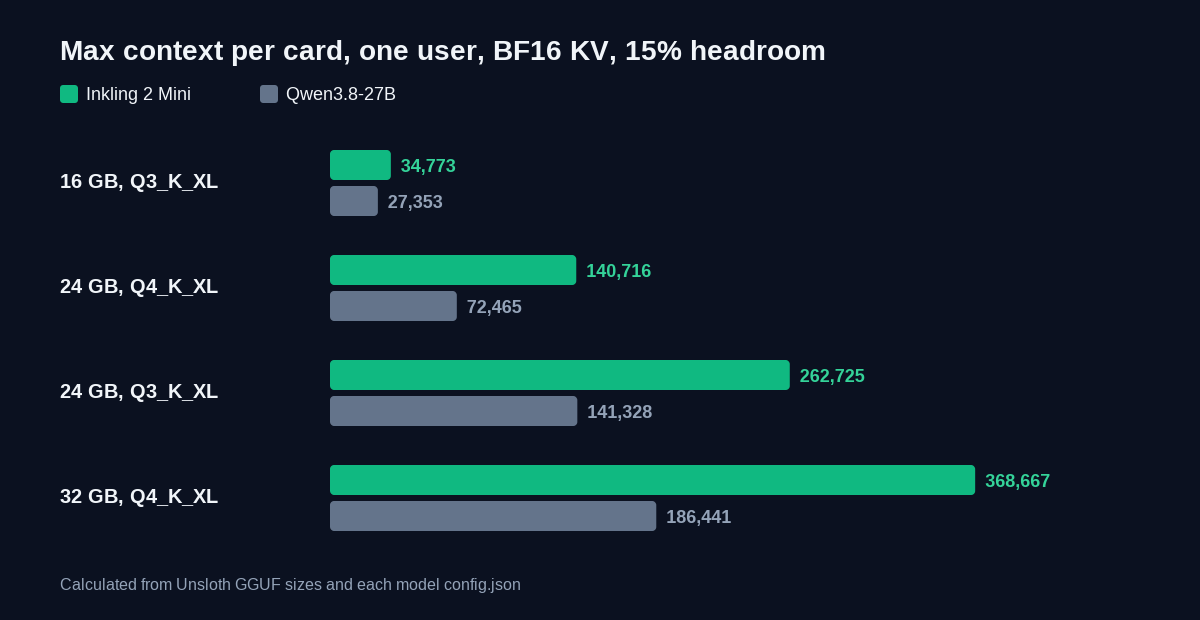
On a 24 GB RTX 4090 or 3090, the recommended 4-bit build holds about 140K tokens, close to double what Qwen3.8-27B leaves you at the same file size. That's the headroom an agent session with a big repo map needs. A 16 GB card works with the 3-bit file at around 32K, which is also the context Unsloth's own example uses.
Unsloth lists 24 GB for the 8-bit build. With our 15% margin it doesn't fit on a 24 GB card at all, and without the margin it needs 22.45 GiB at 32K, so it only works with nothing else on the GPU. Use the 4-bit file there.
The calculator's preset list now includes Inkling 2 Mini with the eight KV layers counted. Its weight estimate uses average bits per weight: 14.91 GiB for Q4_K_M, against a real 15.47 GiB file. For 8-bit, it's off the other way (26.12 GiB estimated, 21.30 GiB real) because of the NVFP4 experts. For this model, trust the file size and use the calculator for the KV side.
Benchmarks and the agent warnings
All of these come from Thinking Machines' model card, run on its own harnesses. Nobody outside the lab has reproduced them yet.
| Benchmark | Inkling 2 Mini | Qwen3.8-27B |
|---|---|---|
| SWE-bench Verified (bash only) | 79.2% | 77.8% |
| DeepSWE v1.1 | 48.2% | 42.2% |
| Terminal Bench v2.1 | 71.6% | 73.0% |
| MCP Atlas | 82.7% | 77.3% |
| AutomationBench-AA | 41.8% | 48.2% |
| AA-Omniscience non-hallucination | 63.4% | 71.4% |
| Destructive actions (internal, lower is better) | 10.2% | 35.2% |
Mini wins most coding and tool-use rows. It loses Terminal Bench v2.1 and AutomationBench-AA, and it trails on factual recall. The card is blunt about the limits. It says the model can get stuck in long reasoning loops while debugging, and that it "may take destructive actions, such as deleting or overwriting files, without confirmation". Thinking Machines recommends limits on output tokens and agent turns, plus a sandbox for agent work.
If you plug it into Claude Code, Codex or Hermes Agent through a local OpenAI-compatible endpoint, keep the agent's approval prompts on for deletes and git operations. Setting reasoning effort to none doesn't fully turn reasoning off, according to the card, so cap max_tokens as well.
Running it with llama.cpp or vLLM
Upstream llama.cpp doesn't support the looped architecture yet. Unsloth ships a build, b12568-mix-8eebad4, that does. For NVIDIA on Linux:
curl -L -o llama.tar.gz https://github.com/unslothai/llama.cpp/releases/download/b12568-mix-8eebad4/app-b12568-mix-8eebad4-linux-x64-cuda12-portable.tar.gz
mkdir -p llama.cpp
tar -xzf llama.tar.gz -C llama.cpp
pip install -U huggingface_hub
hf download unsloth/Inkling-2-Mini-GGUF Inkling-2-Mini-UD-Q4_K_XL.gguf --local-dir Inkling-2-Mini-GGUF
Then start the server. This is Unsloth's command without the vision projector, with the context raised to 131,072 for a 24 GB card:
./llama.cpp/llama-server \
    --model Inkling-2-Mini-GGUF/Inkling-2-Mini-UD-Q4_K_XL.gguf \
    --jinja --ctx-size 131072 --n-gpu-layers 99 --parallel 1 \
    --temp 1.0 --top-p 1.0 --top-k 0 --min-p 0.0 \
    --host 127.0.0.1 --port 8080
Start at Unsloth's 32,768 if you're on 16 GB. Keep --parallel 1 unless you need more slots, since each extra slot reserves its own KV cache. The release page also has macOS, ROCm, Windows and DGX Spark builds. Unsloth Desktop can download and serve the same GGUF with unsloth run --model unsloth/Inkling-2-Mini-GGUF:UD-Q4_K_XL. Our Unsloth vs Ollama post covers where that app overlaps with Ollama.
For a server GPU, vLLM needs its vllm/vllm-openai:inkling-2-mini image until support lands in a release:
vllm serve thinkingmachines/Inkling-2-Mini \
  --tensor-parallel-size 1 \
  --reasoning-parser inkling \
  --speculative-config '{"method":"dspark","num_speculative_tokens":7,"draft_sample_method":"probabilistic"}'
The recipe caps context at 262,144 tokens on H100 and DGX Spark. On one GB200 it serves the full 1M window and reports about 45, 32 and 20 concurrent sessions at 32K, 64K and 128K tokens, each at 100 tokens per second.
There's no pay-per-token API for Mini yet. Thinking Machines' Tinker page lists serverless inference for Inkling 2 Small, Inkling and Inkling-Small only. If you'd rather pay per token for the bigger sibling, our Inkling 2 Small cost comparison has the Together and Cloudflare rates.
FAQ
Does Ollama run Inkling 2 Mini?
The model card lists Ollama on Apple silicon only. On Windows and Linux with an NVIDIA card, use Unsloth's llama.cpp build or Unsloth Desktop until upstream llama.cpp merges support.
Can I run it on a Mac?
Yes. Thinking Machines supports Apple silicon with 32 GB or more of memory, through MLX, Ollama, Exo or Unsloth's macOS llama.cpp build. The card notes that looped-model support in local runtimes is new and speed varies by runtime.
What sampling settings does it want?
Unsloth recommends temperature 1.0, top-p 1.0, top-k 0 and min-p 0.0. Reasoning effort defaults to high (0.9) and goes from none (0.0) to max (0.99).
Sources
- Hugging Face,
thinkingmachines/Inkling-2-Minimodel card,config.jsonand file list (read 21 November 2026): release date, license, parameter counts, loop layout, attention layers, KV heads, head size, hardware support, runtime list, benchmark table, limitations. - Unsloth, Inkling 2 Mini run-locally guide (unsloth.ai/docs/models/inkling-2-mini, read 21 November 2026): llama.cpp build tag, commands, hardware table, sampling settings, KL divergence table.
- Hugging Face,
unsloth/Inkling-2-Mini-GGUFandunsloth/Qwen3.8-27B-GGUFfile lists (read 21 November 2026): GGUF, mmproj and DSpark file sizes. - Hugging Face blog, Inkling 2 Mini (hf.co/blog/inkling2mini, read 21 November 2026): per-pass KV and conv state, cross-pass messages, reasoning-effort levels.
- vLLM Recipes,
thinkingmachines/Inkling-2-Mini(recipes.vllm.ai, updated 20 November 2026): 48 per-pass caches, serve command, context caps, GB200 session counts. - Thinking Machines, Tinker page (thinkingmachines.ai/tinker, read 21 November 2026): serverless inference model list.
- Qwen3.8-27B KV layout from the ToolMintX VRAM calculator preset, taken from the Qwen repo's
config.json. - KV per token, window cache, memory at 32K and max-context figures are calculated by ToolMintX from the values above.