Thinking Machines Lab released Inkling 2 Small on 4 November 2026: open weights under Apache 2.0, 594B total parameters with 17B active, text and image input, and a 1M-token context window. Nobody runs that at home. The model card asks for at least 500 GB of aggregated VRAM for the NVFP4 checkpoint, so almost everyone will call it through a hosted API.
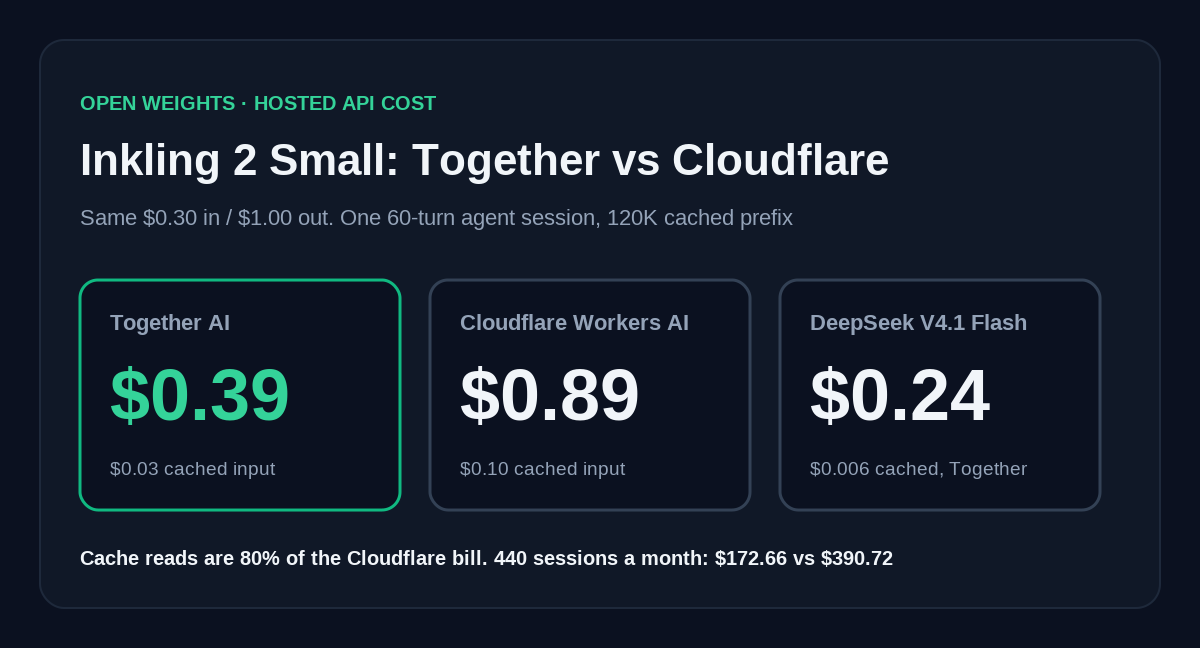
Two of the hosts on the model card, Together AI and Cloudflare Workers AI, list the same headline rate: $0.30 per million input tokens and $1.00 per million output tokens. The cached-input line is where they split. Together charges $0.03 per million cached tokens and Cloudflare charges $0.10. An agent spends most of its input on cache reads, so that one line more than doubles the bill.
I costed our standard 60-turn agent session on both hosts, added DeepSeek V4.1 Flash 1017 on Together as the cheapest comparable open model, and listed the request settings that keep the cache hitting.
Table of contents
- Rate cards on Together and Cloudflare
- One agent session on each host
- Cache hit rate moves the gap
- Inkling 2 Small against DeepSeek V4.1 Flash
- Settings that break the cache
- Running it yourself
- FAQ
- Sources
Rate cards on Together and Cloudflare
Per million tokens, read from each provider's model page on 15 November 2026.
| Host | Model ID | Input | Cached input | Output |
|---|---|---|---|---|
| Together AI | thinkingmachines/Inkling-2-Small | $0.30 | $0.03 | $1.00 |
| Cloudflare Workers AI | @cf/thinkingmachines/inkling-2-small | $0.30 | $0.10 | $1.00 |
| Together AI (for comparison) | deepseek-ai/DeepSeek-V4.1-Flash-1017 | $0.30 | $0.006 | $1.20 |
Together's cached rate is a 90% discount on input. Cloudflare's is 67%. Neither host lists a cache-write fee, so the first pass over a prompt bills at the plain input rate.
Cloudflare also puts the model behind its paid plan. The model page says it isn't available on Workers Free billing, so you need Workers Paid or prepaid AI Gateway credits before the first request works. The same page says 18B active parameters where the model card and Together say 17B. The price doesn't depend on it, but don't copy the number from Cloudflare into a comparison table.
One agent session on each host
This is the session from every agent-cost post on this site, so the numbers compare directly with the Gemini 4 Hydrogen vs 3.8 Flash post:
- 60 turns
- a 120,000-token prefix (system prompt, tool schemas, files), sent once and read from cache on the other 59 turns
- 3,000 new input tokens per turn
- 1,500 output tokens per turn, reasoning included
That is 7.08 million cached tokens, 180,000 new input tokens and 90,000 output tokens for the session.
| Line | Inkling on Together | Inkling on Cloudflare | DeepSeek V4.1 Flash 1017 on Together |
|---|---|---|---|
| Prefix pass (120K) | $0.036 | $0.036 | $0.036 |
| Cache reads (7.08M) | $0.2124 | $0.708 | $0.0425 |
| New input (180K) | $0.054 | $0.054 | $0.054 |
| Output (90K) | $0.09 | $0.09 | $0.108 |
| Session | $0.39 | $0.89 | $0.24 |
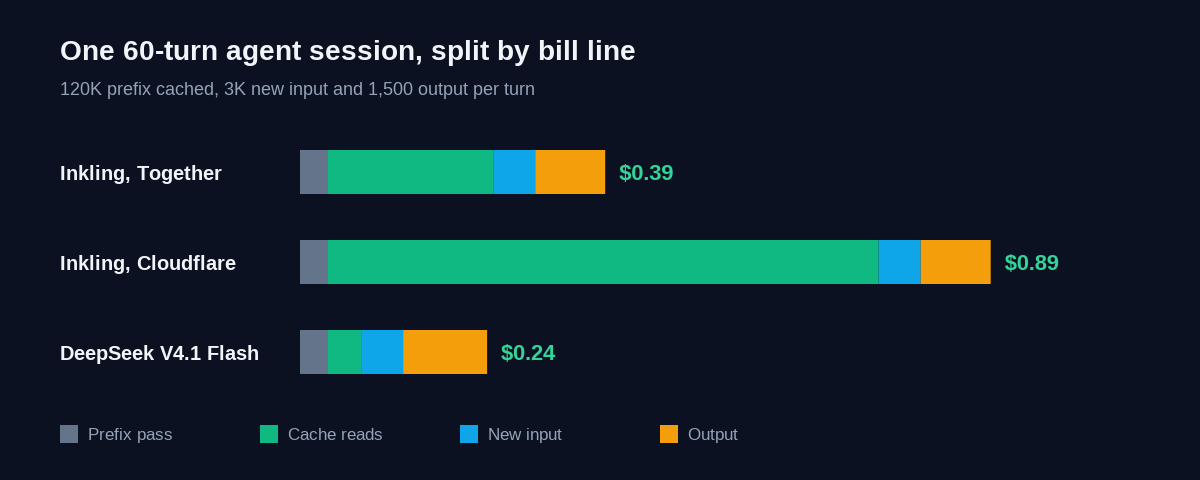
On Cloudflare the cache-read line is $0.708 of an $0.888 session, 80% of the bill. On Together the same line is $0.21. Every other row is identical, so the whole $0.50 difference per session comes from one price.
At 440 sessions a month (20 a day, 22 working days) that's $172.66 on Together and $390.72 on Cloudflare. DeepSeek V4.1 Flash 1017 on Together comes to $105.81.
Cache hit rate moves the gap
The table assumes every one of those 7.08 million prefix tokens is served from cache. Real agents miss sometimes: an eviction, a request routed to a different machine, a tool list that changed order. Every missed token bills at $0.30 on both hosts.
| Share of prefix served from cache | Together | Cloudflare | DeepSeek V4.1 Flash 1017 |
|---|---|---|---|
| 100% | $0.39 | $0.89 | $0.24 |
| 90% | $0.58 | $1.03 | $0.45 |
| 75% | $0.87 | $1.24 | $0.76 |
| 50% | $1.35 | $1.60 | $1.28 |
| 0% | $2.30 | $2.30 | $2.32 |
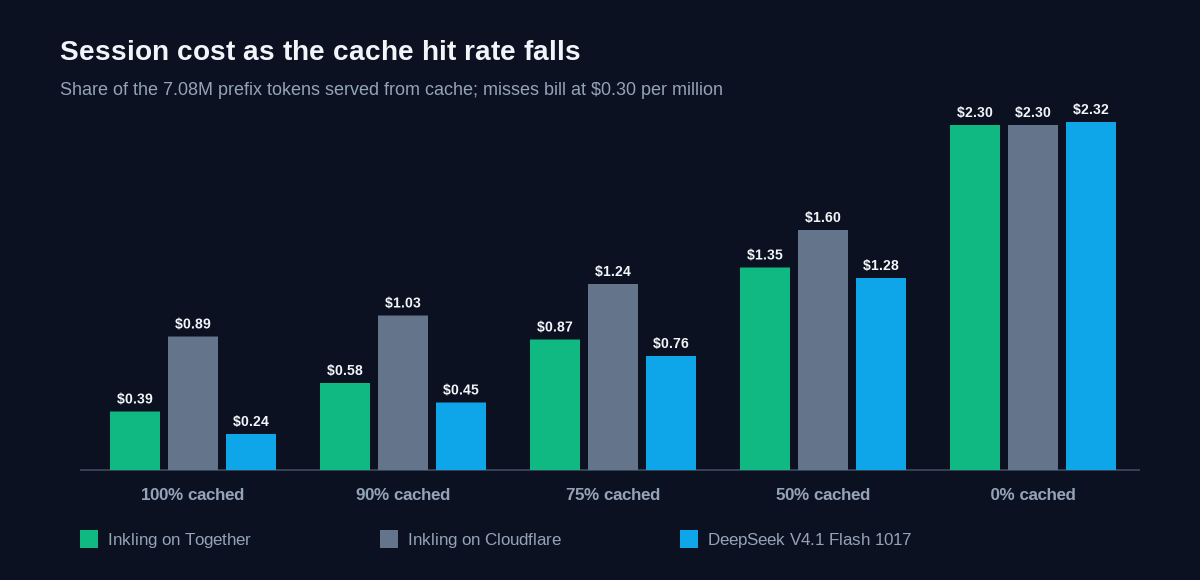
Two things fall out of this. A 10-point drop in hit rate costs more on Together (+$0.19) than on Cloudflare (+$0.14), because Together's discount is bigger. And with zero cache hits the three setups cost about the same, around $2.30. The price list only decides the bill when caching works, so the request settings below are worth more than the choice of host.
You can rerun this with your own token counts in the API cost calculator, which now lists Inkling 2 Small at both Together and Cloudflare rates.
Inkling 2 Small against DeepSeek V4.1 Flash
DeepSeek V4.1 Flash 1017 is $0.15 cheaper per session on Together, mostly because its cached input is $0.006. Inkling's own model card compares the two directly, which gives a fair way to ask what the extra $0.15 buys. These are the vendor's numbers, with the harness the card names.
| Benchmark | Inkling 2 Small | DeepSeek V4.1 Flash 1017 |
|---|---|---|
| DeepSWE v1.1 (mini-swe-agent) | 72.1% | 77.0% |
| Terminal Bench Science v0.1 | 5.7% | 12.9% |
| SWE-Atlas v1.1 | 61.9% | 62.1% |
| BrowseComp (with compaction) | 90.2% | 87.8% |
| MCP Atlas, public set | 85.0% | 83.2% |
| JobBench | 70.5% | 68.5% |
| PerceptionBench | 64.7% | 47.7% |
| ScreenSpot Pro, original | 83.8% | not listed |
For a coding agent, DeepSeek wins on the card's own coding rows and costs less. Inkling is ahead on browsing, MCP tool use and especially vision: 17 points on PerceptionBench. If your agent reads screenshots, PDFs rendered as images or UI state, Inkling is the one to test. If it edits code in a terminal, the cheaper model also scores higher.
Settings that break the cache
Both hosts cache automatically on matching prefixes. Neither gives you a cache ID or an expiry setting. What you control is whether the next request starts with exactly the same tokens.
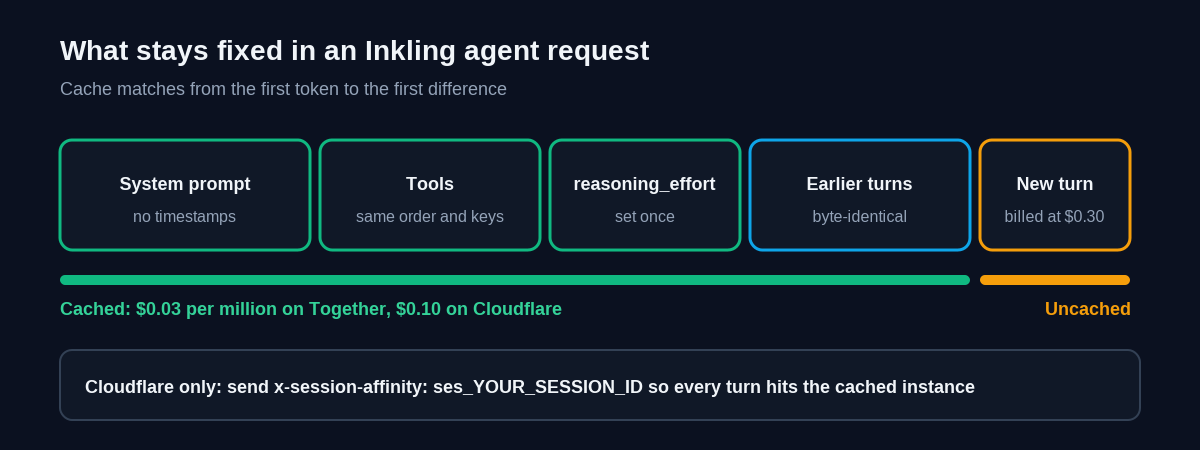
- On Cloudflare, send
x-session-affinity. Cloudflare's prompt-caching page says a cache hit needs the request to land on the same model instance, and the header with a stable session ID is how you get that. Without it, the 100% row above is optimistic. - Pick
reasoning_effortonce per conversation. Together's caching docs listreasoningandreasoning_effortamong the settings the chat template renders into the prompt. Changing effort mid-session changes the prefix, so the next turn re-bills the whole history at $0.30. - Keep tool definitions identical. Same names, descriptions, schema key order and tool order on every request. A JSON formatter with sorted keys is a quick way to diff two tool payloads that look the same.
- No timestamps in the system prompt. Put the date in the latest user message instead. Both providers call this out.
- Append, don't summarize. Compacting history rewrites the prefix from the first edited message. Do it rarely, and expect the turn after a compaction to cost more.
- Mind idle time on Together. Its docs say entries typically last about an hour on a best-effort basis and can be evicted sooner under load. An agent paused over lunch starts cold.
Cloudflare's model page lists reasoning levels none, minimal, low, medium, high (the default) and max. Output bills at $1.00 on both hosts and reasoning counts as output, so dropping from high saves less here than on models with $7.50 output. At 1,500 output tokens per turn, the 90,000-token output line is only $0.09.
A Together request with the settings pinned:
from together import Together

client = Together()  # reads TOGETHER_API_KEY from the environment

SYSTEM = open("agent_system_prompt.md").read()  # no dates in here
TOOLS = load_tools_sorted()  # same order and key order every call

resp = client.chat.completions.create(
    model="thinkingmachines/Inkling-2-Small",
    messages=[{"role": "system", "content": SYSTEM}, *history],
    tools=TOOLS,
    reasoning_effort="medium",  # set once, never change mid-session
)
print(resp.usage)  # check the cached token count after turn 2
On Cloudflare the same call goes through the OpenAI-compatible endpoint with an extra header, x-session-affinity: ses_YOUR_SESSION_ID, set to one value for the whole agent run.
Running it yourself
The NVFP4 checkpoint is 24 safetensors shards plus an MTP draft file, 393.5 GB in total (366.5 GiB). The MXFP8 checkpoint is 622.8 GB. Thinking Machines lists 2x B300 or 4x H200 for NVFP4 and 4x B300 or 8x H200 for MXFP8, with SGLang, vLLM, TokenSpeed and Unsloth recipes.
The KV cache is the small part. Of the 48 layers in config.json, 40 are local layers with a 1,024-token sliding window and 8 are global. With 8 KV heads of dimension 128, the global layers need 32 KiB per token in BF16, so a full 1M-token context adds about 32 GiB, and the sliding layers hold a fixed 160 MiB per sequence. That's my estimate from the config, before any extra state the custom attention keeps. Put the numbers into the AI VRAM calculator to see how many parallel sessions fit beside the weights.
Compare that with the API bill. At 440 sessions a month, Together charges $172.66. A 4x H200 node has to run all month to serve the same sessions, so self-hosting is for teams whose data rules forbid a hosted API, or whose traffic is many times that volume.
FAQ
Is Inkling 2 Small free anywhere?
OpenRouter lists a free inkling-2-small:free variant. Cloudflare's model page says the model needs Workers Paid or AI Gateway credits, and Together lists only paid serverless pricing.
Can I fine-tune it?
Yes. The weights are Apache 2.0. The model card points to Thinking Machines' Tinker service, plus Miles, SkyRL and Snowflake Cortex Training for post-training.
Does the 1M context cost extra?
Neither Together nor Cloudflare lists a long-context tier for Inkling 2 Small. Both price the full 1,048,576-token window at the same per-token rates.
Sources
- Thinking Machines Lab, Inkling 2 Small model card (huggingface.co/thinkingmachines/Inkling-2-Small, read 15 November 2026): 594B total / 17B active, 1M context, Apache 2.0, hardware requirements, inference and post-training frameworks, hosting providers, benchmark table.
- Inkling 2 Small
config.jsonand file listing on Hugging Face: 48 layers, 40 local layers with a 1,024-token window, 8 KV heads of 128, 384 experts with 8 per token, NVFP4 checkpoint size; MXFP8 checkpoint size from the Inkling-2-Small-MXFP8 repo. - Together AI, Inkling 2 Small model page (together.ai/models/inkling-2-small, read 15 November 2026): $0.30 input, $0.03 cached, $1.00 output, release date 4 November 2026.
- Together AI, DeepSeek V4.1 Flash 1017 model page (together.ai/models/deepseek-v4-1-flash-1017): $0.30 input, $0.006 cached, $1.20 output.
- Together AI, Prompt caching docs (docs.together.ai/docs/inference/chat/prompt-caching): automatic caching, about one-hour best-effort entries, reasoning settings rendered into the prefix.
- Cloudflare, Workers AI model page for inkling-2-small (developers.cloudflare.com/workers-ai/models/inkling-2-small, read 15 November 2026): $0.30 input, $0.10 cached, $1.00 output, reasoning levels, paid plan requirement.
- Cloudflare, Workers AI prompt caching docs (developers.cloudflare.com/workers-ai/features/prompt-caching):
x-session-affinityheader, prefix structuring advice. - Session, hit-rate, monthly and KV cache figures are calculated by ToolMintX from the rates and config above. Benchmarks are vendor-reported.