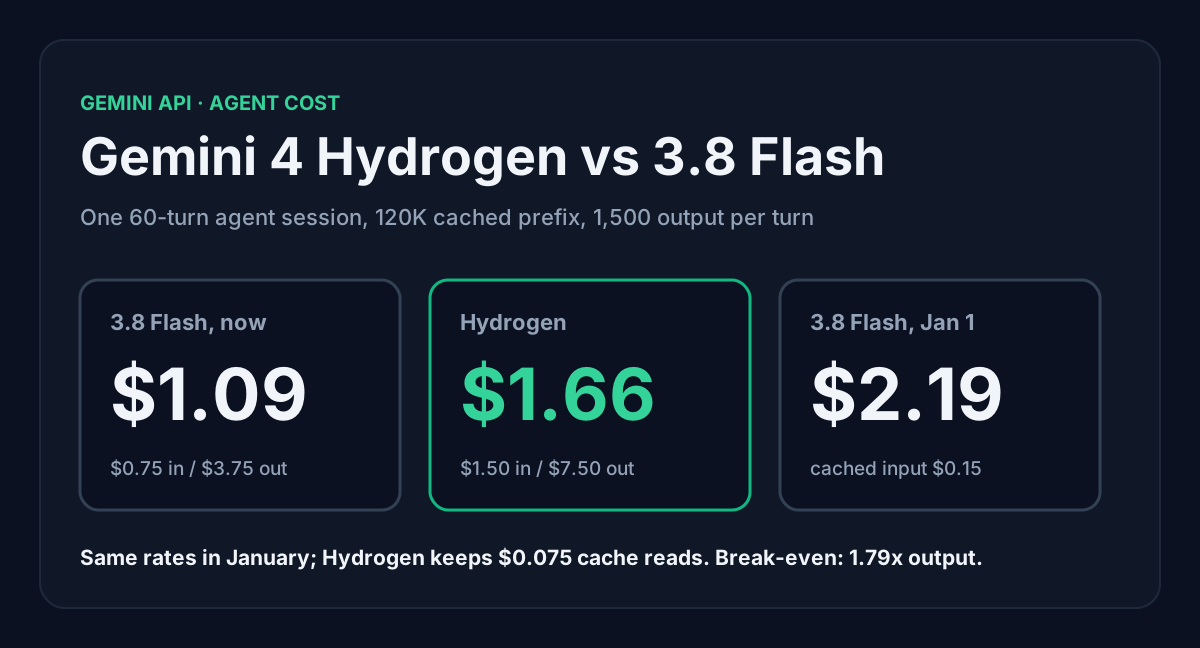
Google made Gemini 4 Hydrogen (gemini-4-hydrogen) generally available on 12 November 2026 and called it the "recommended upgrade from Gemini 3.8 Flash". On the paid tier it costs $1.50 per million input tokens, $0.075 for cached input and $7.50 for output, flat across the whole 1,048,576-token window.
Those are exactly the rates Gemini 3.8 Flash moves to on 1 January 2027. Until then Flash sits on an introductory $0.75 input and $3.75 output. So if you switch an agent today, your bill goes up. If you wait until January and stay on Flash, your bill goes up anyway, and Flash's cached input doubles to $0.15 while Hydrogen's stays at $0.075.
I costed our standard 60-turn agent session on both models, before and after the Flash price change, and worked out how much more Hydrogen can think before it loses its January lead.
Table of contents
- Hydrogen and 3.8 Flash rate cards
- One agent session, now and in January
- How much extra thinking Hydrogen can afford
- Hydrogen as the worker under Carbon
- What breaks when you change the model string
- FAQ
- Sources
Hydrogen and 3.8 Flash rate cards
Per million tokens on the paid tier, from Google's Gemini API pricing page, read 14 November 2026.
| Tier | Hydrogen input | Hydrogen cached | Hydrogen output | 3.8 Flash input | 3.8 Flash cached | 3.8 Flash output |
|---|---|---|---|---|---|---|
| Standard, through Dec 31 | $1.50 | $0.075 | $7.50 | $0.75 | $0.075 | $3.75 |
| Standard, from Jan 1, 2027 | $1.50 | $0.075 | $7.50 | $1.50 | $0.15 | $7.50 |
| Batch or Flex | $0.75 | $0.0375 | $3.75 | half of Standard | half of Standard | half of Standard |
| Priority | $2.70 | $0.135 | $13.50 |
Hydrogen has no end date on its table. It's also on the free tier, which Gemini 4 Carbon and Argon are not, and it has an invite-only Contributor tab at $0.75, $0.0375 and $3.75 where Google uses your prompts to improve its products.
The cached column hides a second difference. Flash supports explicit caching, and its pricing row adds a storage fee of $0.50 per million tokens per hour through December and $1.00 from January. Hydrogen has implicit caching only, with no storage fee, so there's nothing to keep warm and nothing to pay for idle time.
One agent session, now and in January
This is the session we use in every agent-cost post, so the numbers line up with the Gemini 4 Carbon vs Argon post:
- 60 turns
- a 120,000-token prefix (system prompt, tool schemas, files), sent once and read from cache on the other 59 turns
- 3,000 new input tokens per turn
- 1,500 output tokens per turn, thinking included
| Model | Prefix pass | Cache reads | New input | Output | Session |
|---|---|---|---|---|---|
| 3.8 Flash, through Dec 31 | $0.09 | $0.531 | $0.135 | $0.3375 | $1.09 |
| Hydrogen | $0.18 | $0.531 | $0.27 | $0.675 | $1.66 |
| 3.8 Flash, from Jan 1 | $0.18 | $1.062 | $0.27 | $0.675 | $2.19 |
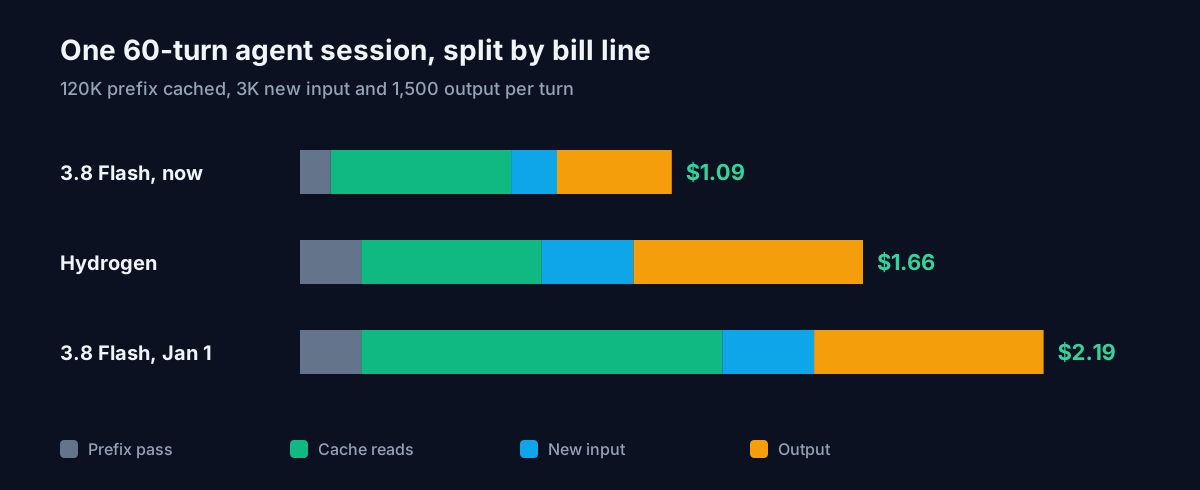
Right now Hydrogen costs 1.51 times what Flash does, because every line except cache reads is doubled. In January the order flips. Hydrogen and Flash then share input and output rates, and the whole $0.53 gap is the cache-read line, which makes up 32% of Hydrogen's session.
At 440 sessions a month (20 a day, 22 working days), that's $481.14 on Flash in December, $728.64 on Hydrogen, and $962.28 on Flash in January.
So the decision for most teams is timing. If Flash works for you, keep it through December and save about $247 a month at this volume. Switch before 1 January, after you've tested Hydrogen on your own tasks.
How much extra thinking Hydrogen can afford
The table above assumes both models write 1,500 output tokens per turn. That's unlikely. Hydrogen defaults to thinking_level: "high" while 3.8 Flash defaults to medium, and thinking tokens bill at the output rate.
Google doesn't publish a token ratio, so here's Hydrogen at higher output against January Flash at 1,500:
| Hydrogen output per turn | Hydrogen session | vs Flash from Jan 1 ($2.19) |
|---|---|---|
| 1,500 (1x) | $1.66 | $0.53 cheaper |
| 1,875 (1.25x) | $1.82 | $0.36 cheaper |
| 2,250 (1.5x) | $1.99 | $0.19 cheaper |
| 2,680 (1.79x) | $2.19 | break-even |
| 3,000 (2x) | $2.33 | $0.14 more |
Hydrogen can write up to 2,680 output tokens per turn, 1.79 times Flash, and still match January Flash. Past that, the cache-read saving is gone.
There's a cheaper fix than switching back. Set thinking_level to medium, which is the level Flash was running at, and run your eval set on both. Google's own advice is to test all four levels and keep the lowest one that meets your quality bar.
You can measure your own ratio from the response's usage.total_thought_tokens field. Average it over 20 tasks per model and plug the totals into the API cost calculator, which lists Hydrogen and both Flash price periods.
Hydrogen as the worker under Carbon
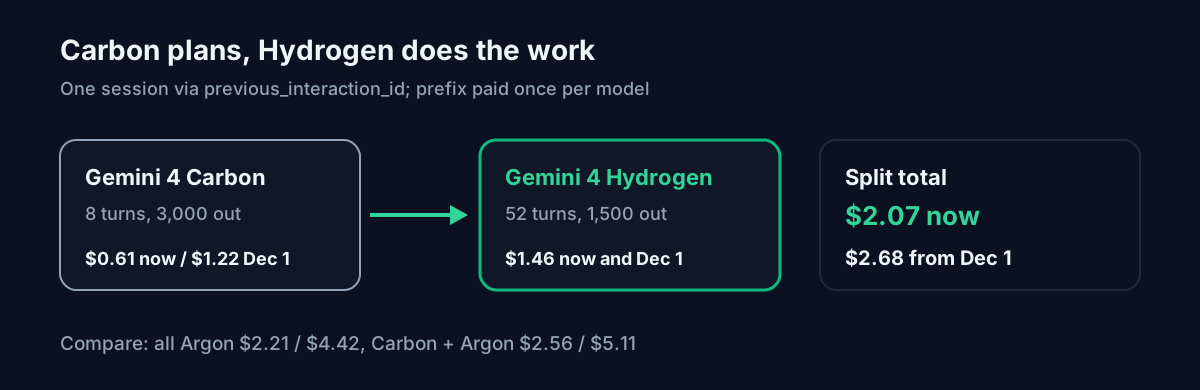
Google's migration notes suggest a pairing: let Gemini 4 Carbon plan system interfaces or resolve hard roadblocks, then hand code edits, parallel subagent tasks and test runs to Hydrogen, in one session via previous_interaction_id. The Carbon post costed the same idea with Argon as the worker. Here is the Hydrogen version, with Carbon taking 8 turns at 3,000 output tokens and Hydrogen the other 52 at 1,500.
| Setup | Through Nov 30 | From Dec 1 |
|---|---|---|
| All Argon, 60 turns | $2.21 | $4.42 |
| Carbon 8 turns + Argon 52 turns | $2.56 | $5.11 |
| Carbon 8 turns + Hydrogen 52 turns | $2.07 | $2.68 |
| All Carbon at 2x output, 60 turns | $3.11 | $6.22 |
The Carbon slice costs $0.61 now and $1.22 from December. The Hydrogen slice is $1.46 in both columns, because Hydrogen's rate has no December step. That's why the gap widens so much on 1 December, when Carbon and Argon double.
As in the Argon version, the split pays the 120K prefix twice. Google's caching page gives the 4,096-token implicit minimum and the 95% discount but says nothing about a cache entry carrying across models, so I assumed Hydrogen starts cold.
What breaks when you change the model string
Google's checklist for moving from gemini-3.8-flash lists several changes. These are the ones that either change the bill or fail at runtime:
minimalthinking returns an error. Hydrogen acceptslow,medium,high(default) and the newxhigh. Flash didn't supportminimaleither, but code shared with Gemini 3.6 Flash or Flash-Lite often sends it.- Explicit caching is gone. Remove
cached_contentfields and anycaches.createcalls. Implicit caching kicks in on prompts of at least 4,096 tokens. - Sampling parameters are ignored or rejected. Hydrogen ignores in-range
temperature,top_pandtop_kand returns a400for out-of-range values. - The context window is shared. Flash had a 1M input budget and a separate 64K output budget. Hydrogen fits input, thinking and output in one 1,048,576-token window, with a 65,536-token cap per synchronous request. Raise hardcoded caps such as 8,192 to 65,536, because thinking eats into the same number.
- Raw-text tool calls fail. Prompting the model to emit JSON tool calls with no tools declared can return
MALFORMED_FUNCTION_CALL. Declare tools through function calling or use structured outputs.
If you hit a malformed tool payload while debugging step 5, the JSON formatter shows where the structure breaks.
A request with the cost controls set explicitly:
from google import genai

client = genai.Client()  # reads GEMINI_API_KEY from the environment
interaction = client.interactions.create(
    model="gemini-4-hydrogen",
    input="Fix the failing test in tests/test_retry.py and run the suite",
    generation_config={
        "thinking_level": "medium",   # Hydrogen defaults to "high"
        "max_output_tokens": 65536,   # thinking + answer share this cap
    },
)
print(interaction.output_text)
print(interaction.usage.total_thought_tokens)
FAQ
Is Gemini 4 Hydrogen free to use?
Yes, on the free tier of the Gemini API and in Google AI Studio, with rate limits. Google's pricing table marks free-tier prompts as used to improve its products, while paid-tier prompts are not.
Will Gemini 3.8 Flash be shut down?
Not yet. Google's deprecations page lists gemini-3.8-flash with no shutdown date announced. Only the price changes on 1 January 2027.
Does Batch pricing change the comparison?
Batch and Flex halve every Hydrogen rate to $0.75, $0.0375 and $3.75, and Flash's Batch rates are also half of Standard. Both halve together, so the ratios above hold and the session costs simply halve.
Sources
- Google, Gemini Developer API pricing (ai.google.dev/gemini-api/docs/pricing, read 14 November 2026): Hydrogen Standard, Batch, Flex, Priority and Contributor rates, free-tier availability; Gemini 3.8 Flash rates through 31 December 2026 and from 1 January 2027, including cache storage.
- Google, What's new in Gemini 4 Hydrogen (ai.google.dev/gemini-api/docs/whats-new-gemini-4-hydrogen): thinking levels, unified context window, migration checklist from 3.8 Flash, Carbon pairing, 95% implicit cache discount.
- Google, Gemini 4 Hydrogen model page (ai.google.dev/gemini-api/docs/models/gemini-4-hydrogen): 1,048,576-token context, 65,536 default max output, explicit caching not supported.
- Google, Gemini API release notes (ai.google.dev/gemini-api/docs/changelog): Hydrogen GA on 12 November 2026.
- Google, Context caching and Thinking docs (ai.google.dev/gemini-api/docs/caching, /docs/thinking): 4,096-token implicit cache minimum, default thinking levels per model.
- Google, Gemini deprecations (ai.google.dev/gemini-api/docs/deprecations): no shutdown date for
gemini-3.8-flash. - Session, break-even, split and monthly figures are calculated by ToolMintX from the official rates above. The output ratios are scenarios, not Google figures. Carbon and Argon rates come from the same pricing page.