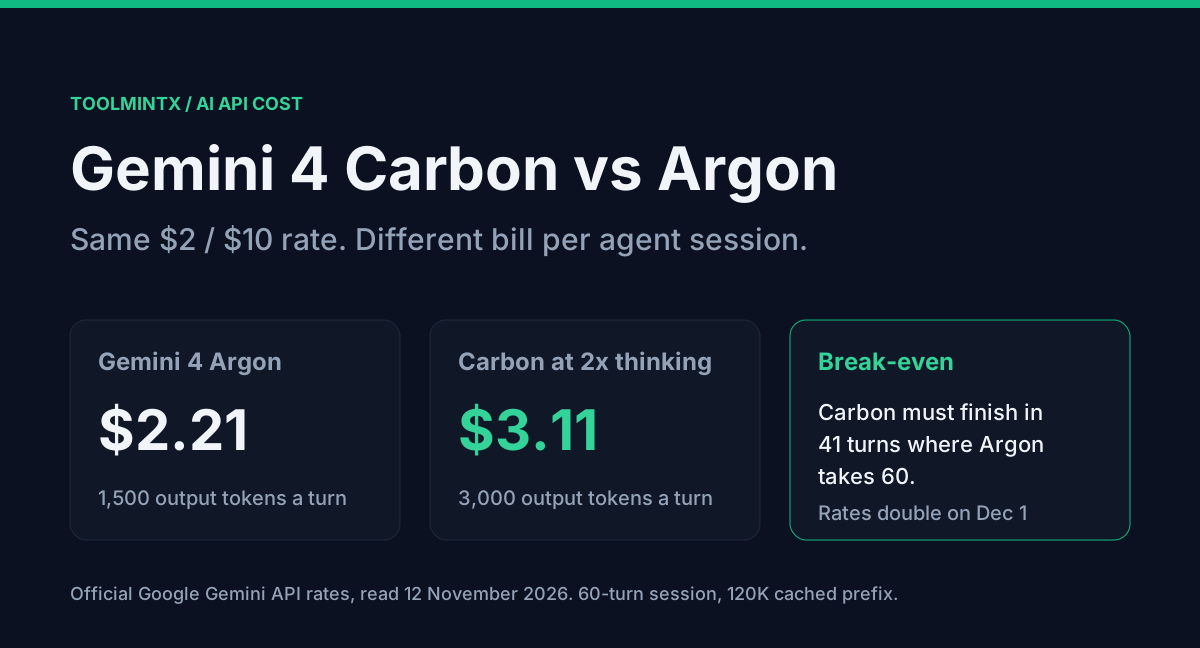
Google made Gemini 4 Carbon (gemini-4-carbon) generally available on 10 November 2026. It costs exactly what Gemini 4 Argon costs: $2 per million input tokens, $0.10 for cached input and $10 for output until 30 November, then $4, $0.20 and $20 from 1 December. Same table, same 1,048,576-token window, same thinking levels.
The price per token is identical. The price per turn is not. Google's own docs say Carbon "spends more thinking tokens per turn" than Argon, and thinking tokens bill as output, which is the most expensive line on the bill. So the question for anyone running a coding agent is simple arithmetic: how many fewer turns does Carbon have to take before the extra thinking pays for itself?
Below I cost our standard 60-turn agent session on both models, work out the break-even turn count, and price the planner-and-worker split that Google's developer guide recommends.
Table of contents
- Carbon and Argon rate cards
- One agent session at three thinking budgets
- How many turns Carbon has to save
- Carbon as planner, Argon as worker
- Where Carbon pulls ahead on the model card
- Switching from Argon
- FAQ
- Sources
Carbon and Argon rate cards
Per million tokens on the paid tier, from Google's Gemini API pricing page, read 12 November 2026. Carbon and Argon share every row below.
| Tier | Input | Cached input | Output (incl. thinking) |
|---|---|---|---|
| Standard, through Nov 30 | $2.00 | $0.10 | $10.00 |
| Standard, from Dec 1 | $4.00 | $0.20 | $20.00 |
| Batch or Flex, through Nov 30 | $1.00 | $0.05 | $5.00 |
| Batch or Flex, from Dec 1 | $2.00 | $0.10 | $10.00 |
| Priority, through Nov 30 | $3.60 | $0.18 | $18.00 |
| Priority, from Dec 1 | $7.20 | $0.36 | $36.00 |
There is one row Carbon doesn't get. Argon's pricing section has a Contributor tab at $1 input, $0.05 cached and $5 output, an invite-only private preview where Google uses your prompts to improve its products. Carbon has no Contributor tab. Neither model is on the free tier, and both use implicit caching only.
One agent session at three thinking budgets
The session is the one we use in every agent-cost post, so the numbers line up with our Gemini 4 Argon post and the Fable 5.2 vs Opus 5.5 comparison:
- 60 turns
- a 120,000-token prefix (system prompt, tool schemas, files), sent once and read from cache on the other 59 turns
- 3,000 new input tokens per turn
- 1,500 output tokens per turn on Argon, thinking included
Google doesn't publish how much more Carbon thinks. "More thinking tokens per turn" is all the docs say. So the table runs Carbon at 1.5, 2 and 3 times Argon's output.
| Model and output per turn | Prefix pass | Cache reads | New input | Output | Session now | Session from Dec 1 |
|---|---|---|---|---|---|---|
| Argon, 1,500 | $0.24 | $0.708 | $0.36 | $0.90 | $2.21 | $4.42 |
| Carbon, 2,250 (1.5x) | $0.24 | $0.708 | $0.36 | $1.35 | $2.66 | $5.32 |
| Carbon, 3,000 (2x) | $0.24 | $0.708 | $0.36 | $1.80 | $3.11 | $6.22 |
| Carbon, 4,500 (3x) | $0.24 | $0.708 | $0.36 | $2.70 | $4.01 | $8.02 |
The December column doubles every cell, so I've only shown its totals.
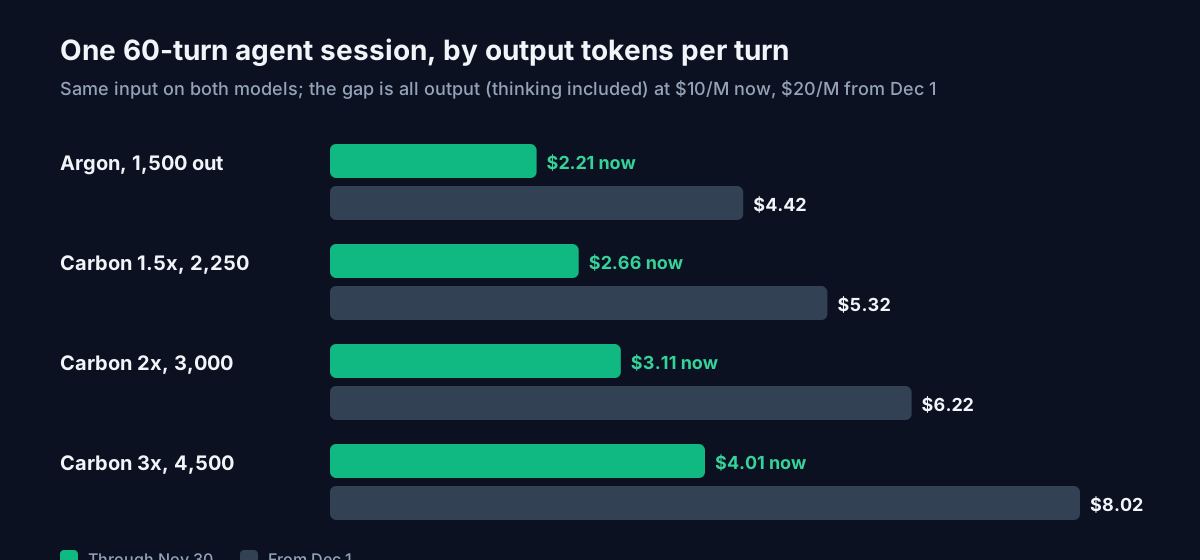
Input is the same on both models. Every extra cent comes from the output column. Each additional 1,000 output tokens per turn adds $0.60 to the session today and $1.20 from December.
At 440 sessions a month (20 a day, 22 working days), Argon costs $971.52 today. Carbon at twice the output costs $1,367.52. From December those become $1,943.04 and $2,735.04.
How many turns Carbon has to save
Carbon is only cheaper if it finishes the job in fewer turns. Fewer turns means fewer cache reads, fewer new-input tokens and fewer output blocks. Holding everything else fixed, this is the most turns Carbon can take and still cost no more than Argon's 60:
| Carbon output vs Argon | Max Carbon turns | Turns saved | Carbon session at that count |
|---|---|---|---|
| 1.5x | 48 | 20% | $2.17 |
| 2x | 41 | 31.7% | $2.20 |
| 3x | 31 | 48.3% | $2.18 |
The break-even counts don't move on 1 December, because both models double together.
A third fewer turns is a lot to ask. If your Argon agent already finishes most tasks without looping, Carbon will cost more on almost every task. Where Argon thrashes (the same test failing on retry five times, a root cause it never finds), cutting a third of the turns is plausible, and it's the case Google built Carbon for.
You can measure the ratio directly. The response's usage.total_thought_tokens field gives thinking tokens per turn. Run 20 of your own tasks on each model at the same thinking_level, divide the averages, and read the break-even row off the table. The API cost calculator lists both models if you want to try a different token mix.
Carbon as planner, Argon as worker
Google's Carbon developer guide doesn't tell you to switch every agent over. It suggests giving Carbon the roles that need deep reasoning, "upfront architecture, task coordination, and final verification", and handing the parallel implementation slices to gemini-4-argon or gemini-3.8-flash.
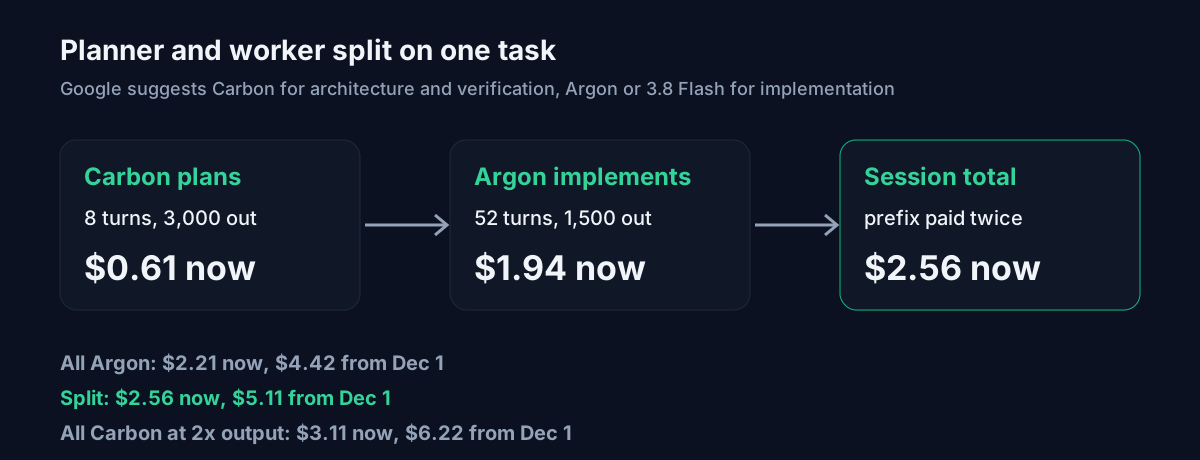
Costed on the same task, with Carbon taking 8 turns at 3,000 output tokens and Argon taking the remaining 52 at 1,500:
| Setup | Now | From Dec 1 |
|---|---|---|
| All Argon, 60 turns | $2.21 | $4.42 |
| Carbon 8 turns + Argon 52 turns | $2.56 | $5.11 |
| All Carbon at 2x output, 60 turns | $3.11 | $6.22 |
The split charges the 120K prefix twice, once per model, at $0.24 each today. Google's caching docs give the 4,096-token minimum and the 95% hit discount but say nothing about a cache entry carrying across models, so I've assumed the Argon worker starts cold. Even with that second prefix pass, the split costs $0.55 less than running Carbon end to end.
It costs $0.35 more than plain Argon. That's the price of Carbon's planning and final check. On a team running 440 sessions a month it comes to $153 today and $306 from December. Whether that buys fewer broken merges is something only your own eval set can answer.
Where Carbon pulls ahead on the model card
These rows come from Google DeepMind's Carbon model card, results as of October 2026, as reported by Google:
| Benchmark | Gemini 4 Carbon | Gemini 4 Argon | GPT-6 Astra | Claude Opus 5.5 |
|---|---|---|---|---|
| Terminal-Bench 4.0 (AA) | 65.2% | 57.1% | 59.1% | 59.6% |
| FrontierSWE 2 | 61.2% | 55.0% | 65.5% | 62.3% |
| SWE-sweep | 9.6% | 4.3% | 9.5% | 3.6% |
| OSWorld-2.1 (offline subset) | 81.5% | 74.7% | 80.9% | 87.2% |
| GraphWalks 256K to 1M (F1) | 96.2% | 84.2% | 71.8% | 66.8% |
| AA Index v5.0 | 59 | 50 | 57 | 58 |
The 8.1-point gap on Terminal-Bench is the number to watch for shell-heavy agents, since that's where turn counts blow up. Carbon still trails GPT-6 Astra on FrontierSWE 2 and Opus 5.5 on OSWorld. The Terminal-Bench row here is the AA-run version; the Argon card we quoted in October used a different harness, so don't compare across the two cards.
The card also lists a March 2026 knowledge cutoff and warns that Carbon "may use more tokens to maximize performance, especially at higher thinking levels".
Switching from Argon
Google's migration notes say moving from Argon needs no request schema changes. The items that change your bill or break silently:
- Change the model string to
gemini-4-carbon. - Keep
thinking_levelatmedium(the default) unless a task needshigh. Trylowfor routing and extraction. - Check
max_output_tokens. It caps thinking plus answer together, and Google recommends at least 32,768. Set it too low and Carbon's longer thinking eats the answer. - Raise HTTP timeouts to at least 15 minutes, or use
background: true. Long decode past 65,536 tokens also needs background execution, and you have to join the text from everymodel_outputstep. - Log
usage.total_thought_tokensandusage.total_cached_tokensper turn from the first day, so you know your real output ratio before December's rates arrive.
A request with the cost controls set explicitly:
from google import genai

client = genai.Client()  # reads GEMINI_API_KEY from the environment
interaction = client.interactions.create(
    model="gemini-4-carbon",
    input="Find the root cause of the flaky test in tests/test_retry.py",
    generation_config={
        "thinking_level": "medium",   # default; drop to "low" for routing
        "max_output_tokens": 32768,   # thinking + answer share this cap
    },
)
print(interaction.output_text)
print(interaction.usage.total_thought_tokens)
FAQ
Is Gemini 4 Carbon more expensive than Argon per token?
No. Every Standard, Batch, Flex and Priority rate is identical. Carbon only costs more because it writes more thinking tokens per turn, and those bill at the output rate.
Does the Contributor discount apply to Carbon?
No. Google's pricing page shows a Contributor tab ($1 input, $5 output) for Argon but not for Carbon.
Can I use explicit context caching on Carbon?
No. Like Argon, Carbon supports implicit caching only, for prompts of at least 4,096 tokens, with a 95% discount on cached input. Calls to cachedContents or caches.create need to come out.
Sources
- Google, Gemini Developer API pricing (aistudio.google.com/docs/pricing, read 12 November 2026): Gemini 4 Carbon and Argon Standard, Batch, Flex and Priority rates through 30 November and from 1 December 2026, Argon Contributor tier, free-tier exclusion, implicit-only caching.
- Google, What's new in Gemini 4 Carbon (aistudio.google.com/docs/whats-new-gemini-4-carbon, read 12 November 2026): thinking levels, Carbon vs Argon guidance, long decode,
max_output_tokensadvice, migration checklist. - Google, Gemini 4 Carbon: Developer Guide (aistudio.google.com/learn/gemini-4-carbon-developer-guide, published 10 November 2026): multi-agent pairing with Argon and Gemini 3.8 Flash.
- Google, Gemini API release notes (aistudio.google.com/docs/changelog): Carbon GA on 10 November 2026.
- Google, Gemini 4 Carbon model page (aistudio.google.com/docs/models/gemini-4-carbon): 1,048,576-token context, 65,536 default max output, explicit caching not supported.
- Google, Context caching and Thinking docs (aistudio.google.com/docs/caching, /docs/thinking): 4,096-token implicit cache minimum,
total_cached_tokens,total_thought_tokens. - Google DeepMind, Gemini 4 Carbon model card (deepmind.google/models/model-cards/gemini-4-carbon, published 10 November 2026): benchmark table, knowledge cutoff.
- Session, break-even, split and monthly figures are calculated by ToolMintX from the official rates above. The 1.5x, 2x and 3x output ratios are scenarios, not Google figures.