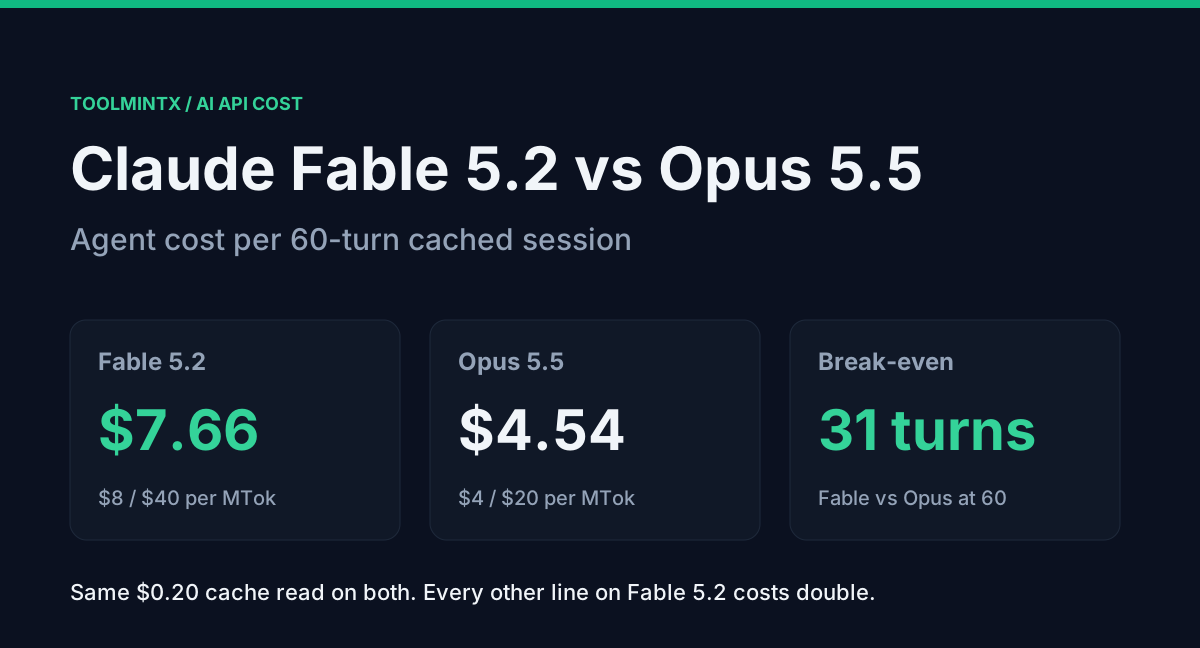
Anthropic released Claude Fable 5.2 and Claude Mythos 5.2 on 10 November 2026. Fable 5.2 is priced at $8 per million input tokens and $40 per million output tokens, down from $10 and $50 on Fable 5.1. The launch post also says Fable 5.2 at High effort matches Opus 5.5's best FrontierCode 2.0 score "for roughly half the cost per task".
Those two numbers point in opposite directions. Per token, Fable 5.2 costs exactly twice what Opus 5.5 does on input, output and cache writes. The one line where they match is the cache read, $0.20 per million on both. So whether Fable is the cheaper model for your coding agent comes down to how many turns it saves you. Below is one realistic agent session costed line by line from Anthropic's pricing page, the turn count where Fable stops paying for itself, and the settings that move the bill.
Table of contents
- The rate card side by side
- One 60-turn agent session, line by line
- The break-even is 31 turns
- Fast mode, US routing and Batch
- Effort defaults change the output line
- Using Fable 5.2 as an advisor to Opus
- FAQ
- Sources
The rate card side by side
All prices are per million tokens, from Anthropic's pricing page on launch day.
| Model | Input | Output | 5-min cache write | 1-hour cache write | Cache read |
|---|---|---|---|---|---|
| Claude Fable 5.2 | $8 | $40 | $10 | $16 | $0.20 |
| Claude Fable 5.1 | $10 | $50 | $12.50 | $20 | $0.25 |
| Claude Opus 5.5 | $4 | $20 | $5 | $8 | $0.20 |
| Claude Sonnet 5.5 | $2 | $10 | $2.50 | $4 | $0.10 |
The cache read is the odd one. Anthropic bills it at 0.025x input on the new model and 0.05x on Opus 5.5, and because the new model's input is twice as expensive, both land on $0.20. Every other column is double the Opus rate.
Mythos 5.2 is the same underlying model at the same prices. Anthropic gates it behind its Cyber and Life Sciences verification programs, so for most teams the choice is between the public model and a cheaper Claude.
Both models have a 1M-token context window billed at standard rates across the whole window, and both cap output at 128K tokens. Unlike GPT-6-tier models, there is no long-context surcharge to plan around.
One 60-turn agent session, line by line
The workload is the same one we used for Sonnet 5.5 vs GPT-6.1 Sol, so the numbers compare directly. A coding agent keeps a 120K-token prefix (system prompt, tool definitions, repo files) in a 5-minute cache. Each of 60 turns adds 3K new input tokens and produces 1.5K output tokens. The prefix is written once and read on the other 59 turns.
That session moves 7.38 million input tokens, and 94.8% of all tokens are cache reads.
| Line | Tokens | Fable 5.2 | Opus 5.5 | Fable 5.1 |
|---|---|---|---|---|
| Cache write (once) | 120K | $1.20 | $0.60 | $1.50 |
| Cache reads (59 turns) | 7.08M | $1.416 | $1.416 | $1.77 |
| New input (60 turns) | 180K | $1.44 | $0.72 | $1.80 |
| Output (60 turns) | 90K | $3.60 | $1.80 | $4.50 |
| Session total | $7.656 | $4.536 | $9.57 |
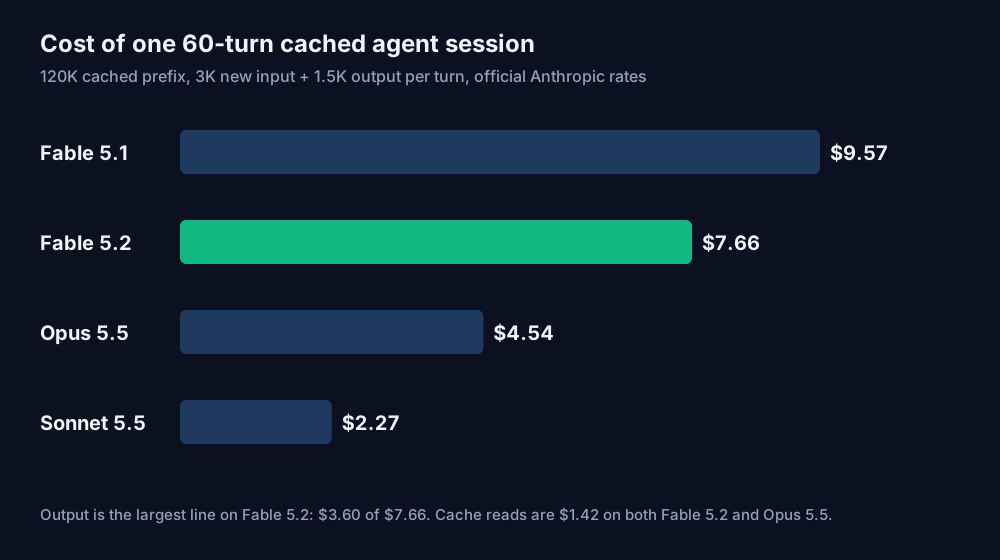
The new model comes out at 1.69 times the Opus 5.5 bill, $3.12 more per session. Against Fable 5.1 it is exactly 20% cheaper, which is the per-token cut and nothing else. Even though cache reads are almost 95% of the tokens, they are only $1.42 of the $7.66. Output is the biggest line at $3.60, and output is billed at double the Opus rate.
Scale it to a team running 20 sessions a day for 22 working days (440 sessions) and the gap is $3,368.64 a month on Fable 5.2 against $1,995.84 on Opus 5.5. Sonnet 5.5 would be $997.92.
Turn caching off and the same Fable session costs $62.64, because the 120K prefix is billed at $8 every turn. If you only take one setting from this post, check that cache_control is on and that your prefix stays byte-identical between turns.
The break-even is 31 turns
Anthropic's case for the model is that it gets there in fewer steps. On FrontierCode 2.0, Fable 5.2 at High effort scored 45.3% against Opus 5.5's best of 45.5%, and Anthropic puts the cost per task at roughly half. That claim is about tokens per task, so you can test it on your own work.
With the same per-turn shape, each extra turn on 5.2 costs $0.108 and each Opus turn costs $0.066. Opus 5.5 finishes 60 turns for $4.536. Fable 5.2 matches that at 31 turns ($4.524) and passes it at 32.
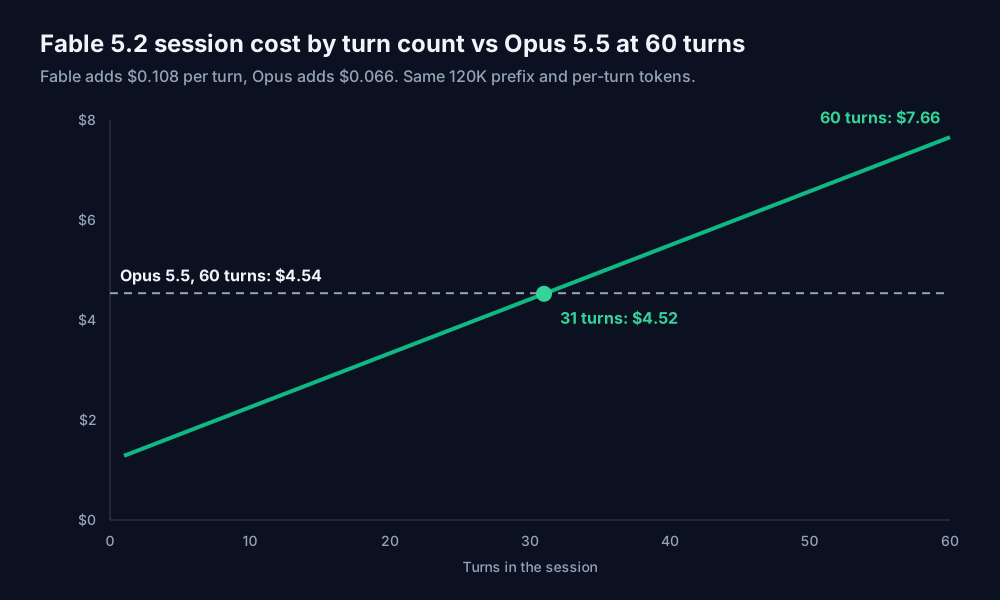
So the rule for this workload: Fable 5.2 is the cheaper model when it finishes a task in about half the turns Opus needs. If it finishes in 40 turns where Opus needs 60, you pay $5.50 instead of $4.54. The other way to break even is output. Keep 60 turns and the model needs to write only 200 tokens per turn, 13.3% of the 1.5K Opus writes, to match the Opus bill. That is unrealistic for coding, so turn count is the lever to watch.
To measure it, log usage from every response on a sample of real tasks, run each task on both models, and add up the four lines above per model. The API cost calculator now lists Fable 5.2 and Mythos 5.2, with a cached-input field for the $0.20 read rate.
Fast mode, US routing and Batch
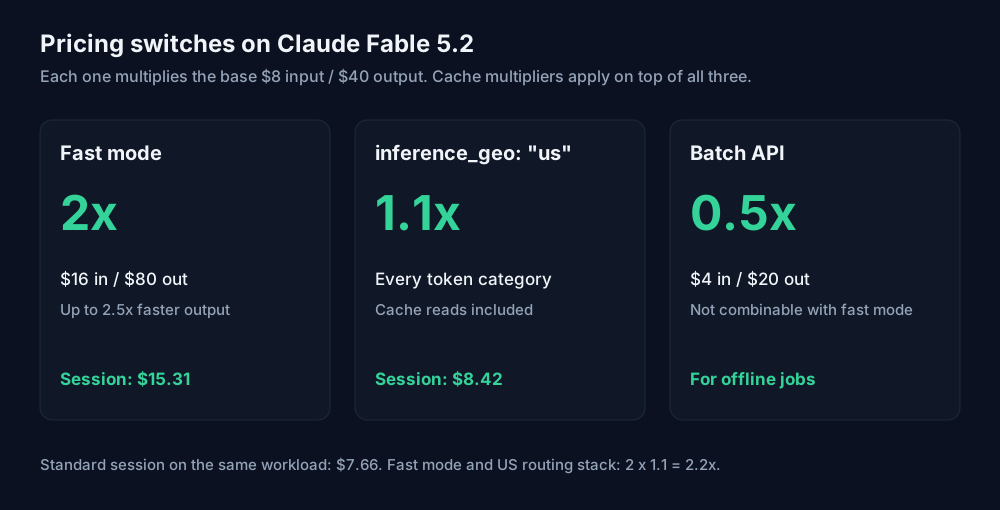
Three switches change these numbers, and two of them stack.
- Fast mode bills Fable 5.2 at $16 input and $80 output, double the standard rate, for up to 2.5 times faster generation. Cache multipliers apply on top. Our session costs $15.312 in fast mode. Fast mode is not available on the Batch API.
- Setting
inference_geo: "us"multiplies every token category by 1.1, cache reads included. The session goes from $7.656 to $8.42. - The Batch API halves input and output to $4 and $20. Cache multipliers stack with it too. Batch suits evaluation runs and offline refactors, not an interactive agent loop.
Effort defaults change the output line
The models overview lists Fable 5.2 with thinking "Adaptive (always on)" and a default effort of high. Opus 5.5 is also always-on adaptive thinking, but defaults to medium. Thinking tokens bill as output, so calling the new model without setting effort gives you a higher-effort run than the Opus call you are comparing it with.
Anthropic's own comparison uses different settings on each side. The 45.3% figure is Fable at High against Opus 5.5 at its highest effort. Fable's top score, 49.1% on FrontierCode 2.0, is at Xhigh. The launch post also says Medium is the default in Claude apps and Claude Code and that Fable 5.2 uses fewer tokens there than Fable 5.1. For API work, pick effort explicitly on both models before you compare bills, or the test measures the defaults.
The launch post also claims output up to 30% faster than Fable 5.1. That is a speed figure. It doesn't change what a token costs.
Using Fable 5.2 as an advisor to Opus
Anthropic suggests Fable 5.2 as an advisor that Haiku, Sonnet or Opus models consult on hard problems, or as an orchestrator that hands simple work to smaller models. The advisor pattern keeps the expensive output off most turns.
Here is a rough version on our session. Opus 5.5 runs all 60 turns ($4.536). Six times in the session it sends a 20K-token brief to Fable 5.2 as a fresh, uncached request and gets 2K tokens back. Each consult costs $0.16 input plus $0.08 output, $1.44 for all six, and the session totals $5.976. That is 22% under the bill for running every turn on 5.2, and 32% over plain Opus. Whether the consults are worth $1.44 depends on how often they save a failed run.
FAQ
Is Claude Fable 5.2 cheaper than Fable 5.1?
Yes, by 20% on every line. Input drops from $10 to $8, output from $50 to $40, 5-minute cache writes from $12.50 to $10 and cache reads from $0.25 to $0.20 per million tokens.
What is the API model ID?
claude-fable-5-2. Anthropic says it is available on the Claude Platform, Amazon Web Services, Google Cloud and Microsoft Azure from launch day.
Sources
- Anthropic, "Pricing" (platform.claude.com/docs/en/about-claude/pricing, read 10 November 2026): base, cache write and cache read rates for Fable 5.2, Fable 5.1, Opus 5.5 and Sonnet 5.5; 0.025x and 0.05x cache read multipliers; fast mode $16/$80; Batch $4/$20; 1.1x
inference_geomultiplier; long-context pricing. - Anthropic, "Models overview" (platform.claude.com/docs/en/about-claude/models/overview, read 10 November 2026):
claude-fable-5-2ID, 1M context, 128K max output, adaptive thinking always on, default effort high vs medium on Opus 5.5. - Anthropic, "Introducing Claude Fable 5.2 and Claude Mythos 5.2" (anthropic.com/claude-fable-and-mythos-5-2, read 10 November 2026): FrontierCode 2.0 scores (45.3%, 45.5%, 49.1%), "roughly half the cost per task", up to 30% faster output, advisor and orchestrator roles, availability.
- Session, monthly, break-even and advisor costs are calculated by ToolMintX from the official rates above. Workload shape (120K prefix, 3K new input and 1.5K output per turn, 60 turns) is our assumption.