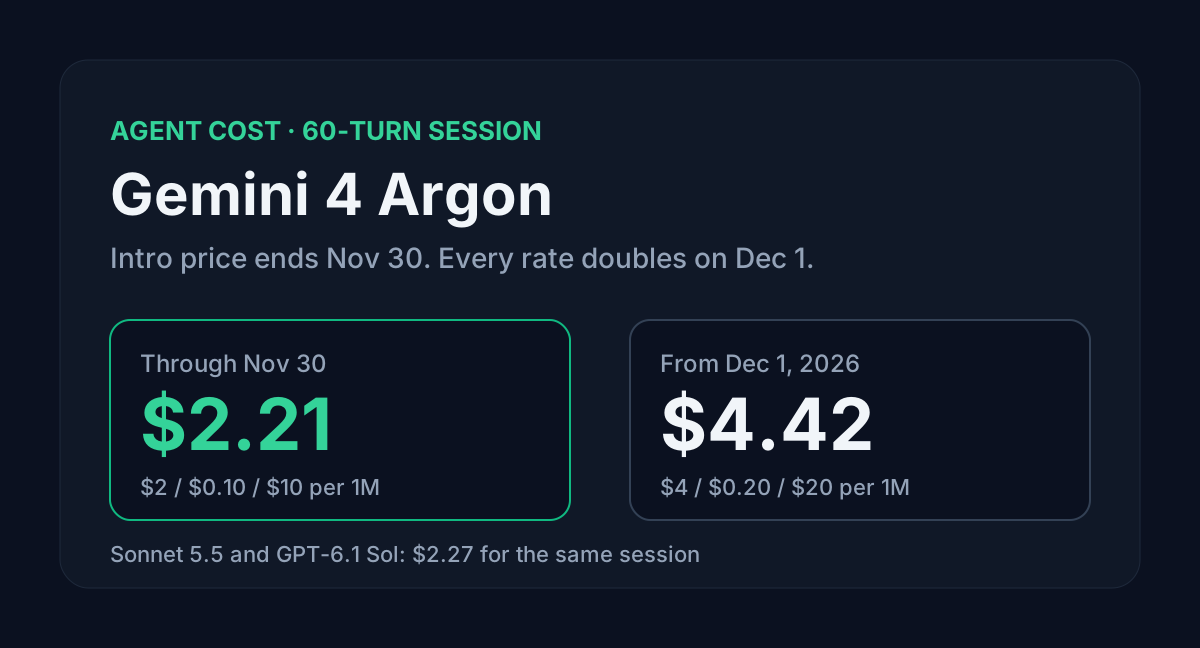
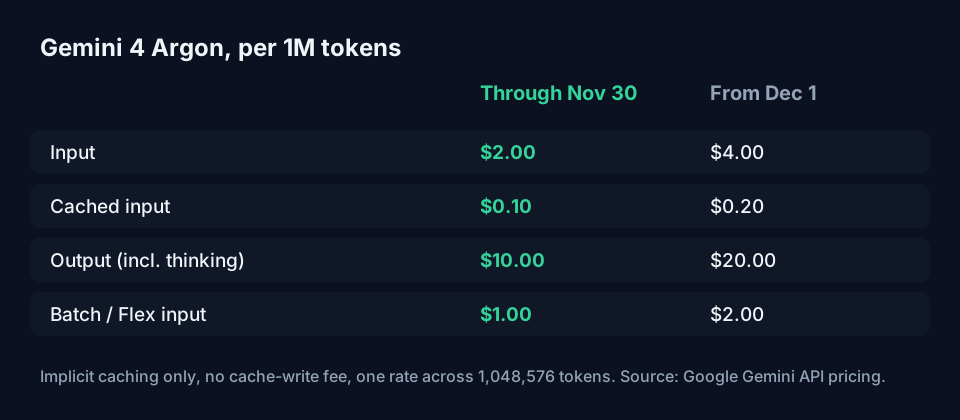
Google made Gemini 4 Argon (gemini-4-argon) generally available on 13 October 2026. Until 30 November it costs $2 per million input tokens, $0.10 for cached input and $10 for output. Claude Sonnet 5.5 and GPT-6.1 Sol charge exactly the same three rates. On 1 December every Argon rate doubles, to $4, $0.20 and $20, which matches Claude Opus 5.5 and Meta's Muse Wonder.
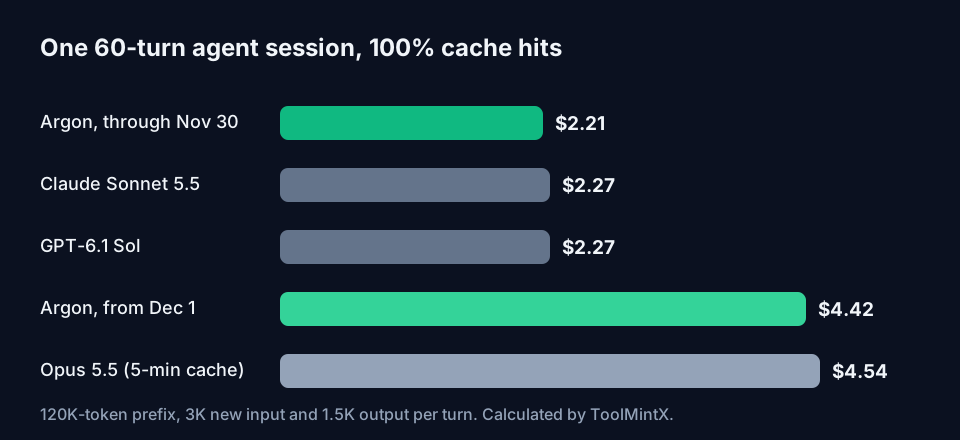
So the price you see today lasts about seven weeks. On our standard 60-turn coding-agent session, Argon costs $2.21 now and $4.42 from December. Today it is 6 cents cheaper than Sonnet 5.5 because Google has no cache-write fee. One missed cache read wipes that out, and Argon's caching is implicit only, so you can't pin the prefix.
This post prices the session at both rates, shows what a cache miss and extra thinking tokens add, and lists the migration steps Google's guide puts in small print.
Table of Contents
- The rates now and on December 1
- One agent session, priced twice
- Implicit caching: no write fee, no control
- Thinking tokens bill as output
- Migration checklist before you switch an agent
- Benchmarks against Opus 5.5 and GPT-6 Astra
- FAQ
- Conclusion
- Sources
The rates now and on December 1
Per million tokens on the paid tier, from Google's Gemini API pricing page:
| Tier | Input | Cached input | Output (incl. thinking) |
|---|---|---|---|
| Standard, through Nov 30 | $2.00 | $0.10 | $10.00 |
| Standard, from Dec 1 | $4.00 | $0.20 | $20.00 |
| Batch or Flex, through Nov 30 | $1.00 | $0.05 | $5.00 |
| Batch or Flex, from Dec 1 | $2.00 | $0.10 | $10.00 |
| Priority, through Nov 30 | $3.60 | $0.18 | $18.00 |
| Priority, from Dec 1 | $7.20 | $0.36 | $36.00 |
There is one price across the whole 1,048,576-token window. Gemini 3.1 Pro charges more above 200K input tokens, and Argon's table has no such row. Search grounding is free for the first 5,000 requests a month (the allowance is shared across Gemini 3 and newer models), then $14 per 1,000. Argon isn't on the free tier or the Google AI Pro plan.
One agent session, priced twice
This is the same session we used for Sonnet 5.5 vs GPT-6.1 Sol and Muse Wonder vs Opus 5.5, so the rows compare directly:
- 60 turns
- a 120,000-token prefix (system prompt, tool schemas and files read), sent on turn 1 and re-read on the other 59
- 3,000 new input tokens and 1,500 output tokens per turn
That is 7.38 million input tokens, and 95.9% of them are cache reads.
| Model | First prefix pass | Cache reads | New input | Output | Session | Month* |
|---|---|---|---|---|---|---|
| Gemini 4 Argon, now | $0.24 | $0.71 | $0.36 | $0.90 | $2.21 | $972 |
| Claude Sonnet 5.5 | $0.30 | $0.71 | $0.36 | $0.90 | $2.27 | $998 |
| GPT-6.1 Sol | $0.30 | $0.71 | $0.36 | $0.90 | $2.27 | $998 |
| Gemini 4 Argon, from Dec 1 | $0.48 | $1.42 | $0.72 | $1.80 | $4.42 | $1,943 |
| Muse Wonder | $0.48 | $1.42 | $0.72 | $1.80 | $4.42 | $1,943 |
| Claude Opus 5.5 (5-min cache) | $0.60 | $1.42 | $0.72 | $1.80 | $4.54 | $1,996 |
*20 sessions a day for 22 working days (440 sessions). Google has no separate cache-write rate, so Argon's first pass bills at the normal input price. Anthropic and OpenAI bill it at $2.50. Totals use unrounded figures.
Argon's only advantage today is that first pass: 6 cents a session, about $26 a month at 440 sessions. On 1 December the session doubles to $4.42, which ties Muse Wonder to the cent and sits 12 cents under Opus 5.5.
If you're testing Argon this month for a long-term contract, budget it at the December rate. A team that moves to Argon from Sonnet 5.5 on today's numbers saves about $26 a month until 30 November and then pays about $945 a month more for the same token count.
Implicit caching: no write fee, no control
Google's migration guide says explicit caching (cachedContents and caches.create) is not supported on Argon. You have to remove those calls. Implicit caching is on by default for prompts of at least 4,096 tokens and gives a 95% discount on cache hits. You don't configure anything, and you can't reserve or extend a cache entry either.
That matters because the 6-cent lead is smaller than a single miss. When a prefix read misses, 120,000 tokens bill at $2.00 instead of $0.10, adding $0.23 to the session at today's rates or $0.46 from December.
| Missed prefix reads (of 59) | Hit rate | Argon now | Argon from Dec 1 |
|---|---|---|---|
| 0 | 100% | $2.21 | $4.42 |
| 1 | 98.3% | $2.44 | $4.87 |
| 3 | 94.9% | $2.89 | $5.78 |
| 6 | 89.8% | $3.58 | $7.15 |
| 12 | 79.7% | $4.94 | $9.89 |
One miss puts today's Argon session at $2.44, above Sonnet 5.5's $2.27. Anthropic and OpenAI charge for the cache write but let you mark exactly what to cache. Google gives you the write for free and decides itself what stays cached.
Google's caching docs give two ways to raise the hit rate: put large, shared content at the start of the prompt, and send requests with the same prefix close together. Keep the system prompt and tool schemas byte-identical from turn to turn. A timestamp or session ID near the top changes the prefix on every request. Then measure. The response's usage.total_cached_tokens field shows how many input tokens hit the cache, and dividing that by the 120K prefix gives your hit rate for each turn.
Thinking tokens bill as output
Argon's output price includes thinking tokens, and the migration guide warns that Argon "can spend more of the limit on thinking than earlier models". The default thinking level is medium. Our session assumes 1,500 output tokens per turn, thinking included. If your agent averages 1,000 more thinking tokens a turn, the session gains $0.60 now and $1.20 from December. That is ten times the cache-write saving.
thinking_level (low, medium or high) is the main cost control. Google's advice is to run your evals at all three levels and pick the lowest that meets your quality bar. If you need fewer tokens, lower the thinking level. Don't cut max_output_tokens, because that cap covers thinking and answer together, and a low cap ends the answer partway through.
Migration checklist before you switch an agent
These steps come from Google's "What's new in Gemini 4 Argon" guide. Several of them break existing code without any error:
- Change the model string to
gemini-4-argon. - Delete explicit cache calls (
cached_content,caches.create). - Remove
temperature,top_pandtop_k. Argon ignores them, so any tuning you did on those parameters stops having an effect. - If you set
max_output_tokensbelow 32K, raise it to at least 32,768. - For outputs above 64K tokens, set
background: trueandmax_output_tokensabove 65,536. The server then generates in hops of up to 64K tokens. Join the text from everymodel_outputstep, because reading only the first step returns a truncated answer. - Set HTTP client timeouts to at least 15 minutes, or use background execution. Google says hard prompts can take several minutes.
- Use
previous_interaction_idfor multi-turn and function-calling conversations, so state stays on the server.
A minimal call with the thinking level set explicitly:
from google import genai

client = genai.Client()  # reads GEMINI_API_KEY from the environment
interaction = client.interactions.create(
    model="gemini-4-argon",
    input="Review this diff for race conditions: ...",
    generation_config={
        "thinking_level": "low",       # try low first, move up only if evals fail
        "max_output_tokens": 32768,    # covers thinking + answer
    },
)
print(interaction.output_text)
print(interaction.usage)  # check cached and output token counts per turn
If you log the usage object as JSON, the JSON Formatter makes the cached-token fields easier to read while you debug.
Benchmarks against Opus 5.5 and GPT-6 Astra
Coding rows from Google's model card, as reported by Google:
| Benchmark | Gemini 4 Argon | GPT-6 Astra | Claude Opus 5.5 |
|---|---|---|---|
| DeepSWE v1.1 | 77.9% | 74.1% | 74.2% |
| FrontierSWE v2 | 55.0% | 65.5% | 62.3% |
| Terminal-bench 4.0 | 57.4% | 58.2% | 66.4% |
| Vibe Code Bench | 91.9% | 89.6% | 90.3% |
| GraphWalks 256K to 1M (F1) | 84.2% | 71.8% | 66.8% |
Argon leads on DeepSWE and on long-context retrieval, and it trails Opus 5.5 by 9 points on Terminal-bench. If your agent works mostly in a shell, expect more turns per finished task, and every extra turn costs another cache read plus output. The card doesn't include Sonnet 5.5 or GPT-6.1 Sol, the two models Argon ties on price this month, so test against those yourself.
FAQ
How much does Gemini 4 Argon cost? $2.00 per million input tokens, $0.10 cached and $10.00 output through 30 November 2026. From 1 December it is $4.00, $0.20 and $20.00. Batch and Flex are half those rates.
Is Gemini 4 Argon cheaper than Claude Sonnet 5.5? Slightly, until 30 November, and only with a perfect cache. Our 60-turn session costs $2.21 on Argon and $2.27 on Sonnet 5.5. One missed prefix read pushes Argon to $2.44. From December, Argon costs twice as much.
Does Gemini 4 Argon support context caching?
Only implicit caching, for prompts of at least 4,096 tokens, with a 95% discount on hits. Explicit cachedContents caching is not supported.
Is there a long-context surcharge on Gemini 4 Argon? No. The pricing page shows one rate for the full 1,048,576-token window, unlike Gemini 3.1 Pro's higher rate above 200K tokens.
Can I use Gemini 4 Argon for free? No. It isn't on the Gemini API free tier or the Google AI Pro plan.
Conclusion
Gemini 4 Argon's launch price ties Sonnet 5.5 and GPT-6.1 Sol, and the missing cache-write fee saves 6 cents on a 60-turn agent session. That margin is gone after one cache miss, and on 1 December the whole bill doubles to Opus 5.5 territory. Test it now if the DeepSWE and long-context numbers fit your work, but cost it at $4.42 a session, set thinking_level deliberately, and log cached tokens from day one. Put your own token mix into the API Cost Calculator, which now lists Argon at both rates.
Sources
- Google, Gemini Developer API pricing (ai.google.dev/gemini-api/docs/pricing): Gemini 4 Argon Standard, Batch, Flex and Priority rates through 30 November and from 1 December 2026, implicit-only caching, grounding prices, free tier and AI Pro exclusion, Gemini 3.1 Pro 200K tier.
- Google, What's new in Gemini 4 Argon (ai.google.dev/gemini-api/docs/latest-model): default thinking level, long decode and background execution, migration checklist, 95% implicit cache discount at 4,096 tokens, ignored sampling parameters, timeout guidance.
- Google, Gemini 4 Argon model page (ai.google.dev/gemini-api/docs/models/gemini-4-argon): 1,048,576-token context, 65,536 default max output, capabilities.
- Google, Gemini API release notes (ai.google.dev/gemini-api/docs/changelog): Argon GA on 13 October 2026.
- Google, Context caching docs (ai.google.dev/gemini-api/docs/caching): implicit caching minimums, prefix tips,
total_cached_tokens. - Google DeepMind, Gemini 4 Argon model card (deepmind.google/models/model-cards/gemini-4-argon): benchmark table.
- Claude Sonnet 5.5, Opus 5.5, GPT-6.1 Sol and Muse Wonder rates are from the ToolMintX API Cost Calculator dataset, read from each provider's pricing page. Session, hit-rate and monthly figures are calculated by ToolMintX.