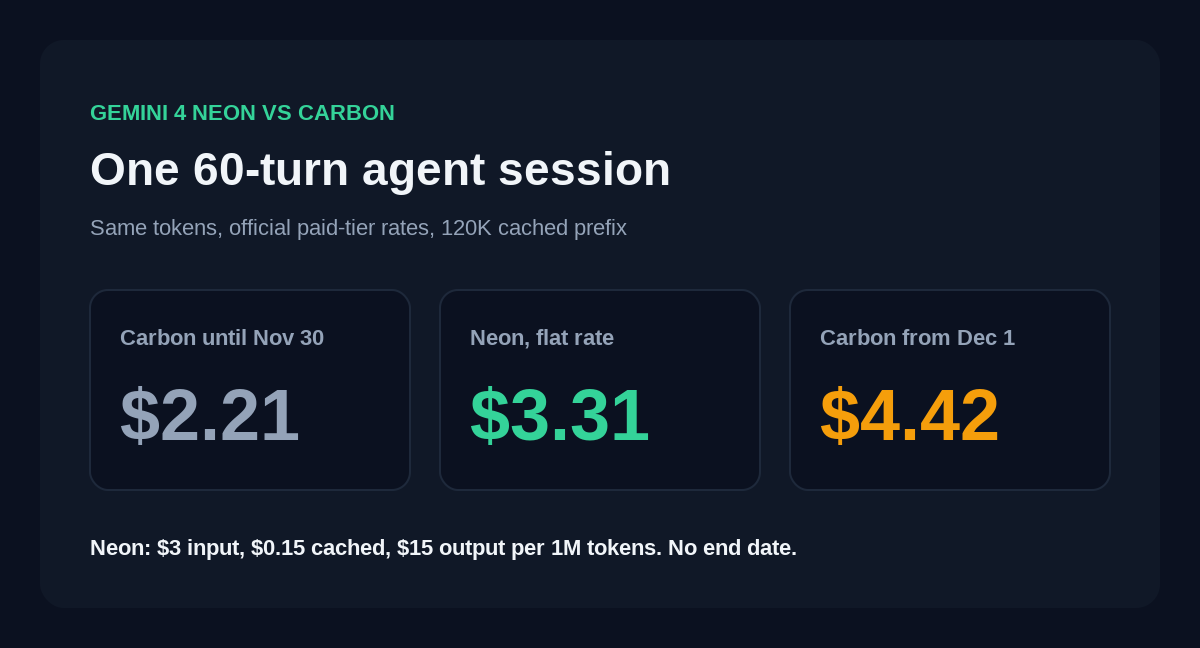
Google made Gemini 4 Neon (gemini-4-neon) generally available on 18 November 2026. It costs $3.00 per million input tokens, $0.15 for cached input and $15.00 for output, flat across the 1,048,576-token window. Google places it between Hydrogen and Carbon: deeper reasoning than Hydrogen, faster finishes than Carbon.
The odd part is the price order. For the next 11 days, Neon costs more than Carbon, the model Google calls its strongest. Carbon is on an introductory $2.00 and $10.00 through 30 November, and doubles to $4.00 and $20.00 on 1 December. Neon has no introductory price, so it lands right between Carbon's two rate cards.
I costed our usual 60-turn agent session on all three models and worked out how many extra thinking tokens each one can spend before it loses.
Table of contents
- Neon, Carbon and Hydrogen rate cards
- One agent session on each model
- The thinking-token break-even
- Neon as the planner over Hydrogen
- Migration catches from the Neon guide
- FAQ
- Sources
Neon, Carbon and Hydrogen rate cards
Paid tier, per million tokens, from Google's Gemini API pricing page read on 19 November 2026.
| Model | Input | Cached input | Output (thinking included) | Default thinking |
|---|---|---|---|---|
| Gemini 4 Hydrogen | $1.50 | $0.075 | $7.50 | high |
| Gemini 4 Carbon, through Nov 30 | $2.00 | $0.10 | $10.00 | medium |
| Gemini 4 Neon | $3.00 | $0.15 | $15.00 | high |
| Gemini 4 Carbon, from Dec 1 | $4.00 | $0.20 | $20.00 | medium |
Neon's Batch and Flex rows are half of Standard: $1.50, $0.075 and $7.50, which is Hydrogen's Standard card exactly. Priority is $5.40, $0.27 and $27.00.
Caching works the same way on all three. It's implicit only, with no explicit cachedContents, no storage fee, a 4,096-token minimum and a 95% discount on hits. Neon isn't on the free tier, and neither is Carbon. Hydrogen is.
All three cards keep the same ratios, so every line of a Neon bill is exactly 2x Hydrogen, 1.5x Carbon today, and 0.75x Carbon from December.
One agent session on each model
Same session as the Hydrogen vs 3.8 Flash post and the Carbon vs Argon post:
- 60 turns
- a 120,000-token prefix (system prompt, tool schemas, files), sent once and read from cache on the other 59 turns
- 3,000 new input tokens per turn
- 1,500 output tokens per turn, thinking included
| Model | Prefix pass | Cache reads | New input | Output | Session |
|---|---|---|---|---|---|
| Hydrogen | $0.18 | $0.531 | $0.27 | $0.675 | $1.66 |
| Carbon, through Nov 30 | $0.24 | $0.708 | $0.36 | $0.90 | $2.21 |
| Neon | $0.36 | $1.062 | $0.54 | $1.35 | $3.31 |
| Carbon, from Dec 1 | $0.48 | $1.416 | $0.72 | $1.80 | $4.42 |
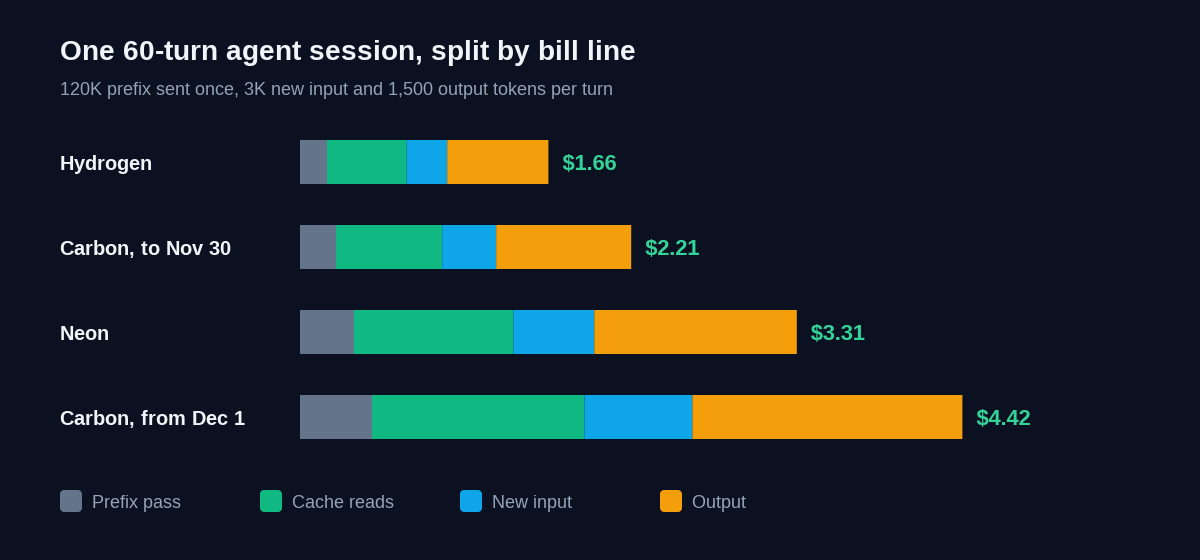
Output is 40.8% of each session and cache reads are 32.1%. The share is identical across the four rows because the ratios between rate lines are identical.
At 440 sessions a month (20 a day over 22 working days) that's $728.64 on Hydrogen, $971.52 on Carbon in November, $1,457.28 on Neon and $1,943.04 on Carbon in December. Neon saves $485.76 a month against December Carbon, if both models used the same number of tokens. They won't.
The thinking-token break-even
Thinking bills as output, and the two models start at different levels. Carbon defaults to medium and caps at high. Neon defaults to high and adds xhigh. Google says Neon "finishes faster with fewer output tokens than Carbon", but it publishes no ratio. So here are the lines where the choice flips.
Against Carbon from 1 December at 1,500 output tokens per turn, Neon can write up to 2,726 tokens per turn (1.82x) and still cost less. With Carbon on the introductory card, the question runs the other way: Carbon has to write 3,340 tokens per turn (2.23x Neon's 1,500) before it becomes the more expensive model.
| Neon output per turn | Neon session | vs Carbon from Dec 1 ($4.42) |
|---|---|---|
| 1,500 | $3.31 | $1.10 cheaper |
| 1,875 | $3.65 | $0.77 cheaper |
| 2,250 | $3.99 | $0.43 cheaper |
| 2,726 | $4.42 | break-even |
| 3,000 | $4.66 | $0.25 more |
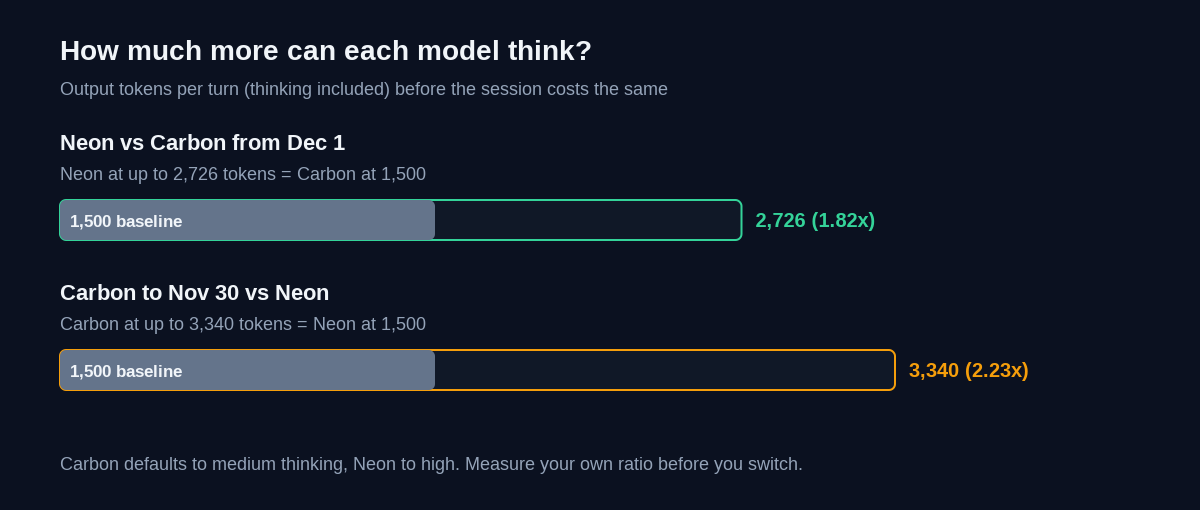
My reading: if Carbon already does the job for you, keep it until 30 November, because there's almost no way Neon beats a model that costs a third less per token. Run your eval set on Neon at high and medium this month, read the thought tokens off each response's usage, and switch on 1 December if Neon stays under 1.8x Carbon's output. Google's own advice is to test all four thinking levels and keep the lowest one that clears your quality bar.
The API cost calculator now lists Neon next to both Carbon price periods, so you can plug in your own measured token counts.
Neon as the planner over Hydrogen
Google's model guide pairs Carbon with Hydrogen: the stronger model plans or isolates a hard bug, then previous_interaction_id hands the conversation to Hydrogen for edits and tests. The guide says the three models share one request schema, context window and toolset, so Neon slots into the planner seat with only the model string changed.
Same split as the Hydrogen post: the planner takes 8 turns at 3,000 output tokens, Hydrogen takes the other 52 at 1,500. Google's caching docs don't say a cache entry carries across models, so I assumed Hydrogen starts cold and the 120K prefix is paid twice.
| Setup | Through Nov 30 | From Dec 1 |
|---|---|---|
| Carbon 8 turns + Hydrogen 52 turns | $2.07 | $2.68 |
| Neon 8 turns + Hydrogen 52 turns | $2.38 | $2.38 |
| All Neon, 60 turns | $3.31 | $3.31 |
The Neon slice is $0.918 and the Hydrogen slice is $1.458. From December the Neon planner is $0.30 cheaper per session than the Carbon one, and it costs $0.94 less than running Neon for all 60 turns. For a loop where most turns are file edits and test runs, I'd use the split and keep the expensive model for the 8 turns that need it.
Migration catches from the Neon guide
Switching from Carbon, Argon or Hydrogen needs no schema change, only the model ID. Coming from Gemini 3.8 Flash or older, the guide lists several things that break:
thinking_level: "minimal"returns an error on Neon. Uselow.- Explicit caching is gone. Remove
cached_contentfields; implicit caching runs by default on prompts of 4,096 tokens or more. - Remove
temperature,top_pandtop_k. The server ignores in-range values and returns a400for out-of-range ones. - Input, thinking and output share one 1,048,576-token window. A single response tops out at 65,536 tokens. For more, set
backgroundtotruewithmax_output_tokensabove 65,536, or the server stops at 65,536. - Declare tools natively. Asking for raw-text JSON tool calls with zero declared tools can return
MALFORMED_FUNCTION_CALL. - Hard prompts can run for minutes, so the guide asks for HTTP timeouts of at least 15 minutes.
The last one is the one I'd check first. Old apps often hardcode max_output_tokens at 8,192. On a model that defaults to high thinking, that cap gets eaten by reasoning and the answer comes back cut short. If you log tool payloads, a JSON formatter makes it quick to see when a function call came back malformed.
FAQ
Is Gemini 4 Neon on the free tier?
No. Neon and Carbon are paid tier only. Hydrogen and Gemini 3.5 Flash-Lite are on the free tier.
Will Neon's price change on 1 December?
Google's model guide says "Neon has no introductory price", and its pricing table shows no end date. Only Carbon and Argon double on 1 December.
Does grounding cost extra on Neon?
Yes. Google Search grounding gives 5,000 free requests a month, shared across Gemini 3 and newer models, then $14 per 1,000. Google also counts and bills the internal tool instructions and function declarations that grounding adds.
Sources
- Google Gemini API, Pricing (ai.google.dev/gemini-api/docs/pricing, read 19 November 2026): Standard, Batch, Flex and Priority rows for gemini-4-neon; Carbon's introductory rate through 30 November and $4/$0.20/$20 from 1 December; Hydrogen rates; grounding prices.
- Google Gemini API, Release notes (ai.google.dev/gemini-api/docs/changelog): Gemini 4 Neon generally available 18 November 2026.
- Google Gemini API, What's new in Gemini 4 Neon (ai.google.dev/gemini-api/docs/whats-new-gemini-4-neon): thinking levels, 65,536-token response cap, long decode, migration checklist, implicit caching at 95% off with a 4,096-token minimum.
- Google Gemini API, Choosing a model (ai.google.dev/gemini-api/docs/choosing-a-model): position between Hydrogen and Carbon, default thinking levels, free-tier availability, "Neon has no introductory price", Carbon plus Hydrogen pairing.
- Google Gemini API, Gemini 4 Neon model page (ai.google.dev/gemini-api/docs/models/gemini-4-neon): inputs, token limits, capabilities, Batch, Flex and Priority support.
- Session, monthly and break-even figures are calculated by ToolMintX from the rates above.