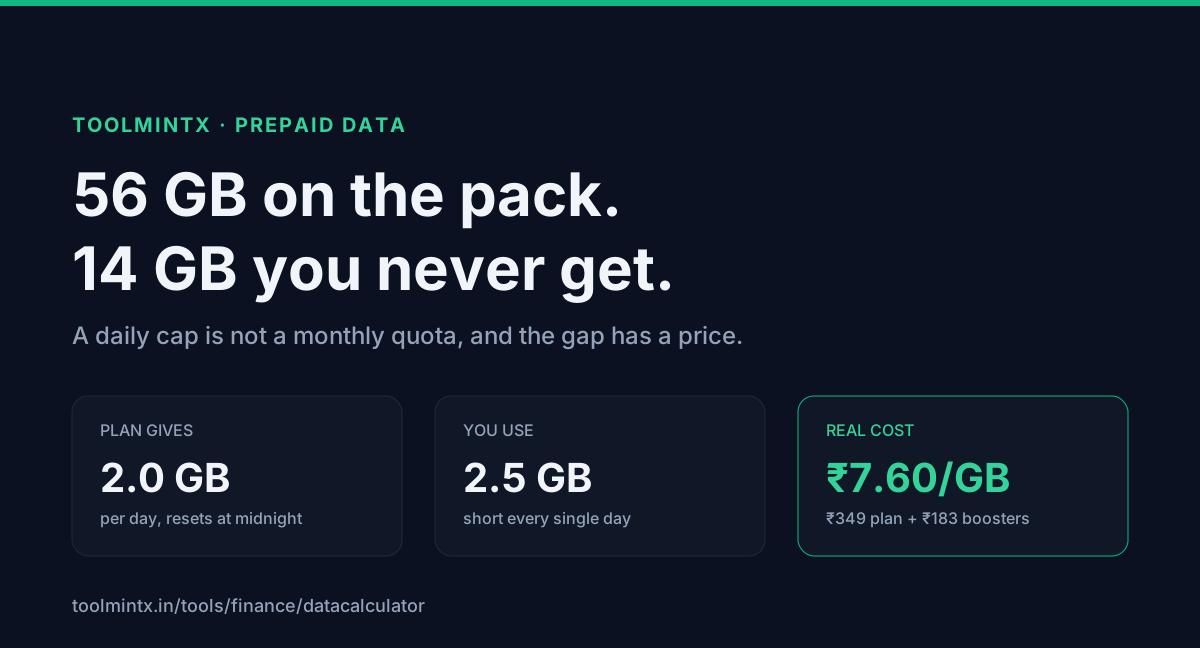
Your pack says 56 GB. You used 70 GB worth of internet last cycle and still spent three separate mornings on a crawling connection, wondering where a number that large went.
Nothing went missing. A 2 GB/day plan for 28 days is not a 56 GB pool. It is 2 GB, twenty-eight times, and the two are different products with different prices. Here is the arithmetic that turns a ₹349 plan into a ₹532 one, and the point where a bigger daily cap becomes the cheaper option.
Table of contents
- Where the 14 GB goes
- What 64 Kbps actually costs
- Boosters against the next tier up
- The reverse case, paying for headroom
- Read your own daily average first
- FAQ
- Conclusion
- Sources
Where the 14 GB goes
Take a real plan. Jio's ₹349 pack gives 2 GB a day with 28 days of validity, unlimited calls and 100 SMS a day. Airtel's ₹349 sits at the same daily cap and validity. Multiply and you get the 56 GB that every comparison page prints.
Now suppose you actually use 2.5 GB on a normal day. Not a heavy day, just a day with a video call and some autoplay in a feed.
| Per day | Per 28-day cycle | |
|---|---|---|
| Plan gives | 2.0 GB | 56 GB |
| You need | 2.5 GB | 70 GB |
| Unserved | 0.5 GB | 14 GB |
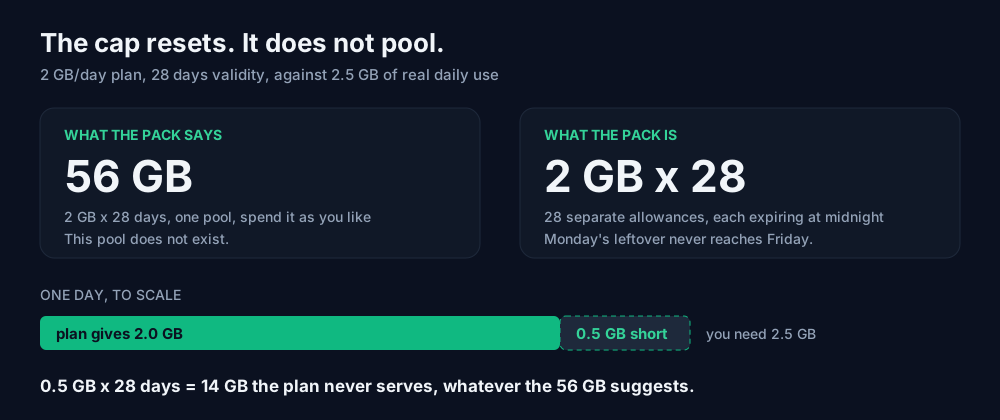
Half a gigabyte does not sound like a problem. It is a problem 28 times, and it never nets off against a light Sunday, because midnight deletes whatever you did not spend. That is the entire mechanic: the cap resets, it does not accumulate. A plan you finish early on Tuesday owes you nothing extra on Wednesday, and a plan you barely touch on Sunday hands nothing forward to Monday.
So the 56 GB figure describes the maximum the plan will ever serve, under the exact usage pattern of using precisely 2 GB every single day. Any other pattern and you get less.
What 64 Kbps actually costs
Every major Indian operator handles an exhausted daily limit identically. The connection stays up and the speed drops to 64 Kbps until midnight, on Jio, Airtel and Vi alike.
That sounds like a mild inconvenience and is not one. 64 Kbps carries WhatsApp text and roughly nothing else: no video at any resolution, maps that spin without ever drawing the route, data calls that fail to connect, images that arrive line by line. For anything you were doing when the cap hit, the phone is offline with the bars still showing.
Which is why a daily shortfall does not stay a shortfall. It becomes a purchase. You are standing at a bus stop needing a map, so you buy a booster, and the cost of the plan quietly stops being the price on the plan.
Boosters against the next tier up
Add-on data vouchers are priced per GB far above the base plan, and the rate swings hard with pack size. Small 5G add-ons around ₹61 for 6 GB work out to ₹10.17 a GB. Larger data vouchers land nearer ₹4 to ₹7 a GB. Those figures move every few months, so read your own operator's app rather than trusting a number in a blog post, mine included.
Take the ₹61 for 6 GB voucher against the 14 GB shortfall above. Vouchers sell whole, so you buy three of them, not 2.33 of them:
shortfall        = (2.5 - 2.0) x 28 = 14 GB
vouchers needed  = ceil(14 / 6)     = 3
booster spend    = 3 x 61           = ₹183
real cycle cost  = 349 + 183        = ₹532
cost per GB used = 532 / 70         = ₹7.60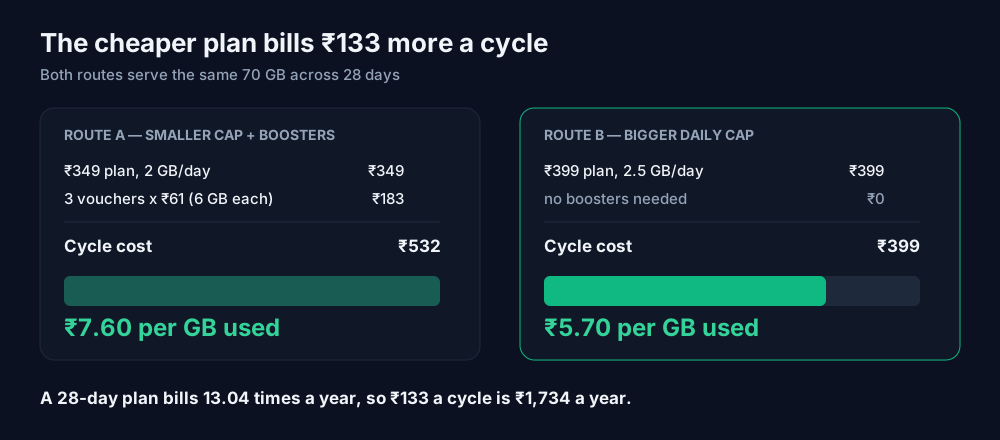
Now price the alternative. Airtel's 2.5 GB/day tier starts at ₹399 for 28 days, which covers the same 70 GB with nothing bought on top:
| Cycle cost | GB served | Per GB used | |
|---|---|---|---|
| ₹349 plan + 3 boosters | ₹532 | 70 | ₹7.60 |
| ₹399 plan, 2.5 GB/day | ₹399 | 70 | ₹5.70 |
The cheaper-looking plan costs ₹133 more per cycle. A 28-day plan bills 13.04 times a year rather than 12, so that is ₹1,734 a year for the privilege of starting from the smaller sticker price. The Mobile Data Usage Calculator runs this comparison on your own daily figure and your own operator's booster price, and reports the cost per GB you actually use rather than the cost per GB the pack claims.
One rule falls out of the arithmetic. If you are buying a booster most cycles, the answer is a bigger daily cap, not a bigger booster. Add-on data is priced as an emergency, and emergencies bought on schedule are just an expensive plan.
The reverse case, paying for headroom
The same maths runs the other way, and this side is quieter because nothing ever breaks.
Use 1.2 GB a day on that ₹349 plan and you consume 33.6 GB of the 56 GB you paid for. The 22.4 GB you never touch is not saved, refunded, or carried anywhere. Your effective rate is ₹10.39 per GB used, worse than the person who overshot and bought boosters.
| Daily use | GB used per cycle | Cost per GB used |
|---|---|---|
| 1.2 GB | 33.6 | ₹10.39 |
| 2.0 GB | 56.0 | ₹6.23 |
| 2.5 GB (with boosters) | 70.0 | ₹7.60 |
Before dropping a tier, check what else the pack carries. Unlimited 5G eligibility on Jio and Airtel generally attaches to plans at ₹349 and above with at least 2 GB daily, and the bundled OTT subscriptions on the pricier packs are worth real money if you would otherwise pay for them. A ₹349 plan judged purely on its data is being judged unfairly. Judge the data separately, then decide whether the rest is worth the difference.
For the whole household picture, mobile plus broadband plus DTH plus OTT, the Recharge Cost Calculator annualises all four heads and handles the 28-day cycle correctly instead of assuming 12 recharges a year.
Read your own daily average first
Every number above depends on one input, and it is the one people guess. A guessed daily figure produces a confident wrong answer, so pull the real one.
On Android it sits under Settings, Network and internet, SIMs, then app data usage. On iPhone, Settings then Mobile Data, where the running total needs a manual reset to be useful. Take a full week and divide by seven. One day is never representative.
Four ways the reading goes wrong:
A quiet day used as the average understates the shortfall, so the plan looks adequate while the boosters keep arriving. Counting only deliberate usage misses background app updates and cloud photo backup, which land on the same cap. Reading total GB off the pack instead of the daily cap is the original mistake this whole post is about. Ignoring hotspot days can throw the average completely, because a laptop tethered through one work day can outrun the phone's whole week.
Roughly, per hour: 4K video around 7 GB, 1080p around 3 GB, 480p about 700 MB, browsing and social feeds 100 to 300 MB depending on how much video the feed autoplays. Music streaming is negligible next to any of it. Which means a single settings screen sometimes closes the gap for free. Forcing video to SD on a phone-sized display, turning off autoplay and restricting app updates and photo backup to Wi-Fi can halve a daily figure without changing what you do with the phone. Try that before paying for a larger cap.
FAQ
Is a 2 GB/day plan for 28 days the same as 56 GB? No. It is 2 GB available on each of 28 days, and unused data expires at midnight. 56 GB is only the total if you use exactly 2 GB every single day. Any lighter day permanently reduces what the plan serves you.
Why do I run out of data when my pack says 56 GB? Because you exceeded the daily 2 GB, not the 56 GB. At 2.5 GB of real daily use you are 0.5 GB short every day, which is 14 GB across the cycle even though the headline number looks generous.
What happens after the daily data limit is exhausted? Speed drops to 64 Kbps until midnight and the connection stays active. Text messaging works. Video, maps and data calls effectively do not.
Can I carry forward unused daily data in Jio or Airtel? No. Daily-cap plans reset at midnight with no rollover. Only fixed-quota data vouchers hold their balance until used or expired.
Are data booster packs cheaper than upgrading the plan? Once per cycle, usually yes. Every cycle, no. At ₹61 for 6 GB you are paying ₹10.17 a GB, so three vouchers turn a ₹349 plan into ₹532, while a ₹399 plan with a 2.5 GB cap covers the same usage for ₹133 less per cycle.
Do add-on packs work without an active base plan? They need an active base plan. A data voucher supplements a plan, it does not replace one, and it activates when the daily allowance runs out.
How do I calculate the real cost per GB of my plan? Divide what you actually spend in a cycle, plan price plus any boosters, by the GB you actually use. Not by the GB the pack advertises. That single division makes a cheap-looking plan and an expensive-looking one comparable.
Does unlimited 5G solve the daily cap? On eligible plans the 5G data is separate from the daily 4G allowance, but eligibility is tied to plan price and daily cap, and it only applies inside 5G coverage on a 5G handset. On 4G or outside coverage, the daily cap is all you have.
Conclusion
Indian prepaid data is sold on a daily cap and compared on a monthly total, and the mismatch is where the money leaks. The headline GB figure is a ceiling that assumes perfectly even usage, which nobody has.
Read one week of your own usage, divide by seven, and price the shortfall or the waste against the next tier. If boosters are becoming a habit, the daily cap is too small, and the tier that looked expensive is the one billing you less per GB you actually use.
The Mobile Data Usage Calculator takes your daily figure, your plan's cap and price, and the booster you would really buy, then returns the effective cost per GB used so two plans can be compared on the same basis.
Sources
- Jio ₹349 prepaid plan: 2 GB/day, 28 days, unlimited calls, 100 SMS/day — TelecomTalk, 12 September 2026.
- Jio unlimited 5G eligibility on plans from ₹349 with at least 2 GB daily — Bajaj Finserv plan listing.
- Airtel prepaid plans with a 2.5 GB daily cap, starting at ₹399 for 28 days — 6 September 2026.
- Post-limit speed reduction to 64 Kbps until the daily reset — Jio support.
- Data vouchers queue behind an active plan and activate when the daily allowance is exhausted — Jio support.
- Booster pricing of ₹61 for 6 GB (₹10.17 per GB) is used illustratively; add-on pack sizes and prices change every few months, so verify the current rate in your operator's app. All per-GB and per-cycle figures here were computed from the plan prices cited above.