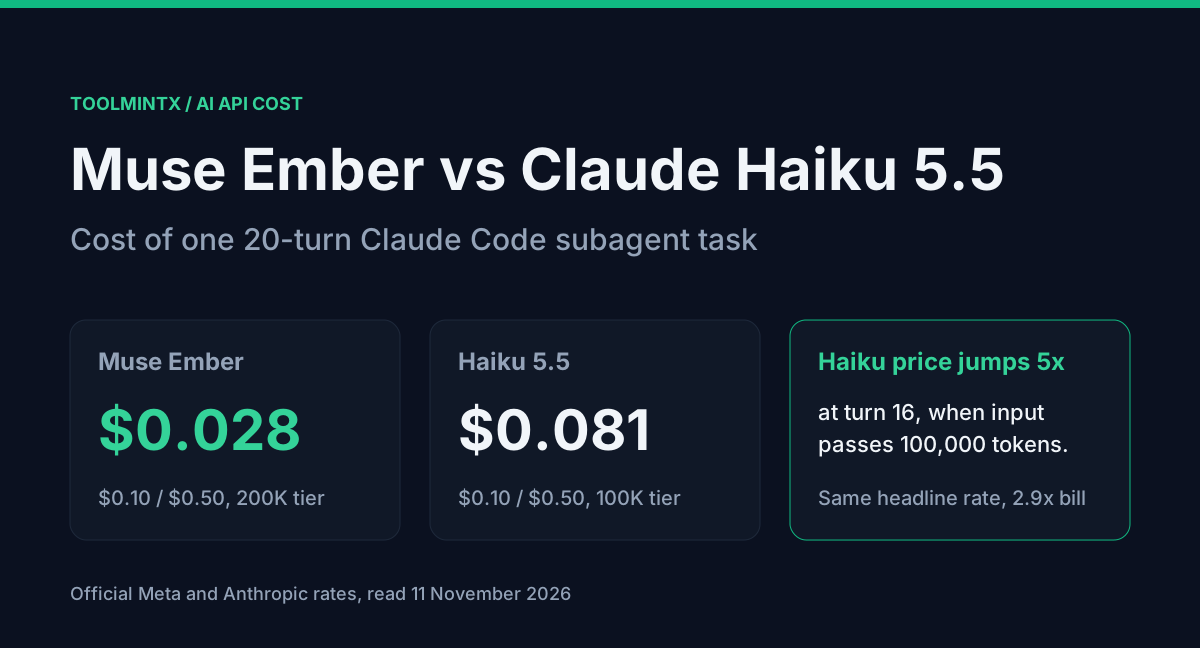
Meta's Model API now lists Muse Ember (muse-ember-1.0) at $0.10 per million input tokens and $0.50 per million output tokens. That is the same headline rate as Claude Haiku 5.5. Meta's own docs pitch Ember for the work Haiku usually gets inside a coding agent: subagents, tool calls, routing and commit messages. They even ship a Claude Code config that maps the haiku alias and the subagent model to Ember.
The headline rates match. The bills don't. Haiku 5.5 switches every request over 100,000 input tokens to a price five times higher, and a subagent's context crosses that line sooner than most people expect. Ember's line sits at 200,000. Below is one subagent task costed turn by turn from both official pricing pages, the Claude Code environment variables Meta publishes, and the two settings that decide whether the cheap model stays cheap.
Table of contents
- The two rate cards
- One 20-turn subagent task, costed
- Where each price line hits
- The Claude Code config Meta publishes
- A full session with five subagents
- Ember defaults to max reasoning effort
- FAQ
- Sources
The two rate cards
Prices per million tokens, read from Meta's and Anthropic's pricing pages on 11 November 2026.
| Line | Muse Ember, up to 200K input | Muse Ember, over 200K | Haiku 5.5, up to 100K | Haiku 5.5, over 100K |
|---|---|---|---|---|
| Input | $0.10 | $0.30 | $0.10 | $0.50 |
| Output | $0.50 | $1.50 | $0.50 | $2.50 |
| Cache read | $0.004 | $0.012 | $0.01 | $0.05 |
| 5-minute cache write | none | none | $0.125 | $0.625 |
Three differences show up before any arithmetic. Ember's cache read is $0.004, 40% of Haiku's. Ember has no cache-write charge, because Meta caches prompt prefixes automatically and bills only the read. And the two long-context lines differ in both height and position: Ember triples past 200K, Haiku quintuples past 100K.
Both providers bill the whole request at the higher tier once it crosses, cached tokens included. Meta's wording is that a request over 200K "is billed at the long-context rates in full, not only for the tokens past 200K". Anthropic's table splits Haiku 5.5 into "prompts up to 100,000 tokens" and "prompts over 100,000 tokens".
Ember is Standard mode only. Meta's discounted Contributor mode, which trades your prompts for training data, exists for Muse Spark but not for Ember or Muse Wonder.
One 20-turn subagent task, costed
The workload is a typical Claude Code subagent: the main agent hands it a bounded job, such as "find every caller of this function and update the signature". The subagent starts with a 40K-token prefix (system prompt, tool definitions, the brief and a few files). Each turn adds 3K new tokens of tool results and writes 1K tokens of output, which also stays in the context. So the input grows by 4K per turn: 43K on turn 1, 119K on turn 20.
Over 20 turns the subagent sends 1.62 million input tokens. Of those, 1.501 million are repeated prefix that a cache can serve, and 119K are new.
For Haiku 5.5 we assume Claude Code's usual pattern: each turn writes its new tokens to the 5-minute cache and reads the rest. For Ember, the new tokens bill as plain input and the rest as cache reads.
| Line | Muse Ember | Claude Haiku 5.5 |
|---|---|---|
| Cache writes | $0 | $0.02488 |
| Cache reads | $0.00600 | $0.03641 |
| New input | $0.01190 | $0 (billed as writes) |
| Output (20K tokens) | $0.01000 | $0.02000 |
| Task total | $0.0279 | $0.0813 |
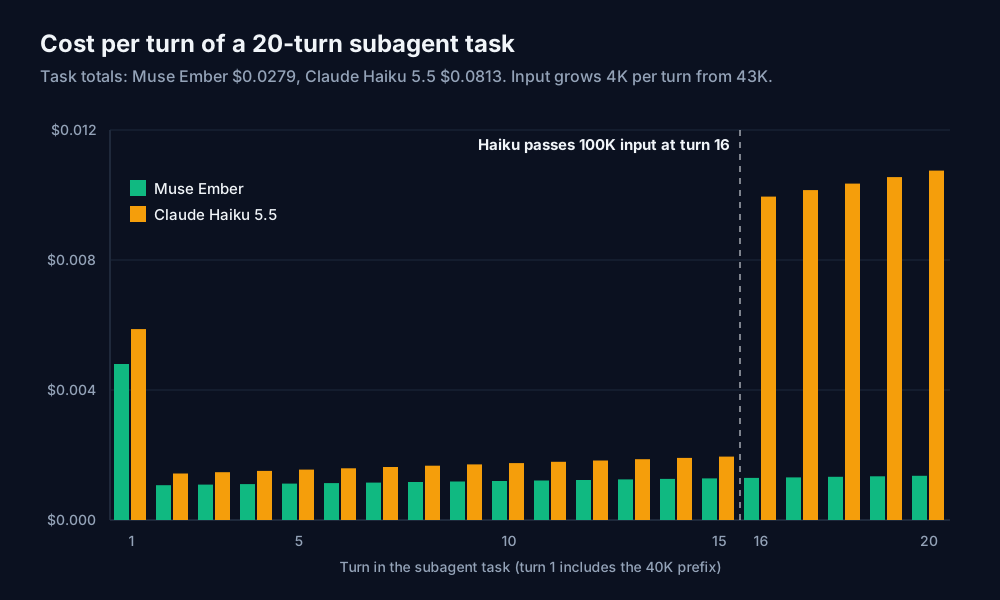
Haiku costs 2.9 times as much for the same task at the same headline price. Most of the gap comes from the last five turns.
Where each price line hits
Turn 15 sends 99K input tokens, so Haiku bills it at the low rates: $0.00195 for the turn. Turn 16 sends 103K. It now bills at $0.50 input, $0.05 cache read, $0.625 cache write and $2.50 output, and the turn costs $0.00995. That is about five times the previous turn for 4K more tokens.
Ember turns 16 to 20 cost $0.0013 to $0.0014 each, because 119K is still well under 200K.
Stop both runs at 15 turns and the gap almost closes: $0.0213 on Ember against $0.0295 on Haiku. The leftover difference is the cache read and the write fee. So the 100K line, not the rate card, is what makes Haiku expensive here.
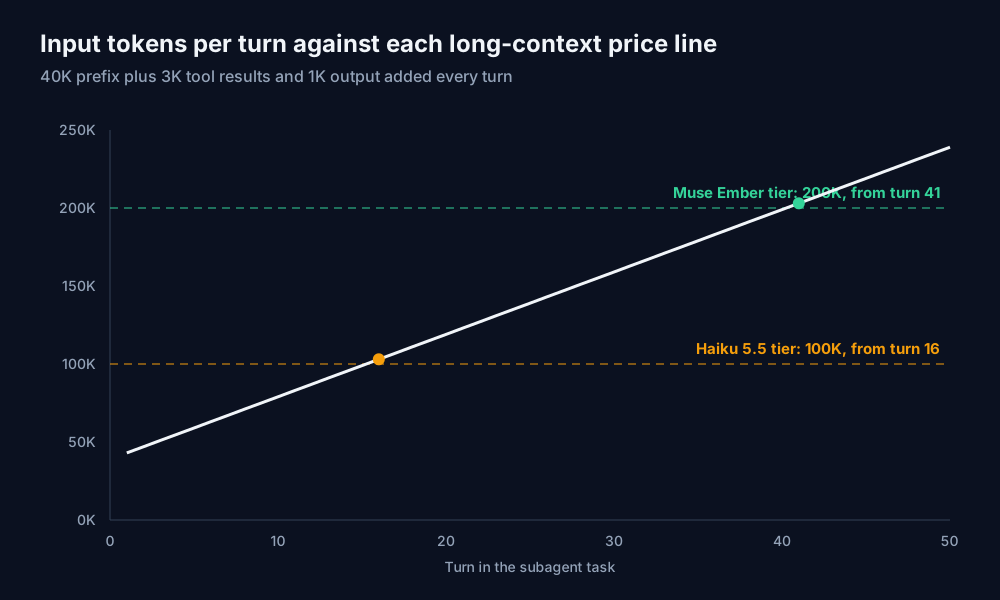
Ember has its own line. With the same 4K growth, turn 41 sends 203K tokens and jumps from $0.00168 to $0.00509. A 50-turn Ember task costs $0.1115; without the jump it would be $0.0761. A 50-turn Haiku task costs $0.4968.
What to do with this:
- Keep subagent briefs short. The prefix is the number you control. Cutting it from 40K to 20K moves Haiku's crossing from turn 16 to turn 21.
- Watch
usage.input_tokens(Anthropic) orcached_tokensandinput_tokens(Meta) on the subagent's last turn. If it regularly ends above 100K, Haiku is billing you at $0.50 input. - On a long job, have the subagent return early and let the main agent start a fresh one. A new subagent starts back at 40K.
You can check your own token shape in the API cost calculator, which now lists Muse Ember with both tiers in the note.
The Claude Code config Meta publishes
Meta's coding-agents guide connects Claude Code to Model API through its Anthropic-compatible Messages endpoint. These are the variables from that page, with your key in MODEL_API_KEY:
export ANTHROPIC_BASE_URL="https://api.meta.ai"
export ANTHROPIC_AUTH_TOKEN="$MODEL_API_KEY"
export ANTHROPIC_MODEL="muse-wonder-1.0"
export ANTHROPIC_DEFAULT_OPUS_MODEL="muse-wonder-1.0"
export ANTHROPIC_DEFAULT_SONNET_MODEL="muse-spark-1.3"
export ANTHROPIC_DEFAULT_HAIKU_MODEL="muse-ember-1.0"
export CLAUDE_CODE_SUBAGENT_MODEL="muse-ember-1.0"
export ENABLE_TOOL_SEARCH="true"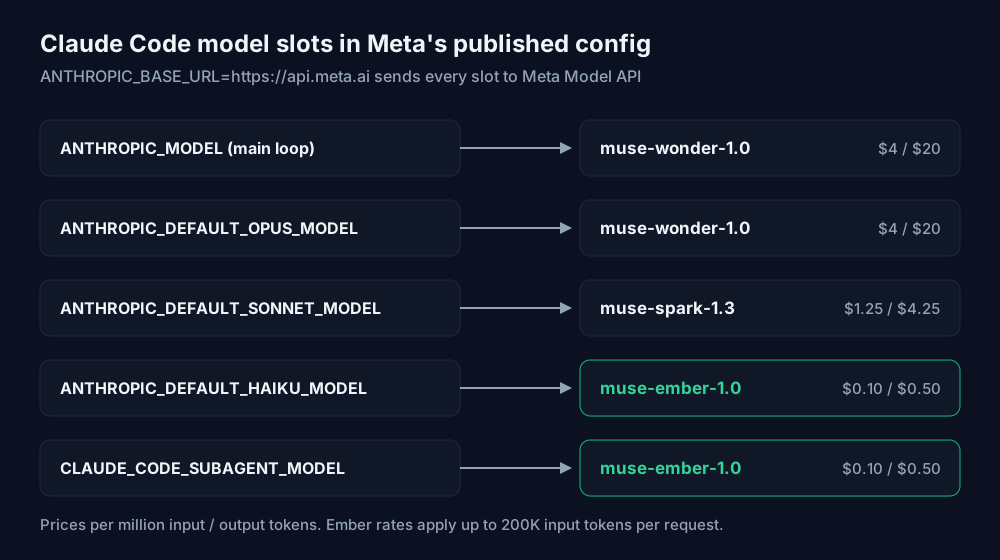
Four details in Meta's notes trip people up:
- The base URL has no
/v1. Claude Code appends/v1/messagesitself. - Use
ANTHROPIC_AUTH_TOKEN, which sends a bearer header.ANTHROPIC_API_KEYsendsx-api-key, which Model API does not use for auth. - Pin all five model variables. If one is missing, Plan Mode, background tasks or subagents try to call a Claude model that Meta doesn't serve.
- Claude Code turns off MCP tool search for hosts other than Anthropic by default.
ENABLE_TOOL_SEARCH="true"turns it back on.
Meta also warns that Claude Code may show a $0 cost with a custom provider, because it has no price metadata for Meta's models. Read spend from the Model API dashboard instead.
If you only want cheap subagents and want to keep Claude on the main loop, this config does not do that. ANTHROPIC_BASE_URL points every request at one host, so the main loop and the subagents have to come from the same provider unless you put a router in front.
A full session with five subagents
Take the main-loop session from our Fable 5.2 vs Opus 5.5 comparison: a 120K cached prefix, 60 turns, 3K new input and 1.5K output per turn. Add five subagent tasks shaped like the one above.
| Setup | Main loop | 5 subagents | Session |
|---|---|---|---|
| Opus 5.5 + Haiku 5.5 | $4.536 | $0.406 | $4.942 |
| Muse Wonder + Muse Ember | $4.416 | $0.140 | $4.556 |
| Sonnet 5.5 + Haiku 5.5 | $2.268 | $0.406 | $2.674 |
| Muse Spark 1.3 + Muse Ember | $1.820 | $0.140 | $1.959 |
Muse Wonder has the same $4/$20 rate as Opus 5.5 and the same $0.20 cache read. It comes out $0.12 cheaper only because Meta charges no cache write on the 120K prefix.
The subagent line is 3.1% of the Wonder plus Ember session and 8.2% of the Opus plus Haiku one. On a team running 440 sessions a month, the Wonder plus Ember setup costs $2,004.46 against $2,174.66. The model on the main loop still decides most of the bill. Ember saves real money only when subagent work is a big share of the session, such as batch jobs that fan out over hundreds of files.
Ember defaults to max reasoning effort
Meta's model page lists Ember's reasoning effort as "minimal" to "max" with "max" as the default. Muse Spark defaults to "high". Reasoning tokens count as output, so an Ember subagent with no effort set can write far more than the 1K tokens per turn in our table.
Each extra 1K output tokens per turn adds $0.0005 on an Ember turn under 200K. Over 20 turns that is $0.01, which would push our task from $0.0279 to about $0.038. That still undercuts Haiku, but it is a third more than the table shows. For routing, classification and commit messages, set a low effort level explicitly in the request.
Meta's guidance on where Ember fits is also narrower than "use it for everything cheap". The choose-a-model page sends hard single-shot coding problems, knowledge-heavy questions and visual coding to Muse Spark or Muse Wonder.
FAQ
Does Muse Ember support images and PDFs?
Yes. Meta lists text, image, video, audio and PDF input with text output, a 1,048,576-token context window and 524,288 max output tokens.
Does Ember need a cache key or cache breakpoints?
No. Meta caches matching prompt prefixes automatically. You can send prompt_cache_key to group similar requests at high volume, and cached_tokens in the response shows how many input tokens came from cache.
Is web search extra?
Yes, $2.50 per 1,000 search queries on top of token costs, the same rate as Muse Spark and Muse Wonder.
Sources
- Meta, "Pricing and rate limits" (dev.meta.ai/docs/pricing-rate-limits, read 11 November 2026): Muse Ember rates below and above 200K input tokens, whole-request tier billing, Standard mode only, Muse Wonder and Muse Spark rates, web search $2.50 per 1,000 queries.
- Meta, "Muse Ember" (dev.meta.ai/docs/muse-ember, read 11 November 2026): model ID, inputs, 1,048,576-token context, 524,288 max output, reasoning effort default
"max". - Meta, "Choose a model" (dev.meta.ai/docs/choose-a-model, read 11 November 2026): workload guidance, Muse Spark default effort
"high", Claude Code alias mapping. - Meta, "Use Model API with coding agents" (dev.meta.ai/docs/coding-agents, read 11 November 2026): Claude Code environment variables, bearer auth, pinned aliases,
ENABLE_TOOL_SEARCH, $0 cost display. - Meta, "Prompt caching and token counting" (dev.meta.ai/docs/prompt-caching, read 11 November 2026): automatic prefix caching,
prompt_cache_key,cached_tokens. - Anthropic, "Pricing" (platform.claude.com/docs/en/about-claude/pricing, read 11 November 2026): Haiku 5.5 rates for prompts up to and over 100,000 tokens, cache write and read rates, Opus 5.5 and Sonnet 5.5 rates.
- Task, session and monthly costs are calculated by ToolMintX from the official rates above. The workload shapes (40K subagent prefix growing 4K a turn, 120K main-loop prefix over 60 turns) are our assumptions.