inclusionAI put Ling-3.2-air on Hugging Face on 23 November 2026 under the MIT license. It's a 124B-parameter mixture-of-experts model with 5.5B active per token, it reads images and video, and its context runs to 262,144 tokens. Within a day bartowski had GGUF builds up, from a 27.75 GiB IQ1_S to a 74.87 GiB Q4_K_M.
Most VRAM guides would tell you a 75 GiB file needs 80 GB of GPU. For this model that advice is wrong in two directions. The KV cache is tiny, about 9 KiB per token, so long context costs almost nothing. The routed experts are huge, and on any consumer card most of them have to live in system RAM. Your RAM size decides which quant you can run, and the GPU decides how fast it goes.
I read the official config and safetensors headers, then parsed the tensor tables of three GGUF builds to get the numbers below.
Table of contents
- What inclusionAI shipped
- Where the 124B parameters sit
- KV cache per token
- GGUF sizes
- Offload plans for 12 to 32 GB cards
- Running it with llama.cpp
- Benchmarks from the model card
- FAQ
- Sources
What inclusionAI shipped
The official repo holds one FP8 checkpoint (block-wise E4M3, 128 x 128 blocks) in 13 shards, 129.26 GB in total. The vision tower, embeddings and output head stay in BF16. The card describes it as sharing "the same native multimodal architecture" as Ling-3.0-flash-VL, and the gains it claims are in workflow automation and reading professional documents.
inclusionAI's own serving recipe is a datacenter one: SGLang on four 141 GB GPUs (H20-3e or H200) at a 256K context, or eight 80 GB H100s. vLLM needs inclusionAI's fork, vllm-ling-v3, for now. Both recipes turn on MTP speculative decoding and the ling3 tool-call and reasoning parsers. Recommended sampling is temperature 1.0, top_p 0.95 and top_k 20, with thinking on.
Where the 124B parameters sit
The text model has 43 blocks. 42 are the main stack and the last one is a multi-token prediction (MTP) head used as a built-in draft model. Attention alternates in a 5:1 pattern: five Kimi delta attention (KDA) layers, then one gated multi-head latent attention (MLA) layer. That gives 35 KDA layers and 7 MLA layers at 5, 11, 17, 23, 29, 35 and 41.
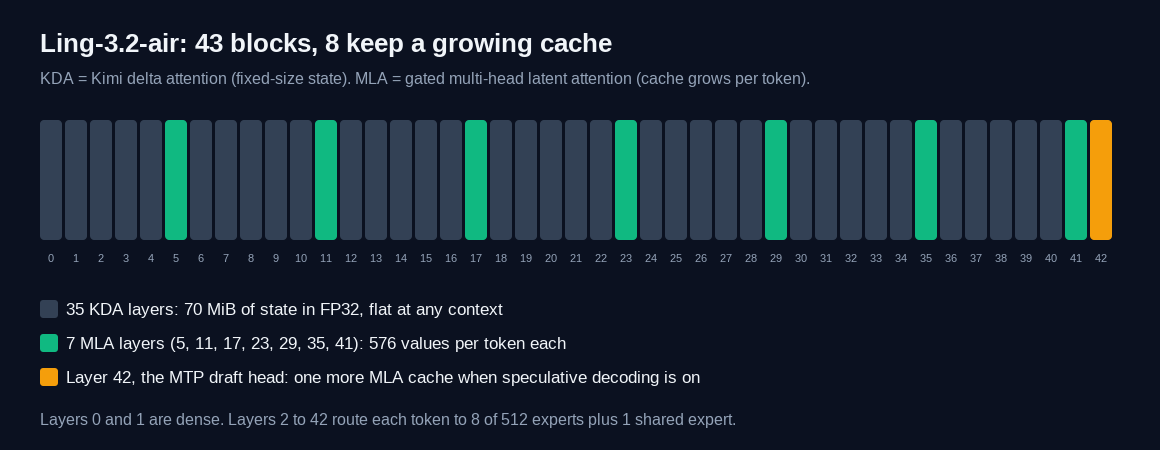
Layers 0 and 1 are dense. Every other layer sends each token to 8 of 512 routed experts plus one shared expert, and each expert is small (768 wide, against a hidden size of 2,560).
I summed the tensor shapes in the safetensors headers, leaving out the FP8 scale tensors:
| Part | Parameters | Share |
|---|---|---|
| Routed experts | 120.80B | 94.4% |
| MTP head (layer 42) | 3.07B | 2.4% |
| Attention, all layers | 2.43B | 1.9% |
| Embeddings and output head | 0.80B | 0.6% |
| Vision tower | 0.43B | 0.3% |
| Shared experts | 0.24B | 0.2% |
| Total | 127.92B |
Take out the MTP head and the vision tower and you land on about 124.4B, which matches the card's 124B. The point of the table is the first row. Almost everything you download is expert weights, and a token only touches 8 of 512 experts per layer, about 1/64 of them.
KV cache per token
Only the 7 MLA layers keep a cache that grows with context. MLA stores one compressed latent per token per layer instead of full keys and values: 512 values of kv_lora_rank plus 64 of rotary key, 576 in all. The GGUF metadata confirms it with attention.key_length = 576.
At FP16 that's 1,152 bytes per layer, or 8,064 bytes across the 7 MLA layers. Add the MTP layer when speculative decoding is on and you get 9,216 bytes, exactly 9 KiB per token.
Now run the usual formula on config.json, which lists 42 layers and 32 KV heads of 128. You get 672 KiB per token, 74.7 times too much.
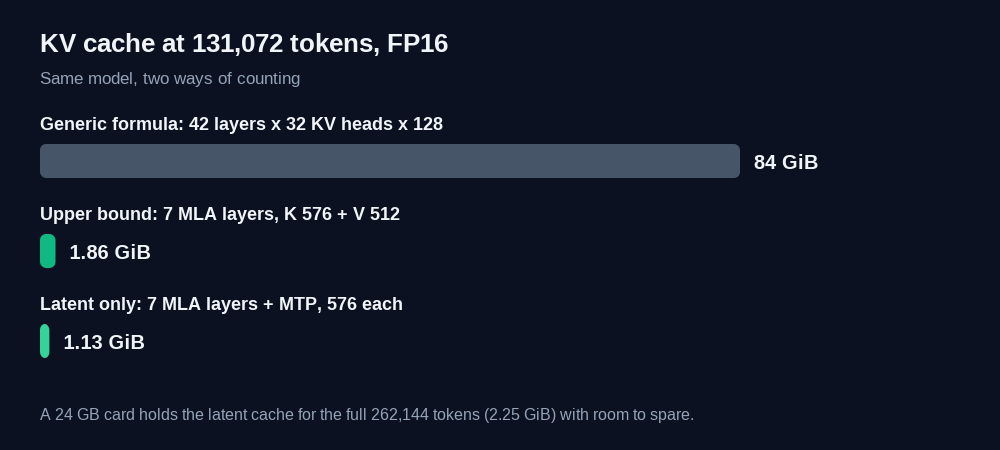
| Context | MLA latents + MTP | Upper bound (K 576 + V 512) | Generic formula |
|---|---|---|---|
| 32,768 | 0.28 GiB | 0.46 GiB | 21 GiB |
| 131,072 | 1.13 GiB | 1.86 GiB | 84 GiB |
| 262,144 | 2.25 GiB | 3.72 GiB | 168 GiB |
The upper-bound column covers a runtime that keeps a separate 512-wide value cache for the 7 MLA layers instead of reading values out of the latent. Even then, the full 262,144-token window costs less than 4 GiB.
The 35 KDA layers keep a fixed-size state instead. With 32 heads of 128 x 128 held in FP32, I estimate 70 MiB per request, and it doesn't grow with context.
So pick your context length freely. The memory problem is elsewhere.
GGUF sizes
bartowski's builds use llama.cpp release b12600, architecture bailingmoe3. Sizes from the Hugging Face file list:
| Build | Size | Size in GiB |
|---|---|---|
| IQ1_S | 29.80 GB | 27.75 GiB |
| IQ2_M | 47.05 GB | 43.82 GiB |
| Q3_K_M | 61.50 GB | 57.28 GiB |
| Q4_K_M | 80.39 GB | 74.87 GiB |
| Q5_K_M | 97.62 GB | 90.91 GiB |
| Q8_0 | 135.63 GB | 126.32 GiB |
| BF16 | 255.09 GB | 237.57 GiB |
| mmproj BF16 | 0.88 GB | 0.82 GiB |
The MTP layers are kept at Q4_0 in every build except Q8_0. That's 1.61 GiB. The mmproj file is needed only for image or video input.
I parsed the tensor tables of three builds and split each into the part that should sit on the GPU and the part that can go to RAM:
| Build | Non-expert weights | MTP head | Routed experts |
|---|---|---|---|
| IQ2_M | 3.42 GiB | 1.61 GiB | 38.78 GiB |
| Q3_K_M | 3.73 GiB | 1.61 GiB | 51.92 GiB |
| Q4_K_M | 3.74 GiB | 1.61 GiB | 69.51 GiB |
Non-expert weights, the MTP head, a 32K latent cache and the KDA state come to 5.70 GiB for Q4_K_M. That's the GPU floor. Everything above it is room for experts.
Offload plans for 12 to 32 GB cards
llama.cpp's --n-cpu-moe N keeps the expert weights of the first N layers in system RAM and puts the rest on the GPU. I filled each card from layer 41 downward until 15% of VRAM was left free, at a 32K context, text only, MTP head on the GPU. Expert layers differ in size because the quant mixes types, so I used the real per-layer byte counts from the files.
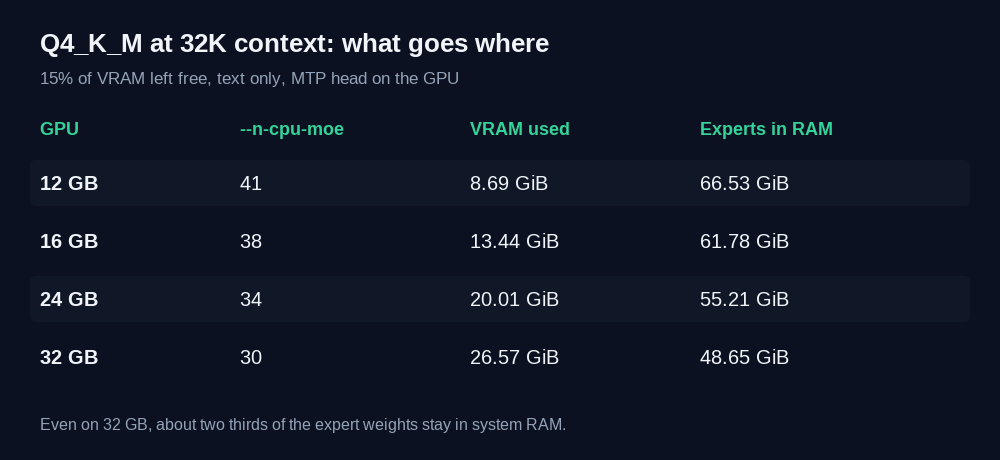
| GPU | Build | --n-cpu-moe | VRAM used | Experts in RAM |
|---|---|---|---|---|
| 12 GB | IQ2_M | 38 | 9.58 GiB | 34.58 GiB |
| 12 GB | Q3_K_M | 39 | 10.05 GiB | 47.57 GiB |
| 12 GB | Q4_K_M | 41 | 8.69 GiB | 66.53 GiB |
| 16 GB | IQ2_M | 34 | 13.29 GiB | 30.88 GiB |
| 16 GB | Q3_K_M | 37 | 12.47 GiB | 45.15 GiB |
| 16 GB | Q4_K_M | 38 | 13.44 GiB | 61.78 GiB |
| 24 GB | IQ2_M | 27 | 19.80 GiB | 24.37 GiB |
| 24 GB | Q3_K_M | 31 | 20.21 GiB | 37.40 GiB |
| 24 GB | Q4_K_M | 34 | 20.01 GiB | 55.21 GiB |
| 32 GB | IQ2_M | 19 | 27.00 GiB | 17.16 GiB |
| 32 GB | Q3_K_M | 26 | 26.26 GiB | 31.36 GiB |
| 32 GB | Q4_K_M | 30 | 26.57 GiB | 48.65 GiB |
Read the last column against your RAM, and leave room for the OS and the page cache. Q4_K_M needs a 96 GB machine on a 12 or 16 GB card, and a 64 GB machine is only enough from a 32 GB card up, with little to spare. Q3_K_M fits a 64 GB machine on any of these cards. IQ2_M fits a 48 GB machine on any of them, and a 32 GB machine only next to a 32 GB card.
Going to 131,072 tokens changes these plans by at most one layer, because the cache only grows by 0.84 GiB.
Speed follows the RAM side. Each token reads about 1/64 of the expert bytes. For Q4_K_M on a 24 GB card that's about 0.93 GB per token from RAM. Dual-channel DDR5-5600 moves 89.6 GB/s in theory, which caps generation near 97 tokens per second before any compute or overhead. Real llama.cpp numbers will come in well under that, but the ratio between builds holds: IQ2_M reads 0.41 GB per token on the same card, so it should run a little over twice as fast.
The AI VRAM calculator now has a Ling-3.2-air preset with the 9 KiB latent cache built in. Its weight estimate treats the model as dense and puts all of it on the GPU, so for this model trust its KV figure and use the table above for the weights.
Running it with llama.cpp
You need llama.cpp b12600 or newer. For Q4_K_M on a 24 GB card at 32K:
llama-server -hf bartowski/Ling-3.2-air-GGUF:Q4_K_M \
  -ngl 99 --n-cpu-moe 34 -c 32768 \
  --spec-type draft-mtp
-ngl 99 puts every layer on the GPU, then --n-cpu-moe 34 pulls the experts of the first 34 layers back to RAM (layers 0 and 1 are dense and have none). --spec-type draft-mtp turns on the MTP draft head, which the bartowski card recommends. If the server runs out of VRAM at load, raise --n-cpu-moe by one and try again. If you have VRAM left over, lower it.
-hf downloads the mmproj file too. Image input adds the projector plus the image tokens, so leave another gigabyte or so free if you plan to send images.
llama-server serves an OpenAI-compatible API and a chat UI on port 8080. Any client that works with LM Studio's local server works here after a base URL change. The bartowski card lists LM Studio and koboldcpp among the apps that load these files. Both bundle their own llama.cpp, so check that the bundled version is b12600 or later before you blame the model.
Benchmarks from the model card
All figures are inclusionAI's, compared with the previous model (Ling-3.0-flash-VL). I haven't seen an outside run yet.
| Benchmark | Previous | Ling-3.2-air |
|---|---|---|
| AutomationBench-AA | 15.7% | 61% |
| GDP.pdf all-pass | 8.4% | 16% |
| AA-Briefcase v1.1 Elo | 987 | 1340 |
| Terminal-Bench 4.0 | 0% | 27% |
The card puts the model at 23 on the Artificial Analysis Intelligence Index v5.0.1. On Harvey LAB-AA v1.1 it reports an 87.7% criterion pass rate. Its all-pass rate there is 8.3% before the material hallucination check and 0.8% after it, and inclusionAI printed that number itself. If you want it for legal or document work, check its claims against the source text.
Low-bit quants will move these numbers further. Nobody has published scores for the GGUF builds yet, so test the one you pick on your own prompts before you rely on it for agent work.
FAQ
Does thinking mode change memory use?
No. Thinking adds tokens, and each one costs the same 9 KiB of cache. A long reasoning trace that was a problem on a dense model is cheap here.
Can I run it on a Mac?
There are MLX conversions on Hugging Face already, at 2.75 and 4.62 bits per weight among others. On Apple Silicon the GPU and RAM are one pool, so the offload question goes away and the total file size is what has to fit.
Will REAP-pruned builds help?
They cut experts from each layer, so the files get smaller and less RAM is needed. They also change the model, and none of them publish scores against the full one yet.
Sources
- Hugging Face,
inclusionAI/Ling-3.2-airmodel card,config.json,model.safetensors.index.jsonand safetensors shard headers (read 25 November 2026): release date, license, architecture table, layer types and positions, expert counts, MLA dimensions, file size, SGLang and vLLM recipes, sampling settings, benchmark figures. - Hugging Face,
bartowski/Ling-3.2-air-GGUFmodel card, file list and GGUF headers of the IQ2_M, Q3_K_M and Q4_K_M builds (read 25 November 2026): llama.cpp release, file sizes, MTP quantization,--spec-type draft-mtp, mmproj files, GGUF metadata, per-tensor sizes. - Hugging Face model search for "Ling-3.2-air" (25 November 2026): MLX and REAP derivative builds.
- Parameter split, KV per token, KDA state estimate, offload plans and bandwidth figures are calculated by ToolMintX from the values above.