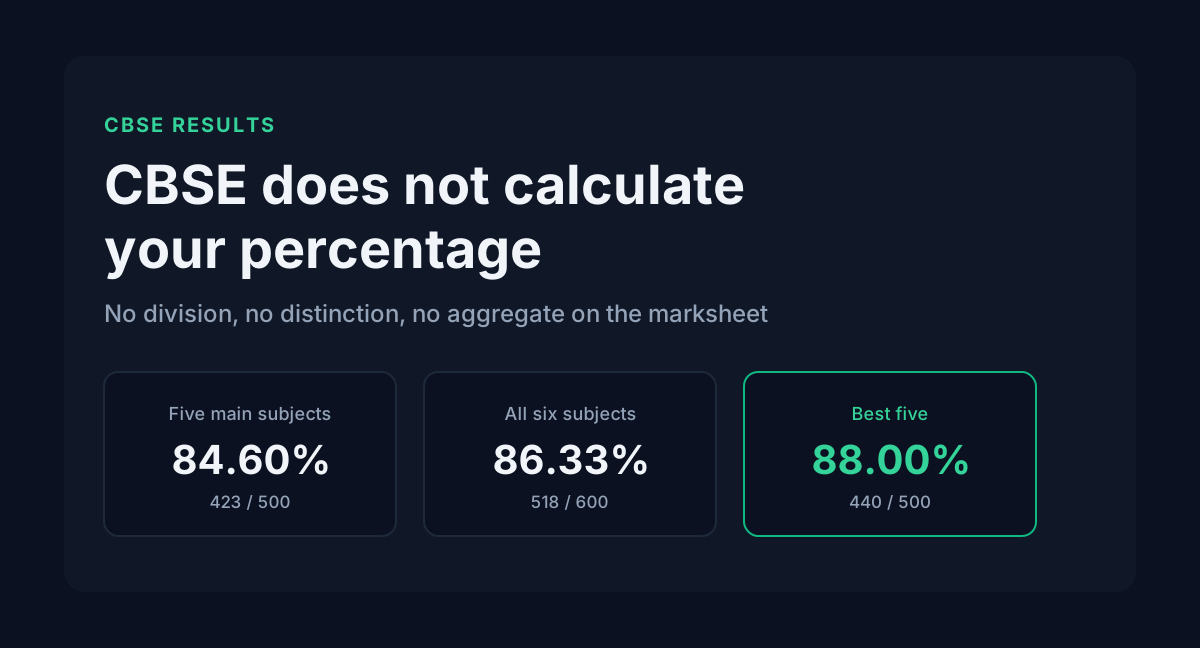
Nobody tells you this until you are filling an admission form at 11pm. Your CBSE marksheet has your marks, your grades, and no percentage anywhere on it. There is no division, no distinction, no aggregate line. That number you have been quoting since Class 10 was calculated by you, or by your school, or by whoever was admitting you, and the three of them may not agree.
This is not an oversight. CBSE stopped awarding it deliberately, and the Board says so plainly: it does not calculate, declare or inform the percentage of marks. Which leaves one marksheet capable of producing several different, equally defensible percentages.
Table of contents
- What CBSE actually removed
- One marksheet, three legal percentages
- Who decides which number is yours
- The best-of-five rule nobody owns
- Where the 9.5 multiplier came from
- The averaging mistake that costs real marks
- What to do before you type a number into a form
- FAQ
- Conclusion
- Sources
What CBSE actually removed
On 1 December 2023, CBSE Examination Controller Sanyam Bhardwaj confirmed the position that applies to Class 10 and Class 12 results from the 2024 exams onward. The wording matters, so here it is as issued: "No overall division, distinction or aggregate of marks shall be awarded."
It sits in sub-section 40.1(iii) of Chapter 7 of the Examination Bye-Laws. The same clarification adds two consequences that students usually miss. The Board does not calculate or declare a percentage, and where a candidate has offered more than five subjects, the decision on which five count is left to the admitting institution or the employer.
So the marksheet gives you subject-wise marks and grades. Everything above that layer, the aggregate and the percentage and the division, is now somebody else's arithmetic.
One marksheet, three legal percentages
Take a Class 10 student with six subjects, each out of 100. English 78, Hindi 92, Maths 88, Science 84, Social Science 81, and Artificial Intelligence 95 as the additional subject.
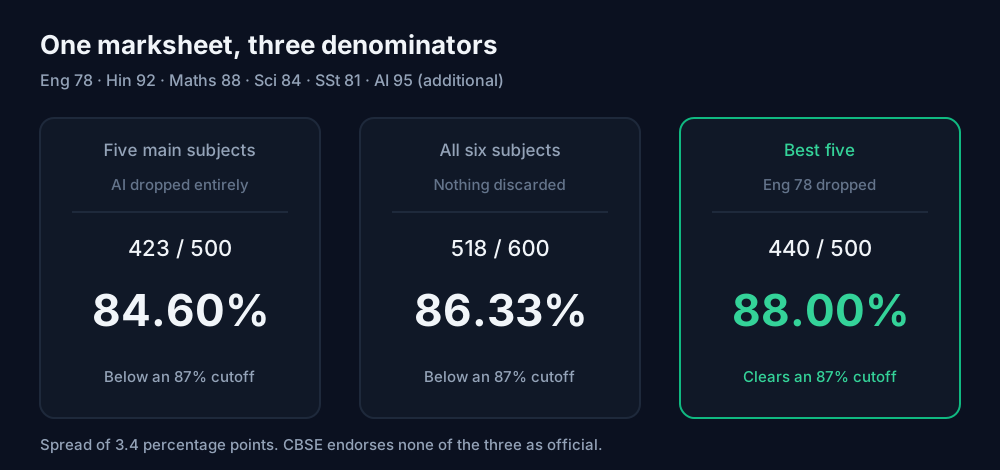
The marks total 518. What that becomes depends entirely on the denominator someone chooses.
| Basis | Subjects counted | Marks | Out of | Percentage |
|---|---|---|---|---|
| Five main subjects | Eng, Hin, Maths, Sci, SSt | 423 | 500 | 84.60% |
| All six subjects | every subject offered | 518 | 600 | 86.33% |
| Best five | drops English (78) | 440 | 500 | 88.00% |
Same student, same answer sheets, a spread of 3.4 percentage points. If the college cutoff is 87%, two of those three numbers are rejections and one is an admission.
None of the three is a trick. The five-subject figure ignores the additional subject the way the old scholastic-five convention did. The all-six figure is the honest arithmetic on everything sat. The best-five figure drops the weakest paper, which is the convention most Indian schools quote. CBSE endorses none of them as the official one, because there is no longer an official one.
Who decides which number is yours
The chain of authority is shorter than people assume, and you are not at the top of it.
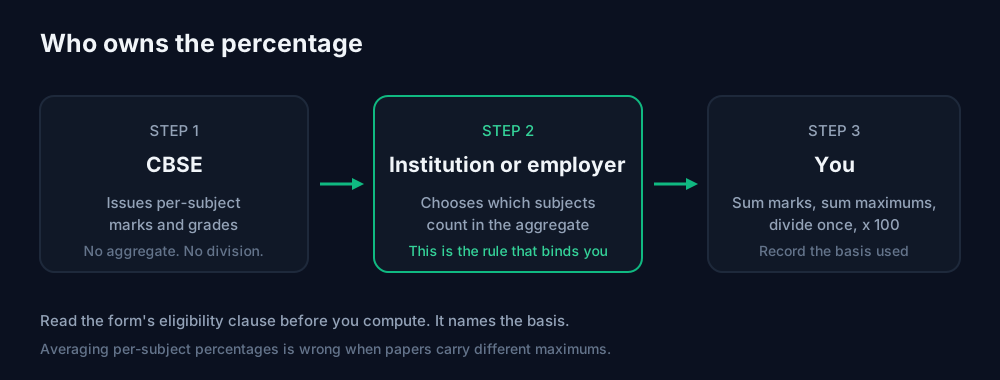
CBSE issues per-subject marks and grades and stops. The admitting institution or employer sets the rule, including which subjects count when you have offered more than five. You then do the arithmetic to match whatever rule they published.
That ordering is the practical takeaway. Before you compute anything, find the admission form's own definition of aggregate. Most Indian universities print it in the eligibility clause, often as "best of five including English" or "aggregate of all subjects". Once you have that sentence, the percentage is one division, and our percentage and marks calculator will do it without a spreadsheet: enter the marks you are counting as obtained and the matching maximum as total.
What you cannot do is pick the flattering basis and stay quiet about it. Quoting 88% computed best-of-five to an institution whose form says all-subject aggregate is a misstatement on a legal document, not a clever optimisation.
The best-of-five rule nobody owns
Best-of-five is real in the sense that almost everyone uses it. It is not real in the sense of being a CBSE rule. The Board's own clarification pushes the decision outward to institutions, which is why the rule's details vary by who you ask.
The common version runs like this: one language, usually English, plus the four highest-scoring remaining subjects. A sixth or additional subject gets counted only when it beats one of the five, which is why a strong score in Artificial Intelligence or a skill subject can quietly lift an aggregate by two or three points.
The variation is in the language clause. Some institutions force English into the five regardless of score. Apply that to our example student and English 78 must stay, so the drop falls on Social Science 81 instead, giving 437 out of 500, or 87.40%. That is a fourth number from the same marksheet, and it is the one that sits exactly on an 87% cutoff.
I find this genuinely uncomfortable as a system. A student's headline number depends on a clause in a form they may never have read carefully, and the difference is large enough to change where they study.
Where the 9.5 multiplier came from
If you have an older marksheet with CGPA on it, the folk formula is percentage = CGPA x 9.5. CGPA 9.2 becomes 87.4%.
The 9.5 is not arbitrary. CBSE looked at students in the A1 band, which covered 91 to 100 marks, and found the average score landed near 95. A1 carried a grade point of 10, so 95 divided by 10 gives 9.5 as the conversion factor.
Two cautions. The multiplier is an average across a band, so it is an estimate for any individual, not a recovered exact mark. And CGPA is not printed on current Class 10 marksheets, so for a recent result this formula has nothing to consume. Use your actual marks.
The averaging mistake that costs real marks
This one is independent of any board rule, and it is the error I see most often.
When subjects carry different maximum marks, averaging the per-subject percentages gives the wrong answer. Suppose 80% on a 100-mark paper and 50% on a 40-mark paper. Averaging the percentages gives 65%. The correct aggregate sums the marks and sums the maximums: 80 plus 20 is 100 obtained, out of 140, which is 71.43%.
The gap is 6.43 percentage points, and it appears because averaging silently treats the 40-mark paper as if it were worth as much as the 100-mark one. Sum first, divide once. The two methods agree only when every paper carries the same maximum, which is exactly why the six-subjects-of-100 example above works out cleanly either way.
What to do before you type a number into a form
Read the form's eligibility clause and find its definition of aggregate. That sentence, not convention and not what your friends are quoting, is the rule you compute to.
Then sum the marks for only those subjects, sum their maximums, and divide once. Keep the figure the arithmetic gives you. Rounding 86.33% up to 87% to clear a cutoff is the kind of thing that surfaces during document verification, when the marksheet is in front of someone with a calculator.
If a form asks for a percentage and defines nothing, the all-subjects aggregate is the defensible default, because it is the only basis that discards no information. Write down which basis you used. When three institutions ask for three different figures from one marksheet, and they will, you want a note rather than a memory.
FAQ
Does CBSE give a percentage on the Class 10 or 12 marksheet?
No. Under the Examination Bye-Laws the Board awards no overall division, distinction or aggregate, and it states that it does not calculate, declare or inform the percentage of marks. The marksheet carries per-subject marks and grades only.
Then who calculates my CBSE percentage?
You do, to the rule your admitting institution or employer sets. CBSE's clarification explicitly assigns that calculation to the institution or employer where a percentage is needed for higher education or employment.
Is best-of-five an official CBSE rule?
No. CBSE leaves the choice of which five subjects count to the admitting institution or employer when a candidate has offered more than five. Best-of-five is a widely used institutional convention, not a Board rule, and its details, especially whether English is compulsory in the five, vary between institutions.
How do I calculate percentage from marks?
Divide total marks obtained by total maximum marks and multiply by 100. For 440 out of 500 that is 88.00%. Sum across subjects before dividing rather than averaging per-subject percentages, or unequal paper weights will distort the result.
What is the CBSE passing mark per subject?
33%. On a 100-mark subject that is 33 marks, counted on the aggregate of theory and internal assessment for that subject. Passing is a per-subject condition, so it is unaffected by whichever aggregate basis an institution later applies.
Can I use my additional subject to improve my percentage?
Under a best-of-five rule, yes, when it scores higher than one of your other five. In the example above, Artificial Intelligence at 95 replaces English at 78 and lifts the figure from 84.60% to 88.00%. Whether that substitution is allowed depends on the institution's clause, not on CBSE.
Conclusion
The number you have been calling your percentage was never issued to you. CBSE hands over marks and grades, and the aggregate is assembled downstream by whoever is reading your application.
That makes one habit worth keeping. Find the rule in the form, compute to it exactly, and record which basis you used. Our percentage and marks calculator handles the division and flags an obtained score above the total, which is the typo that produces impossible percentages on real forms. The judgment it cannot make for you is which subjects belong in the sum, because that answer lives in the admission form, not on the marksheet.
Sources
- CBSE Examination Bye-Laws, Chapter 7, sub-section 40.1(iii), on no overall division, distinction or aggregate of marks being awarded.
- Statement by CBSE Examination Controller Sanyam Bhardwaj, 1 December 2023, confirming the position for Class 10 and Class 12 board exams and the transfer of best-five determination to the admitting institution or employer.
- CBSE notification on calculation of percentage of marks, confirming the Board does not calculate, declare or inform the percentage, and that calculation for higher education or employment may be done by the admitting institution or employer.
- AACRAO EDGE emergent-news summary of the CBSE position, citing sub-section 40.1(iii) of Chapter 7 of the Examination Bye-Laws, January 2024.
- Origin of the 9.5 CGPA multiplier: CBSE's A1 band (91 to 100 marks) averaging near 95 against a grade point of 10.