Short Intro
If you noticed Elon Musk and related AI terms rising in today's Google Trends mix, the reason is not just courtroom drama. The more useful story is that a technical term most non-specialists rarely think about suddenly became part of a very public fight in AI.
Recent reporting says Elon Musk testified that xAI used OpenAI models, at least in part, to help train Grok through model distillation. That matters because distillation sits at the intersection of engineering efficiency, product competition, terms of service, and AI ethics. It is common enough that many builders understand the idea, but controversial enough that public admissions still land hard.
For readers, the real value is not gossip. It is understanding what distillation actually is, why this specific moment is trending, what it changes for developers and AI companies, and how teams should think about training data, evaluation pipelines, and model provenance more carefully from here.
Table of Contents
- Why this is trending today
- What happened in the xAI and OpenAI story
- What model distillation actually means
- Why companies use distillation
- Why this case feels different
- What AI builders should learn right now
- Practical examples
- FAQ
- Conclusion
Why this is trending today
On May 5, 2026, Google's daily trend signals included Elon Musk among widely searched topics, and that search interest overlaps with fresh reporting around his testimony in the OpenAI case. The technology angle is especially notable because the story is not simply about Musk versus OpenAI as personalities or companies. It is about how AI systems are actually built and improved behind the scenes.
That is why this trend deserves a proper tech explainer.
Search spikes often flatten important details into one catchy line. In this case, the catchy line is that xAI used OpenAI models to train Grok. The important detail is the method being discussed: distillation.
What happened in the xAI and OpenAI story
Multiple reports published around April 30 and May 1 said Musk acknowledged in court that xAI used OpenAI models in a distillation-style training process for Grok, describing the practice as standard in the industry. Reporting around the same hearing also placed that admission inside the larger legal fight over OpenAI's evolution from its nonprofit roots into a massive commercial AI company.
There are still things ordinary readers should keep straight:
- the courtroom reporting is fresh, but not every technical detail of xAI's internal pipeline is public
- the public summaries do not mean we now have a full engineering blueprint for how Grok was trained
- "used OpenAI models" can cover a range of behaviours, from evaluation-style teacher output usage to more systematic student-model training
So the safest reading is this: the story is significant, but careful wording still matters.
What model distillation actually means
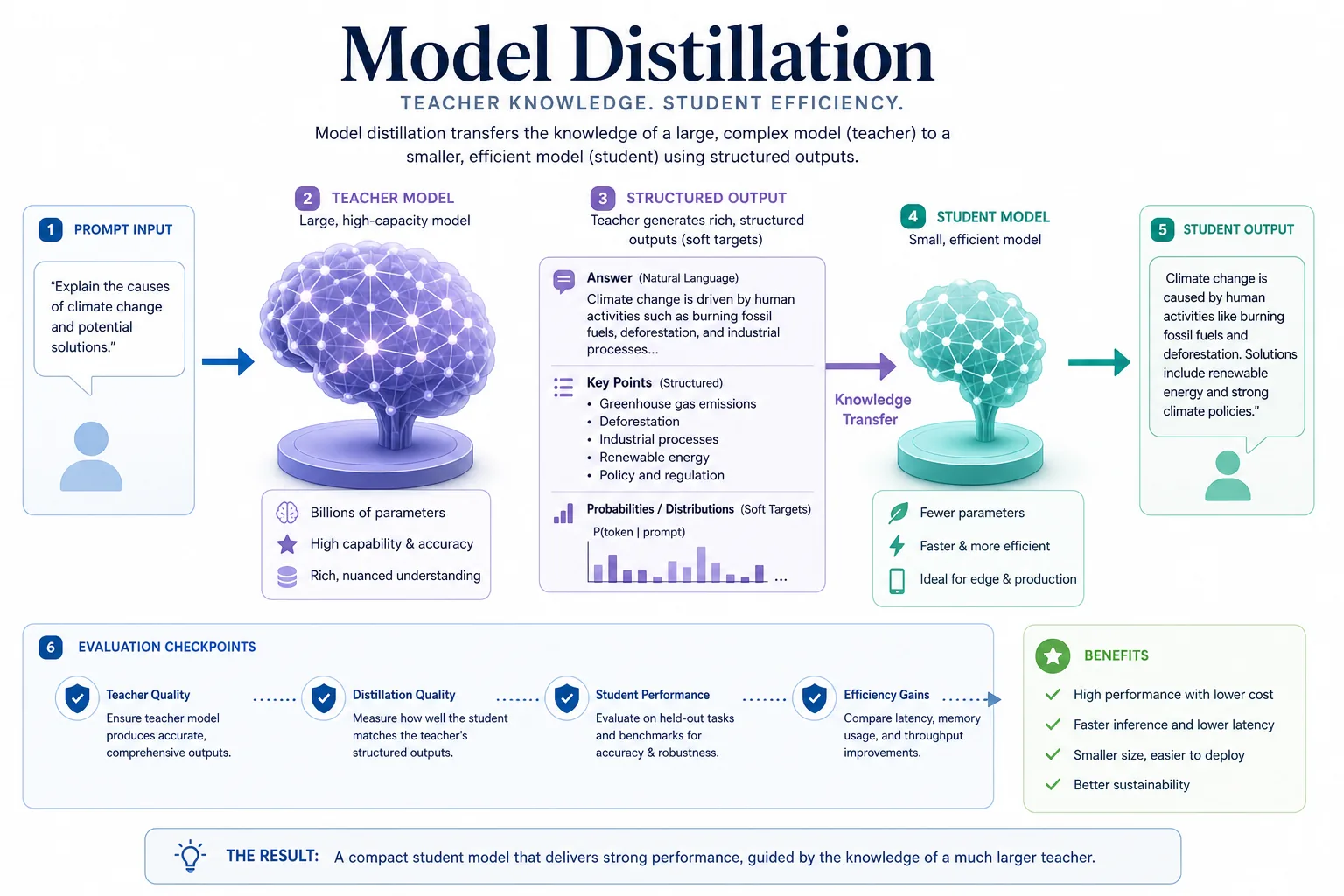
Model distillation is the process of using a stronger, larger, or otherwise useful "teacher" model to help train a "student" model. The student does not necessarily copy the teacher directly. Instead, it learns from the teacher's outputs, preferences, reasoning style, or response patterns in ways that can make the student cheaper, smaller, faster, or more specialised.
That concept is not new. Distillation has been part of machine learning for years. What makes it more controversial in modern generative AI is that frontier model outputs are expensive, commercially valuable, and often governed by restrictive platform terms.
In simple terms, distillation can look like this:
- You create or collect prompts.
- You ask a powerful model to answer them.
- You treat those outputs as valuable training or supervision signals.
- You fine-tune or train another model to behave more like the teacher on those tasks.
This can be useful for several reasons.
1. Cost
A smaller model that imitates some of a stronger model's behaviour can be much cheaper to run.
2. Speed
A distilled student can respond faster and work better in products that need low latency.
3. Domain fit
Companies can distil behaviour for support, coding, classification, summarisation, or safety workflows instead of trying to reproduce a whole frontier system.
4. Local deployment
Distillation can help create models that are realistic to deploy on edge devices, company hardware, or limited-cost inference setups.
Why companies use distillation
From an engineering point of view, distillation is attractive because it turns expensive intelligence into something more operationally manageable.
If a team already knows a frontier model performs well on a certain task, they may not want to keep paying frontier-model costs forever. They may want a smaller model that captures enough of the behaviour to run at scale. That is one reason distillation keeps appearing in discussions about local AI, enterprise inference budgets, and product cost control.
This is also why the issue is larger than one courtroom exchange. AI companies are all trying to answer similar questions:
- what must stay frontier-only?
- what can be compressed into a cheaper model?
- what training sources are technically effective but contractually risky?
- how do you prove your model lineage if regulators, partners, or customers ask?
Those are not abstract questions anymore.
Why this case feels different
Distillation itself is not shocking. Publicly admitting it in such a high-profile rivalry is what makes this story travel.
There are at least four reasons this specific moment stands out.
1. It exposes a real industry tension
AI companies want open competition, but they also want to protect the value of their model outputs. Those two instincts collide quickly once one model becomes training fuel for another.
2. It turns a technical workflow into a legal and reputational issue
Even if a practice is common, that does not mean it is uncontroversial. Contracts, terms of service, and platform expectations still matter.
3. It changes how people hear future accusations
When labs complain about distillation or synthetic data misuse elsewhere, audiences now have a more concrete reference point. That could affect credibility across the industry.
4. It pushes provenance into the foreground
Customers and enterprise buyers are becoming more sensitive to where model capabilities come from, how they were obtained, and whether that lineage could create legal or commercial risk later.
What AI builders should learn right now
If you build with AI, the useful response is not to take sides like a fan. It is to tighten your process.
Step-by-Step Takeaways
1. Separate evaluation from training
Using a stronger model to benchmark outputs is different from using those outputs systematically for training. Teams should document that boundary clearly.
2. Keep source records
If prompts, outputs, synthetic labels, or red-team responses feed into model improvement, record where they came from and under what permissions. This will matter more over time, not less.
3. Read API and platform terms carefully
A workflow that is technically easy may still be contractually risky. AI builders should treat terms of use as part of system design, not as legal fine print to revisit later.
4. Build a provenance habit early
You do not need a giant governance department to start doing this. Even a lean team can maintain:
- dataset origin notes
- prompt source notes
- output lineage logs
- training-run summaries
- human review checkpoints
5. Distil with a specific purpose
The smartest distillation projects are narrow. They try to transfer a useful behaviour for a defined workload, such as support triage, PII masking, code completion style, or document classification. They do not chase a vague goal of copying an entire flagship assistant.
6. Use utility tooling to clean your supervision pipeline
This is where ToolMintX-style workflows fit naturally. If you are preparing text corpora, comparing teacher and student outputs, cleaning extracted PDFs, normalising CSV fields, or formatting structured prompt sets, lightweight browser-based utilities can reduce pipeline mess without adding another cloud dependency.
Practical examples
Example 1: Support automation
A company uses a stronger model to create high-quality draft responses for a few thousand support tickets, then fine-tunes a smaller internal model to match that tone and structure. That is a classic distillation-style workflow, and it needs careful source tracking.
Example 2: Code-assistant refinement
A team benchmarks a frontier coding model against its own local model, studies where the local one fails, then creates a narrow supervised dataset to improve bug-fix suggestions. This can be useful, but only if the team is clear about what signals it is allowed to reuse for training.
Example 3: Privacy and compliance workflows
An enterprise wants a smaller local model for redaction, document routing, or contract tagging. Distillation can make sense here because the target task is narrow, repeatable, and cost-sensitive.

FAQ
Is model distillation illegal?
Not inherently. The problem depends on how it is done, what data or outputs are used, which contracts apply, and how the resulting model is commercialised.
Does this mean Grok simply copied ChatGPT?
That would be too simplistic. Distillation is not the same as cloning an entire product. It usually means learning from outputs or behaviours in a more selective way. The exact details of xAI's process are still not fully public.
Why are people paying so much attention now?
Because the admission reportedly happened in a high-profile legal fight involving some of the most visible AI companies and personalities in the world. That pushes a normally technical topic into mainstream attention.
Why should smaller AI teams care?
Because the underlying lesson is about process discipline. As model ecosystems get more competitive, data and output lineage will matter more for enterprise trust, partnerships, and long-term defensibility.
Is distillation always bad?
No. It is a useful machine learning technique. The real question is whether it is being done with the right permissions, documentation, and scope.
Conclusion
The reason this story matters is not that one billionaire said something surprising in court. It matters because it reveals how much value now sits inside model outputs, training shortcuts, and the blurry line between acceptable learning and contested reuse.
For builders, the practical lesson is simple. Distillation is powerful, but it is not a free pass. If you use stronger models to shape weaker ones, be specific, document your pipeline, understand your permissions, and design for provenance from the start. That is the part of today's trend that will still matter after the headlines move on.
Sources: TechCrunch, WIRED, and Semafor.