From 15 October 2026, a shop taking ₹2,001 on UPI receives less than a shop taking ₹2,000. Not one rupee less. Seven rupees less.
That is the part of the new merchant discount rate worth understanding before the numbers start showing up in settlement reports. NPCI notified the framework on 15 September 2026, and it applies to some person-to-merchant payments only. Consumers pay nothing. Money you send to a friend, a relative, or your own second account is still free at any amount.
Table of contents
- What changes on 15 October
- The rates, in one table
- Why the percentage on the whole amount matters
- The shape of your takings, not the total
- Who is exempt, and the three-month rule
- Special sectors at a flat ₹5
- What sits outside the framework
- The argument on both sides
- What is still unconfirmed
- FAQ
- Conclusion
- Sources
What changes on 15 October
Three sentences cover it.
Customers are not charged anything, and UPI apps are not permitted to add a platform fee to a payment. Person-to-person transfers stay free regardless of size. What changes is that on certain merchant payments above ₹2,000, the merchant's bank or payment provider deducts a fee before settling the money, the way card acceptance has always worked.
Merchants are also not permitted to pass that fee on to the customer. The posted price is what the customer pays, so a shop cannot legitimately add 0.4% at the counter for paying by UPI.
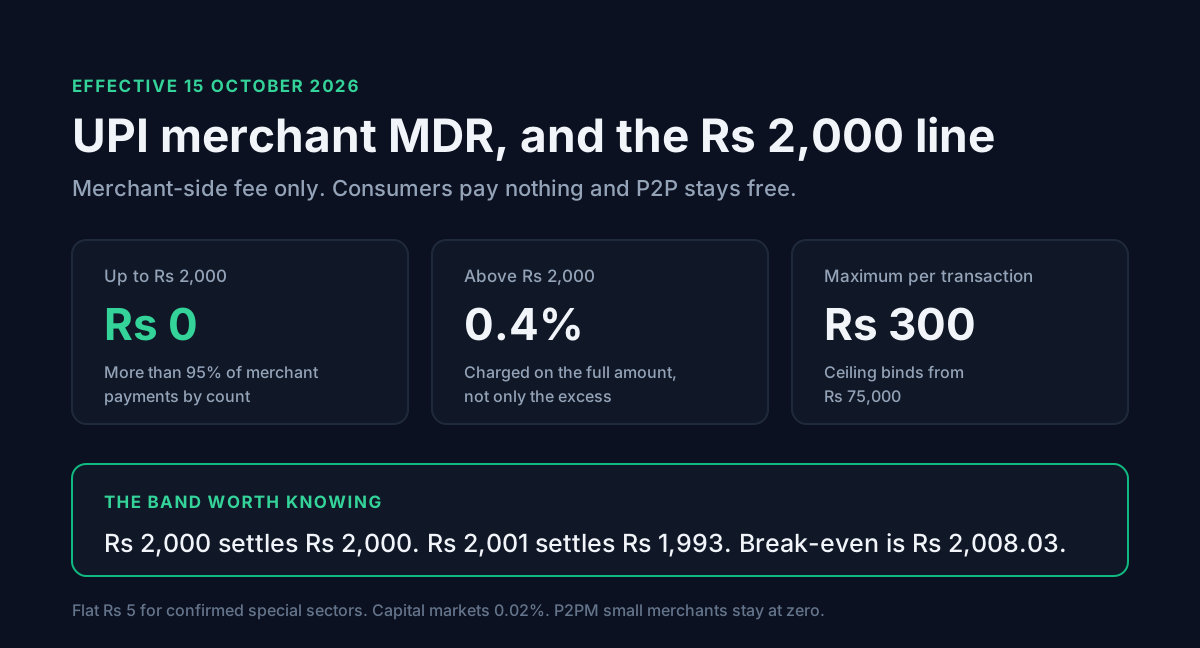
By NPCI's own count, payments up to ₹2,000 are more than 95% of P2M volume, so the fee touches a small slice of transactions and a much larger slice of value. For scale, UPI carried 2,451 crore transactions worth ₹29.9 lakh crore in August 2026.
The rates, in one table
| Category | Up to ₹2,000 | Above ₹2,000 | Maximum per transaction |
|---|---|---|---|
| Standard merchant (P2M) | ₹0 | 0.4% of the full amount | ₹300, from ₹75,000 |
| Confirmed special sectors | ₹0 | Flat ₹5 | flat fee, no percentage |
| Capital markets | ₹0 | 0.02% | ₹300, reached near ₹15,00,000 |
| P2PM small merchant | ₹0 | ₹0 while classified | not applicable |
NPCI's worked examples: a ₹3,000 payment costs ₹12, ₹50,000 costs ₹200, and ₹1,00,000 costs ₹300 rather than ₹400, because the ceiling has already bound by then.
Those rates appear once in this post on purpose. Everything below is about what they do to real takings.
Why the percentage on the whole amount matters
Once a payment crosses ₹2,000, the 0.4% applies to the entire amount, not to the part above ₹2,000. This is the single most common misreading, and it creates a short band where charging more leaves you with less.
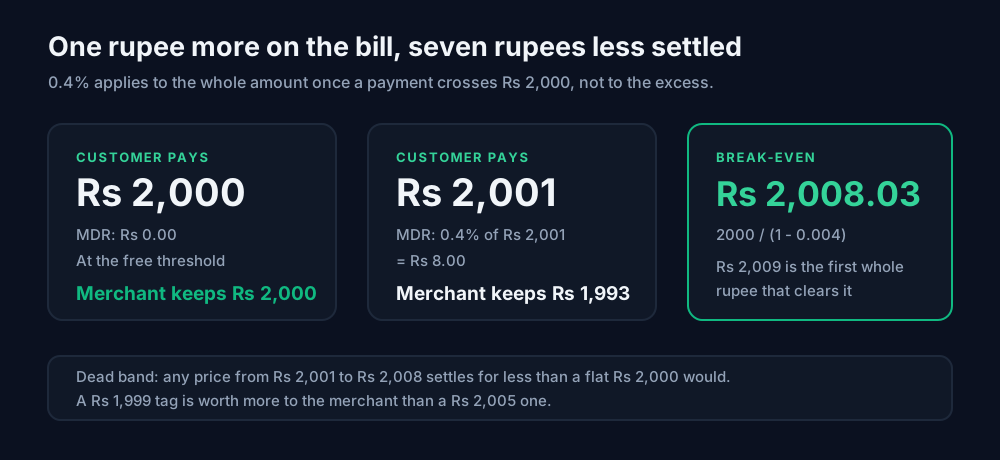
At ₹2,000 the fee is zero and you keep ₹2,000. At ₹2,001 the fee is 0.4% of ₹2,001, which is ₹8.00, so you keep ₹1,993. One rupee more on the bill, seven rupees less in the account.
Break-even is 2000 / (1 - 0.004), or ₹2,008.03. So ₹2,009 is the first whole rupee that clearly beats a flat ₹2,000 payment. Anything you price between ₹2,001 and ₹2,008 nets you less than pricing at ₹2,000 would have.
For a merchant who sets their own prices, that band is worth knowing. A ₹1,999 tag settles higher than a ₹2,005 tag. If you want to check your own price points rather than these, the UPI MDR Calculator works the fee and the net settlement per transaction, entirely in your browser.
The shape of your takings, not the total
Because the ₹300 ceiling is per transaction, two merchants collecting identical monthly totals can pay very different fees.
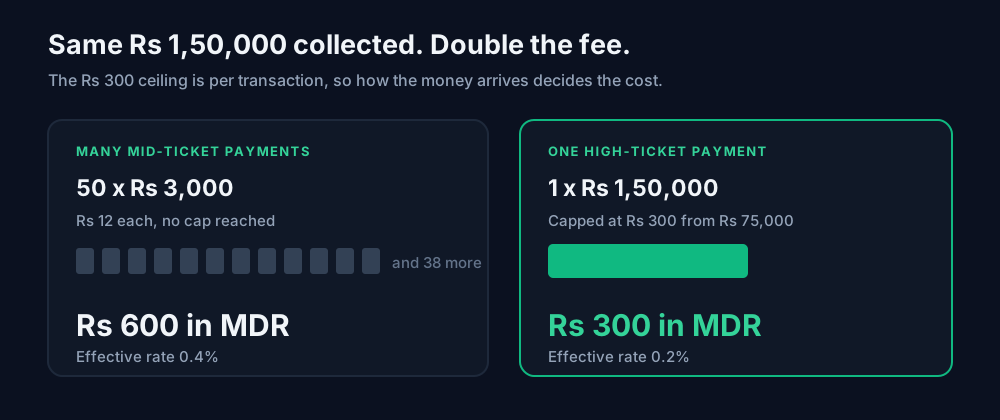
Fifty payments of ₹3,000 collect ₹1,50,000 and cost ₹600. A single payment of ₹1,50,000 collects the same and costs ₹300. Same revenue, double the fee, purely because of how the money arrived.
The effect runs the other way too. Above ₹75,000 the fee stops climbing, so the effective rate falls: 0.4% at ₹50,000, 0.3% at ₹1,00,000, 0.2% at ₹1,50,000. High-ticket sellers land at a lower effective percentage than mid-ticket ones. A business built on ₹3,000 to ₹10,000 invoices sits at the full 0.4% with no relief from the cap.
Who is exempt, and the three-month rule
P2PM merchants keep zero MDR. Broadly, that covers merchants receiving up to ₹1 lakh a month through qualifying UPI QR arrangements. GST registration is not a condition.
One detail matters more than the threshold itself: the exemption follows the account, not the transaction. A ₹5,000 payment to a P2PM merchant is still free, because it is the classification that decides, not the size of the individual payment.
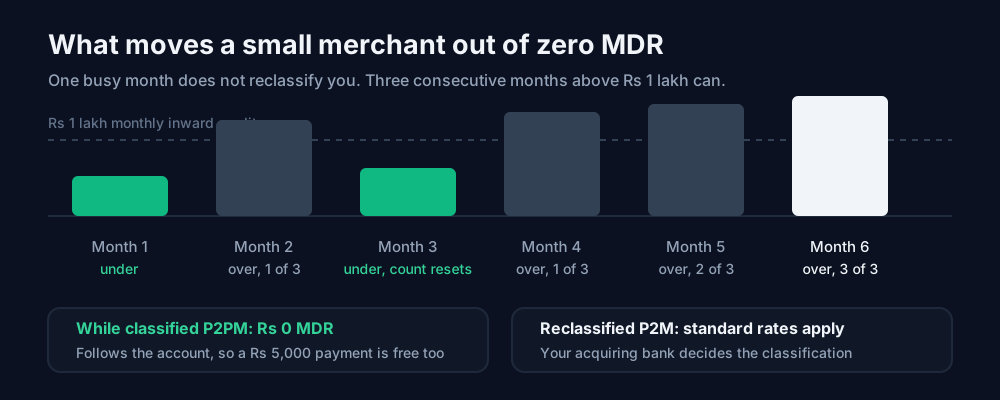
Crossing ₹1 lakh in inward credit for three consecutive months can move a merchant from P2PM to P2M, at which point the standard rates apply. One busy month does not do it. A sustained run does.
Whether any particular account is classified P2PM is decided by the acquiring bank, not by reading the framework. If it matters to your margins, that is a question for your provider.
NPCI has also proposed a dedicated fund for small-merchant onboarding in tier 3 to tier 6 centres, with the framework to be finalised with the RBI within three months.
Special sectors at a flat ₹5
Some categories are charged a flat ₹5 above ₹2,000 instead of a percentage, with no cap needed because the fee never grows. The ones named in the FAQ are railways, telecom services, insurance, fuel, and qualifying public utilities, which include electricity distribution, municipal water, and piped natural gas.
A flat fee changes the arithmetic completely at size. On a ₹40,000 payment, the standard rate would be ₹160; the flat fee is ₹5, an effective rate of 0.0125%.
Capital markets get their own line: mutual funds, securities, stockbrokers, dealers, and SEBI-registered platforms at 0.02%, with the same ₹300 maximum. At that rate the ceiling only binds around ₹15,00,000, so most retail investment payments sit well below it.
What sits outside the framework
RuPay credit cards on UPI and pre-sanctioned credit lines follow credit-product rules rather than these. UPI mandates and AutoPay carry no prescribed MDR here.
If your collections run mostly through AutoPay, or mostly through credit on UPI, this framework is not the document that tells you what they cost.
The argument on both sides
Both cases are worth stating plainly, and neither is settled by arithmetic.
The stated case for the change is cost recovery. Running UPI is estimated in the FAQ at around ₹20,000 crore a year, and under zero MDR that cost sat with banks and payment companies, with government subsidy covering part of it as bridge funding rather than as a permanent arrangement. On that reading, a charge on the larger-value end funds the rails that carry everything else.
The objection is about behaviour at the thin end. Any fee on digital acceptance gives a low-margin merchant a reason to prefer cash, and 0.4% on a ₹10,000 sale is ₹40 out of a margin that may be small. There is also a durability question: a ₹1 lakh exemption threshold and a ₹2,000 free limit are numbers that can be revised later, and merchants planning around them are planning around a current setting rather than a guarantee.
What happens next is not something this post can tell you. The rates above are what is published.
What is still unconfirmed
Two things are genuinely open, and it is worth not filling the gaps with guesses.
Education fees. The FAQ places education fee collection in the industry programme category and says it benefits from flat-fee structures or capped processing rates, but it does not publish a figure. Anyone quoting an exact rate for school or college fees is going beyond the document. Confirm it with the acquiring bank or the current NPCI or DFS circular.
GST on the fee. The FAQ does not mention GST anywhere. Ordinary acquirer practice would be 18% on the fee itself, not on the customer's payment, so on a ₹12 fee that would be about ₹2.16. Treat that as an estimate of normal practice rather than part of the published rate, and note that input tax credit eligibility depends on registration, a valid tax invoice, and business use. With GST included, incidentally, the break-even band widens slightly, ending at ₹2,009.48 instead of ₹2,008.03.
FAQ
Will customers be charged for paying by UPI? No. Consumers pay nothing under this framework, and UPI apps are not permitted to charge a platform fee on a payment. The fee is deducted on the merchant's side before settlement.
Can a shop add 0.4% at the counter for UPI? No. Merchants are not permitted to pass MDR on to customers. The customer pays the posted price.
Are person-to-person transfers affected? No. P2P is free at any amount, including transfers to your own accounts.
Is the 0.4% charged only on the amount above ₹2,000? No, and this is the common error. Once a payment crosses ₹2,000 the rate applies to the whole amount. That is why ₹3,000 costs ₹12 rather than ₹4.
What is the most a single transaction can cost? ₹300 for standard merchants, and the ceiling binds from ₹75,000. Above that the fee stops rising, so the effective percentage falls as the ticket grows.
I receive about ₹80,000 a month through my QR code. Do I pay? While your provider classifies you as a P2PM small merchant, the rate is zero, and it stays zero even on individual payments above ₹2,000. Classification is your acquiring bank's call, so confirm it with them rather than assuming.
Does GST apply on top of the fee? The NPCI FAQ does not address GST. Standard acquirer practice would add 18% on the fee, not on the payment, but that is not a published part of this framework.
Conclusion
The framework is narrower than the headlines suggest. Consumers are untouched, P2P is untouched, and more than 95% of merchant payments by count fall under the ₹2,000 line where nothing is charged.
For merchants above that line, two pieces of arithmetic do most of the work. The rate applies to the full amount, so the ₹2,001 to ₹2,008 band settles for less than a flat ₹2,000. And the ceiling is per transaction, so fifty payments of ₹3,000 cost twice what one payment of ₹1,50,000 costs on identical revenue.
Your own price points are the ones that matter. The UPI MDR Calculator takes an amount and a category and shows the fee, the net settlement, and the effective rate, with the ₹2,000 band flagged where it applies.
Sources
- NPCI notifies MDR of 0.4% on P2M UPI transactions above ₹2,000, effective 15 October 2026, capped at ₹300 from ₹75,000; P2P remains free — Times of India, 15 September 2026.
- Flat ₹5 charge for utility payments, fuel, insurance premiums, rail tickets and several government services — Times of India, 16 September 2026.
- NPCI circular of 15 September 2026: most merchants pay 0.4% on UPI receipts above ₹2,000; small merchants and P2P transfers exempt — The Hindu, 16 September 2026.
- Who pays and who remains exempt; a merchant pays ₹40 on a ₹10,000 UPI receipt — Indian Express, 16 September 2026.
- RBI backs the 0.4% MDR as supporting UPI's long-term sustainability — Times of India, 16 September 2026.
- Rate structure, the P2PM ₹1 lakh monthly threshold and three-consecutive-month reclassification, capital-market 0.02%, the bar on passing MDR to customers, and the worked examples (₹3,000 → ₹12, ₹50,000 → ₹200, ₹1,00,000 → ₹300) are taken from NPCI's FAQ "Merchant Discount Rate (MDR) on Select UPI (P2M) Transactions", 15 September 2026.
- The ₹2,008.03 break-even, the ₹2,009.48 GST-inclusive figure, the effective-rate series above ₹75,000, and the fifty-payments comparison were computed from the published rates and are covered by 102 unit assertions in the calculator's test suite.