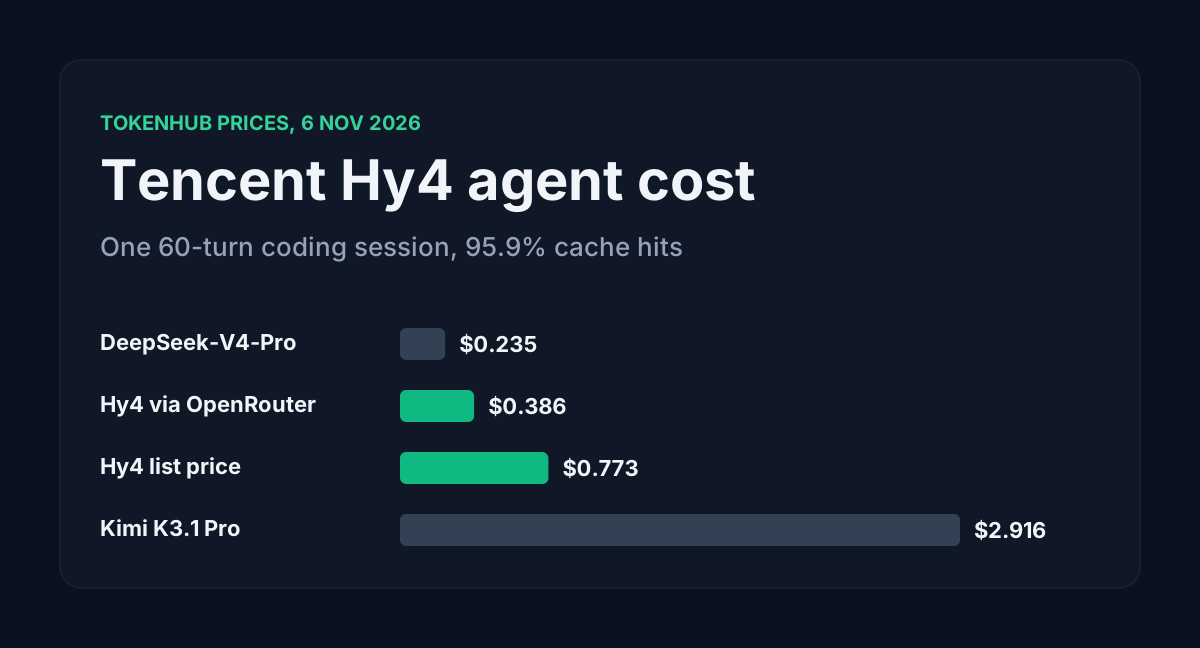
Tencent made Hy4 generally available this week, after a Preview that had been out since August. It now takes images as well as text, it can drive a computer through its computer-use agent (CUA) mode, and it keeps the 1-million-token context. Tencent Cloud's TokenHub page lists it at $0.834 per million input tokens and $2.501 per million output, the same as the Preview. A banner over the subscription plans says "Hy4 at 75% off".
Per-token prices alone don't tell you what a coding agent costs. Agent sessions resend the same long prefix every turn, so the cache-hit rate sets most of the bill. Below is one realistic 60-turn session costed line by line at the rates on Tencent's own TokenHub table, against the other models on that same table.
Table of contents
- What Tencent lists for Hy4
- The test session
- Cost per session on TokenHub prices
- Where the Hy4 bill goes
- Calling Hy4 from an agent
- Catches in the listing
- FAQ
- Sources
What Tencent lists for Hy4
TokenHub's full pricing table is for the Singapore region, in US dollars per million tokens. I read it on 6 November 2026.
| Model on TokenHub | Input | Output | Cache hit |
|---|---|---|---|
| Tencent Hunyuan Hy4 | $0.834 | $2.501 | $0.042 |
| Tencent Hunyuan Hy3 | $0.132 | $0.528 | $0.033 |
| DeepSeek-V4-Pro (0813) | $0.435 | $0.87 | $0.00363 |
| MiniMax-M3 | $0.3 | $1.2 | $0.06 |
| GLM-5.3 | $1.4 | $4.4 | $0.26 |
| Kimi K3.1 Pro | $2 | $10 | $0.2 |
The same page describes Hy4 as an upgrade over the Preview, with "particularly strong gains in agentic capabilities" on long-horizon work, and visual understanding for the first time. It names software engineering, cybersecurity research, financial analysis and game development as targets. The Preview was a 770B-parameter mixture-of-experts model with 49B active. Tencent hasn't published a parameter count for the final release on this page, and the tencent/Hy4 repo on Hugging Face isn't public yet.
On OpenRouter, the Tencent-run endpoint charges $0.417 in, $1.2505 out and $0.021 cached, exactly half of the TokenHub list, and flags it as a 50% discount. OpenRouter's endpoint data also tags that deployment as FP4.
The test session
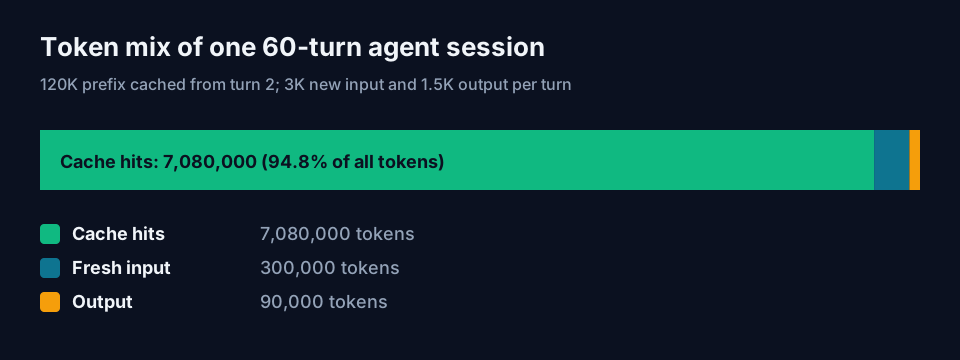
I used the same workload as our Sonnet 5.5 vs GPT-6.1 Sol post, so the numbers line up across posts:
- A 120,000-token prefix: system prompt, tool definitions and the repo files the agent has read.
- 60 turns. Each turn adds 3,000 new input tokens (a tool result or your message) and returns 1,500 output tokens.
- Turn 1 pays full input price for the whole prefix. From turn 2 on, the prefix is a cache hit.
That's 300,000 fresh input tokens, 7,080,000 cache-hit tokens and 90,000 output tokens. Cache hits are 95.9% of all input.
Cost per session on TokenHub prices
| Model | Fresh input | Cache hits | Output | Session total | 100 sessions a day for 30 days |
|---|---|---|---|---|---|
| DeepSeek-V4-Pro (0813) | $0.1305 | $0.0257 | $0.0783 | $0.235 | $703.50 |
| Hy3 | $0.0396 | $0.2336 | $0.0475 | $0.321 | $962.28 |
| Hy4 via OpenRouter | $0.1251 | $0.1487 | $0.1125 | $0.386 | $1,158.98 |
| MiniMax-M3 | $0.0900 | $0.4248 | $0.1080 | $0.623 | $1,868.40 |
| Hy4 (TokenHub list) | $0.2502 | $0.2974 | $0.2251 | $0.773 | $2,317.95 |
| GLM-5.3 | $0.4200 | $1.8408 | $0.3960 | $2.657 | $7,970.40 |
| Kimi K3.1 Pro | $0.6000 | $1.4160 | $0.9000 | $2.916 | $8,748.00 |
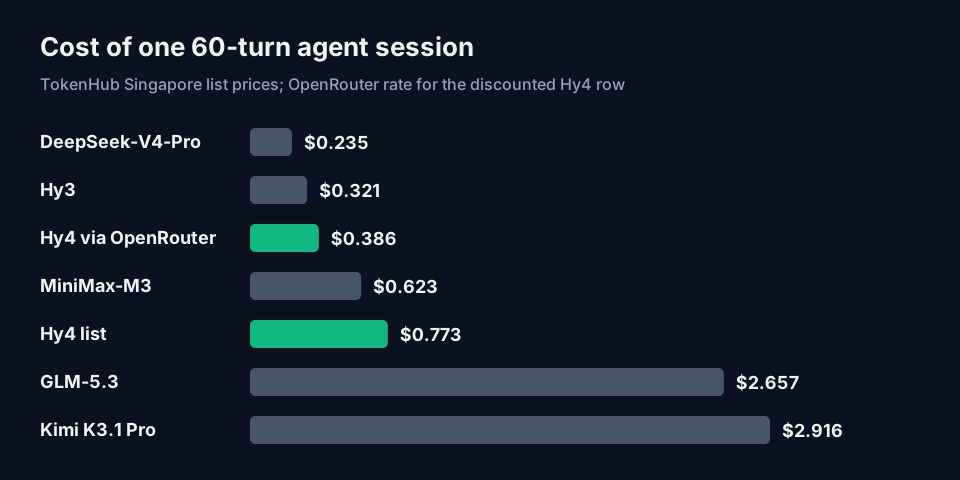
Hy4's input list price is 1.92 times DeepSeek-V4-Pro's. Its session bill is 3.29 times higher. The gap widens because DeepSeek's cache hit is 99.2% off its input price and Hy4's is 95.0% off. On a session that's almost all cache hits, that difference is worth more than the headline input rate.
Against the expensive end of the table, Hy4 looks very different. A session costs about a quarter of what GLM-5.3 or Kimi K3.1 Pro charge on the same gateway.
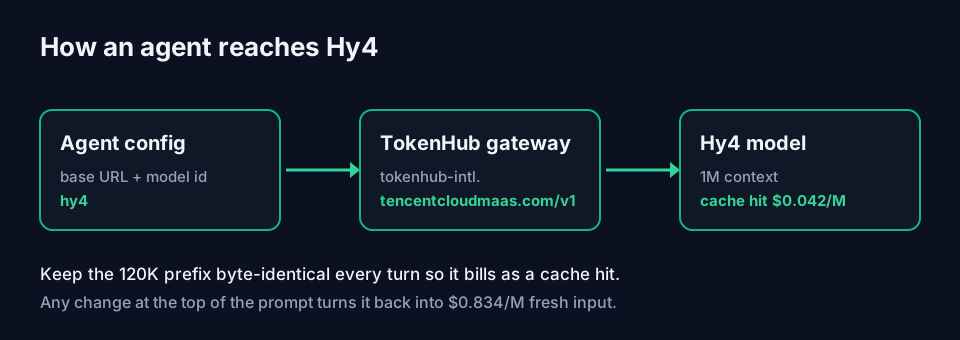
Without any caching, the same session costs $6.38 on Hy4 at list. Check that your client keeps the prefix byte-identical across turns. A timestamp or a reordered tool list at the top of the prompt turns every cache hit into fresh input.
To run your own mix, put the token counts into the API cost calculator. It now has Hy4 and Hy3 at the TokenHub list rates.
Where the Hy4 bill goes
At list price the $0.773 splits into 32.4% fresh input, 38.5% cache hits and 29.1% output. No single line dominates, which means there's no single lever. Trimming the prefix cuts the cache-hit line. Shorter tool results cut fresh input.
Output is the line most likely to grow. OpenRouter lists Hy4 with reasoning on by default at high effort, and reasoning tokens bill as output. If thinking doubles output to 180,000 tokens, the session goes to $0.998 at list, or $0.499 on OpenRouter's discounted rate. DeepSeek-V4-Pro under the same doubling comes to $0.313. Setting reasoning effort to low on routine turns (file reads, small edits) is the cheapest change you can make.
Calling Hy4 from an agent
TokenHub is OpenAI-compatible. The page gives https://tokenhub-intl.tencentcloudmaas.com/v1 as the base URL and hy4 as the model id, so any agent that accepts a custom OpenAI endpoint works: Hermes Agent, Claude Code through a proxy, OpenCode, Cline or Cursor. A minimal request:
curl https://tokenhub-intl.tencentcloudmaas.com/v1/chat/completions \
  -H "Authorization: Bearer YOUR_API_KEY" \
  -H "Content-Type: application/json" \
  -d '{
    "model": "hy4",
    "messages": [
      {"role": "system", "content": "You are a coding agent. Keep this system prompt identical every turn."},
      {"role": "user", "content": "List the files that import utils/date.ts"}
    ]
  }'
For an agent config, three fields carry over: base URL, model id and an API key from the TokenHub console. Keep the key in an environment variable. The JSON formatter helps when you need to read the usage block in the response and see how many tokens were billed as cache hits.
Catches in the listing
The "75% off" banner sits above the subscription plans, which run from $7 a month for 1,000 credits to $103 for 15,900 credits. The per-token table on the same page still shows the full $0.834 and $2.501, and the page doesn't say what the 75% is measured against. Don't plan a budget on it until the console shows the rate on your own account.
The OpenRouter discount is OpenRouter's listing, not Tencent's table. I couldn't find an end date for it on Tencent's page. If you build on the $0.386 session cost, recheck the price monthly.
The OpenRouter endpoint is tagged FP4. If you compare quality with a model served in FP8 or BF16, that's part of what you're comparing.
TokenHub's cache-hit price only applies to tokens the bill actually classes as cache hits. Tencent's own Preview pricing guide makes the same point and tells you to use the API's returned usage, not your own estimate.
FAQ
Is Hy4 open weight?
Not yet in a form I could check. The tencent/Hy4 page on Hugging Face returned a not-found error on 6 November 2026. The Preview had a public model page, so watch the Tencent organisation page if you want to run it locally.
Does Hy4 cost more than Hy4 Preview? No. TokenHub lists $0.834 in, $2.501 out and $0.042 cache hit, the same as Tencent's August Preview pricing guide.
Which is cheaper for an agent, Hy3 or Hy4? Hy3, at $0.321 a session against $0.773. Hy3 has a native 256K context, so it can't take prompts beyond that the way Hy4's 1M context can.
Sources
- Tencent Cloud, TokenHub page (tencentcloud.com/act/pro/tokenhub, read 6 November 2026): Hy4 description, Singapore-region pricing table for all models listed, subscription plans, "Hy4 at 75% off" banner, base URL and model id, Hy3 256K context.
- Tencent Cloud Techpedia, "Hy4 Preview Pricing on Tencent Cloud Input, Output, and Cache Costs" (tencentcloud.com/techpedia/147982, dated 28 August 2026): Preview prices and the note on cache-hit billing.
- OpenRouter, model and endpoint listing for
tencent/hy4(openrouter.ai/api/v1/models/tencent/hy4/endpoints, read 6 November 2026): discounted rates, 50% discount flag, FP4 tag, default reasoning effort, 65,536 max output tokens. - Session costs, ratios and monthly totals are calculated by ToolMintX from the prices above.