A signature file can be rejected for being too small. That sounds like a typo, and the first time it happens on a government application form it feels like one.
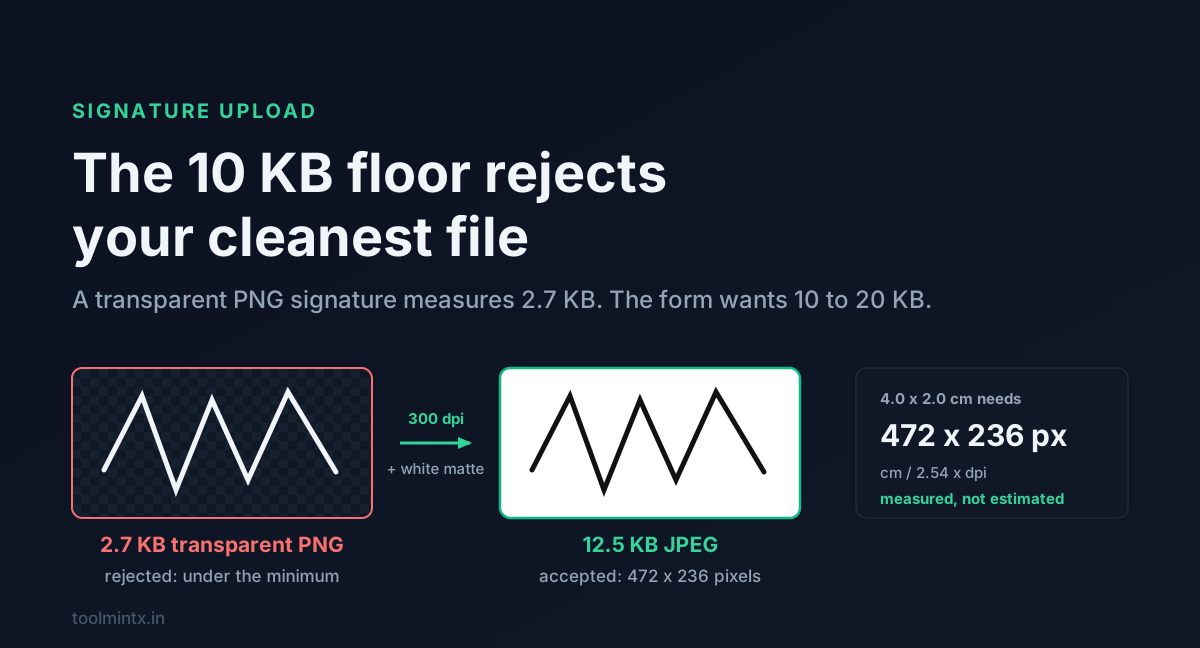
The window most Indian exam forms give you is 10 KB to 20 KB. Both ends are enforced. A clean transparent PNG of a signature, the kind you get when you lift ink off a photo of paper, comes out around 2.7 KB at the size the form wants. That file is a quarter of the minimum, and the upload button will not take it.
Table of contents
- Why a form sets a minimum
- What 4 by 2 centimetres means in pixels
- The transparent PNG problem
- Measured file sizes at each dpi
- When the scan overshoots 20 KB
- A workflow that lands inside the window
- Where the specs disagree
- FAQ
- Conclusion
- Sources
Why a form sets a minimum
The 20 KB ceiling is obvious. Thousands of applications a day, each carrying a photo and a signature, and someone has to store and print them.
The 10 KB floor is the part nobody explains. It exists because file size is the cheapest available proxy for "is there enough detail here to be readable after printing". A recruitment board cannot inspect every upload, but it can reason that a JPEG under 10 KB, at the dimensions asked for, almost certainly has too few pixels or has been crushed by the encoder. Either way the signature will smear on the admit card.
So the floor is a detail check wearing a file-size costume. That matters, because it tells you the fix. You do not pad the file. You give it more real detail, then let the encoder settle where it settles.
What 4 by 2 centimetres means in pixels
Forms specify signatures in centimetres. Your phone and your image editor work in pixels. The bridge is dpi, and it is the single number that decides whether you land in the window.
| Scan resolution | 4.0 x 2.0 cm becomes | Total pixels |
|---|---|---|
| 96 dpi | 151 x 76 | 11,476 |
| 150 dpi | 236 x 118 | 27,848 |
| 200 dpi | 315 x 157 | 49,455 |
| 300 dpi | 472 x 236 | 111,392 |
| 600 dpi | 945 x 472 | 446,040 |
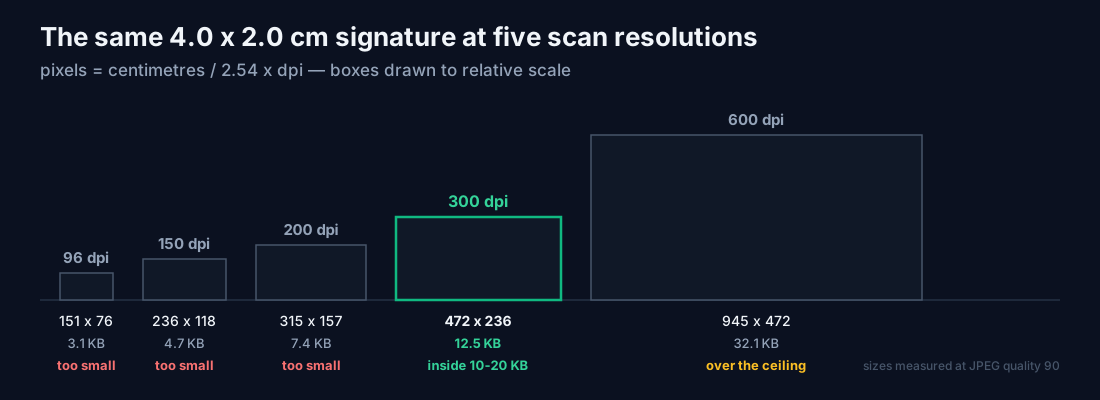
The arithmetic is one line: pixels = centimetres / 2.54 x dpi. Two centimetres of height at 300 dpi is 236 pixels, and at 96 dpi it is 76.
Seventy-six pixels of height is where the trouble starts. A signature has thin strokes, and once the height drops under about 100 pixels a stroke is one or two pixels wide. JPEG then has almost nothing to encode, the file lands near 3 KB, and the form refuses it.
The transparent PNG problem
Here is where a good habit turns into a rejected form. Lifting a signature off a photo of paper and saving it as a transparent PNG is the right thing to do for most uses. You can drop that PNG onto a contract or a letterhead and the paper texture does not come with it. Our own signature extractor does exactly that, in the browser, with a threshold slider.
Two things then go wrong when you feed that PNG into an exam form.
The first is size, and it is counterintuitive. PNG compresses flat areas almost for free, and a transparent background is as flat as it gets. I measured the same 472 x 236 signature both ways: 2.7 KB as a transparent PNG, 12.5 KB as a JPEG at quality 90. Same drawing, same pixels, four and a half times the file. The PNG is the better file and the illegal one.
The second is worse, because it produces a file the form accepts and a human later rejects.
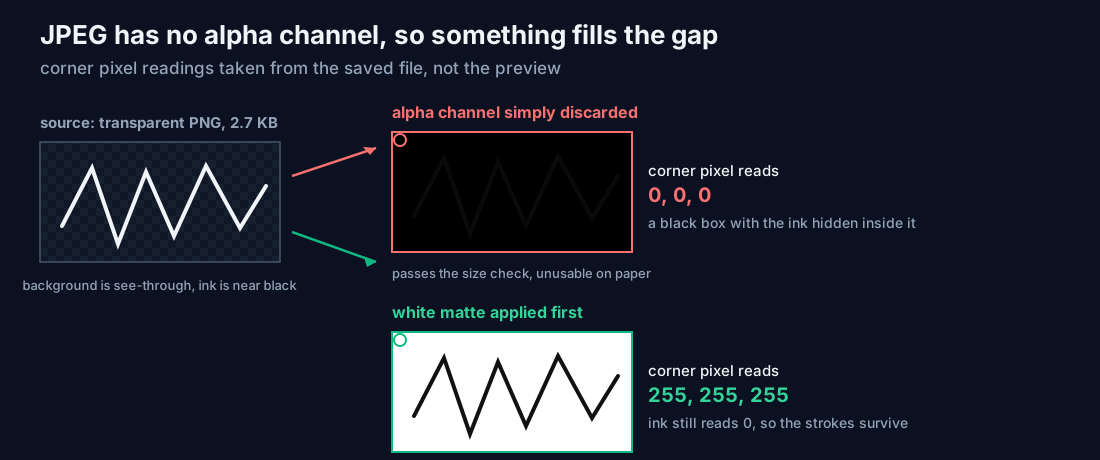
JPEG has no alpha channel. When a transparent PNG becomes a JPEG, every see-through pixel has to be filled with something first. Do it properly and the empty area becomes white. Discard the alpha channel instead, which is what a naive conversion does, and those pixels fall back to their stored colour underneath, which is zero. I ran both paths on the same file. Flattened onto white, the corner pixel reads 255, 255, 255 and the ink still reads 0. Alpha simply dropped, the corner reads 0, 0, 0, and you have uploaded a black rectangle with an invisible signature inside it.
Which is why the matte colour is the one setting to check in any converter. The PNG to JPG converter fills transparent areas with white before encoding and lets you change that colour, so the corner comes out white instead of black.
Measured file sizes at each dpi
I generated a signature at each resolution, flattened it onto white, and encoded it at several JPEG quality settings. Every figure below is measured, not estimated.
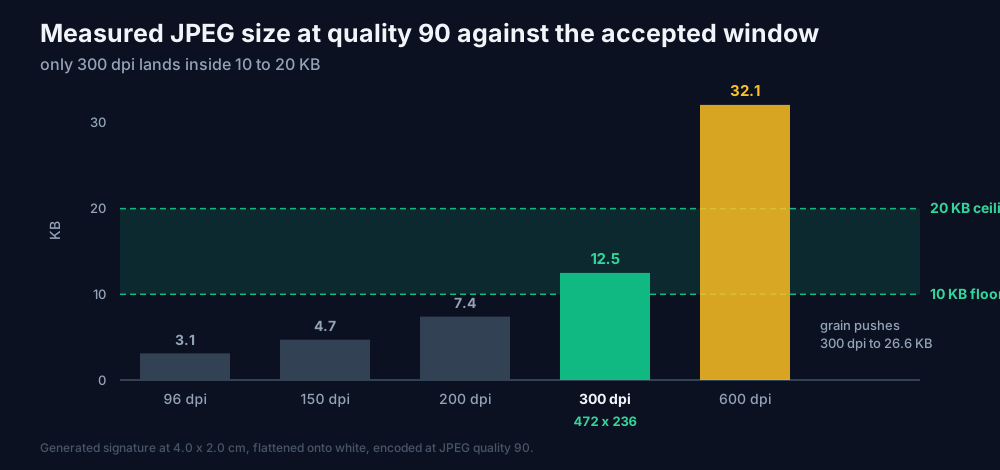
| 4 x 2 cm at | Pixels | q95 | q90 | q80 | q70 |
|---|---|---|---|---|---|
| 96 dpi | 151 x 76 | 3.8 KB | 3.1 KB | 2.6 KB | 2.3 KB |
| 150 dpi | 236 x 118 | 5.8 KB | 4.7 KB | 3.9 KB | 3.5 KB |
| 200 dpi | 315 x 157 | 9.2 KB | 7.4 KB | 6.0 KB | 5.3 KB |
| 300 dpi | 472 x 236 | 15.4 KB | 12.5 KB | 10.1 KB | 9.0 KB |
| 600 dpi | 945 x 472 | 38.9 KB | 32.1 KB | 26.2 KB | 23.4 KB |
Read down the q90 column and the pattern is hard to miss. Nothing below 300 dpi reaches 10 KB at any quality setting. At 200 dpi the best you manage is 9.2 KB, and that is at quality 95, where there is no headroom left to spend.
Three hundred dpi is the first row where the window is reachable, and at that resolution it is comfortable: 10.1 KB at quality 80, 12.5 KB at 90, 15.4 KB at 95. All three pass.
Those numbers come from a clean synthetic signature, which is the friendliest possible input. A photograph of paper carries sensor grain, and grain is expensive to encode. Adding mild noise to the same images moved 300 dpi quality 90 from 12.5 KB to 26.6 KB, straight through the ceiling. The grain, not the signature, is most of that file.
When the scan overshoots 20 KB
The other failure is louder and easier to fix. At 600 dpi the clean file is 32.1 KB at quality 90, and the grainy version is 92 KB. Anyone photographing a signature with a modern phone camera and uploading it untouched is starting several times over the limit, sometimes at a few hundred KB.
The instinct is to drag the quality slider down until the number fits. It works, and it is the wrong lever to pull first. Quality 50 on a 600 dpi scan gets you to 19.7 KB, technically inside the window, with visible blocking on every stroke edge. You would be shipping the artefacts the floor was written to prevent.
Resize first, then compress. Bring the pixel dimensions to what 300 dpi at the requested size actually needs, which is 472 x 236 for a 4 x 2 cm signature, and the file lands in the window on its own without a punishing quality setting. Extra pixels beyond that resolution do not survive printing on an admit card anyway.
A workflow that lands inside the window
This is the order I would use, and each step exists because of a number above.
- Sign on unlined white paper in blue or black ink. Fill the space, since a small signature photographed from far away gives you fewer real pixels of ink.
- Photograph or scan it in good even light, then crop tight to the signature with a thin margin. Cropping is what turns a photo of a desk into a 4 x 2 cm signature.
- Clean the background. Lifting the ink to a transparent PNG here removes paper shadow and grain, which is the single biggest thing standing between you and the 20 KB ceiling.
- Flatten onto white and resize to about 472 x 236 pixels. Confirm the corner of the result is white, not black.
- Save as JPEG at quality 85 to 92 and check the file size. Under 10 KB, go back and use more pixels. Over 20 KB, look for leftover grain before you touch quality.
Step 4 is where most people slip, because a converter with a black default matte or no matte control at all produces a file that passes every automated check and is unusable on paper. Open the saved JPEG and look at it once before uploading. It takes three seconds.
Where the specs disagree
The 10 KB to 20 KB range and the JPEG requirement are consistent across the SSC exam guidance I could find. The dimensions are not.
Coverage of SSC CGL 2026 gives 4.0 cm wide by 2.0 cm tall in one place and 6.0 cm by 2.0 cm in another. SSC CHSL 2026 guidance says roughly 6.0 x 2.0 cm. SSC GD 2026 guidance says 4 cm x 2 cm. Some boards state pixel dimensions instead of centimetres and skip dpi entirely, which is the clearer way to write the spec.
I am not going to pretend one of those is authoritative. Read the notice for the exam you are actually filling, and treat the aggregator articles as a rough guide. The useful part is that the dpi arithmetic does not change with the number: 6 cm at 300 dpi is 709 pixels wide instead of 472, and a wider image at the same resolution gives you more pixels and a slightly larger file, which pushes you further from the floor rather than toward it.
Also worth knowing: newer SSC cycles capture the photograph live through the application module rather than accepting an upload. The signature is still an upload, so it is the file you have to get right.
FAQ
Why is my signature rejected for being too small? Because the form enforces a minimum as well as a maximum, usually 10 KB. A JPEG under that size at the requested dimensions has too little detail to print cleanly, so the file size is used as a stand-in for a detail check. Scan or resize to 300 dpi and the file will clear the floor on its own.
How many pixels is a 4 cm by 2 cm signature? 472 x 236 pixels at 300 dpi. The formula is centimetres divided by 2.54, times dpi. At 150 dpi the same signature is only 236 x 118 pixels, which cannot reach 10 KB as a JPEG at any sensible quality.
Why did my signature turn into a black box after converting to JPG? The transparent background was dropped rather than filled. JPEG cannot store transparency, so those pixels must be given a colour first. If the converter skips that step, they resolve to black. Use a converter that applies a white matte and check the corner of the saved file.
Can I upload a PNG instead? Only if the form says PNG is accepted. Most Indian exam forms ask specifically for JPEG or JPG. A transparent PNG also tends to be far under the size floor, so it usually fails on two counts at once.
My phone photo is 400 KB. What do I reduce first? Crop and resize before you touch quality. Bring the image down to roughly 472 x 236 pixels, remove the paper background, then save at quality 85 to 92. Dropping quality on a full resolution photo can hit the target size while leaving visible blocking on the strokes.
Does a black pen or a blue pen matter? For file size, barely. For acceptance, follow the notice, which commonly asks for blue or black ink on white paper and a running signature rather than block capitals.
Conclusion
The rule that catches people is not the 20 KB ceiling. It is the 10 KB floor, combined with the fact that the cleanest signature file you can produce is also the smallest.
Two numbers cover most of it. A 4 x 2 cm signature needs 472 x 236 pixels, which is 300 dpi, before a JPEG can reach 10 KB at a quality worth using. And a transparent PNG of that same signature is 2.7 KB, so it fails the floor by a wide margin even though it looks perfect on screen.
If you are preparing one now, lift the ink cleanly with the signature extractor, then flatten it onto white with the PNG to JPG converter and confirm the corner pixel is white before the file goes anywhere near the form.
Sources
- SSC CGL signature upload rules 2026: JPEG or JPG, 10 KB to 20 KB, dimensions given as 6.0 cm by 2.0 cm — PW.
- SSC CGL photo and signature size 2026: live photo capture through the application module, scanned signature in JPEG at 10 KB to 20 KB, dimensions given as 4.0 cm by 2.0 cm — PW.
- SSC CHSL photo and signature size 2026: signature in JPEG or JPG, 10 KB to 20 KB, about 6.0 cm by 2.0 cm — PW.
- SSC GD signature and photo size 2026: 4 cm by 2 cm with a file size between 10 KB and 20 KB — Testbook, 29 December 2025.
- SSC Selection Post Phase 14 signature upload rules 2026: JPG or JPEG, 10 KB to 20 KB, 6 cm by 2 cm, running handwriting in blue or black ink on white paper — PW.
- Pixel conversions, the measured JPEG and PNG file sizes at each resolution and quality setting, the 2.7 KB transparent PNG against the 12.5 KB flattened JPEG, and the corner pixel readings of 0, 0, 0 for a discarded alpha channel against 255, 255, 255 for a white matte were all computed locally on a generated signature at the dimensions listed, not taken from a source.