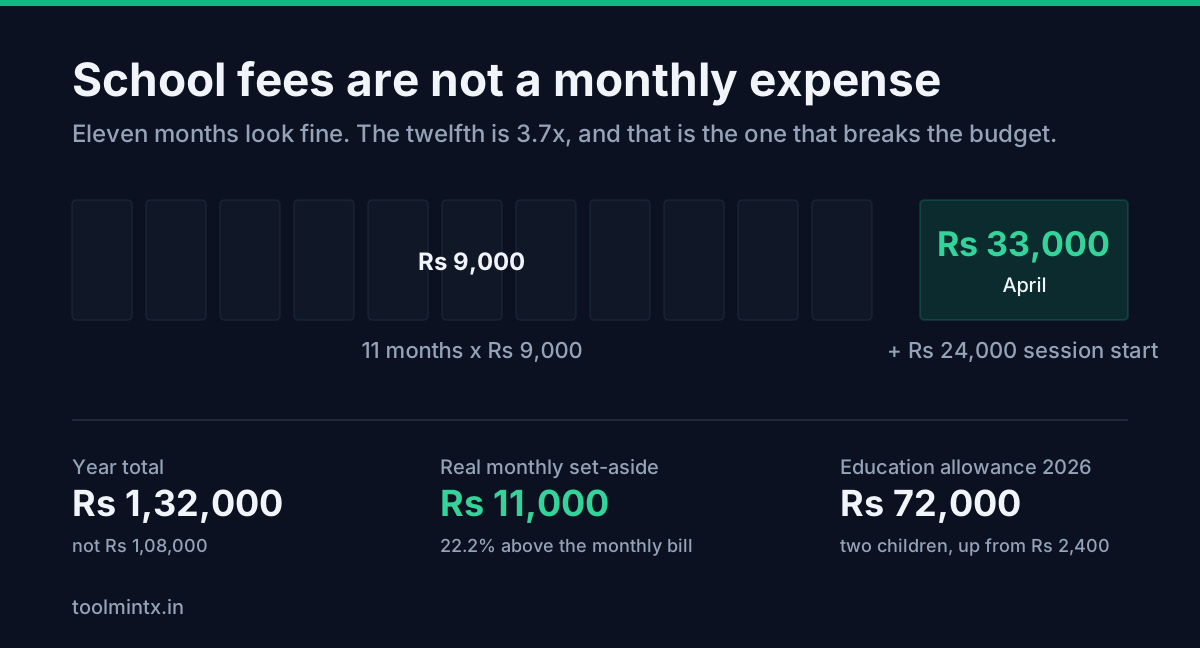
You pay ₹9,000 a month for school and it has never been a problem. Then April arrives, the invoice reads ₹33,000, and you are moving money out of an FD or asking a relative.
Nothing changed about the fee. School fees are not a monthly expense. They are a monthly expense plus one bill at the start of the session that is several times larger, and a budget built on the monthly figure fails in exactly one month every year. Here is the arithmetic that turns ₹9,000 a month into ₹11,000, and the tax change from 1 April 2026 that quietly covers a large part of it for salaried parents.
Table of contents
- The April invoice is 3.7 times a normal month
- Sorting a fee receipt into two buckets
- The hike compounds on a base that already grew
- What the 2026 rules changed for salaried parents
- Most of the bill is not deductible
- FAQ
- Conclusion
- Sources
The April invoice is 3.7 times a normal month
Take a mid-range private school. Tuition instalment ₹6,000, bus ₹2,000, coaching ₹1,000, so ₹9,000 a month. At session start you also pay re-registration, the annual or development charge, two sets of uniform, shoes, and the books list. Call that ₹24,000, which is conservative in a metro.
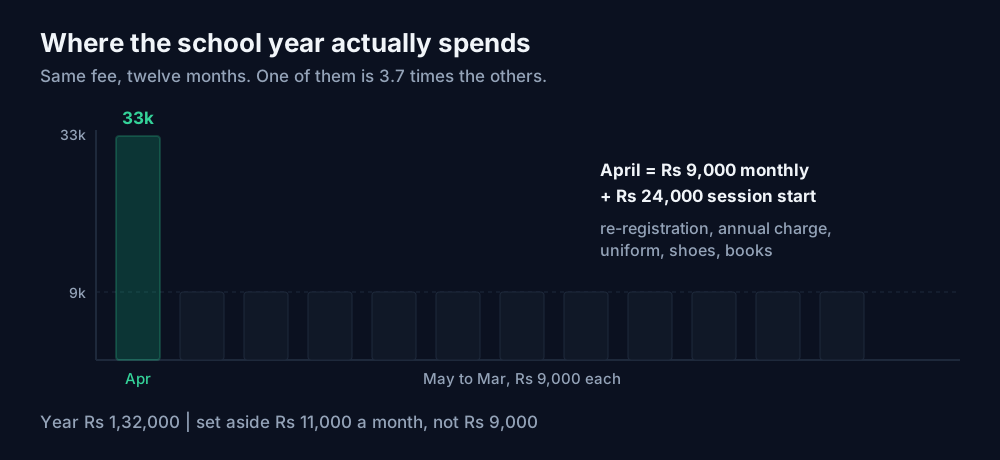
The year is not ₹108,000. It is ₹132,000, and it does not arrive evenly:
| Amount | |
|---|---|
| Normal month | ₹9,000 |
| April, with session-start charges | ₹33,000 |
| Year total | ₹1,32,000 |
| Set-aside needed per month | ₹11,000 |
That ₹11,000 is the number worth writing down. It is 22.2% above the monthly bill, and the ₹2,000 gap is not a rounding error you can absorb in April. Missing it for eleven months produces a ₹24,000 hole in the twelfth.
Note what averaging does here. Divide the lump by twelve before you enter it anywhere and the output becomes ₹11,000 with no visible spike, which is the correct set-aside but hides the reason you need it. Keep the two apart and you can see both the amount to save and the month it leaves.
Sorting a fee receipt into two buckets
The sorting is most of the work, and one test settles nearly every line: does this appear on every invoice, or only on the first one of the session?
Recurring, so monthly: tuition instalment, bus or van, coaching or tuition classes, mess where it is billed monthly.
Once a session, so a lump: admission or re-registration, the "annual charges" or development fee, uniforms, shoes, the books and stationery set, and one-time lab, library, smart-class or ID card charges.
Three lines cause arguments. Exam fees usually arrive per term, three or four times a year, which is close enough to spread across the monthly heads. A caution deposit is refundable when the child leaves, so it is not a cost at all; leave it out of both buckets and remember you are owed it. Excursions and mandatory trips appear without notice and belong in neither bucket, which is the main reason a school year comes in above plan.
The Education Fee Budget Calculator keeps the two buckets separate on purpose and returns the monthly set-aside, the true annual figure, and next year at the hike rate you expect.
The hike compounds on a base that already grew
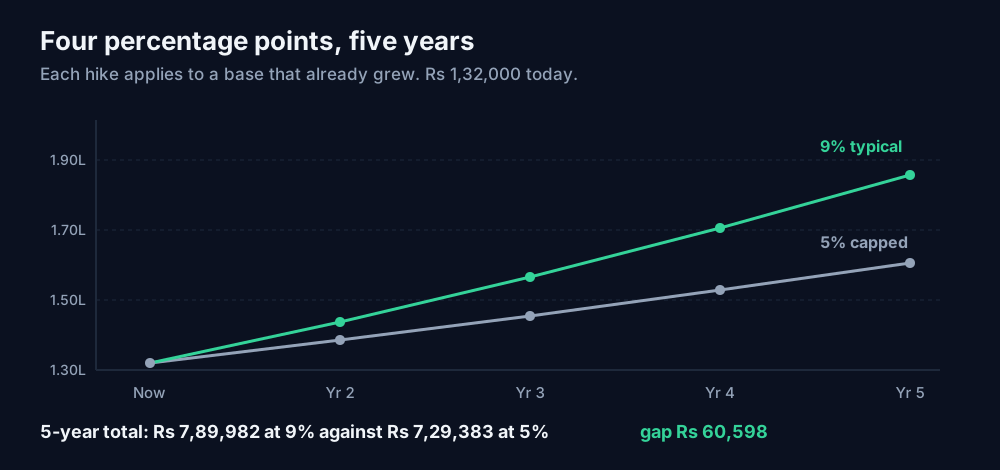
Fee increases are annual, and each one applies to a base that has already grown. Official tuition data puts primary and higher secondary increases at roughly 6% to 9% through the first half of 2026. Parent surveys report worse: a 2025 LocalCircles survey across 301 districts found 81% of private-school parents had seen a single-year hike above 10%.
Regulation is arriving unevenly. Punjab's ordinance, given assent in July 2026, caps annual hikes by private unaided schools at 5%, treats transport and building charges as part of tuition, and mandates refunds where cumulative increases exceeded 15% over three years. Noida's district fee committee capped hikes at 7.23% for the 2026-27 session, applied to admission fees only. Whether your state has anything comparable decides which column below you should plan against.
| Year | At 5% (capped) | At 9% (typical) |
|---|---|---|
| Now | ₹1,32,000 | ₹1,32,000 |
| Year 2 | ₹1,38,600 | ₹1,43,880 |
| Year 3 | ₹1,45,530 | ₹1,56,829 |
| Year 5 | ₹1,60,447 | ₹1,86,329 |
| 5-year total | ₹7,29,383 | ₹7,89,982 |
Four percentage points a year costs ₹60,598 across five years on a bill this size. If you are saving towards fees rather than paying them from salary, that gap is the return your savings have to beat, which a savings account will not do. The SIP Calculator shows what a monthly contribution actually grows to over the same window.
One caveat on the projection. It assumes every head rises at one rate, and they do not: transport follows fuel, tuition follows the school's salary bill, uniforms jump only when the design changes. It also assumes the child stays in the same class band, and the step from primary to middle school is frequently a bigger increase than any annual hike. Treat the five-year column as a planning range and revisit it when the next circular arrives.
What the 2026 rules changed for salaried parents
This is the part most fee-planning advice has not caught up with. Children's education allowance was frozen at ₹100 per month per child for decades, a limit so small it was not worth the paperwork. Under the Income Tax Rules, 2026, notified by CBDT and effective 1 April 2026, it is ₹3,000 per month per child for up to two children. Hostel allowance moved from ₹300 to ₹9,000 per month per child.
| Until FY 2025-26 | From FY 2026-27 | |
|---|---|---|
| Education allowance | ₹100 /month /child | ₹3,000 /month /child |
| Hostel allowance | ₹300 /month /child | ₹9,000 /month /child |
| Annual exemption, two children | ₹7,200 | ₹2,88,000 |
On the ₹1,32,000 year above, the education allowance alone covers ₹72,000 for two children, or 54.5% of the bill, as exempt income rather than a deduction competing for a shared ceiling.
Two conditions decide whether any of this reaches you. The allowance has to actually be a line in your salary structure, paid by your employer as education or hostel allowance; you cannot claim it because you happen to have school-going children. And it sits in the old regime, so a parent on the new default regime gets nothing from it. For salaried parents with two children in hostel, the combined ₹2.88 lakh is large enough that the old-versus-new regime comparison is worth redoing this year even if you settled it before.
Most of the bill is not deductible
Separately from the allowance, the tuition-fee deduction still exists and is narrower than parents assume. Only the tuition line qualifies, for up to two children, and it shares the ₹1.5 lakh ceiling with your PF, insurance premium and home-loan principal, which for most salaried parents is full before school fees are counted.
Transport, books, uniforms, coaching and the annual development fee do not qualify, even when the same school bills them on the same receipt. On the figures above, tuition is ₹72,000 of a ₹1,32,000 outlay, so 45.5% of what you pay is outside the provision entirely. From 1 April 2026 this deduction is renumbered from Section 80C to Section 123 under the Income Tax Act, 2025, with the limit unchanged. Under the new default regime it is unavailable.
Sibling concessions, where a school offers them, usually apply to tuition only. Apply the discount to that head and leave transport and annual charges at full, or you will plan against a total the school never agreed to.
FAQ
Why does my school fee budget fail in April every year? Because the session-start invoice is several times a normal month. On a ₹9,000 monthly bill with ₹24,000 of admission, annual and uniform charges, April is ₹33,000, which is 3.7 times a normal month. The monthly figure is accurate for eleven months and wrong for the one that matters.
How much should I set aside monthly for school fees? Add the monthly heads times twelve to the once-a-year charges, then divide by twelve. On the example above that is ₹1,32,000 over twelve months, so ₹11,000, not the ₹9,000 the monthly bill suggests.
What counts as a once-a-year school charge? Admission or re-registration, annual or development charges, uniforms, shoes, the books and stationery set, and one-time lab, library, smart-class or ID charges. If it appears on the first invoice of the session and not the others, it belongs in the annual bucket.
Is the children's education allowance really ₹3,000 a month now? Yes, from 1 April 2026 under the Income Tax Rules, 2026, up from ₹100 per month per child, for up to two children. Hostel allowance rose from ₹300 to ₹9,000 per month per child. It has to be part of your salary structure and it applies in the old regime.
Can I claim uniforms, books and transport on my income tax? No. Only the tuition component qualifies under the tuition-fee deduction, for up to two children, inside the ₹1.5 lakh limit. Transport, books, uniforms, coaching and development fees do not qualify regardless of who billed them.
What fee hike rate should I plan for? Official tuition data suggests 6% to 9%, and 9% is the safer planning figure unless your state caps it. Punjab caps annual hikes at 5% for private unaided schools and Noida capped admission-fee hikes at 7.23% for 2026-27, so check your own state before assuming either.
Does a caution deposit count as a school cost? No. It is refundable when the child leaves, so it is money held rather than money spent. Keep it out of the annual lump and track it as a receivable.
How do I budget for two children? Run the calculation twice rather than doubling one child, because class bands and sibling concessions differ. Where a concession exists it usually applies to tuition alone, so discount that head and leave transport and annual charges unchanged.
Conclusion
School fees are billed on two schedules and budgeted on one, and the mismatch always surfaces in the same month. The monthly figure describes eleven months accurately and understates the twelfth by the entire session-start lump.
Sort one real fee receipt into recurring and once-a-session lines, divide the true annual total by twelve, and save that number instead. Then check whether your salary structure carries an education or hostel allowance line, because the 2026 limits are thirty times what they were and they are worth more than the deduction most parents chase.
The Education Fee Budget Calculator does the split, the set-aside and the next-year projection, and everything you type stays in your browser.
Sources
- Income Tax Rules, 2026 notified: children's education allowance raised to ₹3,000 per month, hostel allowance to ₹9,000, effective 1 April 2026 — Moneycontrol, 20 March 2026.
- Exemption limits of ₹3,000 per month per child for education and ₹9,000 for hostel, maximum two children — Livemint, 12 July 2026.
- CEA was ₹100/month per child for FY 2025-26 and rises to ₹3,000/month for FY 2026-27 — Economic Times, 10 July 2026.
- Tuition-fee deduction covers only the tuition component for up to two children inside the ₹1.5 lakh aggregate limit — ClearTax, 26 July 2026.
- Punjab ordinance caps annual private-school fee hikes at 5%, treats transport and building charges as tuition, mandates refunds above 15% over three years — ET Education, 14 July 2026.
- Noida district fee regulatory committee capped hikes at 7.23% for the current academic year, applicable to admission fees — Times of India, 9 April 2026.
- The ₹9,000 monthly and ₹24,000 session-start figures are an illustrative mid-range private-school bill. All set-aside, per-month and five-year projection figures here were computed from those inputs.