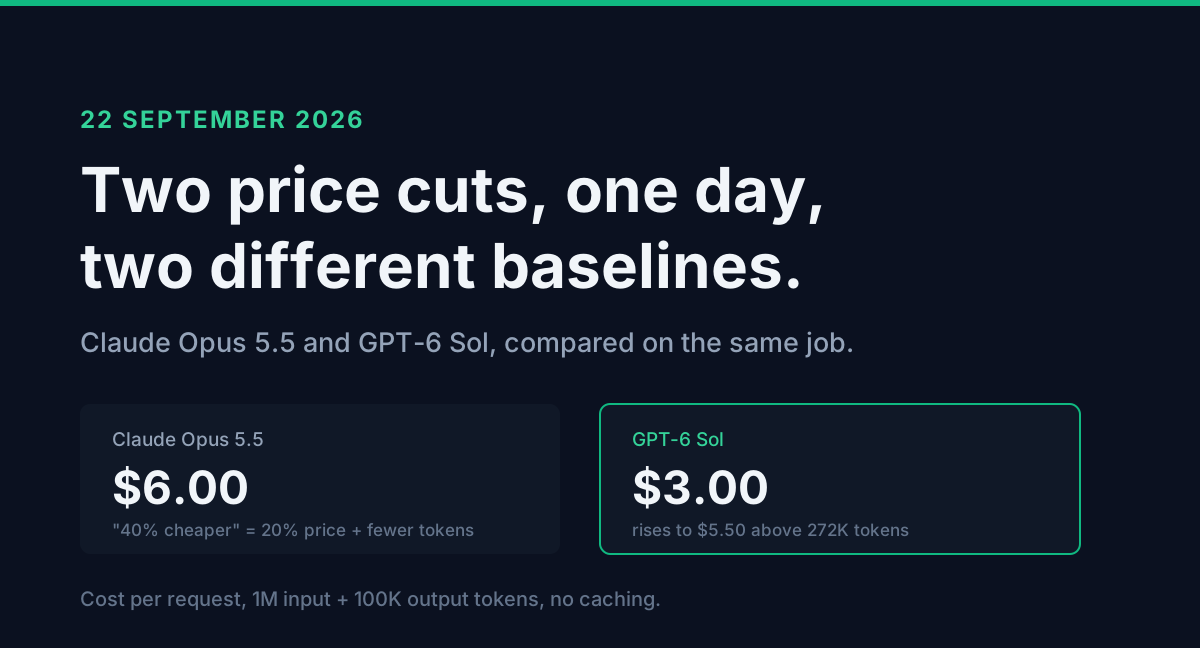
On 22 September 2026 Anthropic shipped Claude Opus 5.5 and cut its price 20%. About an hour later OpenAI shipped GPT-6 Sol and called it 50% cheaper. Both headlines are true. They are also measured against completely different baselines, which makes them useless for deciding what to actually run.
Here is the comparison nobody published: on identical work, 1M input tokens and 100K output with no caching, GPT-6 Sol costs $3.00 per request and Claude Opus 5.5 costs $6.00. Sol is half the price.
Then you cross 272,000 input tokens and that gap nearly closes. Above that line Sol bills at $4 per million input, which is exactly Opus 5.5's rate, and its cached input rate becomes worse than Anthropic's.
Table of contents
- What actually shipped, and when
- The 40% that is really 20%
- The 50% that is against a promotional rate
- Cost on identical work
- The 272K cliff nobody put in a headline
- Benchmarks, including the one Anthropic loses
- Four things that break when you swap Opus 5 for Opus 5.5
- The Videos API dies today
- FAQ
- Conclusion
- Sources
What actually shipped, and when
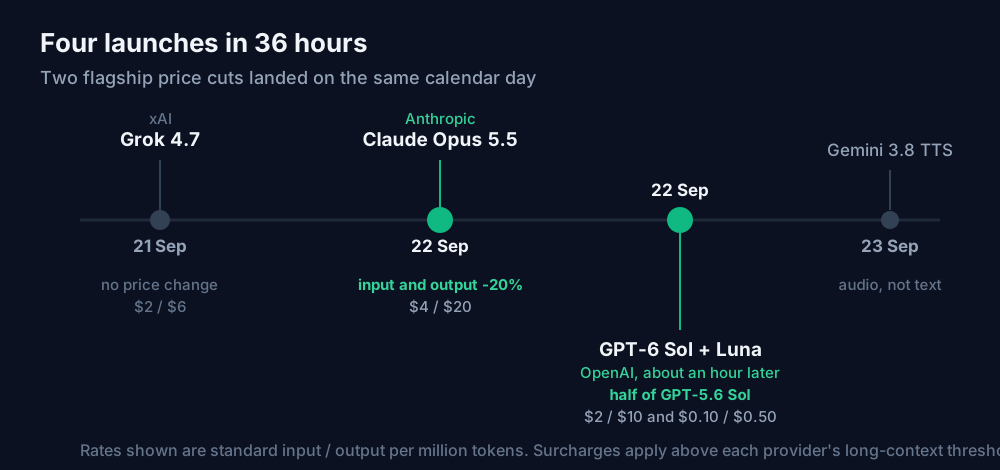
Three labs shipped frontier text models inside about 36 hours:
| Date | Model | Price change |
|---|---|---|
| 21 Sep | Grok 4.7 (xAI) | none, same as Grok 4.6 |
| 22 Sep | Claude Opus 5.5 (Anthropic) | input and output both down 20% |
| 22 Sep | GPT-6 Sol + GPT-6 Luna (OpenAI) | half of GPT-5.6 Sol |
| 23 Sep | Gemini 3.8 Flash TTS and Flash-Lite TTS | audio models, outside this comparison |
Two flagship price cuts on the same calendar day is the part worth reading into. The percentages attached to them are not comparable, and both labs were reasonably upfront about why.
The 40% that is really 20%
Anthropic's headline is a 40% cost drop versus Opus 5. Their own wording explains the arithmetic: it "costs less per token than Opus 5 and uses fewer tokens per task, which nets out to a 40% drop in costs."
So it is two effects stacked. The per-token half:
| Rate | Opus 5 | Opus 5.5 | Change |
|---|---|---|---|
| Input | $5.00/MTok | $4.00/MTok | -20% |
| Output | $25.00/MTok | $20.00/MTok | -20% |
| Cache read | $0.50/MTok | $0.20/MTok | -60% |
| Cache write (5 min) | $6.25/MTok | $5.00/MTok | -20% |
The cache read cut is the biggest single move and it goes unmentioned in most coverage. On a job with 1M input at a 90% cache hit rate plus 100K output, Opus 5 costs $3.45 and Opus 5.5 costs $2.58, a 25.2% saving on price alone.
The other 15 points come from token efficiency, which is a real saving but not one you can plan a budget around. It depends on your workload. Anthropic measured it on typical agentic tasks at default settings, and their figure is honest for that. It just is not a number you can plug into a spreadsheet the way $4/MTok is.
Opus 5.5 also has a Fast mode at $8/$40 for up to 2.5x speed, available in Claude Code and on the Claude Platform. That is double the standard rate, and Anthropic says standard output already generates more than 30% faster than Opus 5.
The 50% that is against a promotional rate
OpenAI's 50% is straightforward once you know the baseline. GPT-5.6 Sol is $4 input and $20 output. GPT-6 Sol is $2 and $10. Half, exactly.
The catch is what GPT-5.6 Sol's price is. It is itself promotional, running through 21 November 2026, after a 20%-plus drop in August. So the 50% is measured against a temporary rate rather than a list price, which makes the percentage a weaker signal than the absolute number.
The absolute numbers for both new OpenAI models:
| Model | Input | Cached input | Output | Context |
|---|---|---|---|---|
| GPT-6 Sol | $2.00/1M | $0.20/1M | $10.00/1M | 1,050,000 |
| GPT-6 Luna | $0.10/1M | $0.01/1M | $0.50/1M | 1,050,000 |
Luna is the interesting one for anyone running volume. At $0.10 input it is a fortieth of Opus 5.5's input rate. OpenAI positions it as their most efficient model for focused, high-volume tasks, which is a narrower claim than Sol's "complex coding and agentic workflows."
Cost on identical work
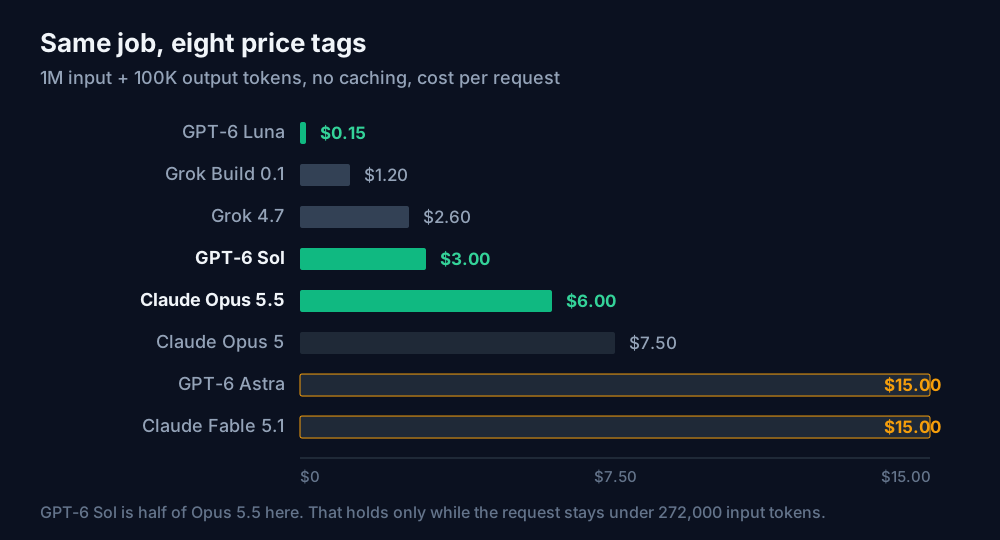
Percentages off a moving baseline are noise. Cost per request on the same job is not. Here is 1M input plus 100K output, no caching:
| Model | Cost per request |
|---|---|
| GPT-6 Luna | $0.15 |
| Grok Build 0.1 | $1.20 |
| Grok 4.7 | $2.60 |
| GPT-6 Sol | $3.00 |
| Claude Opus 5.5 | $6.00 |
| Claude Opus 5 | $7.50 |
| GPT-6 Astra | $15.00 |
| Claude Fable 5.1 | $15.00 |
Turn caching on at a 90% hit rate and the ordering holds but the spread tightens: Opus 5.5 drops to $2.58, Opus 5 to $3.45, GPT-6 Sol to $1.38, Fable 5.1 to $6.22.
Your own token mix will not match mine. Output-heavy work punishes Opus 5.5 harder, since its output rate is double Sol's, and a long cached system prompt favours Anthropic. Run your real numbers through our API cost calculator, which carries all of these models at current rates.
The 272K cliff nobody put in a headline
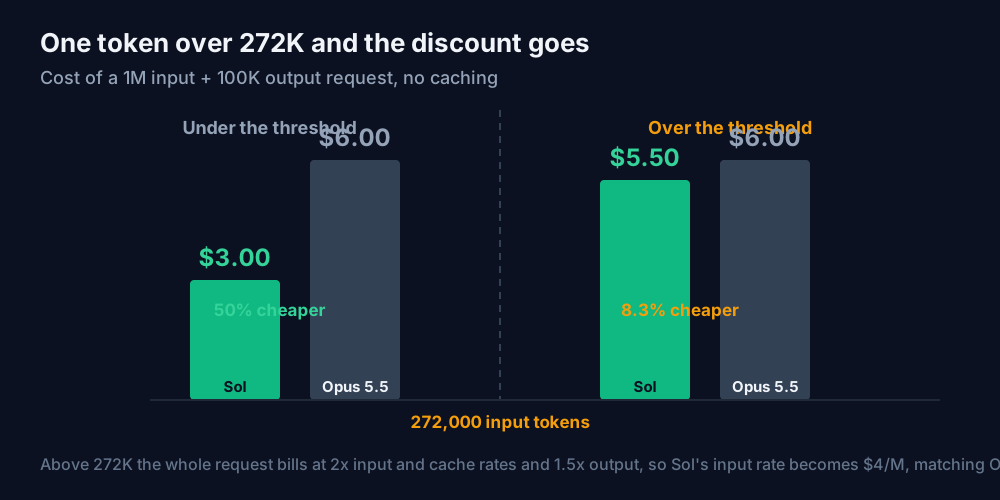
Both GPT-6 models change how they bill above 272,000 input tokens. Cross that line and the entire request, not the overage, bills at 2x input and cache rates and 1.5x output.
That turns a 1M-input job from $3.00 into $5.50, an 83% increase, for a request one token over the threshold.
Effective rates on either side of the line, next to Opus 5.5:
| Rate | Sol under 272K | Sol over 272K | Opus 5.5 |
|---|---|---|---|
| Input | $2.00/M | $4.00/M | $4.00/M |
| Cached input | $0.20/M | $0.40/M | $0.20/M |
| Output | $10.00/M | $15.00/M | $20.00/M |
Above the threshold Sol's input rate is identical to Opus 5.5's, and its cached input rate is twice Anthropic's. On that 1M-token job Sol's advantage collapses from 50% cheaper to 8.3% cheaper, and at a 90% cache hit rate it is 12.4%.
If your workload is long-context by nature, whole repositories, long transcripts, big document sets, the headline price is not your price. Budget from the surcharged rate.
xAI does the same thing at a lower threshold. Grok 4.7 doubles above 200K prompt tokens, going to $4 input, $1 cached and $12 output.
Benchmarks, including the one Anthropic loses
Every number below is self-reported by Anthropic or run by a named partner. No independent head-to-head of Opus 5.5 against GPT-6 Sol exists yet.
| Benchmark | Opus 5.5 | Fable 5.1 | Opus 5 | GPT-6 Astra | GPT-5.6 Sol |
|---|---|---|---|---|---|
| Terminal-Bench 4.0 | 66.4% | 55.8% | 52.3% | 57.9% | 37.3% |
| Terminal-Bench-Science 0.1 | 58.7% | 52.6% | 29.0% | 64.6% | 22.4% |
GPT-6 Astra wins Terminal-Bench-Science, 64.6% against 58.7%. A post that lists only the wins is marketing.
The effort levels are also not matched. Opus 5.5's Terminal-Bench figure is at xhigh effort and Astra's at high effort, each model's own best reported score. Comparing them as though the compute budget were equal overstates the gap.
On GDPval-AA v2.1, an Artificial Analysis evaluation across 44 occupations, Opus 5.5 scores 1846 Elo against Fable 5.1's 1735 and Opus 5's 1708.
Anthropic's own caveat is the most useful line in their announcement, so here it is verbatim: "at these levels of capability we've found that benchmark margins have become a less reliable guide to real-world differences. In our own use, the gap between Opus 5.5 and Claude Fable 5.1 is narrower than these scores suggest."
They also note that safeguard interventions routed some evaluation tasks to older models, cybersecurity to Opus 4.8 and biology and frontier LLM development to Opus 5, which they say likely lowered Opus 5.5's own reported scores.
Four things that break when you swap Opus 5 for Opus 5.5
Opus 5.5 is not a drop-in replacement. From Anthropic's migration documentation:
- Thinking cannot be disabled. If your code sets thinking off, that path is gone.
- Forced tool use returns an error rather than complying.
- Thinking blocks are tied to both the model and the conversation, so you cannot move them across either.
- On the Claude API and Google Cloud, the older
computer_20251124computer use tool is not accepted.
The first three apply to Claude Fable 5.1 as well, so a team already on Fable 5.1 has less work to do.
There is a fifth change that does not fail a request, which makes it the dangerous one. Text that previously came back between tool calls now arrives inside thinking blocks whose text is empty at the default display setting. An app that streams that text as progress updates goes silent between tool calls. Nothing errors, nothing logs, the UI just stops talking until you set a display value that returns the text. If you ship an agent with a live progress feed, test that path before you flip the model ID.
Once you have picked a model, the API cost calculator will show you what the switch does to a month of your actual traffic, including the cached and long-context cases above.
The Videos API dies today
Separately, and with worse timing than anyone at OpenAI probably intended, the Videos API shuts down on 24 September 2026. That covers sora-2, sora-2-pro and three dated snapshots.
Developers were notified on 24 March 2026, and the Sora web and app experiences ended on 26 April. The deprecations page lists a literal dash in the recommended replacement column. There is no OpenAI video model to move to.
Anyone still calling it has to move to another provider: Veo, Runway, Kling, Hailuo or Wan. All of them are in the calculator with per-second rates, which is the comparison you need since video pricing works nothing like token pricing.
FAQ
Is GPT-6 Sol cheaper than Claude Opus 5.5?
Below 272K input tokens, yes, by about half. On 1M input plus 100K output with no caching Sol costs $3.00 and Opus 5.5 costs $6.00. Above 272K input tokens Sol's surcharge takes the same job to $5.50, leaving it only 8.3% cheaper.
Is Claude Opus 5.5 really 40% cheaper than Opus 5?
Anthropic's 40% combines a 20% per-token price cut with Opus 5.5 using fewer tokens per task. On per-token prices alone the saving is 20%, or 25.2% on a 1M-input job at a 90% cache hit rate because cache reads fell 60%.
What is the GPT-6 272K token surcharge?
Any request with more than 272,000 input tokens bills entirely at 2x input and cache rates and 1.5x output. It applies to the whole request, not just the tokens above the threshold, and affects both GPT-6 Sol and GPT-6 Luna.
Can I swap Opus 5 for Opus 5.5 without code changes?
No. Thinking cannot be disabled, forced tool use errors, thinking blocks are bound to the model and conversation, and the older computer_20251124 tool is rejected on the Claude API and Google Cloud. Text between tool calls also moves into thinking blocks that are empty at the default display setting.
Which model wins on benchmarks?
It depends on the benchmark, and every published figure is self-reported. Opus 5.5 leads Terminal-Bench 4.0 at 66.4%, GPT-6 Astra leads Terminal-Bench-Science at 64.6%, and the effort levels behind those numbers differ. No independent head-to-head of Opus 5.5 and GPT-6 Sol has been published.
What replaces the Sora 2 API?
Nothing from OpenAI. The deprecations page leaves the recommended replacement column empty. Veo, Runway, Kling, Hailuo and Wan are the working alternatives.
Did Grok 4.7 change price?
No. It matches Grok 4.6 at $2 input, $0.50 cached and $6 output on 500K context, with rates doubling above 200K prompt tokens.
Conclusion
Two labs cut prices on the same day and both percentages are measured against something you do not care about. Anthropic's 40% bundles a price cut with a token-efficiency estimate. OpenAI's 50% is against a promotional rate that expires in November.
The number that survives contact with a real workload is cost per request, and there GPT-6 Sol is half of Opus 5.5 right up until you cross 272K input tokens, at which point it is barely cheaper at all and its cached input rate is worse. Work out which side of that line your traffic sits on before you pick.
Then budget for the migration rather than the price. Four documented breaking changes and one silent behaviour change between Opus 5 and Opus 5.5 will cost more engineering hours than the 20% saves you in the first month.
Sources
- Claude Opus 5.5 announcement — price cut, Fast mode, benchmark table and the caveat on benchmark margins
- Claude Opus 5.5 model documentation — rates, context window, cache pricing and the migration breaking changes
- GPT-6 Sol model reference — $2/$10 rates, 1.05M context and the 272K surcharge
- GPT-6 Luna model reference — $0.10/$0.50 rates and the same surcharge threshold
- xAI pricing — Grok 4.7 and Grok Build 0.1 rates and the 200K threshold
- OpenAI deprecations — Videos API,
sora-2andsora-2-proshutdown on 2026-09-24 with no named replacement - Cost-per-request figures computed for this article from the published rates above and cross-checked against the ToolMintX API cost calculator