Most electricity bills in India work the way you would expect. Cross into a higher slab and only the extra units get charged at the higher rate. The first 50 stay at the first-slab price no matter how much you end up using.
Kerala's domestic tariff stops working that way at 250 units. Past that line KSEB switches to a non-telescopic slab, where the higher rate applies to every unit on the bill, including the ones you had already been charged cheaply for.
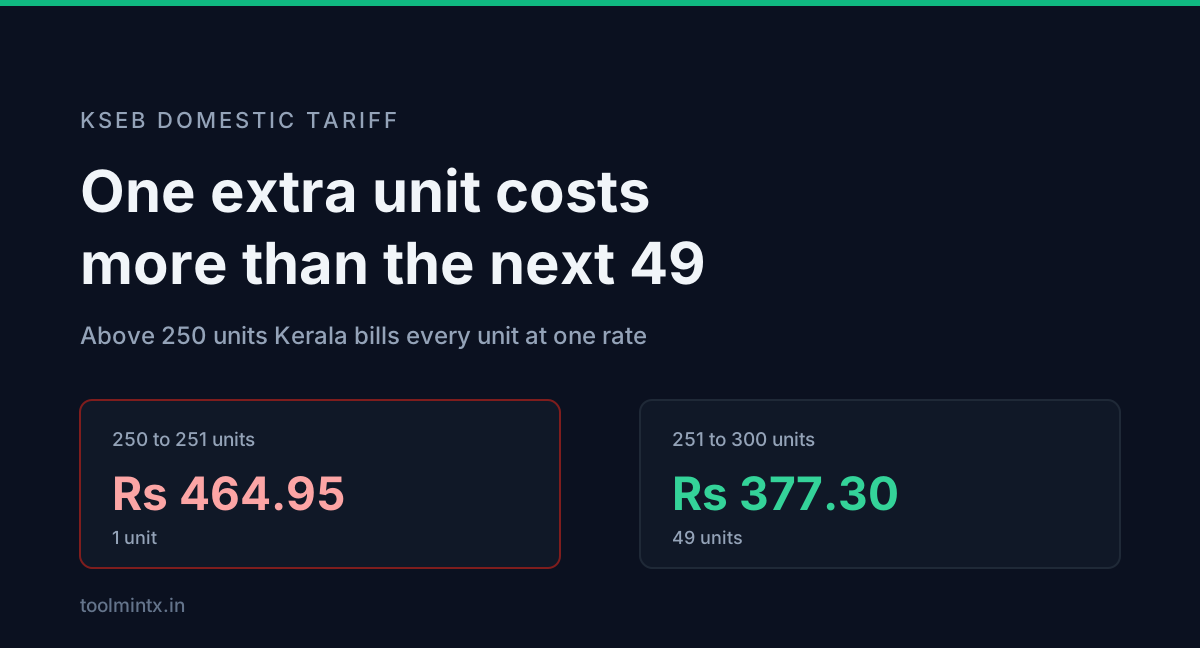
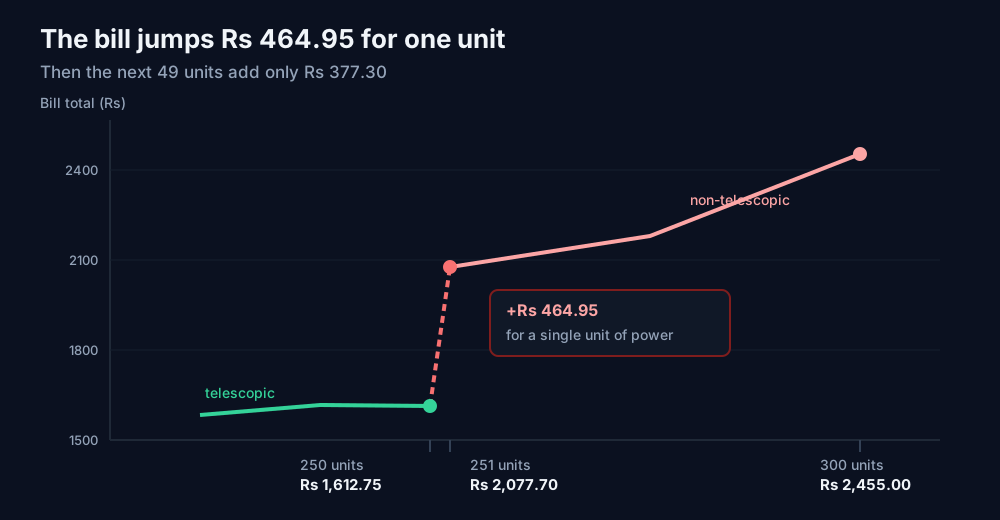
The result is a bill that jumps 464 rupees for one extra unit. Then the next 49 units cost 377 rupees between them. Consuming 251 units is more expensive per unit than consuming 300.
Table of contents
- Telescopic and non-telescopic, in one sentence each
- The actual slab tables
- What happens at 251 units
- Why the crossing unit costs 60 units worth of power
- The other cliffs, which are smaller
- What 250 units actually looks like in appliances
- The mid-cycle check that saves the money
- FAQ
- Conclusion
- Sources
Telescopic and non-telescopic, in one sentence each
Telescopic means each band of units is billed at its own rate and only the excess moves up. Use 120 units and you pay the 1-50 rate on the first 50, the 51-100 rate on the next 50, and the 101-150 rate on the last 20.
Non-telescopic means one rate applies to your entire consumption, chosen by the band your total lands in. There is no cheap first 50. Every unit bills at the same price.
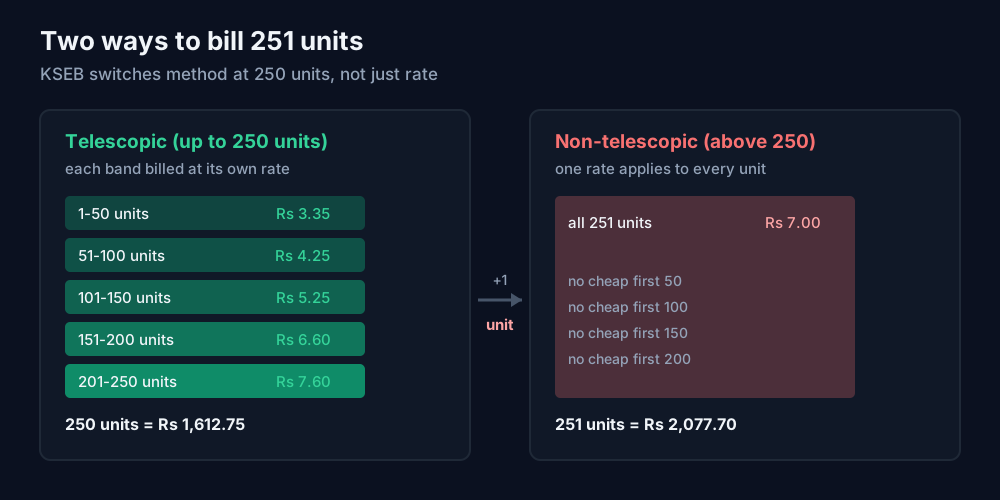
KSEB uses telescopic billing up to and including 250 units a month, and non-telescopic above it. That single switch is what produces the cliff.
The actual slab tables
Telescopic, for monthly consumption up to 250 units:
| Units | Rate per unit |
|---|---|
| 1-50 | Rs 3.35 |
| 51-100 | Rs 4.25 |
| 101-150 | Rs 5.25 |
| 151-200 | Rs 6.60 |
| 201-250 | Rs 7.60 |
Non-telescopic, above 250 units, where the rate hits every unit:
| Monthly consumption | Rate on all units |
|---|---|
| 251-300 | Rs 7.00 |
| 301-350 | Rs 7.60 |
| 351-400 | Rs 8.00 |
| 401-500 | Rs 8.60 |
| Above 500 | Rs 9.30 |
Fixed charge for a single-phase domestic connection runs from Rs 40 at the lowest band to Rs 185 above 500 units, and it steps up at the same boundaries. Electricity duty for domestic consumers is 10% of the energy charge. Meter rent is extra and does not change with consumption.
Notice that Rs 7.00 in the 251-300 band is lower than the Rs 7.60 charged on units 201-250 under telescopic billing. That looks like relief and is the opposite. Under telescopic billing only 50 units ever paid Rs 7.60. Under non-telescopic billing all 251 pay Rs 7.00.
What happens at 251 units
Energy charge plus fixed charge plus 10% duty, worked out at each end of the boundary:
| Units | Energy charge | Fixed | Duty | Total |
|---|---|---|---|---|
| 249 | Rs 1,344.90 | Rs 125 | Rs 134.49 | Rs 1,604.39 |
| 250 | Rs 1,352.50 | Rs 125 | Rs 135.25 | Rs 1,612.75 |
| 251 | Rs 1,757.00 | Rs 145 | Rs 175.70 | Rs 2,077.70 |
| 300 | Rs 2,100.00 | Rs 145 | Rs 210.00 | Rs 2,455.00 |
One unit takes the bill from Rs 1,612.75 to Rs 2,077.70. That is Rs 464.95 for a unit of power worth about Rs 7.
The 249 to 250 step, for comparison, costs Rs 8.36. Same meter, same house, one unit later, and the price of that unit is 56 times higher.
Why the crossing unit costs 60 units worth of power
Inside the 251-300 band the marginal cost of one more unit is Rs 7.00 plus 10% duty, so Rs 7.70. The crossing unit costs Rs 464.95, which is 60 units of ordinary consumption at that same rate.
Put the two numbers side by side and the shape of the tariff becomes obvious:
- crossing from 250 to 251 units: Rs 464.95 for one unit
- going on from 251 to 300 units: Rs 377.30 for 49 units
The single crossing unit costs 1.23 times what the following 49 cost combined. Almost all of the damage is done at the boundary, and once you are over it you may as well use the rest of the band.
That also means the saving from cutting back gets weaker the further past 250 you are. Coming down from 255 units to 250 saves Rs 495.75, which works out to Rs 99.15 for each unit you avoid. From 300 down to 250 saves Rs 842.25, a better total but only Rs 16.84 per unit of effort. Cutting 5 units when you are 5 over is the highest-value electricity saving available to a Kerala household.
Effective per-unit cost tells the same story. At 250 units the bill averages Rs 6.45 a unit. At 251 it averages Rs 8.28. At 300 it is back down to Rs 8.18, slightly cheaper per unit than 251.
The other cliffs, which are smaller
Every non-telescopic boundary has a jump, because the whole-consumption rate steps up at each one:
| Boundary | Bill before | Bill after | Jump |
|---|---|---|---|
| 250 to 251 | Rs 1,612.75 | Rs 2,077.70 | Rs 464.95 |
| 300 to 301 | Rs 2,455.00 | Rs 2,666.36 | Rs 211.36 |
| 350 to 351 | Rs 3,076.00 | Rs 3,243.80 | Rs 167.80 |
| 400 to 401 | Rs 3,675.00 | Rs 3,958.46 | Rs 283.46 |
| 500 to 501 | Rs 4,895.00 | Rs 5,310.23 | Rs 415.23 |
The 250 boundary is the worst because it is the only one where the billing method itself changes. At 300 or 400 you are already non-telescopic and only the rate moves. At 250 you lose the cheap early bands entirely.
If your household normally lands between 240 and 260 units, that is the band worth watching. Anyone sitting at 320 or 480 has a smaller cliff ahead but the same logic applies: check where you are a week before the reading.
What 250 units actually looks like in appliances
Units per month is watts times hours times 30, divided by 1,000. A fridge never draws its nameplate wattage continuously, so it needs a load factor, which is the fraction of time the compressor actually runs.
| Appliance | Draw and use | Units per month |
|---|---|---|
| 1.5 ton AC, 3-star | 1,500 W, 4 h/day | 180.00 |
| 200 L fridge | 150 W, 24 h at 0.35 load | 37.80 |
| 2 kW geyser | 2,000 W, 30 min/day | 30.00 |
| Laptop | 65 W, 8 h/day | 15.60 |
| Washing machine | 500 W, 1 h/day | 15.00 |
| Ceiling fan | 60 W, 8 h/day | 14.40 |
| LED TV | 90 W, 5 h/day | 13.50 |
| 1 kW iron | 1,000 W, 20 min/day | 9.90 |
One AC running four hours a night is 180 units on its own. Add a fridge and you are at 218 before lights, fans or anything else. This is why the 250 line catches ordinary households in a Kerala summer rather than only large ones.
Half an hour less AC per day is 22.5 units a month. If you are 5 units over the line, that single change pays Rs 495.75.
The appliance electricity cost calculator does this per device with the load factor included, and ranks which appliance is eating the largest share of your bill.
The mid-cycle check that saves the money
You cannot act on this after the reading is taken. The check has to happen while the cycle is still running, and it needs your current meter reading rather than an old bill.
Take your reading around day 20 of a 30-day cycle and scale it up:
- 170 units by day 20 projects to 255. Over the line. You need to hold the last 10 days to 80 units, or 8 a day.
- 180 units by day 20 projects to 270. You need 70 units in 10 days, or 7 a day.
- 190 units by day 20 projects to 285. You need 60 units in 10 days, or 6 a day.
At 190 by day 20 the required 6 units a day is below what a house with an AC will manage, so the honest call is to stop trying and use the band you are already in. At 170 the target of 8 a day is reachable by cutting the geyser and an hour of AC, and it is worth about Rs 496.
To get units consumed from two readings, the Indian electricity calculator takes the previous and current reading with a per-unit rate and gives you the consumption and total. Feed it your day-20 reading against the cycle's opening reading and you have the number this projection needs.
Two caveats worth knowing. KSEB bills most domestic consumers on a two-month cycle, and the slab limits are applied on the monthly average of that cycle, so a 500-unit bimonthly reading is treated as 250 a month. Households under 200 units for the cycle also get a state subsidy applied to both the fixed and energy charge without applying for it.
FAQ
What is non-telescopic billing in KSEB?
It charges your entire monthly consumption at a single rate set by the band your total falls in. Above 250 units a month, domestic consumers in Kerala are billed this way, so the cheaper first-50 and first-100 rates no longer apply to any part of the bill.
How much does crossing 250 units cost?
Rs 464.95 on a single-phase domestic connection, taking the bill from Rs 1,612.75 at 250 units to Rs 2,077.70 at 251. That includes the fixed-charge step from Rs 125 to Rs 145 and 10% electricity duty.
Is 251 units more expensive per unit than 300 units?
Yes. At 251 units the bill averages Rs 8.28 a unit. At 300 units it averages Rs 8.18. Both sit in the same Rs 7.00 band, and the fixed charge is the same Rs 145, so spreading it over more units lowers the average.
Should I use up the rest of the band once I have crossed?
Cutting back still lowers the bill, just far less per unit. Coming down from 255 to 250 units saves Rs 99.15 per unit avoided. From 300 to 250 it is Rs 16.84 per unit. There is no consumption above 250 that costs less than 250 units does, so dropping under the line is always cheaper if you can reach it.
Do other states do this?
Most Indian states bill domestic consumers telescopically, where only the excess units move to the higher rate. Kerala's non-telescopic treatment above 250 units is unusual, which is why calculators built on the general slab model get Kerala bills wrong.
Does the 250 limit apply to a two-month bill?
The limit is monthly. On a bimonthly cycle KSEB applies the slabs to the monthly average, so 500 units across two months is assessed as 250 a month.
Conclusion
The number to remember is 250 units a month, and the reason is that Kerala changes billing method there rather than just changing the rate. One unit past it costs Rs 464.95, which is 60 units of ordinary power.
Everything useful about that fact depends on timing. Once the meter reads 251 the money is spent, and cutting back afterwards returns Rs 16 to Rs 20 a unit instead of Rs 99. Read the meter around day 20, scale it to 30 days, and decide then whether 250 is still reachable.
If it is not, stop economising and use the band. If it is, half an hour less AC a day is usually the whole gap.
Sources
- KSEB bill calculator tariff tables — LT-1A domestic telescopic and non-telescopic slab rates, single-phase fixed charges by band, and the 10% duty and bimonthly subsidy rules
- Kerala State Electricity Regulatory Commission — tariff orders for the FY 2023-24 to 2026-27 control period that set the domestic slab structure
- Bajaj Finserv KSEB tariff summary — corroborating telescopic slab rates from Rs 3.35 to Rs 7.60
- Service charges for new power connections in Kerala revised — 24 September 2026 revision to connection service charges, separate from the consumption tariff
- Every bill total, boundary jump, per-unit average and appliance unit figure in this article was computed from the slab rates above and checked against the ToolMintX electricity calculators