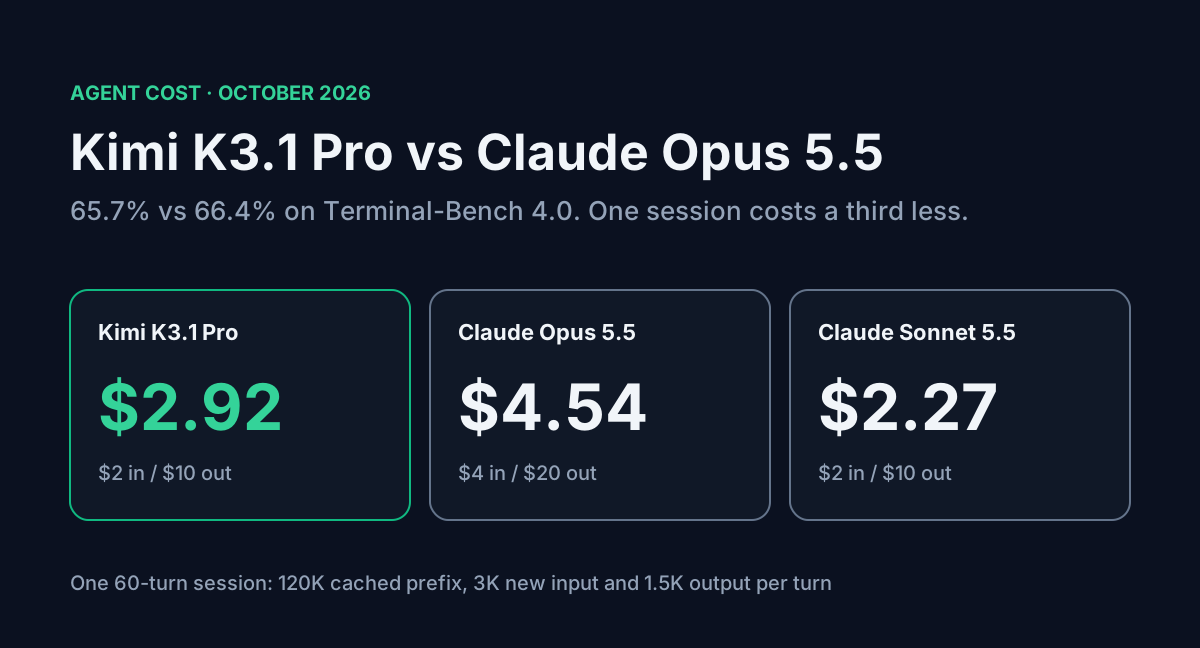
Moonshot AI shipped Kimi K3.1 Pro on 24 October 2026 at $2 per million input tokens and $10 output. On Terminal-Bench 4.0, Moonshot reports 65.7% for it against 66.4% for Claude Opus 5.5, which costs $4 and $20. Both charge $0.20 per million for a cache read.
So the question for anyone running a coding agent is simple. If the scores are that close, how much does the cheaper sticker save once caching is counted? I costed our standard 60-turn session on K3.1 Pro, Opus 5.5, Sonnet 5.5 and Moonshot's own K3 from the official tables. Then I set it up in Claude Code and Hermes Agent, where the official examples hide one date you'll trip over next week.
Table of contents
- K3.1 Pro prices and limits
- One agent session on each model
- The 1h cache is worth paying for on slow sessions
- Benchmarks Moonshot published
- Claude Code setup and the October 31 cutoff
- Hermes Agent and OpenAI-style clients
- FAQ
- Sources
K3.1 Pro prices and limits
From Moonshot's pricing page and the K3.1 Pro quickstart, read on 24 October:
| Per 1M tokens | Kimi K3.1 Pro | K3.1 Pro Highspeed | Kimi K3 | Claude Opus 5.5 | Claude Sonnet 5.5 |
|---|---|---|---|---|---|
| Input | $2.00 | $4.00 | $3.00 | $4 | $2 |
| Output | $10.00 | $20.00 | $15.00 | $20 | $10 |
| Cache read | $0.20 | $0.20 | $0.30 | $0.20 | $0.10 |
| Cache write, 5 min | $2.00 | $4.00 | $3.00 | $5 | $2.50 |
| Cache write, 1 hour | $4.00 | $8.00 | $6.00 | $8 | $4 |
A few things in that table are easy to miss. K3.1 Pro is a third cheaper than K3, the model it replaces, on every line. Highspeed is 2-3x faster by Moonshot's account and matches Opus 5.5 on input, output and cache reads, with a cheaper 5-minute cache write. All three Kimi models take 1,048,576 tokens of context, and there's no long-context tier: the quickstart says pricing is flat across the whole window.
The 5-minute cache write is billed at the plain input rate, so on Kimi you lose nothing by letting the cache fill. Anthropic charges 1.25x input for the same thing.
The model needs a top-up before it unlocks. Moonshot calls it a flagship model, and the minimum is $1.
One agent session on each model
Same session we cost for every model: 60 turns, a 120,000-token prefix written once and read from cache on the next 59 turns, plus 3,000 new input tokens and 1,500 output tokens per turn.
| Line | Tokens | K3.1 Pro | Opus 5.5 | Sonnet 5.5 | K3 |
|---|---|---|---|---|---|
| Prefix, cache write | 120,000 | $0.240 | $0.600 | $0.300 | $0.360 |
| Cache reads | 7,080,000 | $1.416 | $1.416 | $0.708 | $2.124 |
| New input | 180,000 | $0.360 | $0.720 | $0.360 | $0.540 |
| Output | 90,000 | $0.900 | $1.800 | $0.900 | $1.350 |
| Session | 7,470,000 | $2.92 | $4.54 | $2.27 | $4.37 |
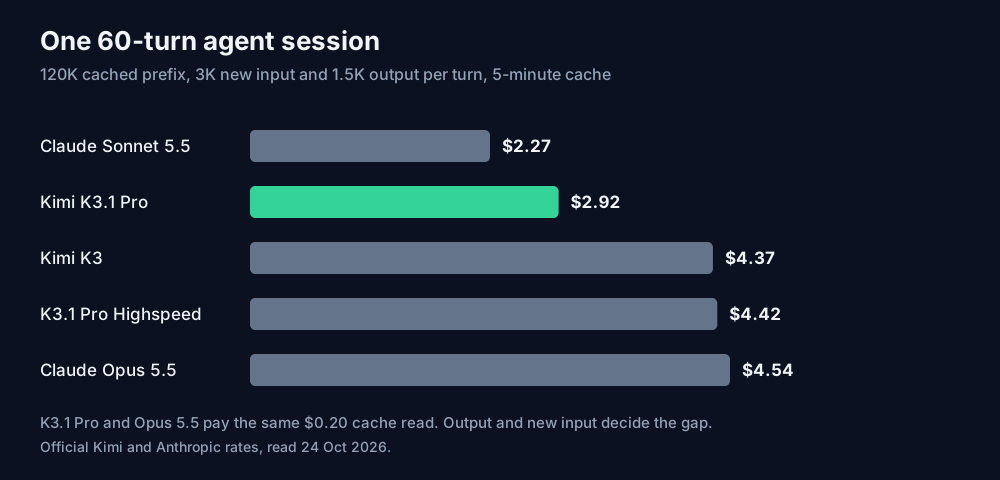
K3.1 Pro comes in 35.7% under Opus 5.5, not the 50% the headline rates suggest. The cache-read line is identical on both at $1.416, and it's 48.6% of the Kimi bill. Halving input and output only works on the other half.
At four sessions a workday for 20 days, that's $233.28 a month on K3.1 Pro against $362.88 on Opus 5.5, a $129.60 difference. Highspeed lands at $4.42 a session, which is close enough to Opus that you're paying for speed, not for a discount.
Sonnet 5.5 is still cheaper than both. It has the same $2/$10 rates as K3.1 Pro, and Anthropic cut its cache reads to $0.10 on 7 October. That half-price read is the whole $0.65 gap. K3.1 Pro costs 1.29x Sonnet 5.5 and, on Moonshot's numbers, scores close to Opus. Whether that's a good trade depends on whether Sonnet already passes your tasks.
Lose the cache and the picture changes fast. If the prefix misses on every turn, the K3.1 Pro session costs $15.66. Moonshot's quickstart adds one more catch: the cache is stored in blocks, and a partial block at the end of a prefix is billed as a miss. Check usage.prompt_tokens_details.cached_tokens on the first few turns.
To run your own turn count or prefix size, the API Cost Calculator now lists K3.1 Pro, Highspeed and K3.
The 1h cache is worth paying for on slow sessions
The numbers above assume turns arrive inside five minutes, so every read renews the 5-minute cache for free. Real sessions have gaps. You read a diff, run tests yourself, get a coffee.
Say the same session has four breaks longer than five minutes. Each one expires the cache, and the next turn writes the 120K prefix again instead of reading it.
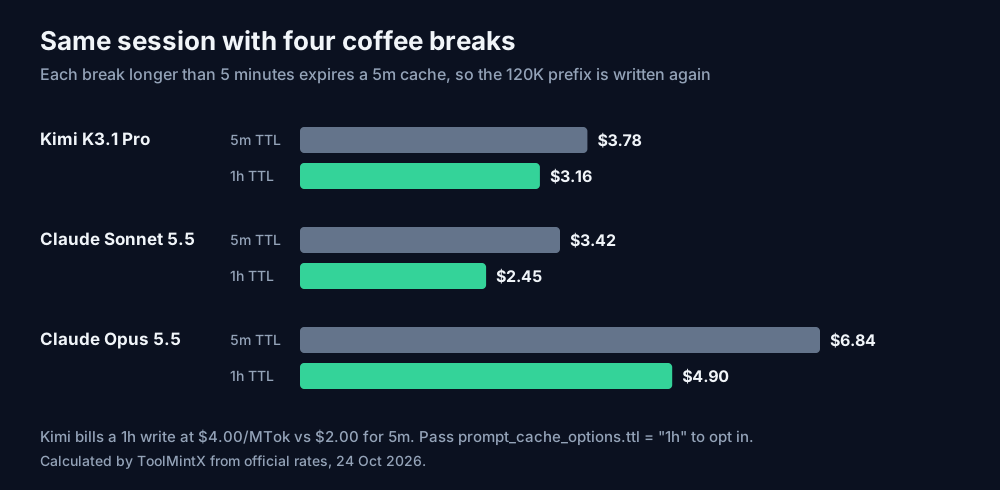
On K3.1 Pro, four rewrites push the session from $2.92 to $3.78. Opting into the 1-hour cache costs $0.24 more on the first write ($4.00 instead of $2.00 per million), and after that every turn is a read. That session comes to $3.16. Moonshot's own docs put the break-even at two extra hits within the hour.
The setting is opt-in. Chat Completions and the Responses API take it in the request body:
{
  "model": "kimi-k3.1-pro",
  "messages": [{"role": "user", "content": "..."}],
  "prompt_cache_options": {"mode": "implicit", "ttl": "1h"}
}
On the Anthropic-compatible endpoint it's a top-level cache_control field with "ttl": "1h". Moonshot ignores the same marker inside the messages, which is where Anthropic's own API expects it. A client written for Anthropic caching will silently fall back to 5 minutes.
The TTL also locks on first write. If the 5-minute entry is still alive, you can't switch that prefix to 1 hour until it expires.
Benchmarks Moonshot published
These are Moonshot's numbers from the K3.1 Pro blog. I haven't run them.
| Benchmark | K3.1 Pro | Claude Opus 5.5 | GPT-6 Astra |
|---|---|---|---|
| Terminal-Bench 4.0 | 65.7% | 66.4% | 58.2% |
| BenchCAD, with tools | 92.7% | 96.2% | 95.9% |
On its internal Kimi Code Bench 3.0 Long-horizon, K3.1 Pro scores 61.2% against 55.95% for K3. Moonshot ran K3.1 Pro through the Claude Code harness for the Terminal-Bench numbers, which makes them a fair proxy for the setup below.
One thing the blog says outright: Moonshot removed cyber-related data from training for the open-weight release, and the final model solves 81.0% of xdev-bench-hard at pass@3 against 90.5% for an unfiltered checkpoint. If security research is your use case, expect it to trail the closed models there.
Claude Code setup and the October 31 cutoff
Kimi serves an Anthropic-compatible endpoint at https://api.moonshot.ai/anthropic. Moonshot's guide writes everything into the env block of ~/.claude/settings.json, which overrides any ANTHROPIC_* variables in your shell. Its example points every tier at kimi-k3[1m] and the Haiku tier at kimi-k2.7-code.
Two changes before you copy it. Swap the main tiers to kimi-k3.1-pro, which is a third cheaper than K3. And look hard at that Haiku line. The pricing page says K2 series models stop being available to newly registered users on 31 October 2026, and all K2 models retire by the end of December. Sign up after the 31st and the background tasks Claude Code routes to the Haiku tier will fail.
{
  "env": {
    "ANTHROPIC_BASE_URL": "https://api.moonshot.ai/anthropic",
    "ANTHROPIC_AUTH_TOKEN": "YOUR_MOONSHOT_API_KEY",
    "ANTHROPIC_MODEL": "kimi-k3.1-pro",
    "ANTHROPIC_DEFAULT_OPUS_MODEL": "kimi-k3.1-pro",
    "ANTHROPIC_DEFAULT_SONNET_MODEL": "kimi-k3.1-pro",
    "ANTHROPIC_DEFAULT_HAIKU_MODEL": "kimi-k3.1-pro",
    "ANTHROPIC_DEFAULT_FABLE_MODEL": "kimi-k3.1-pro",
    "CLAUDE_CODE_SUBAGENT_MODEL": "kimi-k3.1-pro",
    "CLAUDE_CODE_AUTO_COMPACT_WINDOW": "1000000",
    "CLAUDE_CODE_EFFORT_LEVEL": "high"
  }
}
The [1m] suffix appears in Moonshot's guide only on kimi-k3, so I've left it off here. Run /model after starting claude and check the name it reports. Moonshot also documents a one-token curl check against /anthropic/v1/messages with kimi-k3.1-pro, which is the fastest way to confirm the key works.
I set effort to high. Moonshot's guide sets max, and max is also the API default when you send nothing. Thinking bills as output, and output is the largest line after cache reads. If max doubled output to 3,000 tokens a turn, the session would go from $2.92 to $3.82.
Leave ANTHROPIC_API_KEY unset. The guide warns it conflicts with ANTHROPIC_AUTH_TOKEN and causes 401s.
Hermes Agent and OpenAI-style clients
The OpenAI-compatible base URL is https://api.moonshot.ai/v1. Moonshot's Hermes guide runs hermes model, picks Kimi / Moonshot, then adds a custom provider. Its example still names kimi-k3, so change the model:
custom_providers:
  - name: kimi-global
    base_url: https://api.moonshot.ai/v1
    key_env: KIMI_API_KEY
    api_mode: chat_completions
    model: kimi-k3.1-pro
    extra_body:
      reasoning_effort: high
    models:
      kimi-k3.1-pro:
        context_length: 1048576
        supports_vision: true

model:
  provider: custom:kimi-global
  default: kimi-k3.1-pro
  context_length: 1048576
Keep the key in the KIMI_API_KEY environment variable, not in config.yaml. Set base_url to the /v1 root only, because Hermes appends /chat/completions itself.
K3.1 Pro always reasons. reasoning_effort takes low, high or max, and on tool-calling turns you must pass the whole assistant message back, reasoning_content and tool_calls included. Coming from K2.x, delete the old thinking block from your requests. Codex users get a separate guide through the Kimi Responses API.
For streaming Chat Completions, set stream_options.include_usage to true or the final chunk won't carry the cache read and write counts you need to check the bill.
FAQ
Can I run K3.1 Pro locally? Not yet. Moonshot says the full weights will be released by 4 November. It's a 3T-class model, so plan on a multi-GPU server rather than a workstation. Once the config is public you can size it in the AI VRAM Calculator.
Is K3 still worth using? Only if you have a pinned reason. K3 is $3/$15 with $0.30 cache reads, and our session costs $4.37 on it against $2.92 on K3.1 Pro, which Moonshot describes as a post-trained K3.
Does a Kimi membership or Kimi Code plan change these figures? No. Moonshot says API billing is pay-as-you-go and separate from the Kimi membership and Kimi Code products. The costs here are API costs.
Sources
- Moonshot AI, "Kimi K3.1 Pro Tech Blog" (kimi.com/en/blog/kimi-k3-1-pro, read 24 October 2026): release, Highspeed speed claim, weights by 4 November, Terminal-Bench 4.0, BenchCAD, Kimi Code Bench and xdev-bench-hard figures.
- Kimi API Platform, Model Inference Pricing (platform.kimi.ai/docs/pricing/chat, read 24 October 2026): K3 and K2 series rates, cache write tiers, K2 cutoff on 31 October and retirement by end of December.
- Kimi API docs: Kimi K3.1 Pro quickstart, Best Practices for context caching, Reasoning Effort (platform.kimi.ai/docs/guide, read 24 October 2026): flat pricing, $1 top-up, block caching, TTL rules and parameters, usage fields, reasoning_content handling.
- Kimi API docs: Use Kimi in Claude Code, Use Kimi K3 in Hermes Agent (platform.kimi.ai/docs/guide, read 24 October 2026): endpoints, settings.json variables, Hermes config.
- Anthropic, Pricing (platform.claude.com/docs/en/about-claude/pricing, read 24 October 2026): Opus 5.5 and Sonnet 5.5 rates.
- Session costs, monthly totals and percentages are calculated by ToolMintX from those rates.