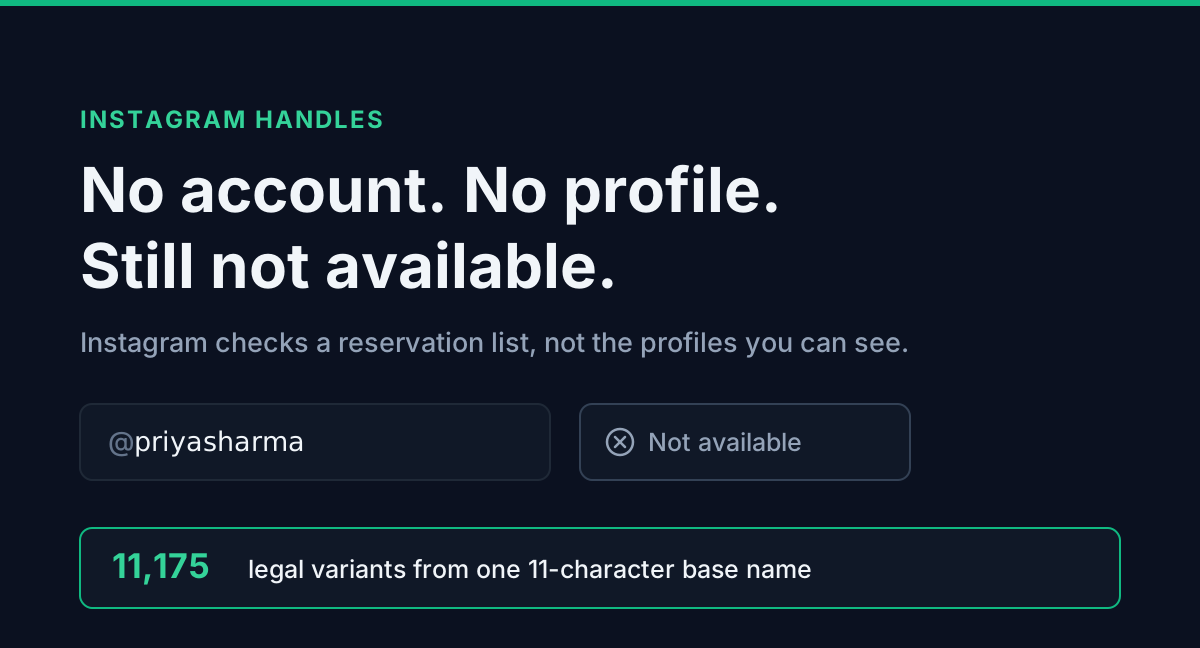
You search the handle. Nothing loads. No profile, no posts, no "user not found" page with a familiar avatar. Instagram still says the username is not available.
Refreshing will not change it. Instagram checks the string against a reservation list rather than against the accounts you can see, so a handle stays locked while its account sits deactivated, was deleted last week, got banned two years ago, or never existed because the word itself is withheld.
Which of those you hit decides what to do next, and the answers differ a lot. Some cases free up on a timeline nobody publishes, others are closed permanently. Either way the same base name still gives you thousands of legal alternatives, and I counted them below.
Table of contents
- Visible account and reserved string are different checks
- Five reasons a free-looking handle is locked
- Which ones release, and when
- Your base name has 11,175 legal variants
- The four characters, and the one placement rule
- What to do in the next ten minutes
- FAQ
- Conclusion
- Sources
Visible account and reserved string are different checks
When you type a handle into the signup or edit screen, Instagram is not asking "can I find a profile here". It is asking whether the string is claimable.
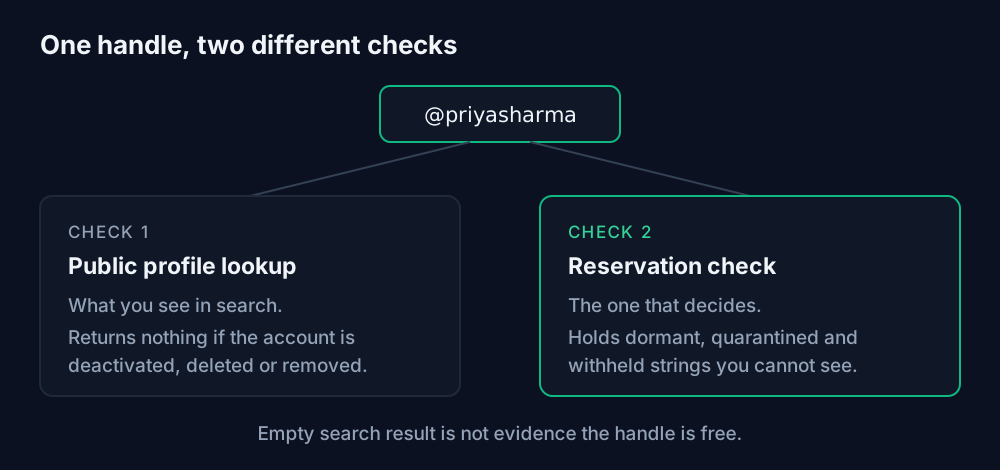
A profile lookup can come back empty for reasons that have nothing to do with whether the name is free. The account might be deactivated, which hides the profile and keeps the handle. It might be removed for violations, where the name stays parked. The string might sit on a withheld list for trademark or safety reasons, in which case no account ever held it.
This is why "I searched and found nothing" is weak evidence. The public search surface and the reservation table do not agree, and only one of them decides.
Five reasons a free-looking handle is locked
| What happened | Profile visible? | Handle claimable? |
|---|---|---|
| Owner deactivated the account | No | No, held while dormant |
| Owner deleted the account | No | Not immediately, hold period varies |
| Account removed for violations | No | Usually not, parked long-term |
| Owner changed handle recently | No | No, short quarantine on the old name |
| String withheld (trademark, slur, brand) | No, never existed | No, and not on a timer |
The fourth row catches people who change a handle, dislike the new one, and try to switch back within minutes. Instagram reserves the old name so nobody can grab it out from under you, which also means you cannot retake it yet. Reports put that hold around 14 days, though Instagram does not publish a fixed figure and behaviour varies by account.
The fifth row is the one worth recognising early. If the handle contains a brand name, a trademarked term, a slur, or wording tied to impersonation, it is not queued behind anybody. There is no date to wait for. Pick something else.
Which ones release, and when
No public timetable exists for any of these, and every number circulating in guides is observed behaviour rather than documented policy. What you can reason about is the shape of each case.
A recently released handle from a name change is the shortest wait and the most likely to come free. A user-deleted account releases its handle after a hold Instagram has never specified, sometimes weeks, sometimes much longer. A deactivated account is indefinite by design, because deactivation is reversible and the owner expects their handle to be there when they come back. A banned account's handle is usually kept parked to block the impersonation that reusing it would enable.
So the honest ranking is: wait only on the name-change case, treat deletion as a maybe worth one retry in a month, and treat deactivation, bans and withheld strings as permanently gone.
Waiting also has a cost people forget. While you hold out for one string, you are not building anything on a handle you own.
Your base name has 11,175 legal variants
This is where the math is friendlier than it feels at 11pm with a rejected handle on screen.
Take priyasharma, 11 characters, leaving 19 spare under Instagram's 30-character limit. Counting only variants that keep the name readable and in order:
| Variant family | Count |
|---|---|
One internal . or _ | 20 |
| Numeric suffix, 1 to 4 digits | 11,110 |
| Leading or trailing separator | 3 |
| Seven affix words, both orders | 42 |
| Total from one base name | 11,175 |
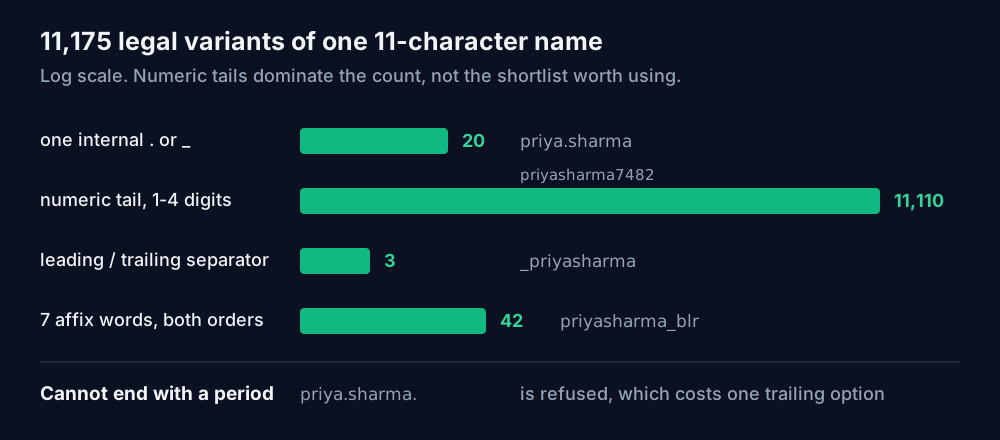
Combine families and it grows again: one separator paired with a two-digit tail alone gives 2,000 options. the_priyasharma_official is 24 characters, still comfortably legal.
Not all 11,175 are good. A four-digit tail reads like a throwaway account, and priyasharma7482 tells a visitor nothing. The useful subset is small and it is the one worth generating deliberately: a clean separator placement, or a short meaningful affix like a city, craft or niche. Our Instagram username generator works that subset, tagging each suggestion by style so you can see which ones read as a name versus a brand.
The number matters because it shows the string you lost was never your only option, and a replacement picked deliberately can read better than the one you were originally set on.
The four characters, and the one placement rule
Instagram permits exactly four character types: letters, numbers, periods and underscores. No spaces, no @, no hyphens, no other symbols. Length runs 1 to 30 characters.
One placement rule causes most of the confusing rejections: a username cannot end with a period. priya.sharma is fine, priya.sharma. is refused, and the error message does not always explain which rule you broke.
Underscores are not penalised, despite years of advice claiming otherwise. They are one of the four permitted characters. What hurts is stacking them: the__real__priya is legal at 16 characters and still a bad handle, because nobody can dictate it over a phone call or type it right the first time. One separator used as a word break is the readable choice.
Handles are case-insensitive in practice, so capitalisation is not a way around a taken name. Your display name is the field that carries capitals, spaces and emoji, and it follows a different set of rules entirely, including the twice-per-14-days cap covered in the Instagram 14-day limit explained.
What to do in the next ten minutes
Work out which case you are in, then act on it rather than retrying the same string.
If you changed your own handle recently and want it back, that is the quarantine case. Note the date you changed it and try again after two weeks. Do not create a second account holding the old name in the meantime, because that ties the string to a live account and blocks you for real.
If the handle contains a brand or trademarked term, stop. Even if it frees up, a handle built on somebody else's mark can be reclaimed later through a trademark complaint, and losing it after you have printed it on packaging costs more than choosing differently today.
For everything else, generate a shortlist and check availability in the app rather than in search, since the app is the surface that runs the real reservation check. Then apply two filters before you commit: can you say it out loud without spelling it, and does it still fit if your niche shifts in two years. Changing a handle later breaks every old link and tag pointing at you, which is the actual cost of getting this wrong twice.
FAQ
Why does Instagram say a username is taken when the profile does not exist?
The check runs against reserved strings, not visible profiles. Deactivated accounts, deleted accounts inside their hold period, accounts removed for violations, recently released handles and withheld words all read as unavailable with nothing to show publicly.
How long until a deleted account's username is free?
Instagram does not publish a timeline. Reports range from weeks to indefinite, and handles from accounts removed for violations are generally kept parked rather than released. Treat it as a maybe, not a queue you are in.
Can I get my old username back after changing it?
Often yes, after a hold that is widely reported as about 14 days. Instagram reserves it so nobody else can take it during that window, which is also why you cannot retake it immediately. Do not park it on a second account while you wait.
Do underscores or periods hurt my account?
No. Both are permitted characters and neither is penalised. Stacking them hurts readability, and a username cannot end with a period.
What is the Instagram username character limit?
1 to 30 characters, using only letters, numbers, periods and underscores.
Does capitalisation make a taken handle available?
No. Handles are treated case-insensitively, so a capitalised version of a taken name is the same name. Capitals belong in your display name.
Conclusion
An unavailable handle with no visible account almost always means a reservation you cannot see, and the five causes behind it split cleanly: one is worth waiting out, one is worth a single retry later, and three are closed. Reading the message as "this specific string is reserved" rather than "Instagram is broken" saves the hour people spend refreshing.
Then spend the time on the replacement instead. One 11-character name generates 11,175 legal variants, only a handful of which are genuinely good, and the two filters worth applying are whether you can say it aloud without spelling it and whether you will still want it in two years.
Sources
- Instagram Help Center — username rules and account settings
- Instagram handle rules, changes and selection guide — display name versus username rule split, separator readability
- Instagram username checker guide — 1-30 character limit and permitted characters
- Instagram character limits reference — field-level limits
- Why a username shows unavailable — old-handle reservation window after a change
- Variant counts computed for this article against the documented 1-30 character and permitted-character rules