Tencent put Hy4 flash on Hugging Face on 17 November 2026 and made it generally available on its TokenHub API the same week. It has 220B total parameters, about 12B active per token, a 1,048,576-token window, and image input. TokenHub charges $0.07 per million input tokens, $0.003 for cache hits and $0.281 for output.
That's a twelfth of the input price of the full Hy4, so the obvious question is whether you should still pay anyone at all, or pull the open weights and run it at home. I costed our usual 60-turn agent session on the API, then went through the GGUF builds Tencent shipped to see what "local" really takes.
Table of contents
- What Hy4 flash is
- TokenHub prices next to Hy4 and DeepSeek
- One agent session on each model
- The GGUF builds and the 59 GiB shard
- Local speed against the API
- Running Hy4 flash with llama.cpp
- FAQ
- Sources
What Hy4 flash is
The model card gives the split. 155.5B parameters sit in the language backbone, 63.5B in an Engram table, 0.43B in a SigLIP2-based vision encoder, and 0.85B in a built-in drafter called DFly2. Per token it activates 11.3B text parameters plus the 0.43B vision encoder.
Three parts are new compared with Hy4:
- Attention alternates between sparse layers and 512-token sliding-window layers, 12 of the first kind and 30 of the second across 42 layers.
- The MoE runs its 512 routed experts in a 1,536-wide latent space, with 16 experts and one shared expert per token.
- Engram adds learned bigram and trigram embeddings, looked up by hash at four layers. That table is the 63.5B parameters, and it's why the downloads are so large for a 12B-active model.
Tencent says the KV cache is 1/24 of Hy3's and 1/6 of Hy4's. The config backs up the reason: only the 12 sparse layers keep a full-length cache, and they use MLA with a 512-wide latent. The other 30 layers never hold more than 512 tokens.
Tencent recommends it for deep search, document work, slides, simple frontend demos and computer use, and recommends the full Hy4 for long-horizon software engineering. In its blind test with 85 WorkBuddy users, Hy4 flash scored 2.79 out of 4 for satisfaction against 2.81 for Claude Haiku 5.5. Those are Tencent's numbers on Tencent's internal tasks.
TokenHub prices next to Hy4 and DeepSeek
Singapore region, per million tokens, from the TokenHub pricing table read on 20 November 2026.
| Model | Input | Cache hit | Output |
|---|---|---|---|
| Hy4 flash | $0.07 | $0.003 | $0.281 |
| Hy4 | $0.834 | $0.042 | $2.501 |
| DeepSeek-V4-Flash (0731) | $0.14 | $0.0028 | $0.28 |
Hy4 flash is 11.9x cheaper than Hy4 on input, 8.9x on output and 14x on cache hits. Against DeepSeek-V4-Flash on the same page it's half the input price, with near-identical cache and output prices. TokenHub notes that DeepSeek-V4 models use peak and off-peak pricing in Beijing hours. Hy4 flash has one flat rate.
OpenRouter also lists tencent/hy4-flash with Tencent as the only provider, at half these rates under a launch discount flag, served in FP8. Neither the TokenHub page nor OpenRouter gives an end date for that discount, so I costed the TokenHub list price.
One agent session on each model
The session is the one we use across these posts:
- 60 turns
- a 120,000-token prefix (system prompt, tool schemas, files), billed at the input rate once and read from cache on the other 59 turns
- 3,000 new input tokens per turn
- 1,500 output tokens per turn, thinking included
Haiku 5.5 is in the table because Tencent compared against it. Every request in this session carries more than 100,000 tokens of prompt, so Anthropic bills all of them at its long-prompt rates: $0.50 in, $0.05 cache read, $2.50 out.
| Model | Prefix pass | Cache reads | New input | Output | Session |
|---|---|---|---|---|---|
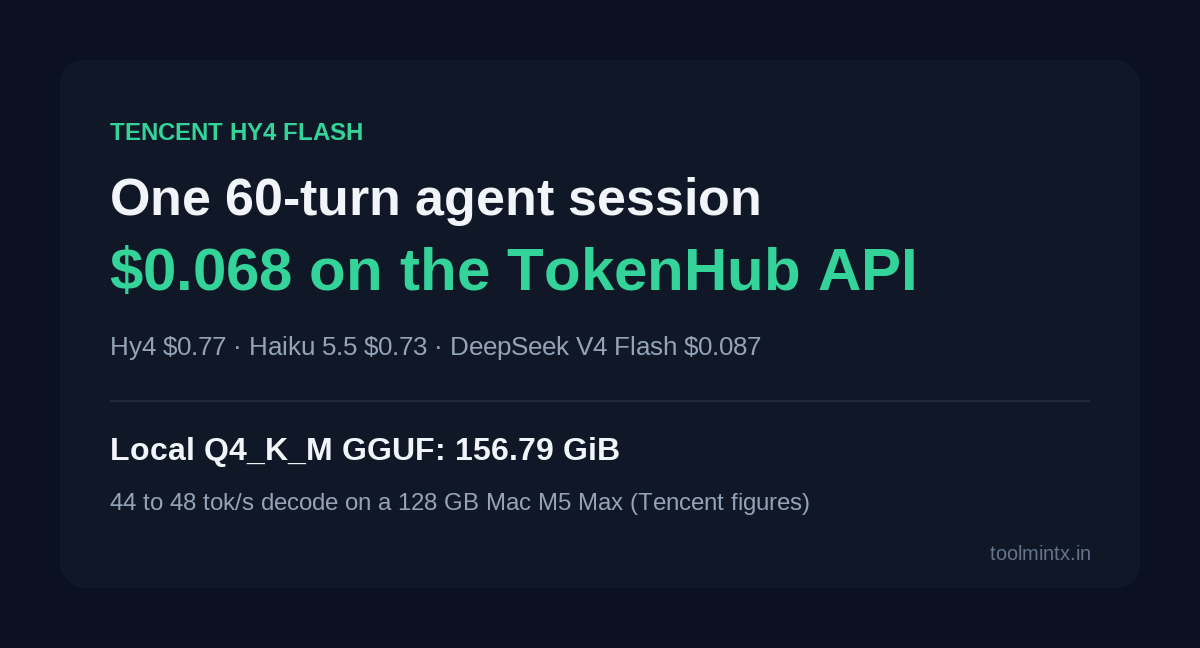
| Hy4 flash | $0.0084 | $0.0212 | $0.0126 | $0.0253 | $0.068 |
| DeepSeek-V4-Flash (TokenHub) | $0.0168 | $0.0198 | $0.0252 | $0.0252 | $0.087 |
| Claude Haiku 5.5, over 100K | $0.06 | $0.354 | $0.09 | $0.225 | $0.729 |
| Hy4 | $0.1001 | $0.2974 | $0.1501 | $0.2251 | $0.773 |
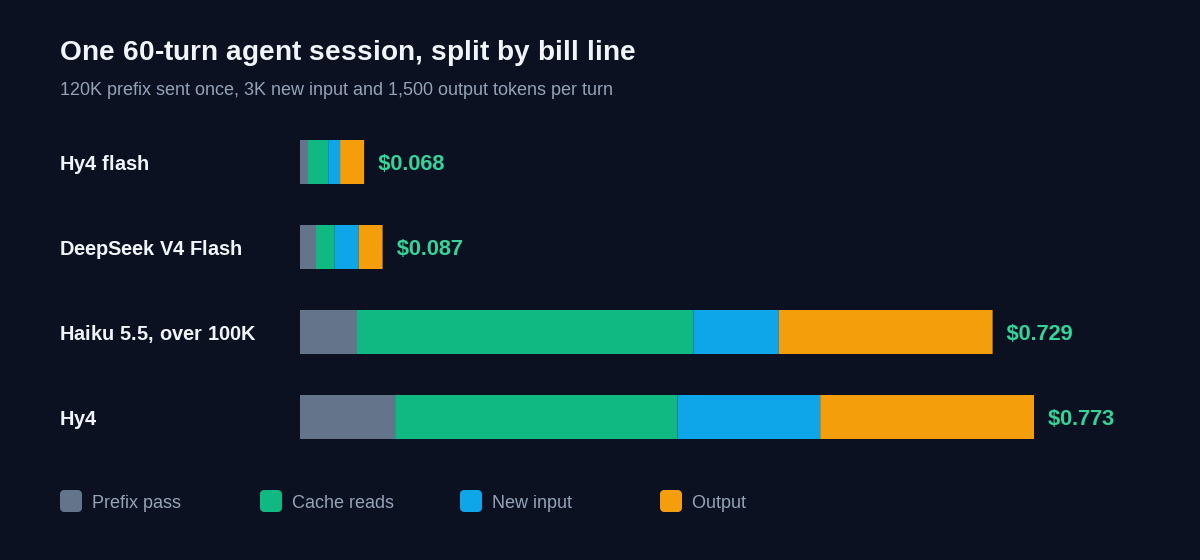
At 440 sessions a month (20 a day over 22 working days), Hy4 flash comes to $29.71. DeepSeek-V4-Flash on TokenHub is $38.29, Haiku 5.5 is $320.76 and Hy4 is $339.97.
Output is the biggest line on Hy4 flash at 37.5% of the bill, so thinking length decides the ranking. Reasoning is on by default at high effort. If the model writes twice as much (3,000 output tokens a turn), the session goes to $0.093 and DeepSeek-V4-Flash wins. The crossover sits at 2,656 output tokens per turn. Tencent says reinforcement learning cut its average output by 50%, but you should measure your own traffic. For tool-routing turns that don't need reasoning, reasoning_effort: "no_think" turns it off.
The cache is doing most of the work here. Without hits, those 59 prefix reads would bill at the full $0.07 and cost $0.496 instead of $0.021. Keep the prefix byte-identical between turns. You can plug other turn counts into the API cost calculator, which now lists Hy4 flash.
The GGUF builds and the 59 GiB shard
Tencent's AngelSlim team published five GGUF builds. The full BF16 repo is 440.53 GB and the FP8 repo is 287.09 GB, both meant for 8-GPU servers.
| Build | Size | Bits per weight | Bits per weight, excluding Engram |
|---|---|---|---|
| Q4_K_M | 156.79 GiB | 6.05 | 5.27 |
| SPARK-4Bit | 151.3 GiB | 5.84 | 4.78 |
| SPARK-4Bit-Fast | 148.6 GiB | 5.74 | 4.63 |
| Q3_K | 144.70 GiB | 5.58 | 4.62 |
| IQ2_AH | 125.73 GiB | 4.85 | 3.60 |
The Q4_K_M, Q3_K and IQ2_AH builds come in two shards each, and the second shard is the same 63,360,616,128 bytes (59.01 GiB) in all three. That matches the 63.4B Engram table stored in FP8, one byte per parameter, which the config confirms with engram_fp8_embedding: true. It's the same in every build because nobody quantized it below FP8. The shrinking happens in shard one.
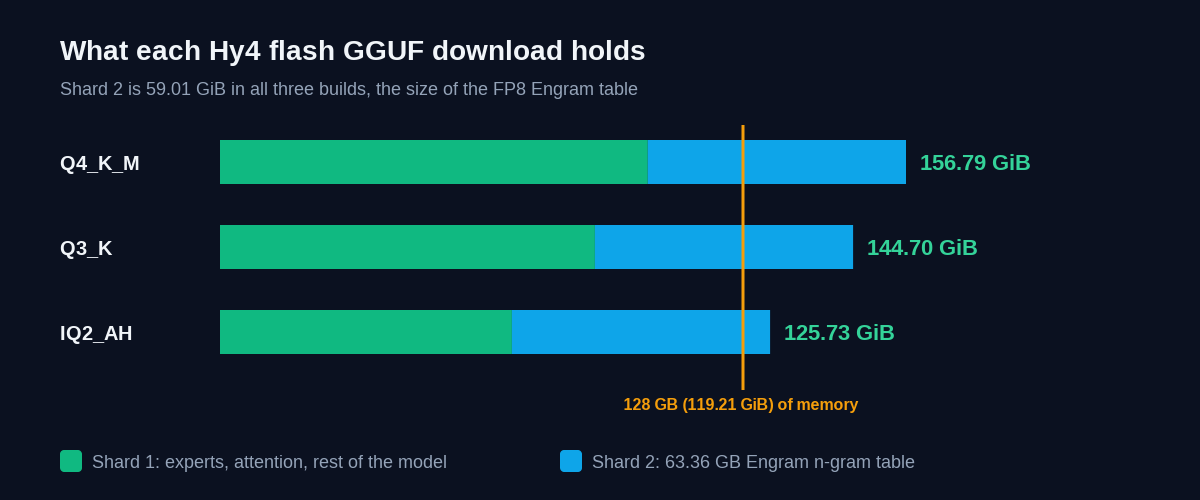
128 GB is 119.21 GiB, so every one of these builds is bigger than the 128 GB machines Tencent benchmarked on, and Tencent still ran them there. Its DGX Spark notes explain how: the build relies on mmap and lazy access to the per-layer embedding rows, which stay on the CPU side, so only the rows a prompt touches get read. Tencent's instruction is to keep the GGUF on a local SSD. Treat the SSD as part of the inference path.
Don't use the AI VRAM calculator for this model as-is. It assumes every weight is resident, and on Q4_K_M 37.6% of the file is the Engram shard, which isn't. It's still a good check for the KV side. At 196,608 tokens, the 12 sparse layers with a 576-wide MLA entry come to about 2.5 GiB in FP16.
Local speed against the API
Tencent's own measurements, in tokens per second, on real WorkBuddy tasks:
| Machine | Build | Prefill at 4K / 16K / 32K | Decode at 4K / 16K / 32K |
|---|---|---|---|
| Mac M5 Max 128 GB | Q4_K_M | 629.8 / 448.1 / 418.6 | 48.13 / 45.18 / 44.15 |
| Mac M5 Max 128 GB | Q3_K | 743.2 / 563.0 / 520.6 | 50.34 / 49.47 / 47.37 |
| RTX Spark 128 GB | SPARK-4Bit-Fast | 799 / 717 / 707 | 31.95 / 33.14 / 33.39 |
| RTX Spark 128 GB | SPARK-4Bit | 765 / 686 / 666 | 25.80 / 28.16 / 30.3 |
On the Mac, Q3_K is faster than Q4_K_M at every length and 12.09 GiB smaller. Tencent says it reaches up to 70 tok/s on code.
Put the same 60-turn session through the Q4_K_M build. The 90,000 output tokens take about 34 minutes of pure decode at 44.15 tok/s, and the first 120K-token prefix takes close to 5 minutes to prefill at the 32K rate (prefill slows as context grows, so the real figure is likely worse). On the API, Tencent says the served model decodes past 150 tokens per second with DFly2 and 4-bit kernels, which would put that output at about 10 minutes.
So the money case for local is thin. At $29.71 a month for 440 sessions, the API bill for a whole year is $356.52, a small slice of what a 128 GB workstation costs. Local makes sense when the data can't leave your machine, or when you want to fine-tune: Tencent ships LoRA and full SFT recipes for LLaMA-Factory and DeepSpeed in the repo.
Running Hy4 flash with llama.cpp
Hy4 flash support sits in llama.cpp pull request 32517, which isn't merged yet, so you build from that branch:
git clone https://github.com/ggml-org/llama.cpp
cd llama.cpp
git fetch origin pull/32517/head:hy4-flash
git checkout hy4-flash
cmake -B build                # add -DGGML_CUDA=ON on NVIDIA; Metal is on by default on macOS
cmake --build build --config Release -j
Download both Q3_K shards and the vision projector if you want image input. Then start an OpenAI-compatible server:
hf download AngelSlim/Hy4-flash-GGUF --include "Hy4-flash-Q3_K-*" --local-dir ./hy4-flash
./build/bin/llama-server -m ./hy4-flash/Hy4-flash-Q3_K-00001-of-00002.gguf \
  -c 8192 -ngl 99 --jinja --port 8080
Tencent's example uses 8,192 tokens of context. Raise -c once you've seen the memory use. On a 128 GB Mac, Tencent pins llama.cpp to commit 2cbca389f and applies hy4-flash-mac-minimal.patch from the GGUF repo. On DGX Spark it uses hy4-flash-spark.patch, the SPARK-4Bit build, and a 196,608-token context.
The API route needs less work. TokenHub is OpenAI-compatible at https://tokenhub-intl.tencentcloudmaas.com/v1. Point Claude Code, Hermes Agent or Cursor at it with a key from the console in place of YOUR_API_KEY.
FAQ
Is Hy4 flash free to use commercially?
It's under the Tencent Hy License, not Apache 2.0 or MIT. Read the LICENSE file in the Hugging Face repo before you ship a product on it.
Does Ollama run Hy4 flash?
Not yet. The GGUF needs the unmerged llama.cpp branch above, and Ollama and LM Studio pick up new architectures only after llama.cpp merges them.
Which recommended sampling settings does Tencent give?
temperature=0.9 and top_p=1.0. reasoning_effort accepts "high", the default with thinking on, and "no_think" for direct answers.
Sources
- Hugging Face,
tencent/Hy4-flashmodel card,config.jsonand file list (read 20 November 2026): parameter split, attention layout, Engram table size, KV claims, WorkIndex and blind-test figures, sampling settings, vLLM and SGLang commands, license, repo size. - Hugging Face,
tencent/Hy4-flash-FP8file list (read 20 November 2026): FP8 repo size. - Hugging Face,
AngelSlim/Hy4-flash-GGUFREADME, README_SPARK-4Bit and file list (read 20 November 2026): build sizes, bits per weight, shard byte counts, Mac and Spark speed tables, llama.cpp PR 32517, mmap note, server settings. - Tencent Cloud, TokenHub page (tencentcloud.com/act/pro/tokenhub, read 20 November 2026): Singapore-region prices for Hy4 flash, Hy4 and DeepSeek-V4-Flash, base URL, general availability.
- Anthropic, Claude pricing (platform.claude.com/docs/en/about-claude/pricing, read 20 November 2026): Claude Haiku 5.5 rates over 100,000 prompt tokens.
- OpenRouter,
tencent/hy4-flashendpoint listing (read 20 November 2026): launch discount flag and FP8 serving. - Session, monthly, crossover and timing figures are calculated by ToolMintX from the prices and speeds above.