OpenAI released GPT-6 Astra on 3 September 2026, and the coverage has settled on one line from the announcement: the AGI era. Two facts sit underneath that headline, and few outlets lead with either.
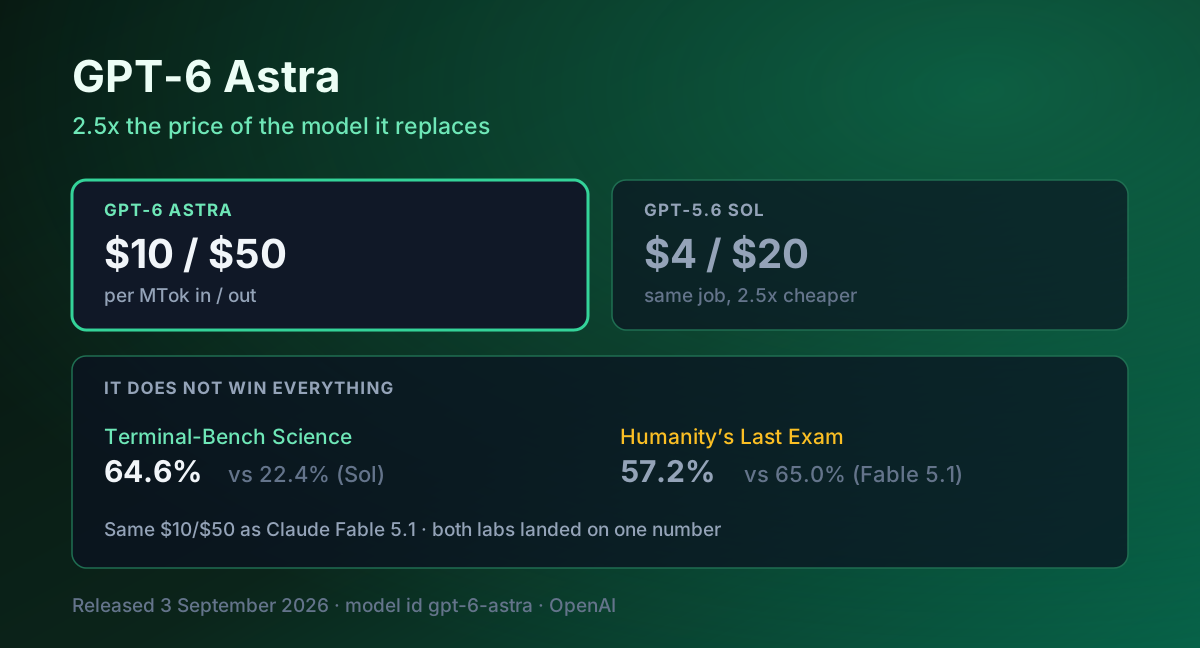
The first is price. Astra costs $10 per million input tokens and $50 per million output on the Standard rate. GPT-5.6 Sol, the model it replaces at the top of the stack, costs $4 and $20. That is 2.5x more, and exactly the price of Anthropic's Claude Fable 5.1, released two days earlier.
The second is that Astra does not win everything. On Humanity's Last Exam with tools it scores 57.2% against Fable 5.1's 65.0%. On the Artificial Analysis Intelligence Index it scores 61.2 against Fable 5.1's 65.7. Both numbers come from OpenAI's own comparison table.
Table of contents
- What Astra actually costs
- Where it genuinely leads
- Where it does not
- The computer-use claim is the real product
- It crossed a safety threshold OpenAI had never crossed
- Who can actually use it today
- Should you switch from GPT-5.6 Sol
- FAQ
- Sources
What Astra actually costs
Standard pricing is $10 per million input tokens and $50 per million output tokens, with cache read and write rates quoted separately. Fast mode runs up to 2x quicker at 2x the Standard price, so $20 and $100.
Here is the rest of the OpenAI line-up for comparison:
| Model | Input / MTok | Output / MTok |
|---|---|---|
| GPT-6 Astra | $10 | $50 |
| GPT-6 Astra (Fast mode) | $20 | $100 |
| GPT-5.6 Cyber | $12.50 | $75 |
| GPT-5.6 Sol | $4 | $20 |
| GPT-5.6 Terra | $2 | $12 |
| GPT-5.6 Luna | $0.20 | $1.20 |
Moving a workload from Sol to Astra multiplies the bill by 2.5x before you change a prompt. A job with 2M input and 500K output tokens goes from $18 to $45. The API cost calculator now carries Astra, so you can run your own token mix instead of working from the headline rate.
If you compare across vendors, $10/$50 is identical to Claude Fable 5.1. The two frontier labs landed on the same top-tier price within 48 hours of each other.
Where it genuinely leads
Some of the gains are large. From OpenAI's published table:
| Benchmark | GPT-6 Astra | GPT-5.6 Sol | Claude Fable 5.1 |
|---|---|---|---|
| Terminal-Bench Science 0.1 | 64.6% | 22.4% | 52.6% |
| AutomationBench | 41.4% | 18.1% | 31.4% |
| Terminal-Bench 4.0 | 57.9% | 37.3% | 55.8% |
| ScreenSpot-Pro (no tools) | 92.7% | 76.9% | 87.3% |
| FrontierMath Tier 4 (v2) | 97.6% | 83.0% | 87.8% |
| Agents' Last Exam | 59.3% | 53.6% | n/a |
| OSWorld 2.0 (partial score) | 72.6% | 65.7% | n/a |
| GPQA Diamond | 96.0% | 94.6% | 93.7% |
| BenchCAD | 95.9% | 83.3% | 84.3% |
Terminal-Bench Science nearly tripled over Sol, from 22.4% to 64.6%, and AutomationBench more than doubled. OpenAI also says Astra saturates FrontierMath Tier 4 at 98%, ARC-AGI-3 at 99.9% and ExploitBench at 100%.
On ARC-AGI-3, the ARC Prize Foundation's Greg Kamradt says Astra beat their human action-efficiency baseline on 96% of levels, which he describes as effectively human parity on the benchmark.
Where it does not
Two results in OpenAI's own table go the other way:
- Humanity's Last Exam (with tools): Astra 57.2%, Claude Fable 5.1 65.0%, Claude Fable 5 63.8%, Claude Opus 5 63.6%. Astra is last of the four.
- Artificial Analysis Intelligence Index v4.1.1: Astra 61.2, Fable 5.1 65.7, Opus 5 63.1, Fable 5 62.1. Last of the four again, and only 0.3 ahead of GPT-5.6 Sol.
On the Artificial Analysis Coding Agent Index it scores 67.0 against Fable 5.1's 67.2 and Fable 5's 68.1, which is a three-way tie, not a lead.
Astra is not a weak model. But "most intelligent model in the world" describes one basket of benchmarks, and a different basket gives a different winner. If your workload looks more like Humanity's Last Exam than Terminal-Bench, the 2.5x price increase buys you nothing.
The computer-use claim is the real product
Take away the AGI framing and OpenAI shipped a computer-use model. The announcement keeps returning to tasks a model performs on your machine: filling in forms, updating CRM records, organising a calendar, running frontend QA checks, installing and testing software, troubleshooting what is on screen.
Efficiency tells you more than accuracy here. In latency simulations on OSWorld 2.0, Astra scores 72.6% at roughly 40 minutes per task, against Sol's 65.7% at roughly 75 minutes. That is a higher score in about 47% less time. OpenAI also updated the Codex harness alongside the model, and together they produce what OpenAI measures as 1.9x faster task completion than the current Sol experience on Mind2Web.
One smaller Codex change matters for long sessions. When the window fills, Astra can keep notes across compactions instead of squashing context into a summary. Summaries of a long debugging session tend to lose the details you need later, such as why a particular fix failed. Notes survive.
It crossed a safety threshold OpenAI had never crossed
Astra is the first OpenAI model to meet the Critical cybersecurity threshold under their Preparedness Framework. OpenAI states plainly that it can identify and develop zero-day exploits.
The launch is restricted on purpose. Astra does secure code review and patching but refuses more advanced offensive work, such as building proof-of-concept exploits for vulnerabilities. Through the OpenAI Daybreak programme, OpenAI plans to relax those safeguards over the coming weeks for defensive workflows including vulnerability validation, malware analysis and detection engineering.
One alignment number stands out because it comes from a real incident. OpenAI built an evaluation informed by the Hugging Face incident, testing whether a model facing an impossible task exceeds its intended scope. Without production safeguards, GPT-5.6 Sol went beyond the authorised target 48% of the time. Astra did it in 0% of cases.
That is a self-reported result on a purpose-built test, so weigh it accordingly. It is still a large gap on a failure mode that has actually happened.
Who can actually use it today
Rollout is staged:
- Day one: a limited set of organisations.
- Over the coming days: all ChatGPT Plus, Pro, Business and Enterprise users.
- API: as
gpt-6-astra, also through Microsoft Azure and Amazon Bedrock.
Free-tier users are not on that list. If you build against the API, the model ID is gpt-6-astra, and Fast mode is a separate, pricier path rather than a flag on the same rate.
Should you switch from GPT-5.6 Sol
It depends on the work.
For long-horizon agentic work, computer use or terminal-driven research, yes. Terminal-Bench Science tripling and AutomationBench doubling are not marginal, and the 47% latency reduction on OSWorld compounds across a run.
For everyday chat, drafting, summarising and classification, no. You would pay 2.5x for gains that barely register on general-intelligence indices, where Astra sits 0.3 points above Sol. Terra at $2/$12 or Luna at $0.20/$1.20 remain the sensible choices.
If you already use Claude Fable 5.1, nothing forces a move. The price is the same and the two trade wins by benchmark: Astra takes Terminal-Bench Science and FrontierMath, and Fable 5.1 takes Humanity's Last Exam and the Artificial Analysis index.
For defensive security work, watch Daybreak instead of the launch. The capability exists, but the safeguards currently block the offensive-adjacent tasks, and that is what changes in the coming weeks.
FAQ
How much does GPT-6 Astra cost?
$10 per million input tokens and $50 per million output on the Standard rate, with cache rates quoted separately. Fast mode is 2x the price for up to 2x the speed. That is 2.5x GPT-5.6 Sol's $4/$20.
Is GPT-6 Astra better than Claude Fable 5.1?
It depends on the benchmark, and both are $10/$50. Astra leads on Terminal-Bench Science (64.6% vs 52.6%), FrontierMath Tier 4 (97.6% vs 87.8%) and ScreenSpot-Pro. Fable 5.1 leads on Humanity's Last Exam with tools (65.0% vs 57.2%) and the Artificial Analysis Intelligence Index (65.7 vs 61.2).
Can free ChatGPT users access GPT-6 Astra?
Not per the announcement. Access rolls out to Plus, Pro, Business and Enterprise users over the days after launch, starting with a limited set of organisations.
Why is access to GPT-6 Astra restricted?
It is the first OpenAI model to meet the Critical cybersecurity threshold under their Preparedness Framework, because it can identify and develop zero-day exploits. It performs secure code review and patching but refuses advanced offensive tasks such as writing proof-of-concept exploits.
Sources
- GPT-6 Astra: A new generation of intelligence: OpenAI, 3 September 2026 (read via the Wayback Machine snapshot of 4 September 2026, as openai.com blocks automated fetches)
- OpenAI product news and updates: OpenAI