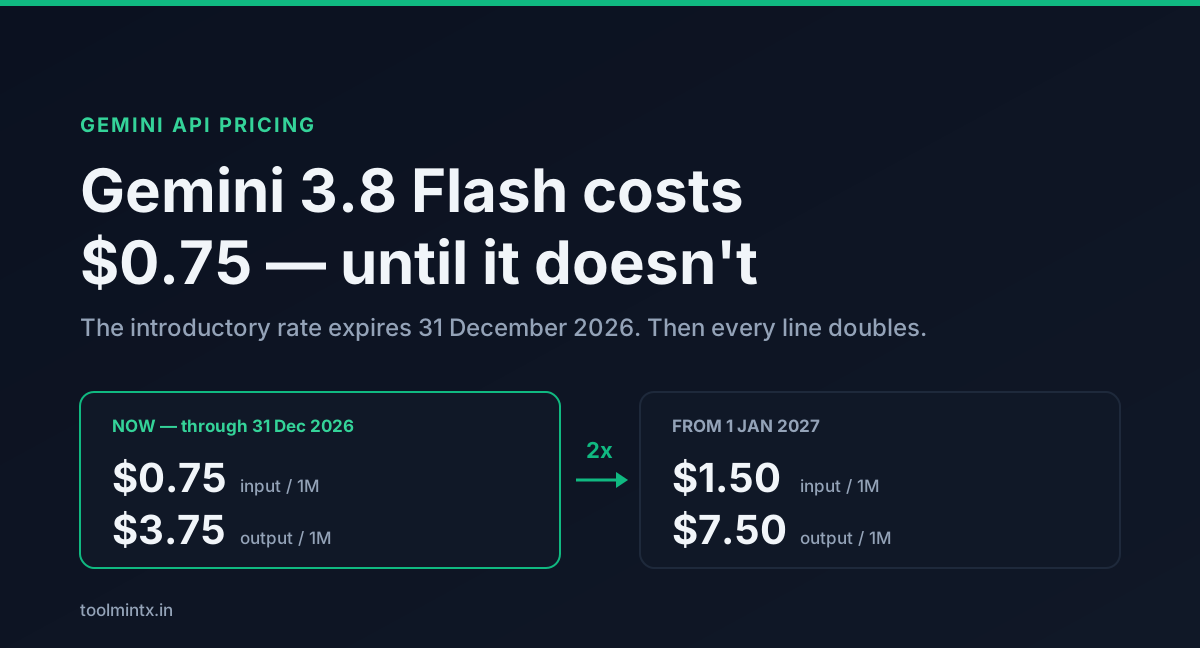
Google shipped Gemini 3.8 Flash on 2 September 2026, its third release in this tier in six weeks. Every headline said the same thing: same price as 3.7, $0.75 per million input tokens and $3.75 output. That is accurate, and it skips the part that will hit your invoice.
The $0.75 is an introductory rate with a hard expiry. Google's pricing page says so for every current model in the tier: $0.75 through December 31, 2026, then $1.50 starting January 1, 2027. The launch announcement carries the same footnote. On 1 January your spend doubles on the same model, with no migration and no further announcement.
Gemini 3.6 is on that discount too. Google extended the introductory rate to the older model, so the version you may have picked to save money costs exactly what the newest one does.
Table of contents
- What Google's pricing page says
- The 2027 increase by serving tier
- Gemini 3.6, 3.7 and 3.8 cost the same
- What 3.8 adds over 3.7
- Budgeting across 1 January
- FAQ
- Sources
What Google's pricing page says
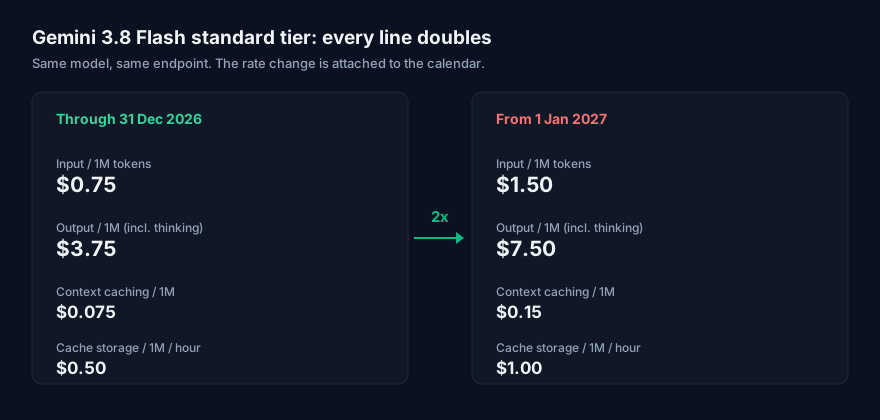
The paid standard tier for gemini-3.8-flash, quoted from the pricing docs:
| Item | Through 31 Dec 2026 | From 1 Jan 2027 |
|---|---|---|
| Input / 1M tokens | $0.75 | $1.50 |
| Output / 1M (incl. thinking) | $3.75 | $7.50 |
| Context caching / 1M | $0.075 | $0.15 |
| Cache storage / 1M / hour | $0.50 | $1.00 |
Every line doubles, including cache storage, which people forget because it bills by time rather than by token.
Output is priced including thinking tokens, and Google says 3.8 Flash deliberately spends more of them. From the launch post: on complex tasks the model executes extra reasoning steps and calls tools iteratively, and "at times, the model might use more tokens to maximize performance, especially at higher effort levels." Your output bill can rise on identical prompts before the rate change touches it. The effort level is the lever if that concerns you.
The 2027 increase by serving tier
The doubling is the same across serving tiers. The batch and flex discount is where most people should look right now.
| Tier | Input now | Input 2027 | Output now | Output 2027 |
|---|---|---|---|---|
| Standard | $0.75 | $1.50 | $3.75 | $7.50 |
| Batch | $0.375 | $0.75 | $1.875 | $3.75 |
| Flex | $0.375 | $0.75 | $1.875 | $3.75 |
| Priority | $1.35 | $2.70 | $6.75 | $13.50 |
Batch and flex are a flat 50% off standard, and both keep that ratio after the change. Priority is 1.8x standard. Read the table across: batch pricing in 2027 ($0.75 / $3.75) is exactly today's standard pricing. If your workload tolerates asynchronous execution, moving it to batch cancels the increase, and it needs no model change.
OpenRouter's live model API shows the same numbers from outside Google: google/gemini-3.8-flash at $0.75 / $3.75, and google/gemini-3.8-flash:batch at $0.375 / $1.875, with a 1,048,576-token context on both.
Gemini 3.6, 3.7 and 3.8 cost the same
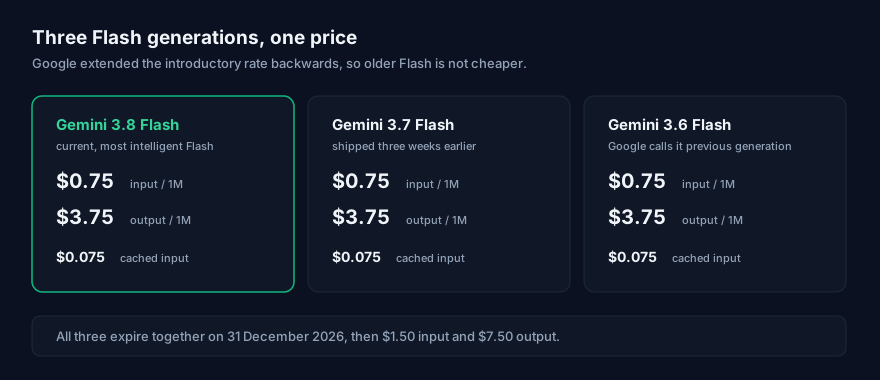
I expected a price ladder, so I checked the pricing page for each generation still listed.
| Model | Input | Output | Cached input |
|---|---|---|---|
| Gemini 3.8 Flash | $0.75 | $3.75 | $0.075 |
| Gemini 3.7 Flash | $0.75 | $3.75 | $0.075 |
| Gemini 3.6 Flash | $0.75 | $3.75 | $0.075 |
The prices are identical and all three expire on the same date. Google's own page calls 3.6 "our previous generation" while charging the same rate as the current one.
If you pinned gemini-3.6-flash in production for cost reasons, that reason is gone. You pay current-generation prices for a model Google has superseded twice. Pinning for output stability is still a fair argument, since reasoning models shift behaviour between versions in ways that break brittle prompts. Just name that as the reason instead of a saving you are not getting.
Our API cost calculator now carries all three at the correct $0.75 / $3.75, so you can run your own token mix against them. It previously listed 3.6 at the post-2027 rate, which overstated the cost by 2x.
What 3.8 adds over 3.7
Google's claimed gains over 3.7, from the launch post:
- 54.9% on HLE-Verified for multi-step reasoning across STEM, humanities and professional fields
- Beats most larger frontier models on DeepSWE v1.1 for long-horizon software engineering, at a fraction of their cost
- Ahead of 3.7 and other frontier models on Vals Finance Agent V2 and Harvey's Legal Agent Benchmark
These are vendor benchmarks, so treat them as claims rather than measurements. Either way, when a newer model costs the same as the one it replaces, the only case for staying behind is stability.
The companion release is Gemini 3.8 Flash Cyber, gated to trusted defenders through Google's new Fairwind Program. It has no public price because you cannot buy it. Google reports the Chrome Security team getting 2.6x more correct Chrome vulnerability patches from it than from much larger commercial models, and 47.2% pass@1 on CWE-Bench against a leading frontier model's 47.8%. Both variants run on the same foundational model, and Google credits cybersecurity training for some of the coding gains in the public one.
Budgeting across 1 January
If your bill is mostly Flash, here is what I would do, in order.
Model both prices in whatever spreadsheet or dashboard your finance team reads. A Q1 2027 forecast built on $0.75 is wrong by 100% on the token line, and the error tends to surface in February when someone asks why the bill moved.
Move asynchronous jobs to batch before the deadline, not after. Evaluation runs, backfills, bulk classification and nightly summarisation all qualify, and batch keeps them at today's effective rate through 2027. Doing it now also keeps the migration from competing with a January cost scramble.
Don't expect a discount for an older version. There isn't one, so choose the version on behaviour and stability.
Watch context caching if you run long agentic sessions. The per-token cache rate doubles and so does hourly storage, so a session that holds a large cache for hours takes the increase twice. Caching still beats re-sending tokens at $1.50, but the margin narrows.
Don't assume a fourth release resets the clock. Three releases in six weeks makes another before January likely, but 3.8 inherited 3.7's expiry date instead of getting a fresh twelve months. Ars Technica's read is that new models will arrive long before the price changes, which is probably true and does not help. The expiry is tied to the calendar, not to the model.
FAQ
How much does Gemini 3.8 Flash cost?
$0.75 per million input tokens and $3.75 per million output tokens on the paid standard tier through 31 December 2026. From 1 January 2027 it is $1.50 and $7.50. Google's pricing page and the launch announcement both label the current rate introductory.
Does Gemini 3.6 Flash cost less than 3.8?
No. Gemini 3.6, 3.7 and 3.8 are all $0.75 input and $3.75 output, with the same 31 December 2026 expiry.
What is the cheapest way to run it?
Batch or flex, both at $0.375 input and $1.875 output, half the standard rate. Their 2027 prices match today's standard prices, so batch workloads absorb the increase.
Do thinking tokens count as output?
Yes. Google prices output "including thinking tokens," and says the model may spend more of them on complex tasks at higher effort levels. Lower the effort level to cut the overhead.
Sources
- Gemini Developer API pricing: official tier tables and expiry dates, Wayback snapshot 6 September 2026
- Introducing Gemini 3.8 Flash and 3.8 Flash Cyber: launch benchmarks, effort-level note and the introductory-price footnote, read 7 September 2026
- OpenRouter models API: third-party confirmation of standard and batch rates plus context length, read 7 September 2026
- Google releases Gemini 3.8 Flash, its third Flash model in six weeks: release cadence, 2 September 2026