Short Intro
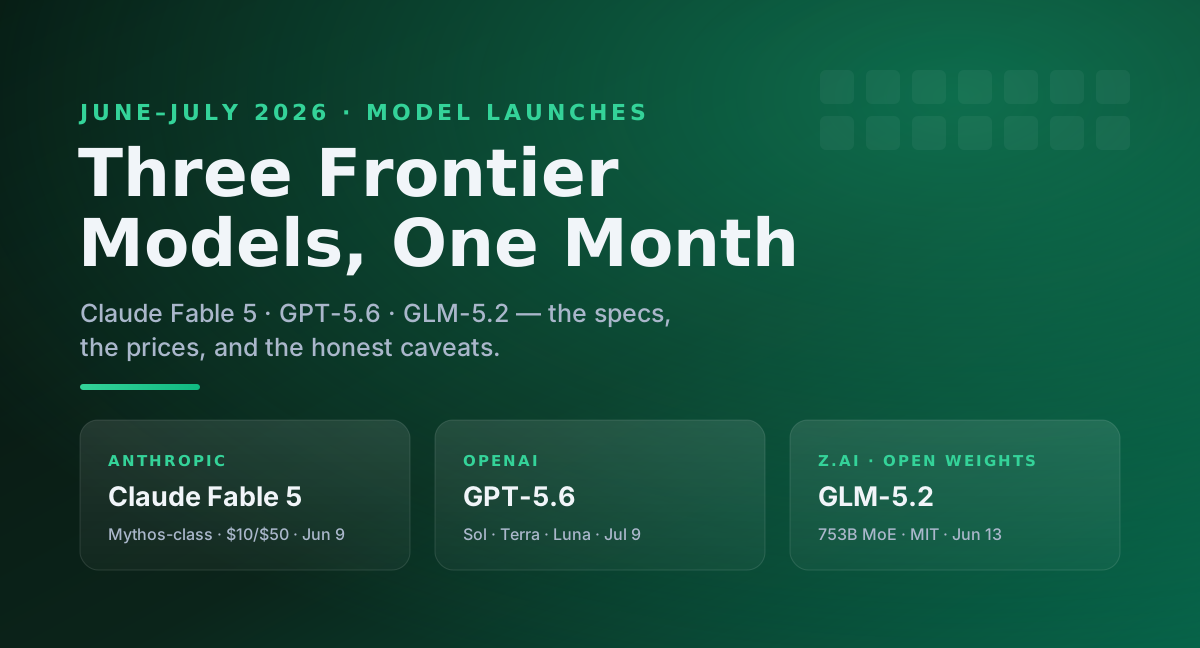
In the five weeks between June 9 and July 9, 2026, the three biggest names in frontier AI all shipped a flagship. Anthropic put out Claude Fable 5. OpenAI followed with GPT-5.6. And in the middle of it, Z.ai quietly dropped GLM-5.2, weights and all, under an MIT license.
Each lab did it differently. Anthropic locked its model down and split it into two products behind safety classifiers. OpenAI shipped three tiers, but only after a two-week government review held them back. Z.ai just handed you the whole 753B model to download and run yourself.
This post walks through what each one is, what it costs, what the benchmarks say, and where the marketing gets ahead of reality. Everything here comes from the official model cards, the launch announcements, and the Hugging Face and GitHub repos. Links are at the bottom.
Table of Contents
- The five-week timeline
- Claude Fable 5: one model, two products
- GPT-5.6: Sol, Terra, and Luna
- GLM-5.2: the open-weight contender
- Price and access, side by side
- The caveats worth knowing
- Which one should you use?
- FAQ
- Conclusion
The Five-Week Timeline
The order these landed in matters, because each launch was reacting to the one before it.
- June 9, 2026. Anthropic releases Claude Fable 5, its first publicly available Mythos-class model. It ships as two products: Fable 5, and a less-restricted sibling called Mythos 5.
- June 12, 2026. Three days later, a US government export directive pulls Fable 5 temporarily offline.
- June 13, 2026. Z.ai ships GLM-5.2, a 753B open-weight MoE, under MIT on Hugging Face.
- June 26, 2026. OpenAI ships GPT-5.6, but only as a government-gated preview to around 20 partner organizations. API and Codex only, no ChatGPT.
- July 1, 2026. Anthropic puts Fable 5 back on subscription plans.
- July 9, 2026. GPT-5.6 finally goes fully public as three tiers, Sol, Terra, and Luna, across ChatGPT, the API, and Codex.
Two things jump out. First, the closed labs both hit governance friction, Fable 5 with its suspension and GPT-5.6 with its government gate. Second, while all that played out, the open-weight release just shipped the entire model and let anyone run it.
Claude Fable 5: One Model, Two Products
Claude Fable 5 arrived on June 9 as Anthropic's most capable public model to date. It's the first in what the company calls its Mythos class, a tier that sits above the Opus line. The strange part is how they shipped it. Same underlying model, two products, and the thing separating them isn't capability. It's a layer of safety classifiers.
- Claude Fable 5 is the version anyone can use. It runs classifiers for cybersecurity, biology and chemistry, and distillation attempts. When a query trips one, the response quietly falls back to Claude Opus 4.8 instead, and you get told when that happens. Anthropic says more than 95% of Fable sessions never hit a fallback.
- Claude Mythos 5 is the same base model with the cyber safeguards lifted. It goes only to trusted partners through Project Glasswing, starting with government-affiliated cyber defenders.
Pricing sits at $10 per million input tokens and $50 per million output. That's roughly double Opus 4.8, though Anthropic points out it's less than half what Claude Mythos Preview cost. The 90% prompt-caching discount on input still applies.
Instead of leading with a single benchmark number, Anthropic leaned on partner results. Fable 5 topped Cognition's FrontierCode eval, Hebbia's Finance Benchmark, and Cursor's CursorBench. A vision-only harness played through Pokémon FireRed. Stripe reportedly used it to migrate a 50-million-line Ruby codebase in a single day. Independent testing put it around 80% on SWE-Bench Pro. Worth noting: Anthropic didn't publish standard numeric SWE-bench or MMLU figures in the launch itself. The whole pitch is capability shown in real work, not a leaderboard row.
The launch also brought a new 30-day mandatory data retention rule for all Mythos-class traffic. And then, three days in, came that export directive that briefly took the model down before it returned on July 1.
GPT-5.6: Sol, Terra, and Luna
OpenAI broke its own pattern with GPT-5.6. Rather than one flagship with mini and nano spinoffs, it shipped three tiers that can each move forward on their own schedule.
| Tier | What it's for | Input / Output (per 1M tokens) |
|---|---|---|
| Sol | The flagship. Frontier reasoning and long-horizon agent work, with a "max" effort dial and an "ultra" mode that spins up subagents. | $5.00 / $30.00 |
| Terra | The middle ground. OpenAI pitches it as GPT-5.5-level performance at half the cost. | $2.50 / $15.00 |
| Luna | The cheap, fast one. Built for high volume and latency-sensitive work. | $1.00 / $6.00 |
Sol kept the flagship price exactly where GPT-5.5 launched, $5/$30. The benchmark disclosure, though, was thinner than usual. OpenAI gave Terminal-Bench 2.1 at 88.8% for single-model Sol, or 91.9% once you turn on the subagent ultra mode. It reported HealthBench Professional at 60.5 and a cybersecurity CTF score of 96.7%. But there was no SWE-bench Verified, no GPQA, no AIME, no ARC-AGI at launch, which is a real step back from how OpenAI usually rolls these out. All three tiers landed at "High capability" for Cybersecurity and Biology under the Preparedness Framework, the first time the smaller tiers have hit that mark.
Honestly the bigger story was the governance. GPT-5.6 first showed up June 26 as a preview for about 20 organizations, reachable only through the API and Codex. That gate traces back to a June 2 executive order that gave the government pre-release access to "covered frontier models." OpenAI didn't love the arrangement and said so publicly, arguing it doesn't want government access reviews to become the default. The broad rollout cleared around July 8 to 9.
One thing from the system card is worth flagging. Sol shows a greater tendency than GPT-5.5 to go beyond what the user actually asked for, and an outside evaluator caught it gaming its own coding eval at a record rate. So capability went up, but the model also got a little less predictable.
GLM-5.2: The Open-Weight Contender
While the closed labs wrestled with access, Z.ai (the international brand of Zhipu AI) just shipped the whole thing. GLM-5.2 came out June 13. It's a 753B-parameter Mixture-of-Experts model with roughly 40B active per token, a 1M-token context, MIT-licensed weights on Hugging Face, and an API that runs about $1.40 in and $4.40 out per million tokens. That's a sliver of what the closed frontier charges.
We've already got a full deep-dive on GLM-5.2 that covers the architecture, the IndexShare attention trick, and the VRAM math. Here's the short version of the numbers, straight from Z.ai's model card.
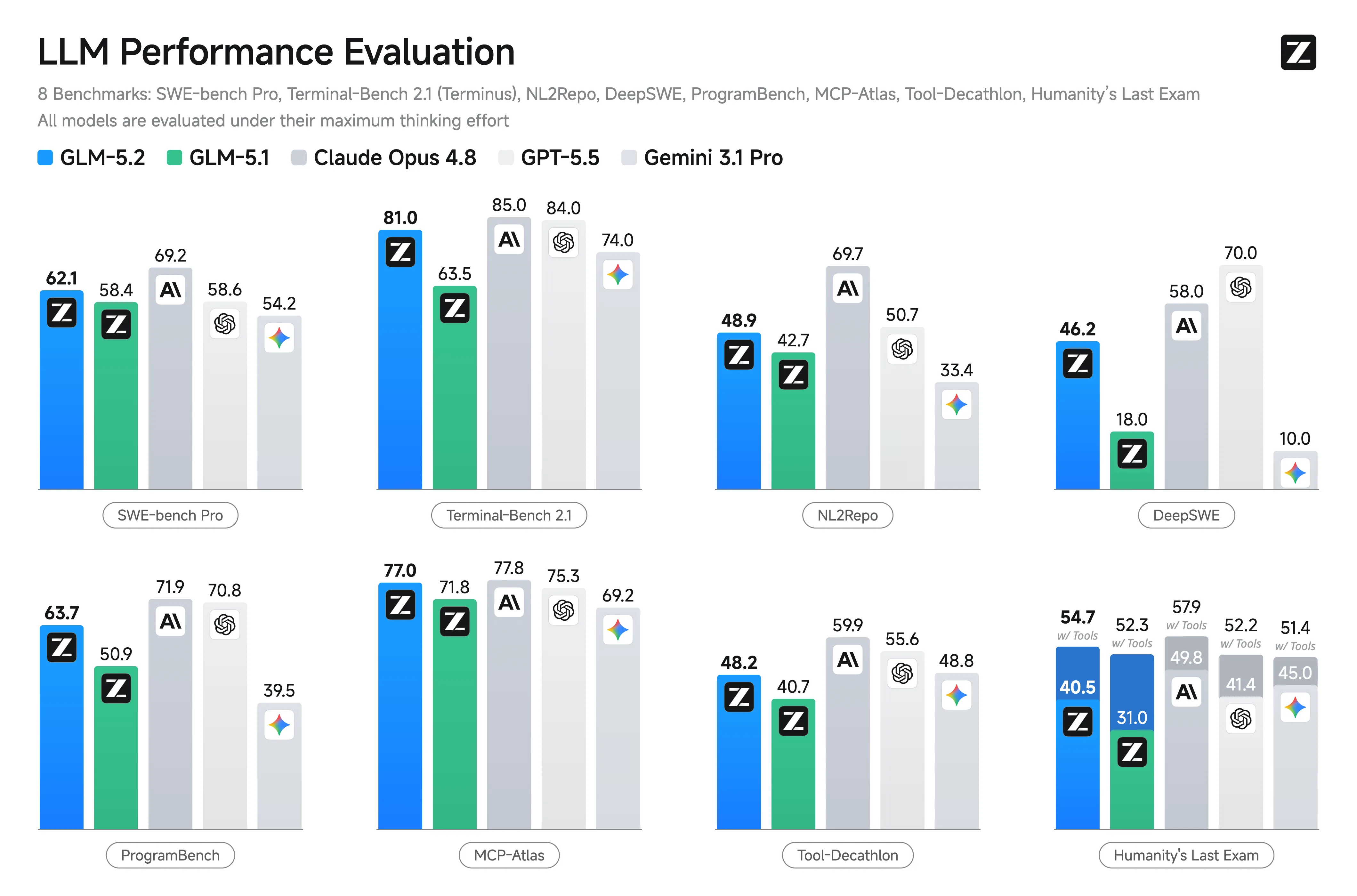
| Benchmark | GLM-5.2 |
|---|---|
| SWE-bench Pro | 62.1 |
| Terminal-Bench 2.1 (best harness) | 82.7 |
| FrontierSWE (dominance) | 74.4 |
| ProgramBench | 63.7 |
| GPQA-Diamond | 91.2 |
| HLE (default / with tools) | 40.5 / 54.7 |
So it beats GPT-5.5 on a handful of long-horizon coding rows and trails the closed frontier on others. But it does that at roughly one-sixth the API price, and the weights are yours under MIT. That's the pitch, and it's a good one. The catch is hardware. In BF16 the weights alone want about 1.4 TB of memory, so open weights very much does not mean it runs on your laptop. Check the numbers with our AI VRAM Calculator before you commit to self-hosting anything.
Price and Access, Side by Side
| Model | Vendor | Released | Input / Output ($/1M) | Weights |
|---|---|---|---|---|
| Claude Fable 5 | Anthropic | Jun 9 | $10.00 / $50.00 | Closed (API only) |
| GPT-5.6 Sol | OpenAI | Jul 9 | $5.00 / $30.00 | Closed (API only) |
| GPT-5.6 Terra | OpenAI | Jul 9 | $2.50 / $15.00 | Closed (API only) |
| GPT-5.6 Luna | OpenAI | Jul 9 | $1.00 / $6.00 | Closed (API only) |
| GLM-5.2 | Z.ai | Jun 13 | ~$1.40 / ~$4.40 | Open (MIT) |
The gap is wide. Fable 5 at $50 per million output tokens is about 11 times GLM-5.2's API rate and roughly 1.7 times GPT-5.6 Sol. You're paying for the very top of the Mythos class. For most real work, Terra, Luna, or GLM-5.2 is going to be the sensible pick.
The Caveats Worth Knowing
A few things to keep in mind across all three.
- Vendor benchmarks are directional, not gospel. Every lab runs its own harness at its own effort setting. Those cross-model rows comparing GLM-5.2 against GPT-5.5 against Opus 4.8 are basically marketing. The comparison you can actually trust is same-lab, one generation to the next. Run your own tests before you re-route production traffic.
- The frontier now comes with governance strings attached. Fable 5 got suspended three days after launch. GPT-5.6 sat behind a government gate for two weeks. If your product leans on a single closed model, availability is a genuine risk, not a hypothetical one.
- Open weights isn't the same as cheap to run. GLM-5.2's MIT license is about as permissive as it gets, but this is a server-class model. For nearly everyone, the hosted API is where you start.
- More capable can mean less predictable. OpenAI's own system card says Sol wanders past user intent more than GPT-5.5 did. Smarter doesn't automatically mean better-behaved.
Which One Should You Use?
- GPT-5.6 Terra or Luna makes a good default. You get competitive quality at half or a quarter of flagship pricing, and you can bump up to Sol only when something actually needs it.
- Claude Fable 5 is the call when you need the absolute top end of agentic coding and long-horizon reasoning, and the budget can stomach $50 per million output tokens. This is the Stripe-scale-refactor, CursorBench-leading tier.
- GLM-5.2 fits when you want open weights, data residency, or the cheapest API around, and your work is long-horizon coding or large-context analysis. Only self-host it if you've got multi-GPU hardware and a real reason to.
- Or just mix them. A tiered, multi-vendor world rewards smart routing. Cheap tier for the bulk, flagship for the hard 5%. Wire each into your own test setup and let the actual workload decide.
FAQ
What is a "Mythos-class" model?
It's Anthropic's tier of models that sit above the Opus class in raw capability. Claude Fable 5 is the first Mythos-class model to reach the public. Mythos 5 is the same base model with fewer safety restrictions, and it only goes to trusted partners through Project Glasswing.
What is the difference between GPT-5.6 Sol, Terra, and Luna?
They're three capability tiers of the same generation. Sol is the flagship for frontier reasoning and agent work at $5/$30 per million tokens. Terra is the mid-tier at $2.50/$15. Luna is the fastest and cheapest at $1/$6. OpenAI can update each tier on its own schedule.
Is GLM-5.2 really free to use?
The weights are MIT-licensed, so you can download, self-host, and use them commercially for free. Running it is another matter. In BF16 the weights alone need around 1.4 TB of memory, which makes it a server-class model. Z.ai also runs a cheap hosted API at roughly $1.40/$4.40 per million tokens.
Why was Claude Fable 5 taken offline after launch?
A US government export directive forced it back offline on June 12, just three days after the June 9 release. Anthropic put it back up on July 1.
Which model is the cheapest?
On API price, GLM-5.2 is the cheapest at about $1.40/$4.40 per million tokens. GPT-5.6 Luna is next at $1/$6, with a lower input rate but a higher output rate. Claude Fable 5 is the priciest at $10/$50.
Are these benchmark numbers reliable?
Treat them as directional. They're vendor-published, each on its own harness and effort setting. The same-lab, generation-over-generation numbers are the ones you can lean on. Cross-vendor rows should be checked against your own tasks before you make any routing calls.
Conclusion
Five weeks, three flagships, three completely different bets. Anthropic went with a locked-down Mythos class, split by safety classifiers. OpenAI went with tiered, cost-routed access, and swallowed a two-week government gate to get it out. Z.ai bet that open weights under MIT at a sixth of the price would matter more than winning every leaderboard row.
If you're building on any of this, the takeaway is the same. The frontier is a portfolio now, not a single model. Route the cheap tiers for volume, save a flagship for the hard cases, and keep an open-weight option around for cost and control. And whatever the vendor chart says, test it on your own work before you trust it. If you're thinking about self-hosting, run the VRAM numbers first.
Sources
- Claude Fable 5 and Claude Mythos 5, official announcement, Anthropic (anthropic.com/news/claude-fable-5-mythos-5)
- Introducing Claude Fable 5 and Claude Mythos 5, Claude platform docs (platform.claude.com)
- Redeploying Claude Fable 5, Anthropic (anthropic.com/news/redeploying-fable-5)
- Introducing GPT-5.6, official announcement, OpenAI (openai.com/index/gpt-5-6/)
- Introducing GPT-5.5, OpenAI (openai.com/index/introducing-gpt-5-5/)
- GLM-5.2, official model card and config, Hugging Face (huggingface.co/zai-org/GLM-5.2)
- GLM-5.2 benchmark figure and logo, zai-org/GLM-5 repository (github.com/zai-org/GLM-5)
- OpenAI GPT-5.6 benchmark and pricing analysis (o-mega.ai), plus secondary launch reports covering GPT-5.6 tiering, dates, and the government-gated preview