RadixArk put DaisyRose-27B on Hugging Face on 18 November 2026. It's Qwen3.8-27B after reinforcement learning on long agent tasks, with no supervised fine-tuning and no distillation. RadixArk calls it a drop-in replacement for the base model, and the config.json backs that up: same 64-layer hybrid stack, same tokenizer, same 262,144-token context, same vision encoder.
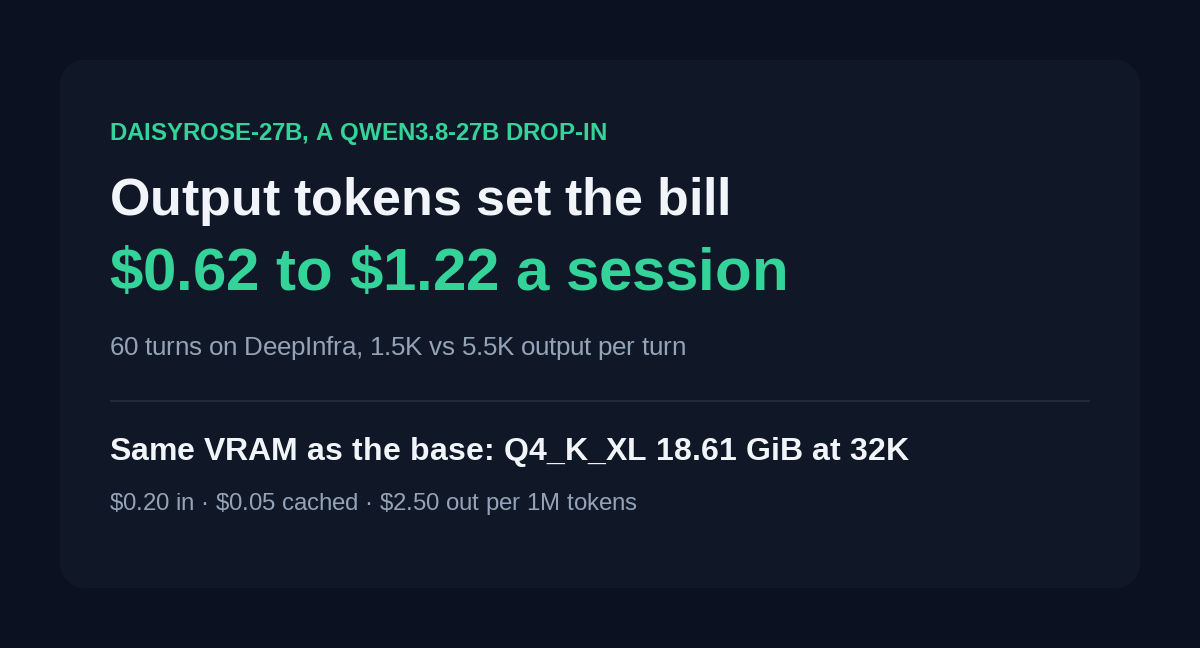
So the memory math you already use for Qwen3.8-27B carries over unchanged. The bill is where you need to look twice. DeepInfra serves it at the same rate as the base model, and that rate puts most of the cost of an agent session on output tokens, which is exactly what a model trained to think longer produces more of. Below: what changed, what it scores, a 60-turn agent session costed line by line, and how much VRAM each GGUF needs.
Table of contents
- What RadixArk changed and what it kept
- Benchmarks against the base model
- API price on DeepInfra
- A 60-turn agent session, costed
- Memory by quant and context
- Serving it with llama-server or SGLang
- FAQ
- Sources
What RadixArk changed and what it kept
DaisyRose is RadixArk's first model. The training set is about 1,200 long-horizon agent tasks built with Eigent AI, each one aimed at a mistake the base model makes. An attempt could run for up to 1.5 hours in a sandbox, with more than 100 tool calls and more than 256K output tokens. Some training sessions reached 1M tokens.
| DaisyRose-27B | |
|---|---|
| Released | 18 November 2026 |
| Base | Qwen/Qwen3.8-27B |
| Training | RL only, no SFT, no distillation |
| Tasks | about 1,200 |
| Compute | 144 H200s for 18 days, about 63,000 GPU-hours |
| Parameters | 27.8B, including a 0.46B vision encoder and a 0.42B MTP head |
| Context | 262,144 tokens |
| Weights | BF16, FP8, NVFP4, GGUF |
| License | Apache 2.0 |
The compute figure checks out: 144 x 18 x 24 is 62,208 GPU-hours. Of the 144 cards, 128 ran the agent and 16 trained on the finished trajectories.
Here is the part that separates it from Nous Research's Arete-27B, the other Qwen3.8-27B fine-tune this month. Arete dropped the multi-token prediction head. DaisyRose keeps it. Its safetensors index lists 15 tensors starting with mtp. and a total size of 55,562,855,904 bytes, identical to the base model. The vision encoder and MTP head are the base model's weights, unchanged.
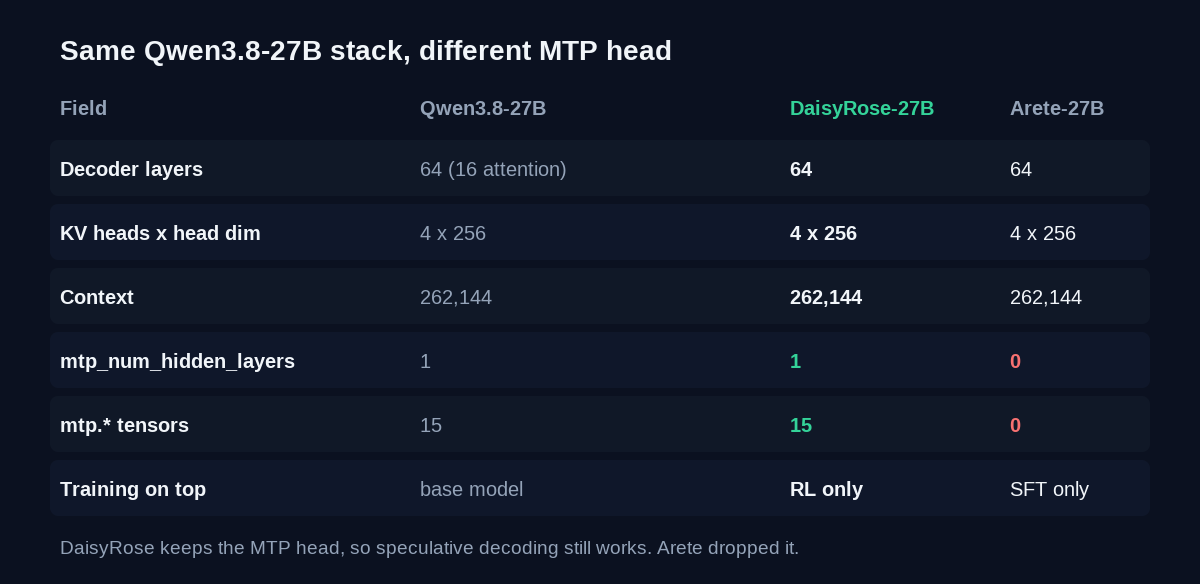
That means speculative decoding still works. RadixArk goes further and recommends its own DSpark draft model, a separate 1.86B checkpoint served through SGLang. On one H200 at concurrency 1, the DSpark card reports 297.3 tokens per second on GSM8K against 94.2 without drafting, a 3.16x speedup. Those runs used Qwen3.8-27B as the target, not DaisyRose, and the gain shrinks with batch size: at concurrency 32 it's 1.09x to 1.75x.
Benchmarks against the base model
All of these come from RadixArk's model card. RadixArk ran the DaisyRose numbers itself, and the base-model numbers come from other sources it names (Artificial Analysis, the Qwen card, a SWE Bench Pro v2 paper). Read the table as self-reported.
| Benchmark | DaisyRose-27B | Qwen3.8-27B | Inkling 2 Small | GPT-6 Luna |
|---|---|---|---|---|
| Terminal Bench 4.1 | 12.0 | 5.6 | 13.0 | 15.2 |
| Terminal Bench 2.1 | 75.5 | 73.0 | 81.3 | 73.0 |
| DeepSWE v1.1 | 46.2 | 42.2 | 72.1 | 66.6 |
| SWE Bench Pro v2 | 94.7 | 91.3 | 97.7 | – |
| HLE (text only) | 34.3 | 33.9 | 44.1 | 38.5 |
| IFBench | 82.4 | 79.5 | – | – |
| GPQA Diamond | 90.7 | 89.2 | 93.0 | 90.5 |
Terminal Bench 4.1 more than doubles, from 5.6 to 12.0. That is the benchmark closest to what RadixArk trained on. Everything else moves by 0.4 to 4 points. One caveat sits in the footnotes: the base model has no Terminal Bench 4.1 entry, so its 5.6 is a Terminal Bench 4.0 score from Artificial Analysis. The headline jump compares two versions of the test.
Inkling 2 Small beats DaisyRose on every row where both have a score. It's also a 594B MoE with 17B active, so it isn't something you run on one card at home. DaisyRose is.
API price on DeepInfra
DeepInfra is the only host serving DaisyRose so far. Its model API lists the same rates for DaisyRose-27B and Qwen3.8-27B:
| Per 1M tokens | List | With DeepInfra's 25% discount |
|---|---|---|
| Input | $0.20 | $0.15 |
| Cached input | $0.05 | $0.0375 |
| Output | $2.50 | $1.875 |
Both models carry a discount: 0.25 flag in DeepInfra's API, and OpenRouter routes DaisyRose through DeepInfra at the discounted $0.15 and $1.875. DeepInfra doesn't publish an end date for that discount, so plan on list price.
The ratio is what stands out. Output costs 12.5x input. For comparison, Inkling 2 Small on Together AI is $0.30 input, $0.03 cached and $1.00 output, a 3.3x ratio. DaisyRose is cheaper on fresh input and dearer on cached reads and on everything it writes.
A 60-turn agent session, costed
This is the same workload as our Sonnet 5.5 vs GPT-6.1 Sol comparison: a 120K-token cached prefix (system prompt, tool schemas, repo context) re-read on every turn, 3K new input tokens per turn and 1.5K output tokens per turn, for 60 turns. That's 7.2M cached tokens, 180,000 new input tokens and 90,000 output tokens.
| Line | Tokens | DaisyRose at list | Inkling 2 Small (Together) |
|---|---|---|---|
| Cached input | 7,200,000 | $0.36 | $0.216 |
| New input | 180,000 | $0.036 | $0.054 |
| Output, 1.5K a turn | 90,000 | $0.225 | $0.09 |
| Session total | $0.621 | $0.36 |
At 1.5K output a turn, DaisyRose costs $0.62 per session at list and $0.47 with the discount. Cheap. But 1.5K output is a low guess for this model.
DaisyRose's chat template defaults to reasoning effort xhigh, and RadixArk's own GGUF card warns that it "can produce tens of thousands of thinking tokens on hard problems." Thinking tokens bill as output. If each turn averages 5.5K output tokens instead of 1.5K, the output line goes from $0.225 to $0.825 and the session total from $0.621 to $1.221. Inkling 2 Small at the same 5.5K is $0.60.
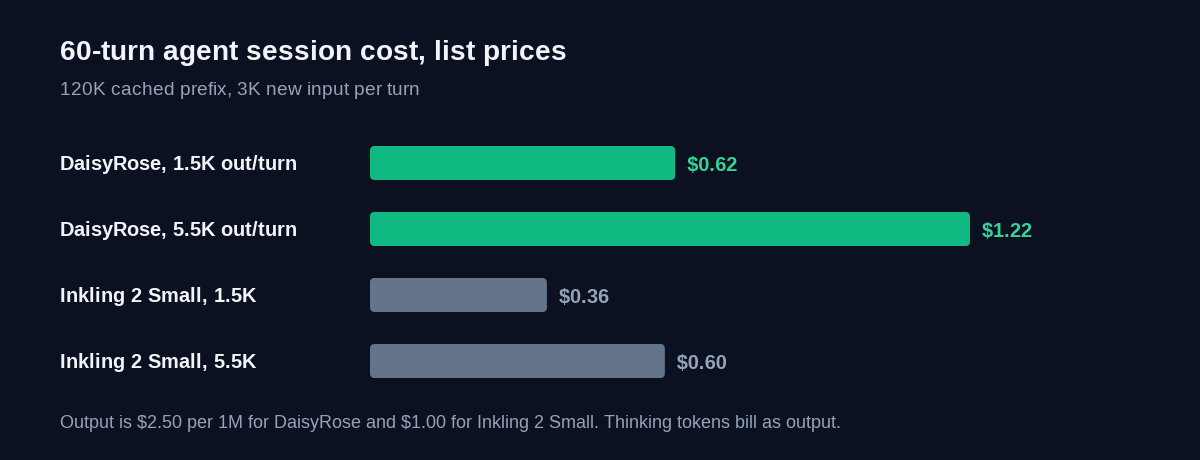
So the cached prefix, which decides the bill for most frontier models, is not the line to watch here. Output is. Two settings move it:
- Lower the effort. The template accepts
"reasoning_effort": "medium"throughchat_template_kwargs, or"enable_thinking": falseto turn thinking off. - Cap
max_tokenson routine turns. RadixArk ran its benchmarks with no cap, so keep it uncapped only for the hard ones.
Plug your own token counts into the API cost calculator. DaisyRose is listed under DeepInfra at the list rates above.
Memory by quant and context
The KV cache math is the base model's. Only 16 of the 64 layers are full attention, each storing keys and values for 4 heads of 256 values. In FP16 that's 2 x 16 x 4 x 256 x 2 bytes, or 65,536 bytes per token. The 48 Gated DeltaNet layers hold a fixed state of 48 x 48 x 128 x 128 x 4 bytes, which is 144 MiB at any context length.
File sizes are RadixArk's own GGUFs, converted from bytes to GiB. Totals add weights, KV cache and the DeltaNet state, with an FP16 KV cache. Compute buffers and the CUDA context are extra, so leave 1 to 2 GiB of headroom.
| Quant | File | Weights | 8K | 32K | 64K | 128K |
|---|---|---|---|---|---|---|
| Q8_0 | 29.05 GB | 27.05 GiB | 27.69 | 29.19 | 31.19 | 35.19 |
| Q6_K | 22.08 GB | 20.57 GiB | 21.21 | 22.71 | 24.71 | 28.71 |
| Q5_K_M | 19.85 GB | 18.49 GiB | 19.13 | 20.63 | 22.63 | 26.63 |
| Q4_K_XL | 17.69 GB | 16.47 GiB | 17.11 | 18.61 | 20.61 | 24.61 |
| Q4_K_M | 16.62 GB | 15.48 GiB | 16.12 | 17.62 | 19.62 | 23.62 |
| Q3_K_XL | 13.22 GB | 12.31 GiB | 12.96 | 14.46 | 16.46 | 20.46 |
| Q2_K_XL | 10.00 GB | 9.31 GiB | 9.95 | 11.45 | 13.45 | 17.45 |
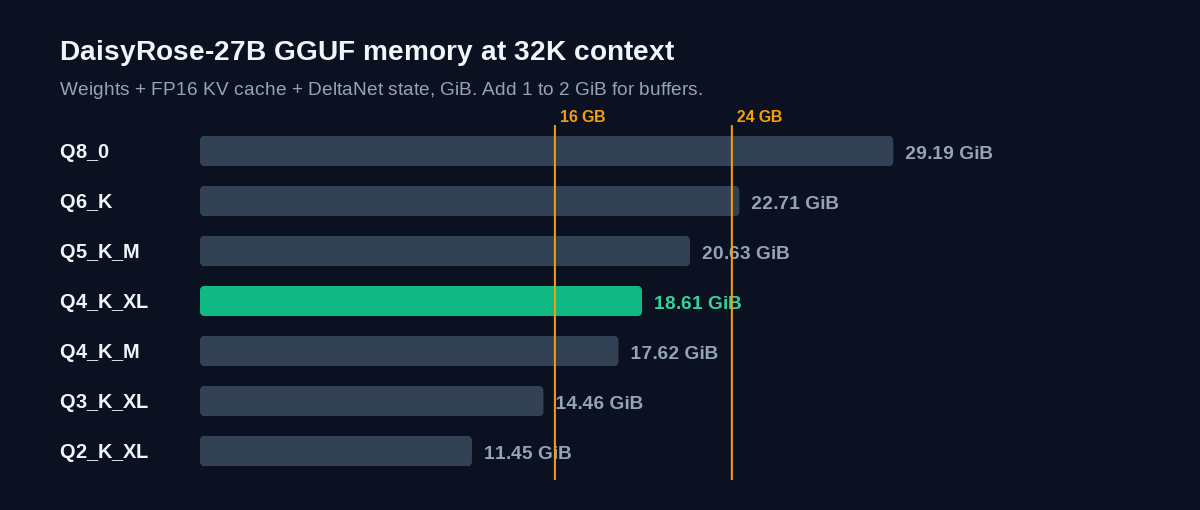
The vision projector, mmproj-DaisyRose-27B-BF16.gguf, adds 0.87 GiB if you want image input.
Which card for which file:
- 12 GB: Q2_K_XL at 8K is 9.95 GiB. RadixArk says this quant "reasons longer and hits context limits more often" and suggests a lower reasoning effort. On a thinking-heavy model that advice is worth following.
- 16 GB: Q3_K_XL at 32K is 14.46 GiB. RadixArk recommends it for 16 GB cards.
- 24 GB: Q4_K_XL at 64K is 20.61 GiB, RadixArk's recommended file. For 128K on 24 GB, a q8_0 KV cache halves the cache line and brings Q4_K_XL to 20.61 GiB at 128K.
- 32 GB: Q6_K at 64K is 24.71 GiB, or Q8_0 at 32K at 29.19 GiB.
The AI VRAM calculator now has a DaisyRose-27B preset that counts only the 16 attention layers, so its KV line matches this table.
The 64K row deserves attention for a different reason. The GGUF card asks for "at least 64k of context" per request at the default xhigh effort, because thinking alone can fill a smaller window. On a 16 GB card that means Q3_K_XL at 16.46 GiB, which is over the limit once buffers are added. Either drop to medium effort and a 32K window, or use Q2_K_XL.
Serving it with llama-server or SGLang
For a single consumer GPU, the GGUF card's command is enough:
# 24 GB card: recommended 4-bit file, 64K context
llama-server -hf RadixArk/DaisyRose-27B-GGUF:Q4_K_XL \
  --jinja -ngl 999 -c 65536

# cheaper turns: medium effort instead of the xhigh default
llama-server -hf RadixArk/DaisyRose-27B-GGUF:Q4_K_XL \
  --jinja -ngl 999 -c 65536 \
  --chat-template-kwargs '{"reasoning_effort":"medium"}'
Ollama works too: ollama run hf.co/RadixArk/DaisyRose-27B-GGUF:Q4_K_XL. --jinja loads the chat template embedded in the file, which is what makes tool calls work.
Sampling settings for thinking mode are temperature 1.0, top_p 0.95, top_k 20 and min_p 0. In multi-turn chats, send earlier turns back with their reasoning_content; the template keeps it by default. If you're writing request bodies by hand, the JSON formatter will catch a broken chat_template_kwargs object before the server does.
On a data-center card, RadixArk recommends SGLang with the DSpark draft. The flags that differ from a normal Qwen3.8 launch are these:
python3 -m sglang.launch_server \
  --model-path RadixArk/DaisyRose-27B \
  --context-length 262144 \
  --reasoning-parser qwen3 --tool-call-parser qwen3_coder \
  --kv-cache-dtype fp8_e4m3 \
  --mamba-ssm-dtype float32 \
  --speculative-algorithm DSPARK \
  --speculative-draft-model-path RadixArk/Qwen3.8-27B-DSpark
The full command, with the mamba cache settings and Docker flags, is in the model card. RadixArk lists weights at about 52 GB in BF16, 29 GB in FP8 and 23 GB in NVFP4, and NVFP4 needs a Blackwell GPU.
FAQ
Can I swap DaisyRose into a Qwen3.8-27B setup without changes?
Mostly. The architecture, tokenizer, chat template and context are the same, so the same GGUF runtime, parsers and memory settings apply. Change the model path, then check your output-token spend, since the default xhigh effort thinks longer.
Does DaisyRose support images?
Yes. It keeps the base model's 27-layer vision encoder unchanged. For llama.cpp, load the 0.9 GB mmproj file alongside the GGUF.
Is DaisyRose better than Inkling 2 Small for agents?
Not on RadixArk's own table. Inkling 2 Small scores higher on every shared benchmark and costs less per agent session on Together AI. DaisyRose's advantage is size: a 27B dense model you can run on one 24 GB card.
Sources
- Hugging Face,
RadixArk/DaisyRose-27Bmodel card,config.json,model.safetensors.index.jsonand repo metadata (read 22 November 2026): release date, training setup, GPU-hours, parameters, benchmark table and footnotes, SGLang command, weight sizes, 15mtp.tensors, 55,562,855,904-byte total. - Hugging Face,
RadixArk/DaisyRose-27B-GGUFmodel card and file list (read 22 November 2026): GGUF file sizes in bytes, mmproj size, quant recommendations, llama-server and Ollama commands, reasoning-effort and 64K-context guidance. - Hugging Face,
RadixArk/Qwen3.8-27B-DSparkmodel card (read 22 November 2026): 1.86B draft parameters, throughput and speedup tables, H200 and GB300 test setup. - DeepInfra model API (
api.deepinfra.com/v1/openai/models, read 22 November 2026): DaisyRose-27B and Qwen3.8-27B input, cached-input and output rates, 25% discount flag. - Together AI pricing page (read 22 November 2026): Inkling 2 Small rates.
- Nous Research
Arete-27Bdetails from our 9 November post:mtp_num_hidden_layers: 0and nomtp.tensors. - KV cache, DeltaNet state, GiB conversions and session costs are calculated by ToolMintX from those figures. Compute buffers and runtime overhead are not included.