Anthropic shipped Claude Fable 5.1 and Claude Mythos 5.1 on September 1, 2026, and the coverage is leading with "up to 45% cheaper." The number is real, but it is easy to misread. The base price did not move at all.
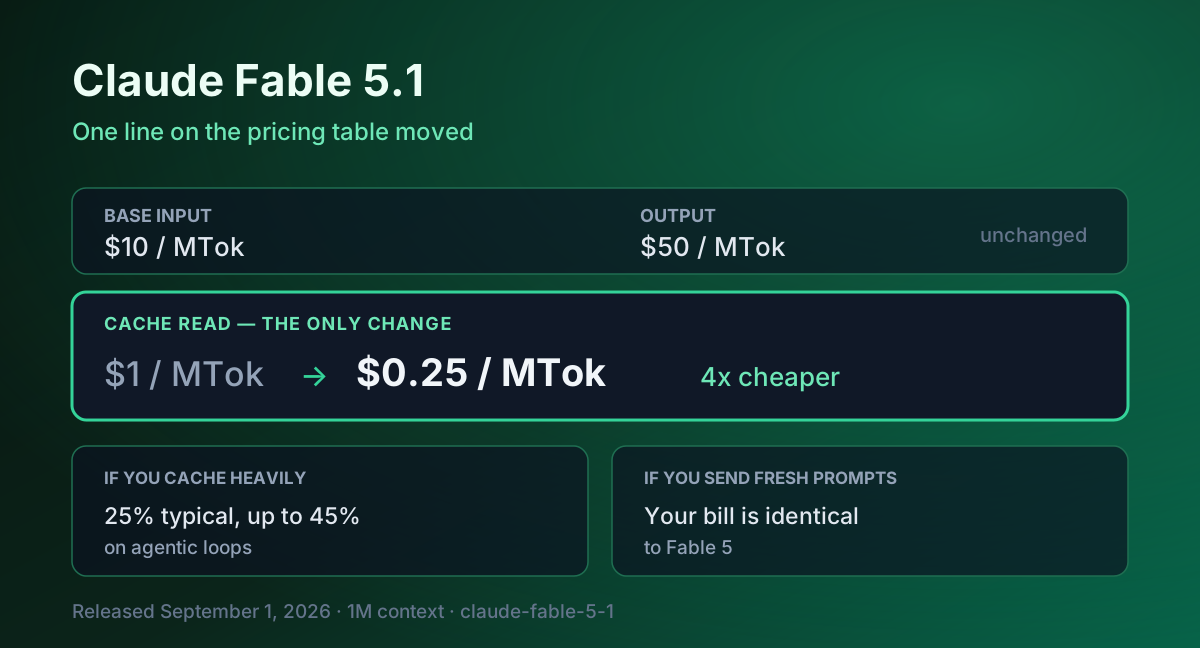
Fable 5.1 still costs $10 per million input tokens and $50 per million output tokens, exactly what Fable 5 cost. The change is one line on the pricing table: cache reads dropped from $1 to $0.25 per million tokens, a 4x cut. Anthropic frames it as a 25% saving on typical workloads and up to 45% on heavily agentic ones, and both figures come from that single line.
Whether you save anything depends on how much of your input is cached. If you send fresh prompts every time, your bill is identical.
Table of contents
- Price changes
- Savings by cache hit rate
- Benchmarks
- Terminal-Bench-Science
- Breaking changes from Fable 5
- Effort levels
- Mythos 5.1
- Who should switch
- FAQ
- Sources
Price changes
The full comparison from Anthropic's pricing table:
| Fable 5 | Fable 5.1 | |
|---|---|---|
| Base input | $10 / MTok | $10 / MTok |
| 5m cache write | $12.50 / MTok | $12.50 / MTok |
| 1h cache write | $20 / MTok | $20 / MTok |
| Cache read | $1 / MTok | $0.25 / MTok |
| Output | $50 / MTok | $50 / MTok |
Only the cache read row moved. Fable 5.1 prices cache reads at 0.025x the base input price, where every other Claude model uses the standard 0.1x. The context window stays at 1M tokens and max output at 128K.
Savings by cache hit rate
Do the arithmetic before you plan around a 45% cut. Take a workload with 1M input tokens and 200K output tokens per run. Output costs $10 either way. On the input side:
- No caching: 1M fresh tokens cost $10 on both models. Saving: zero.
- Half cached: 500K fresh ($5) plus 500K cached. On Fable 5 the cached half is $0.50, on 5.1 it is $0.125. Total run: $15.50 versus $15.13, a saving of 38 cents or 2.4%.
- 90% cached: 100K fresh ($1) plus 900K cached. Fable 5 charges $0.90 for the cached part, Fable 5.1 charges $0.23. Total run: $11.90 versus $11.23, a saving of 5.7%.
Those savings are small because output dominates at $50/MTok. They flip when output is small and cached input is huge, which is what long agentic loops look like: the same large system prompt and codebase context replayed across dozens of turns, each turn emitting a short tool call.
At that extreme, two million cached input tokens against 5K of output costs $2.25 on Fable 5 and $0.75 on Fable 5.1, a 67% cut. Anthropic's 45% sits between that and the single-digit savings above, so it describes a specific shape of workload and isn't a general discount. Our API cost calculator now carries both models, so you can put in your own token mix instead of trusting a headline.
Benchmarks
Anthropic published these with production safeguards enabled. It notes that on tasks where safeguards intervened the model scored zero, which likely drags the figures down.
| Benchmark | Fable 5.1 | Fable 5 | Opus 5 | GPT-5.6 Sol |
|---|---|---|---|---|
| Terminal-Bench-Science 0.1 | 52.6% | 24.7% | 29.0% | 22.4% |
| Terminal-Bench 4.0 | 55.8% | 42.0% | 52.3% | 37.3% |
| GDPval-AA v2 | 1853 | 1723 | 1824 | 1711 |
| OSWorld 2.0 (strict) | 41.7% | 36.1% | 39.6% | n/a |
| Humanity's Last Exam (no tools) | 60.9% | 57.8% | 56.6% | n/a |
| AutomationBench | 31.4% | 17.1% | 26.9% | 19.6% |
| CursorBench 3.2.0 | 73.4% | 70.5% | 70.0% | 67.2% |
Mythos 5.1 scores 60.9% on Terminal-Bench 4.0 against Fable 5.1's 55.8%. Anthropic attributes the gap to its older, less precise cyber safeguards intervening on some tasks, and expects it to shrink now that those safeguards have been improved.
On several benchmarks the jump over Opus 5 is only a few points, and Opus 5 costs half as much ($5/$25). Anthropic's own documentation says to start with Opus 5 for most workloads and reach for Fable 5.1 only for demanding reasoning and long-horizon agentic work, or when your evals on Opus 5 at higher effort still fall short. That is unusually direct advice against its most expensive model.
Terminal-Bench-Science
One result is not incremental: 24.7% to 52.6% on Terminal-Bench-Science 0.1, which measures agentic scientific research.
Read the footnote first. Anthropic states the standard error is ±3.5–4.5 points per model. The public leaderboard reports Opus 5 at 30.0% and Fable 5 at 21.4%, while Anthropic's own setup reproduces 29.0% and 24.7%. Both are within noise, and they show these numbers move by several points depending on harness.
Even discounting generously, doubling is outside that error band. It is the claim most worth independent verification as people run it.
Breaking changes from Fable 5
Fable 5.1 is not a drop-in swap. Three things break:
- Forced tool use returns an error, so any request that requires a specific tool call now fails.
- Earlier models can't read its thinking blocks, so pipelines that hand thinking output to an older Claude will break.
- Editing earlier turns invalidates thinking blocks, so conversation-rewriting patterns need rework.
Five additions are optional: per-message effort (beta), turn-scoped system messages (beta), readable progress updates between tool calls via display: "updates" (beta), the lower cache read price, and content provenance.
Model IDs are claude-fable-5-1 and claude-mythos-5-1.
Effort levels
Buried in the announcement and more useful than the price cut: at Low or Medium effort, Fable 5.1 matches or beats Fable 5's results at much lower cost.
Defaults differ by surface, and that decides your bill:
- Claude Code: High
- Claude Cowork and Claude.ai: Medium
- API: per-message effort control, in beta
If you use Claude Code and haven't thought about effort, you are paying for High on every request. For most people, dropping to Medium for routine work saves more than the cache read change.
Mythos 5.1
Mythos 5.1 is the same model with different access. It has identical capabilities and pricing, and it is available only to Project Glasswing participants by invitation. If you're not in that program, Fable 5.1 is your version.
Anthropic also mentions two related items. Enterprise Frontier Safeguards store data in customer-controlled cloud infrastructure instead of Anthropic's, arriving in phases from later this fall, with zero data retention available to eligible customers until then. And a biology access program built with the US government has enrollment opening soon.
On safeguards, Anthropic claims 60% fewer false positives in cybersecurity. Fable 5.1 can now be used to find software vulnerabilities but not to develop exploits for them.
Who should switch
- Long agentic loops with heavy prompt caching: yes. The cache read cut is aimed at you, the Terminal-Bench 4.0 and AutomationBench gains are the largest, and the effort controls give you a second lever.
- Happy on Opus 5: Anthropic says stay. Opus 5 is half the price and within a few points on most of this table. Switch only if your own evals on Opus 5 at higher effort fall short.
- Mostly fresh prompts: the price change does nothing for you. Judge on capability alone, and 2x the output cost of Opus 5 is a real gap to justify.
- Agentic scientific research: test the Terminal-Bench-Science jump, with the error bars in mind.
FAQ
Is Claude Fable 5.1 cheaper than Fable 5?
Only for cached input. Base input and output prices are identical at $10 and $50 per million tokens. Cache reads fell from $1 to $0.25 per million. Anthropic estimates a 25% saving on typical workloads and up to 45% on heavily agentic ones, both from that one line.
Is it a drop-in replacement for Fable 5?
No. Forced tool use now errors, earlier models can't read its thinking blocks, and editing earlier turns invalidates thinking blocks.
How does it compare to Opus 5?
Better on every published benchmark, though by a few points on most, and it costs twice as much ($10/$50 versus $5/$25). Anthropic's own docs recommend starting with Opus 5.
Can I use Mythos 5.1?
Only as a Project Glasswing participant. It is invitation-only, with the same capabilities and price as Fable 5.1.
Sources
- Introducing Claude Fable 5.1 and Claude Mythos 5.1: Anthropic, September 1, 2026
- Claude Fable 5.1 overview: Claude Platform Docs
- What's new in Claude Fable 5.1: Claude Platform Docs
- Claude model pricing table: Claude Platform Docs