AI video generation stopped being a novelty sometime in 2025. By mid-2026 it is a real production tool: models now generate clips with synchronized dialogue, believable physics, and multi-shot consistency that would have looked impossible two years ago. But the field also moves fast enough that "the best model" changes every few months — and one of last year's headline products (OpenAI's Sora) is already being shut down.
This is a practical comparison of the major AI video generation models as of July 2026: what they actually do, what they cost, which ones you can run yourself, and which one fits your use case.
Table of Contents
- The 2026 video model lineup at a glance
- Google Veo 3.1: the safe default
- Kling 3.0: the longest, most cinematic clips
- What happened to OpenAI Sora
- Runway, Luma, and Pika: the creative-workflow tools
- Hailuo 2.3 and the value tier
- Open-weight models: Wan and HunyuanVideo
- The four big trends of 2026
- Which model should you use
- FAQ
- Conclusion
- Sources and further reading
The 2026 video model lineup at a glance
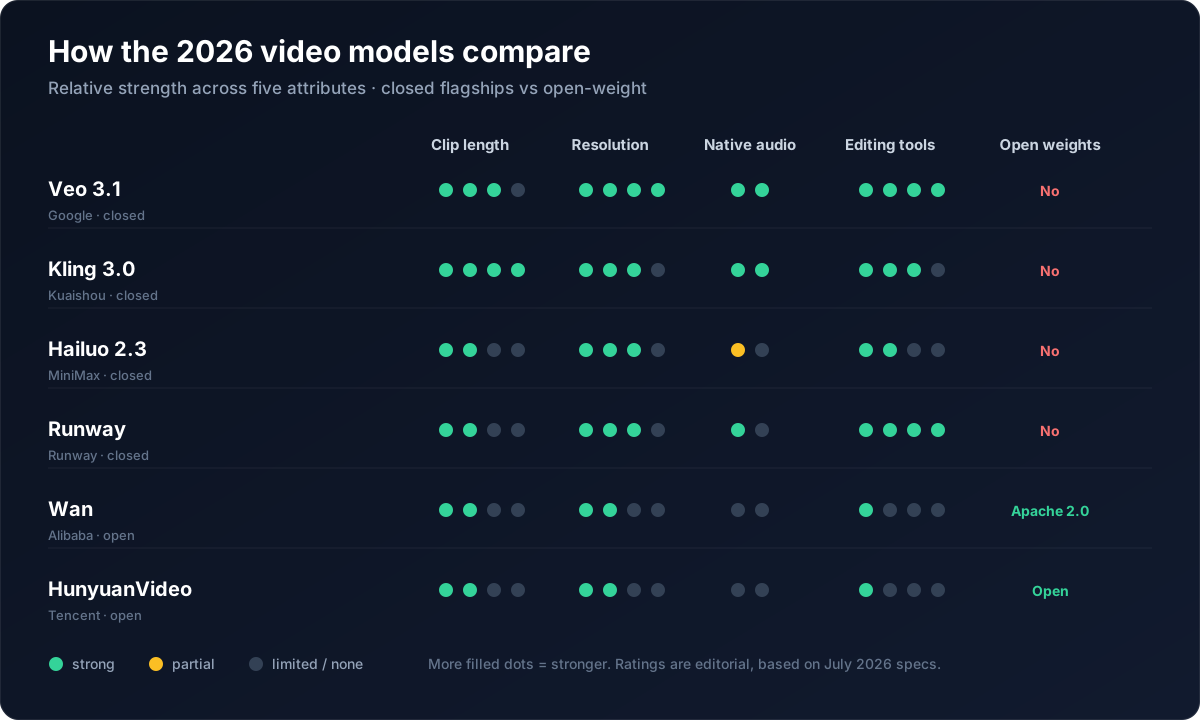
The market splits into three groups: closed API-and-app products from big labs (Google, Kuaishou, MiniMax), creative-suite tools built around an editing workflow (Runway, Luma, Pika), and open-weight models you can download and self-host (Alibaba's Wan, Tencent's HunyuanVideo).
Here is the fast comparison of the closed flagships:
| Model | Maker | Released | Max resolution | Max clip | Native audio | Access |
|---|---|---|---|---|---|---|
| Veo 3.1 | Google DeepMind | Oct 2025 | 1080p / 4K | 8s base + extend | Yes | Gemini app, Flow, API |
| Kling 3.0 | Kuaishou (China) | Feb 2026 | 1080p (4K claimed) | ~15s | Yes, with lip-sync | App, web, API |
| Hailuo 2.3 | MiniMax (China) | Oct 2025 | 1080p | ~6–10s | Partial | App, web, API |
| Sora 2 | OpenAI | Sept 2025 | 1080p (Pro) | 16–20s (120s API) | Yes | Discontinuing (see below) |
Google Veo 3.1: the safe default
Google DeepMind's Veo 3.1, released in October 2025 as the successor to the May 2025 Veo 3, is the model most people should reach for first. It generates up to 4K resolution, produces native synchronized audio (sound effects, ambient noise, and dialogue), and — crucially — ships with the deepest editing toolset of any closed model.
That toolset is what sets it apart. Veo 3.1 supports "ingredients-to-video" (you feed it reference images and it composes a scene), scene extension, first-and-last-frame transitions, outpainting, and add/remove-object editing. Base clips are 8 seconds, extended into longer sequences one segment at a time.
Access is broad: the Gemini app, Google Flow, Google Vids, AI Studio, and the Gemini API. API pricing is per second — roughly $0.40/s for the standard model with audio, dropping to about $0.10–0.15/s for the Fast tier and $0.05/s for Lite. Every output carries Google's invisible SynthID watermark. It is closed and API-only; there are no downloadable weights.
The honest caveat: DeepMind's "we beat everyone" benchmark claims are vendor-reported, and spoken-dialogue coherence on very short clips is still, in Google's own words, "active development."
Kling 3.0: the longest, most cinematic clips
Kuaishou's Kling 3.0, launched in early February 2026 on a new "Omni One" architecture, is the model to beat for narrative, cinematic work. It generates the longest single clips of the mainstream products — up to about 15 seconds — plus multi-shot storyboarding of up to six connected shots, which is a genuine advantage when you are trying to tell a story rather than produce a single loop.
Kling's native audio arrived in the 2.6 release (around December 2025) and 3.0 continues it with frame-synchronized, multilingual audio and lip-sync. Reviewers consistently rate its human motion and face tracking among the best available. It is closed, sold through a credits-plus-membership model on its app, web, and official API.
Two caveats worth knowing: the widely repeated "4K/60fps" spec appears in third-party coverage but was not stated in Kuaishou's own launch release, so treat 1080p as the firmly-supported number. And native audio reportedly costs several times more credits than silent generation.
What happened to OpenAI Sora
If you read older comparisons, they lead with Sora — so this needs saying clearly: OpenAI is shutting Sora down. Sora 2 launched September 30, 2025 with genuinely strong physics, native audio, and the clever "Cameo" system for inserting a consistent likeness. But OpenAI announced its discontinuation on March 24, 2026. The app and Sora.com website shut down on April 26, 2026, and the API is scheduled to shut down on September 24, 2026.
For anything you are building today, Sora is not a viable choice — it is a cautionary tale about betting a workflow on a single vendor's product. Independent benchmarks had also placed Sora 2 Pro behind newer competitors before the wind-down.
Runway, Luma, and Pika: the creative-workflow tools
These three are less about raw benchmark scores and more about being a place you actually edit.
- Runway built its reputation on Gen-4-class models and its video-to-video and in-context editing tools (the "Aleph"-style workflow), which let you restyle or modify existing footage rather than only generate from scratch. It remains the pick for filmmakers who want control surfaces, not just a prompt box.
- Luma AI's Dream Machine / Ray line leans on keyframe control — you set start and end frames and it interpolates — which is intuitive for animators and motion designers.
- Pika stays focused on fast, fun, social-first generation with its effects and frame-transition features.
All three are closed and subscription-based, and all three added native audio and longer clips over the past year to keep pace with Veo and Kling.
Hailuo 2.3 and the value tier
MiniMax's Hailuo 2.3 (October 28, 2025) is the sharp value option. It renders 1080p on its Pro tier and a fast 768p tier for quick iteration, with clips in the 6–10 second range. Its calling card is physics-aware realism and strong prompt adherence at a competitive per-clip cost, which made the Hailuo line a benchmark favorite through 2025. Its weak spot is audio — it generates some native sound but is noticeably behind Veo 3.1 and Kling on synchronized dialogue. It is closed, credits-based, and available globally through its own platform and resellers like Replicate and OpenRouter.
Open-weight models: Wan and HunyuanVideo
If you want to run video generation on your own hardware — for privacy, cost control, or fine-tuning — the open-weight world is led by two Chinese labs:
- Alibaba's Wan series is the most important open-weight text-to-video family, released under a permissive Apache 2.0 license with weights on Hugging Face. It is the go-to base model for the self-hosting and research community.
- Tencent's HunyuanVideo is the other major open release, also downloadable, with a strong ecosystem of community fine-tunes and tooling.
Neither matches Veo 3.1 or Kling 3.0 on native audio or one-click polish, but they are free to run, modifiable, and don't send your footage to anyone's server. For a privacy-first workflow, that trade is often worth it.
The four big trends of 2026
1. Native audio is now table stakes. The single biggest shift since 2024: leading models generate synchronized audio — dialogue, effects, ambient sound — in the same pass as the video. Veo 3.1, Kling 3.0, and Sora 2 all do it. A silent-only model now feels a generation behind.
2. Clips are getting longer. The old ~5–10 second ceiling is lifting. Kling 3.0 does ~15 seconds natively and stitches multi-shot sequences; Sora's API allowed extension up to 120 seconds. "Extend the last frame" is now a standard feature rather than a hack.
3. Physics and world-modeling are the marketing battleground. Every lab now pitches "understands real-world physics." Take the specific benchmark claims with salt — they're almost all vendor-reported — but the improvement in object permanence and believable motion is real and visible.
4. The open-vs-closed split is hardening. The frontier of quality (Veo, Kling) is closed and API-only, while the open-weight tier (Wan, HunyuanVideo, plus smaller entrants like Lightricks' LTX) trades a bit of polish for control, privacy, and zero per-second cost. Which side you pick increasingly depends on whether you value the best output or full ownership.
Which model should you use
- Just want the best all-round result with minimal fuss: Google Veo 3.1.
- Cinematic, story-driven clips or the longest single takes: Kling 3.0.
- Editing existing footage or precise creative control: Runway.
- Fast iteration on a budget: Hailuo 2.3.
- Privacy, self-hosting, or fine-tuning: Alibaba Wan or Tencent HunyuanVideo.
- Do not start a new project on Sora — it is being discontinued in 2026.
FAQ
What is the best AI video generator in 2026?
For most people, Google Veo 3.1 is the best default: 4K output, native audio, and the richest editing toolset. Kling 3.0 is the strongest choice for long, cinematic, multi-shot clips.
Is OpenAI Sora still available?
No, not for long. OpenAI announced Sora's discontinuation on March 24, 2026. The app and website shut down on April 26, 2026, and the API is scheduled to close on September 24, 2026. Don't build new projects on it.
Which AI video models can I run on my own computer?
Alibaba's Wan (Apache 2.0 licensed) and Tencent's HunyuanVideo are the leading open-weight models, both downloadable from Hugging Face. They need a capable GPU but are free to run and modify.
Do these models generate sound too?
Yes — native synchronized audio is now standard on the leading closed models. Veo 3.1, Kling 3.0, and Sora 2 all generate dialogue, sound effects, and ambient audio together with the video. Hailuo 2.3's audio is weaker on synced dialogue, and most open-weight models are still video-only.
How much does AI video generation cost?
Closed models are priced per second via API — roughly $0.05–$0.40 per second on Veo 3.1 depending on tier and resolution, with similar ranges elsewhere. Consumer apps use monthly subscriptions or credit bundles. Open-weight models are free to run if you have the hardware.
Conclusion
The 2026 AI video landscape is defined by three things: native audio everywhere, longer and more coherent clips, and a widening gap between polished closed products and flexible open-weight ones. Google Veo 3.1 is the safest all-round pick, Kling 3.0 owns the cinematic long-clip niche, and Wan and HunyuanVideo give self-hosters a real option. The one clear lesson from Sora's shutdown: in a field moving this fast, don't tie a serious workflow to a single vendor's product.
Specs and versions change monthly, so always check the maker's current pricing and model docs before committing to one.