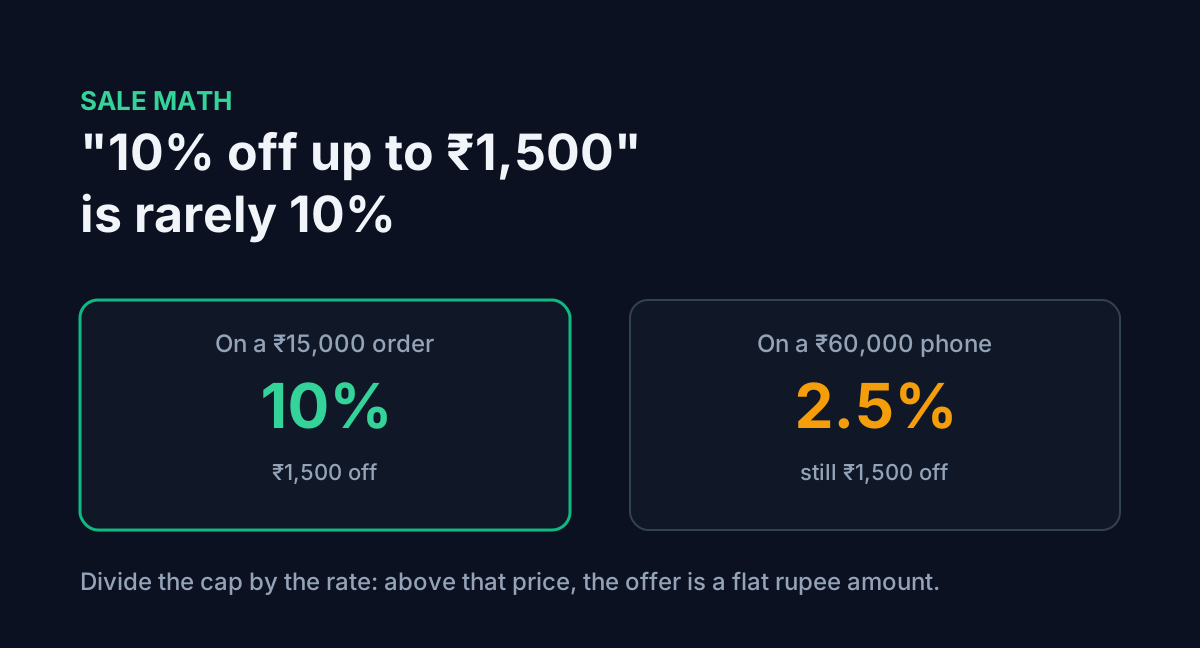
Sale banners love one line: "Extra 10% off with bank cards." The small print then adds "up to ₹1,500". On a ₹60,000 phone, that 10% is really 2.5%. On a ₹4,999 pair of headphones it can be zero, because the offer has a minimum order value and you are one rupee short.
This guide works through the arithmetic of bank offers and stacked sale discounts with real numbers, so you can tell what a deal is worth before you tap Pay. Every figure here is reproducible in the Discount Calculator.
Table of Contents
- How a capped bank offer actually works
- The break-even price where the cap kicks in
- Sale price plus bank offer: why the banner overstates it
- The minimum order trap
- Coupons, order, and which comes first
- Comparing two bank offers
- Do not add GST on top of the sale price
- A 30-second checklist before you pay
- FAQ
- Conclusion
How a capped bank offer actually works
A typical card offer has three parts, and you need all three to price it:
- A percentage, say 10%.
- A maximum discount, say ₹1,500.
- A minimum order value, say ₹5,000.
The discount you get is the smaller of "10% of the order" and "₹1,500", and only if the order crosses ₹5,000. The examples in this post all use that 10% / ₹1,500 / ₹5,000 combination because it is easy to follow. Your card's real terms will differ, so swap in the numbers from the offer page.
The break-even price where the cap kicks in
The cap starts biting at the price where 10% equals ₹1,500. That is ₹1,500 ÷ 0.10 = ₹15,000. Below that you get the full 10%. Above it you get a flat ₹1,500, and the percentage keeps shrinking as the price goes up.
| Order value | Bank discount | Effective % |
|---|---|---|
| ₹5,000 | ₹500 | 10.00% |
| ₹10,000 | ₹1,000 | 10.00% |
| ₹15,000 | ₹1,500 | 10.00% |
| ₹25,000 | ₹1,500 | 6.00% |
| ₹40,000 | ₹1,500 | 3.75% |
| ₹60,000 | ₹1,500 | 2.50% |
| ₹1,00,000 | ₹1,500 | 1.50% |
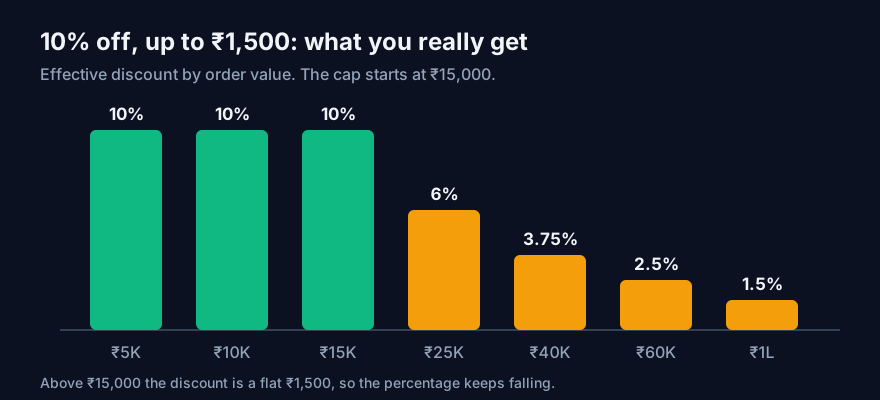
This is why "10% off" offers feel generous on mid-range purchases and barely move the needle on a flagship phone or laptop. The rupee amount is the honest number. The percentage on the banner only holds up to the break-even price.
Sale price plus bank offer: why the banner overstates it
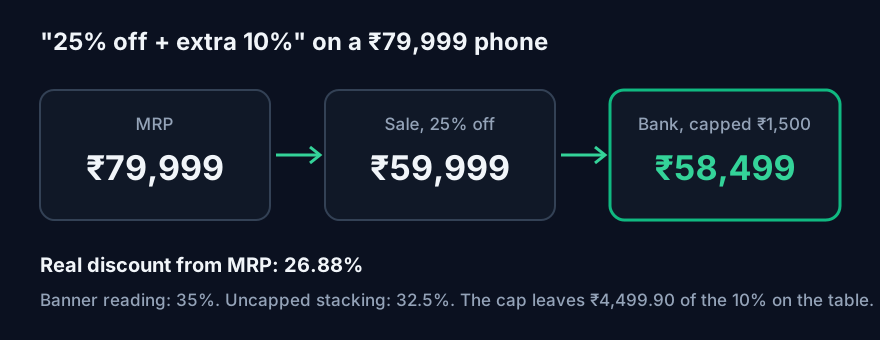
Say a phone has an MRP of ₹79,999 and a sale price of ₹59,999. That is 25% off. Add "extra 10% with bank cards" and it is tempting to read the whole thing as 35% off.
Work it through:
- Sale price: ₹59,999 (25% below MRP)
- Bank offer: 10% of ₹59,999 is ₹5,999.90, capped at ₹1,500
- You pay: ₹59,999 − ₹1,500 = ₹58,499
- Real discount from MRP: (₹79,999 − ₹58,499) ÷ ₹79,999 = 26.88%
So the "35%" deal is 26.88%. Two things shrank it. The cap took most of the bank offer away, and even an uncapped second percentage would be taken from the already reduced price, which is why 25% + 10% stacks to 32.5% and never 35%.
The same multiplying rule applies to "extra 10% off" codes on fashion sales. Shoes at ₹2,999 MRP with 40% off and an extra 10% come to ₹1,619.46, which is 46% off, not 50%.
The minimum order trap
With a ₹5,000 minimum, a ₹4,999 cart gets nothing. A ₹5,049 cart gets ₹504.90 off and costs ₹4,544.10, which is ₹454.90 less than the cheaper cart. Crossing the threshold with something you were going to buy anyway is pure gain.
The reverse is also true. If your cart is ₹4,700 and the only way past ₹5,000 is a ₹400 item you do not need, you pay ₹5,100 − ₹510 = ₹4,590 for things you wanted at ₹4,700. You saved ₹110 and got an item you did not want. That is fine if you would use it, and a loss if you would not.
The cap also works per transaction on most offers. Two separate ₹15,000 orders can each earn ₹1,500, while one ₹30,000 order earns ₹1,500 total. Check the terms first: many offers limit how many times one card can use them during the sale.
Coupons, order, and which comes first
Bank offers are usually calculated on the amount you actually pay, so a coupon comes off first and the bank percentage applies to what is left. Below the cap, that order costs you a little:
- ₹8,000 cart, ₹500 coupon, then 10% bank: ₹7,500 − ₹750 = ₹6,750
- If the bank 10% came first, then the coupon: ₹8,000 − ₹800 − ₹500 = ₹6,700
The ₹50 gap exists because the coupon shrinks the base the 10% works on. Above the cap, the order stops mattering. On a ₹20,000 item, both orders give ₹18,000, because the bank discount is a flat ₹1,500 either way.
You cannot choose the order at checkout. Knowing it lets you predict the final number before the payment page shows it.
Comparing two bank offers
When two cards have different offers, compare rupees, not percentages. On a ₹54,990 laptop:
- 10% up to ₹1,500: you get ₹1,500 (2.73%)
- 7.5% up to ₹4,000: you get ₹4,000 (7.27%), since 7.5% of ₹54,990 is above the cap
The "smaller" 7.5% offer saves ₹2,500 more. Its own cap kicks in at ₹53,333, so anything above that price earns the full ₹4,000.
Cashback is another comparison trap. "5% cashback up to ₹1,000" on a ₹20,000 order is ₹1,000, credited later, often as wallet balance or statement credit. An instant 10% up to ₹1,500 on the same order is ₹1,500 off the bill today. The instant discount wins on amount and on timing.
Do not add GST on top of the sale price
Indian listed prices are tax-inclusive. Under the Legal Metrology (Packaged Commodities) Rules, an MRP includes all taxes, and the sale price you see at checkout already has GST inside it. On a ₹59,999 phone at 18%, about ₹9,152.39 of the price is GST. Adding 18% on top would give ₹70,798.82, a figure nobody will ever charge you.
If you are budgeting a sale purchase, take the final checkout amount as the real cost. The calculator's tax-inclusive mode splits GST out of a price instead of adding it.
A 30-second checklist before you pay
- Find the cap and divide it by the percentage. That is your break-even price.
- If the item costs more than that, the bank offer is a flat rupee amount. Use that number.
- Check the minimum order value against your cart.
- Multiply stacked percentages, never add them: pay = price × (1 − a) × (1 − b).
- Compare cards and cashback in rupees, then weigh instant against delayed.
If the purchase is on EMI, also read the Festival Expense Planner, which prices the upfront discount you lose when you choose a "no-cost" EMI.
FAQ
What does "10% off up to ₹1,500" mean? You get 10% of the order value, but never more than ₹1,500. Above ₹15,000 the discount stays at ₹1,500, so the real percentage falls as the price rises.
Is 25% off plus an extra 10% equal to 35% off? No. The second 10% comes off the reduced price, so it stacks to 32.5%. If the 10% is a capped bank offer, it can be much less: on a ₹59,999 sale price with a ₹1,500 cap, the total is 26.88% off MRP.
Does the bank offer apply before or after a coupon? Usually after, on the amount you pay. Below the cap this gives a slightly smaller bank discount. Above the cap the order makes no difference.
Should I add items to reach the minimum order value? Only if you would buy them anyway. Going from ₹4,999 to ₹5,049 saves ₹454.90. Adding a ₹400 item you do not need to a ₹4,700 cart saves only ₹110.
Is GST added on top of a sale price in India? No. Listed retail prices include GST. The checkout total is what you pay.
Conclusion
A capped bank offer is a fixed rupee discount for most big purchases, and the percentage on the banner only holds up to the break-even price. Divide the cap by the rate, multiply stacked percentages instead of adding them, and compare offers in rupees. The Discount Calculator does the stacking, the coupon order and the GST split, so you can check any sale price in a few seconds.
Sources
- All figures are worked examples calculated with the same formulas as the ToolMintX Discount Calculator: stacked price = price × (1 − a) × (1 − b), bank discount = min(rate × order value, cap) when the order meets the minimum. The 10% / ₹1,500 / ₹5,000 offer terms are illustrative, not a specific bank's offer.
- Tax-inclusive MRP: Legal Metrology (Packaged Commodities) Rules, 2011, as cited on the ToolMintX Discount Calculator page.