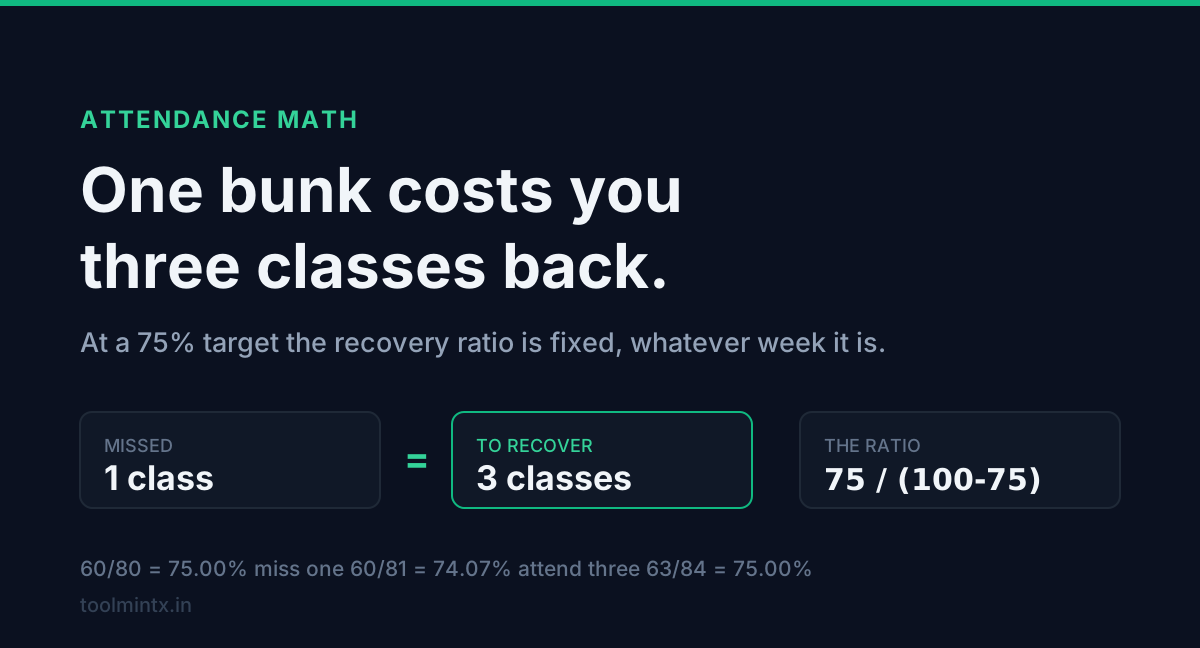
Miss one class and you lose a little under one percent. Attend one class and you gain about the same. That symmetry is what most students assume, and it is wrong in a way that costs people their exam form.
Sitting exactly on 75% with 60 of 80 classes attended, skipping one lecture drops you to 74.07%. Getting back over the line takes three more classes, not one. Not two. Three, every time.
The number does not depend on how long your semester is, how many classes you have already attended, or how early in the term you are. It depends only on the target percentage, and at 75% it is always three.
Table of contents
- The 1:3 rule, and why it never changes
- Where three comes from
- The cost of a bunk at other targets
- Attendance is a bank account you can only overdraw once
- What 75% actually means on paper
- Your real bunk budget for a 15 week semester
- FAQ
- Conclusion
- Sources
The 1:3 rule, and why it never changes
Your attendance is a fraction: classes attended over classes held. Missing a class does something a lot of students never picture properly. The denominator grows and the numerator stays put, so you take damage twice. Attending a class grows both, which is why recovery is slow.
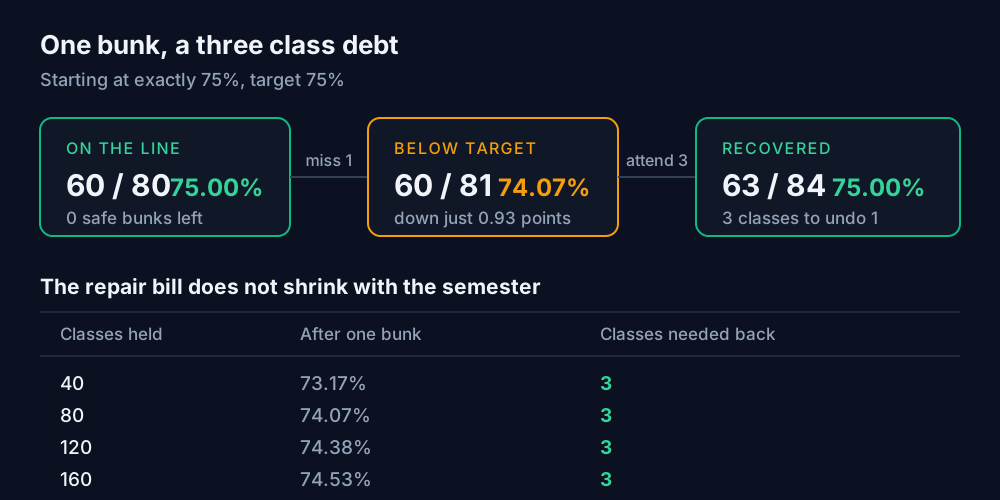
I checked whether that three holds up across the semester or whether it is just an artefact of round numbers. Starting from exactly 75% and missing one class:
| Classes held | Attended | After one bunk | Classes needed to recover |
|---|---|---|---|
| 40 | 30 | 73.17% | 3 |
| 80 | 60 | 74.07% | 3 |
| 120 | 90 | 74.38% | 3 |
| 160 | 120 | 74.53% | 3 |
The percentage you drop to keeps shrinking, which is the part that fools people. Late in the term one bunk looks almost free, a 0.47% dent. The repair bill is identical to week two.
Where three comes from
Say you need p percent and you have just missed a class. Attend n more and your record becomes (a + n) / (t + n). Set that equal to your target and the a and t cancel out, leaving p / (100 - p) as the classes you owe per class missed.
At 75 that is 75 / 25, which is 3. Nothing about your own record appears in the answer, so nothing about your own record can change it.
That ratio is the whole article, and it is worth committing to memory before your next 8am lecture: at a 75% requirement, one bunk is a three class debt.
The cost of a bunk at other targets
Colleges do not all use 75. The ratio makes the difference between requirements much sharper than the ten point gaps suggest.
| Attendance target | One bunk costs |
|---|---|
| 50% | 1 class |
| 65% | 1.86 classes |
| 66.67% (two-thirds) | 2 classes |
| 75% | 3 classes |
| 80% | 4 classes |
| 85% | 5.67 classes |
| 90% | 9 classes |
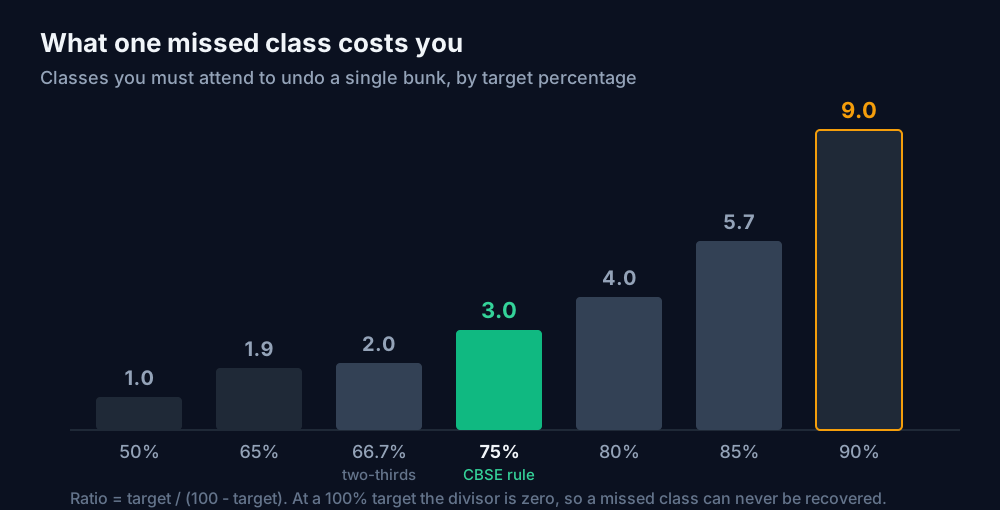
Going from a 75% rule to an 80% rule sounds like a five point tightening. It raises the cost of every single bunk by a third. At 90% a lab you skip for a wedding needs nine consecutive classes to erase, which for a subject meeting three times a week is three weeks of perfect attendance to pay off one afternoon.
The curve is the reason a 100% target is not a target at all. The formula divides by 100 - p, and at 100 that is zero. Once you have missed a single class, a cumulative 100% is unreachable for the rest of the term, no matter how many you attend afterwards. Our attendance calculator says "not reachable" for that case instead of printing a nonsense figure, which is the honest answer.
Attendance is a bank account you can only overdraw once
Flip the arithmetic and it works in your favour. Every class you attend above the line banks a fraction of a future bunk, at the same 1:3 exchange rate running backwards.
On an 80 class record at a 75% target:
| Attended | Percentage | Bunks you can still afford |
|---|---|---|
| 60 | 75.00% | 0 |
| 61 | 76.25% | 1 |
| 63 | 78.75% | 4 |
| 66 | 82.50% | 8 |
| 69 | 86.25% | 12 |
| 72 | 90.00% | 16 |
Three extra classes attended in September buy you four free absences later. That is the actual case for turning up in the first two weeks, and it is a much better argument than being told to attend because attendance is mandatory. Front-load the term and you are spending your own savings in November rather than begging for a medical certificate.
The overdraft only works one way, though. Banked credit is real and spendable. Debt is expensive, at three to one.
What 75% actually means on paper
CBSE puts the requirement at 75% of working days for Class 10 and 12 candidates under Rules 13 and 14 of its Examination Bye-Laws, and reiterated it for the 2026 board exams. The board allows relaxation only in defined cases such as medical emergencies or representing the country in sport, decided on documentation rather than on request.
Higher education is less uniform than the number that gets repeated. Many technical universities and NIT-style regulations use 75% for end-semester eligibility. Delhi University's Ordinance VII sets two-thirds, roughly 66.67%, with a discretionary provision for a student between 40% and two-thirds to be permitted to appear and make up the shortfall in the following semester.
Those two rules split the same record in a way worth seeing:
| Record | Percentage | At 75% | At two-thirds |
|---|---|---|---|
| 60/90 | 66.67% | Short | Eligible |
| 64/90 | 71.11% | Short | Eligible |
| 66/90 | 73.33% | Short | Eligible |
| 68/90 | 75.56% | Eligible | Eligible |
Check your own institution's ordinance rather than a number a senior quoted you, because being comfortable under one rule and debarred under another is a four class difference here. Also check whether your college counts per subject or in aggregate. Aggregate is kinder, since a strong subject can carry a weak one. Per subject means one badly timed 8am slot can hold back your whole form, and a percentage calculator is quicker than doing six subjects by hand.
Your real bunk budget for a 15 week semester
Take a subject with five classes a week over 15 weeks, so 75 classes held. Attend everything and you are at 100%. Here is where the wall sits:
| Classes missed | Record | Percentage | Status |
|---|---|---|---|
| 10 | 65/75 | 86.67% | Safe |
| 15 | 60/75 | 80.00% | Safe |
| 18 | 57/75 | 76.00% | Safe |
| 19 | 56/75 | 74.67% | Short by 1 class |
| 20 | 55/75 | 73.33% | Short by 5 classes |
Eighteen absences across a semester is more slack than the panic suggests, a little over one a week. The 19th costs you one class of recovery and the 20th costs five, because once the term is over there are no classes left to attend and the shortfall is final.
That is the trap with the cliff. It is not gradual. You are fine at 18, short at 19, and by the time the attendance sheet gets posted in the last week there is no denominator left to fix. Work out your number in week two, not week fourteen.
FAQ
How many classes can I miss to keep 75% attendance?
A quarter of the total held, if you attend everything else. With 75 classes in a semester you can miss 18 and sit at 76%. Missing 19 puts you at 74.67% and short.
Why does missing one class need three classes to recover?
Missing one adds to the total without adding to your attended count, so you lose ground twice. The recovery ratio is target divided by (100 minus target), which is 75/25 = 3 at a 75% requirement.
Does the recovery cost change later in the semester?
No. The percentage you drop to gets smaller as the total grows, but the classes needed to get back to target stays at three for a 75% rule. Late bunks look cheaper and cost exactly the same.
Can I get back to 100% attendance after missing a class?
No. A cumulative 100% requires zero missed classes, and no number of future classes attended can remove one from the record.
Is the attendance requirement 75% everywhere in India?
No. CBSE uses 75% of working days for board exam eligibility. Universities vary, and Delhi University's Ordinance VII sets two-thirds with a discretionary provision below that. Check your own institution's ordinance.
Does medical leave count as attendance?
That depends on your institution's rules, and it generally requires documentation submitted through the proper channel rather than an explanation after the fact. CBSE permits relaxation in defined cases such as medical emergencies, decided on evidence.
Conclusion
The number to carry around is three. At a 75% requirement, every class you skip is a three class debt, and that holds in week two and week fourteen alike. The falling percentage drop late in the term makes bunking feel cheaper than it is.
Run the same ratio the other way and attendance in the first month is genuinely worth something: three classes above the line buys four absences you can spend without asking anyone. And check your real target before you plan around 75, because a two-thirds ordinance and a 75% rule disagree about the same record by four classes.
Sources
- CBSE notice on examination attendance requirements — Rule 13 of the Examination Bye-Laws, Class 10 and 12 eligibility
- CBSE mandates 75% attendance for 2026 board exam eligibility — 2025-26 session reiteration
- CBSE notice on minimum requirements to appear in board examinations — September 2025 clarification
- CBSE attendance rules and exemptions — relaxation categories for medical emergencies and national representation
- University of Delhi Ordinance VII — two-thirds attendance requirement and the 40% discretionary provision
- NIT Kurukshetra revised attendance rules — 75% minimum for end-semester examination eligibility
- Recovery ratios, bunk budgets and the eligibility tables computed for this article from the attendance formula