Disclosure: Arivyah is a ToolMintX sponsor. We were given access to a live signed-in account to examine the product. Everything described below was verified hands-on, and nothing in this article was written or approved by Arivyah.
Most AI astrology apps have the same problem, and it is invisible from the outside. You type your birth details, a language model receives them, and that single model produces both the planetary positions and what they supposedly mean — in one breath, with no separation between the two jobs.
That is the worst possible design for this task, because a language model will generate a confident, fluent, completely wrong planetary position and you have no way to tell. There is no error message. The Saturn placement that never existed reads exactly like the one that did.
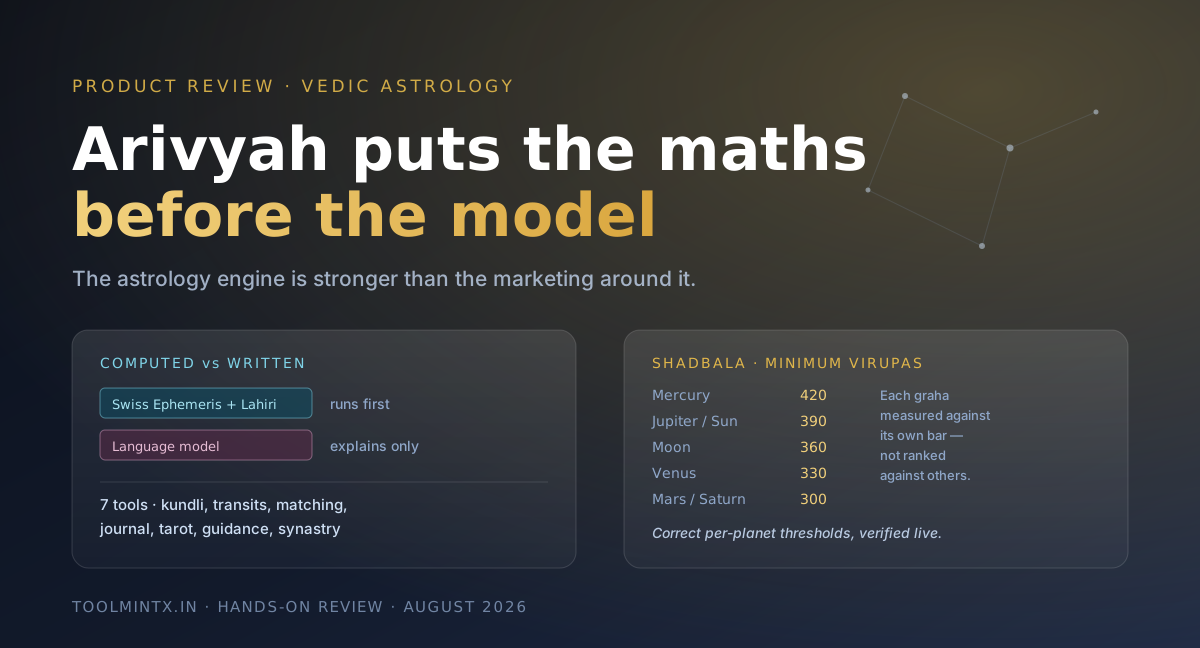
Arivyah is built around the opposite idea, stated plainly on its homepage: every position, yoga, dosha and dasha date is computed from Swiss Ephemeris data with the Lahiri ayanamsa before any model is involved, and the model's only job is to explain what the calculation already produced. Its About page calls this "calculate first, describe second."
I spent an afternoon testing whether that split is real — first across its public pages, then inside a live signed-in chart. The short version: the astrology engine is more rigorous than the marketing around it, and the app is noticeably deeper than its own feature list admits.
Table of contents
- What the product actually contains
- The engineering details it volunteers
- It publishes the score it would rather hide
- Inside the app: where the claim holds up
- What it refuses to do
- Who it is for
- FAQ
What the product actually contains
The search-facing pages lead with the free kundli generator, which undersells it. Counting the navigation and footer, there are seven distinct tools:
| Feature | What is computed | What the model does |
|---|---|---|
| Kundli | Lagna and twelve bhavas, nine grahas with sign, house, degree, dignity, retrogression, nakshatra with pada, Navamsa (D9) beside the Rasi (D1), yogas and doshas, Vimshottari dasha with real dates | Explains each placement; PDF export |
| Transits | Gochara counted from your natal Moon, Sade Sati phase, retrogrades and stations, six months of changes in date order | Writes what each shift touches |
| Compatibility | Ashtakoota Guna Milan, all eight kootas out of 36, Nadi/Bhakoot/Manglik checks, cancellation-adjusted score beside the raw one | A seven-section written report |
| Synastry | Moon-sign based matching from date and city only, for when you lack a birth time | Dimensions instead of a score |
| Guidance | — | Chat or live browser voice call carrying your chart, history and current transits |
| Journal | Auto-stamps each entry with Moon sign, nakshatra, tithi and running dasha; correlates mood across four buckets | Nothing — interpretation is deliberately withheld |
| Tarot | Server-side cryptographic shuffle, committed before you pick | Writes the reading per position |
Two entries stand out. The Journal is the only feature where the model is kept out of the output entirely — it stamps the sky onto your entry and stops, and the page states plainly that the app "never tells you what an entry means." And Tarot is the only one where the interesting engineering is in the randomness rather than the astronomy.
The engineering details it volunteers
A marketing page says "accurate." These pages name mechanisms, which is harder to fake and easier to check.
It warns you that its own output will contradict you. The system is sidereal — Lahiri ayanamsa, whole-sign houses, nakshatras, Vimshottari dasha. The FAQ pre-empts the support ticket this always generates: your sign here "will often differ by one from the Western sun sign you know, and that's expected rather than an error." Telling users your output contradicts what they already believe, before they complain, is a small act of confidence.
Transit dates are bisected, not rounded. The site claims each date is "bisected out of the ephemeris to the hour, not rounded to a month," and that retrogrades are "detected from its actual daily speed, not a table." Bisection is the correct method for finding an ingress moment, and naming it is the kind of detail that comes from having implemented the thing rather than described it.
Only contacts inside orb, with the orb printed. Every transiting planet aspects something if you loosen the orb enough — that is how daily-horoscope filler gets manufactured. Arivyah shows only contacts within orb of a natal point and prints the orb in degrees, which is a deliberate constraint on its own output volume.
The tarot shuffle is committed before you pick. The deck is "shuffled with a cryptographic random source, not a clock-seeded one," and because the order is stored before your browser knows anything, the server "cannot see which card you were reaching for, and it cannot change one after the fact." That is a commitment scheme described in plain language, and it is the right answer to the obvious suspicion about a site that lets you choose.
Missing data stays missing. Journal correlations are gated until ten marked entries exist, with at least three in a bucket before that bucket counts, because "one bad week is the entire dataset." Skipped days are omitted rather than zero-filled, since a zero "would draw a crash that never happened." Most mood-tracking products get this wrong in the direction that produces a prettier chart.
It publishes the score it would rather hide
The compatibility page carries a worked sample rather than a screenshot of a happy result. The pair scores 26.5 of 36 — and the page walks you straight to the column that failed.
| Koota | Score |
|---|---|
| Varna | 1 / 1 |
| Vashya | 2 / 2 |
| Tara | 1.5 / 3 |
| Yoni | 3 / 4 |
| Graha Maitri | 5 / 5 |
| Gana | 6 / 6 |
| Bhakoot | 0 / 7 |
| Nadi | 8 / 8 |
A zero in Bhakoot on a 26.5 total is exactly the case a scoring calculator is tempted to bury, because the headline number still reads "workable." Instead it gets its own explainer tab, with the reasoning stated: Nadi alone carries eight of the thirty-six points and Varna carries one, so "that distribution is the whole reason a total on its own tells you so little."
Then the FAQ declines the question the entire feature exists to invite. Asked whether a low score is a reason not to marry, the answer is no — "plenty of low-scoring pairs build good lives together and plenty of high-scoring ones don't."
Refusing to compress is a running theme. The synastry feature has no composite score at all: "There isn't one, deliberately," with single-number compression named as "the thing that makes compatibility readings feel like a slot machine." And where a missing birth time makes the Moon ambiguous, it reports the uncertainty rather than defaulting to noon, because "a guessed Moon produces a confident reading of the wrong person."
That last line is the product's real thesis, and it is much harder to ship than to write. Filling gaps is what language models do by default.
Inside the app: where the claim holds up
Marketing pages are cheap, so the more useful test was a real chart. What follows describes technique only — no birth details.
The first surprise is that the signed-in app is larger than the public pages admit. Alongside the six advertised sections, a real chart carries Shadbala and Ashtakavarga — six-source planetary strength, and the eight-fold bindu system. Neither appears anywhere in the public feature list. Underselling your own depth is an unusual failure mode.
Shadbala is where the calculate-first claim gets its strongest evidence, because it is the hardest section to fake. Strength is summed in Virupas against the per-graha minimum Parashara sets, and the app uses the correct, different threshold for each planet:
| Graha | Minimum required (Virupas) |
|---|---|
| Mercury | 420 |
| Jupiter | 390 |
| Sun | 390 |
| Moon | 360 |
| Venus | 330 |
| Mars | 300 |
| Saturn | 300 |
Each planet is measured against its own bar rather than ranked against the others, which is the technically correct presentation — a "strong" Saturn and a "strong" Mercury are not the same number. The panel also notes the birth was "read as daytime from the computed sunrise and sunset," a day/night distinction that genuinely changes several of the six components.
Then, printed directly beneath those numbers:
Authorities differ on the exact formulae for Ayana and Cheshta bala, so treat these as close estimates rather than exact values.
That is a real scholarly caveat, correctly scoped to the two components where classical sources actually disagree, sitting under figures the product could have simply asserted. It was the most convincing thing I saw all afternoon.
The interpretation stays tied to the computation too. The written summary names Gaja Kesari Yoga and Neecha Bhanga Raja Yoga — both present as computed entries in the Yogas panel — and states the current mahadasha and antardasha, matching the dasha timeline. Nothing in the prose invoked a placement the chart did not contain. That is the observable consequence of computing first.
Transits behaved the same way: every upcoming change is expressed as a house counted from the natal Moon, retrogrades and stations are listed as their own events, and natal contacts print real orbs — I saw values from 0.0° through 14.3°, meaning the orb is measured and displayed rather than merely described. The Journal's correlation gate is live and states its own reasoning in the interface: "10 more entries with a mood and we can start looking for patterns. Fewer than 10 and any 'pattern' would just be one bad day talking."
On the build itself: it is a Next.js app behind Cloudflare with server-rendered route prefetching. Metadata is in order — a single h1 per page, canonical URLs, per-page titles and descriptions that differ meaningfully, Open Graph and Twitter cards at 1200×630, structured data, and robots: index, follow. At both 1280px and 375px the homepage produced zero horizontal overflow. Nothing here is careless.
What it refuses to do
The clearest signal of intent in any astrology product is the list of things it declines to sell you, and this one is specific rather than tonal.
No remedy store. This is the promise I most expected to break. A real chart does surface gemstone and mantra remedies — Red Coral, Emerald, Blue Sapphire. But they carry no prices, no buy links and no store. They are labelled "traditional suggestions for reflection — not a prescription," and the Manglik entry explicitly defers to a human astrologer. The commitment holds.
No manufactured urgency. It declines to predict a death, an illness, a pregnancy or a breakup, and it will not tell you to marry, leave, quit or wait. Those are exactly the predictions that convert best, which is why most products in this category make them.
No composite compatibility score in synastry, no journal correlations before ten entries, no interpretation of your own diary entries, and tarot walled off from the birth chart so a reading cannot quietly borrow authority from placements.
On privacy, the policy states data is not sold or used to train models, and that deletion is immediate and irreversible. It also volunteers this: "We do not currently claim disk-level encryption at rest — if that changes, this page changes with it." A product willing to print the thing it cannot yet claim is being straight with you about the rest.
Who it is for
Arivyah is free to use today — no paid tier, no card, no pricing page, the whole product open.
It suits you if you want a Vedic chart that shows its working: the Shadbala and Ashtakavarga panels, real dasha dates, orbs in degrees, and a written interpretation that cites only what the engine computed. Hindi, English or Hinglish in chat and voice, switching mid-conversation if you do.
It is a poor fit if what you actually want is a one-line daily horoscope or a single compatibility number to settle an argument. It declines to produce either, on purpose.
Two honest limits on this review. I did not compute the same chart in separate software to compare positions, so "uses Swiss Ephemeris" remains a claim about a data source rather than a proof of correct implementation. And whether the ephemeris genuinely runs before the model is a statement about sequence on a server that no amount of browsing can prove directly — what a live chart shows is the behaviour you would expect if it were true.
If you want a chart that computes before it explains, this is a stronger implementation than its own homepage suggests. Go in knowing the astrology is better than the marketing, which is the opposite of the usual warning.
FAQ
Is Arivyah free? Yes — the whole product is free to use, with no paid tier and no card required.
Is this Vedic or Western astrology? Vedic — sidereal zodiac with the Lahiri ayanamsa, whole-sign houses, nakshatras and Vimshottari dasha. Your sign will often differ by one from the Western sun sign you know, and the site warns you about this rather than letting you discover it as a surprise.
Does the AI invent the chart? The site says no: positions, yogas, doshas and dasha periods are computed from ephemeris data before the model runs, and the model is forbidden from inventing placements. I could not verify the server-side ordering directly, but in a live chart the written interpretation cited only yogas and dasha periods that appeared as computed entries elsewhere in the app — which is the behaviour you would expect if the claim is true.
Do I need my exact birth time? For the full chart, yes — birth time fixes your Lagna and every house that follows. Without it, Moon sign, nakshatra and the dasha timeline stay reliable while house-specific detail should be treated as provisional. There is a separate synastry feature built specifically for matching two people when a birth time is unavailable.
Does it sell gemstones or remedies? No. Gemstone and mantra remedies do appear in a real chart, but with no prices, no purchase links and no store — labelled as suggestions for reflection rather than prescriptions, with the Manglik entry deferring to a human astrologer.
What does it refuse to predict? Death, illness, pregnancy and breakups, and it will not tell you to marry, leave, quit or wait. It also declines to reduce synastry to a single compatibility number.
What languages does it work in? Chat and voice follow your language — Hindi, English or Hinglish — and switch mid-conversation if you do. Written kundli and compatibility reports are always in English.