Short Intro
For most of 2026 the frontier-model API market moved one way: down. Then late August broke the pattern. OpenAI cut GPT-5.6 Sol's price to undercut Claude, Anthropic answered by shipping Claude Opus 5 at half of Sol's rate, and DeepSeek went the other direction entirely, quadrupling some rates at peak hours with a new time-of-day billing scheme. If you pay for tokens, the ground moved under you this month.
This is a plain-language map of who charges what right now, what actually changed, and how to think about the tradeoffs instead of chasing the lowest sticker price. Where a number matters, it is a real published rate with the source named. If you want to run your own workload through these prices instead of trusting a headline, the API Cost Calculator does the arithmetic for you.
Table of Contents
- What actually happened in August 2026
- The current price board
- GPT-5.6 Sol: the opening move
- Claude Opus 5: undercut and outscore
- DeepSeek: cheaper, but now it depends on the clock
- Price is not the whole cost
- How to pick without guessing
- FAQ
- Conclusion
What actually happened in August 2026
Three moves landed inside a few weeks, and they point in different directions.
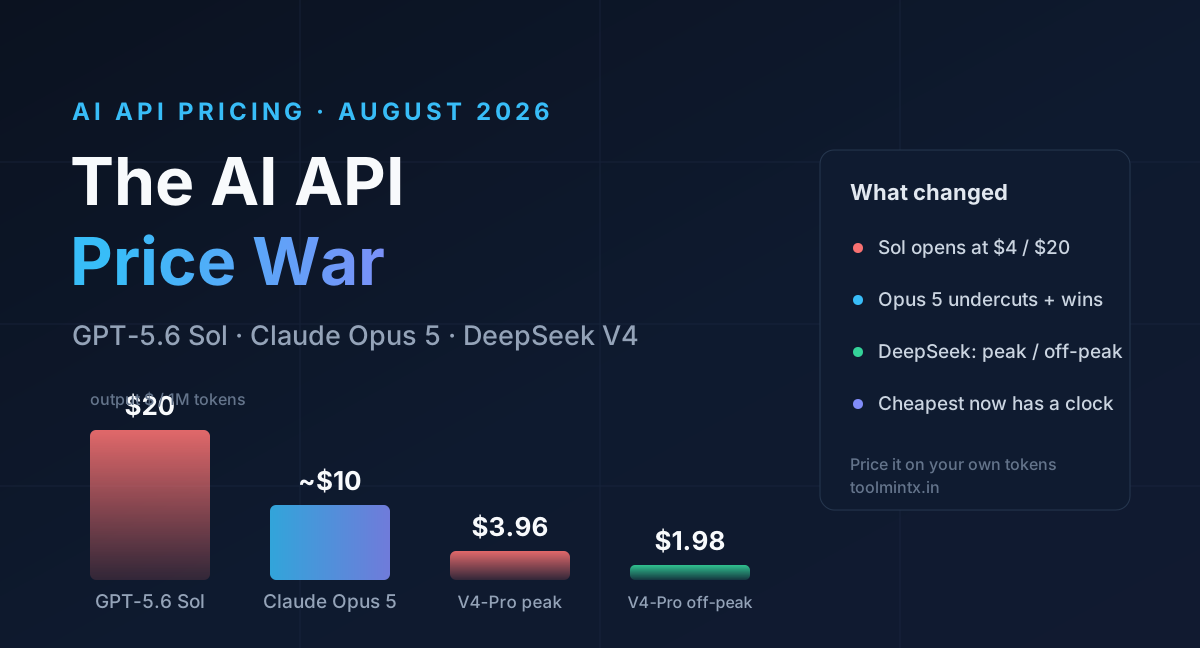
OpenAI set GPT-5.6 Sol at $4 per million input tokens and $20 per million output in early August, positioning it as the premium agentic model and pricing it to pressure Claude. Two weeks later Anthropic released Claude Opus 5 on July 24 at half that price, and on a majority of shared benchmarks it scored higher, not lower. So the "premium" tier got cheaper and stronger at the same time.
DeepSeek zagged. On August 16 it replaced its flat per-token rate with peak and off-peak pricing, and at peak hours some rates more than tripled. The cheapest frontier API in the market is still cheap, but "cheap" now has a schedule attached.
The current price board
Published output-token rates as of late August 2026, per million tokens:
- GPT-5.6 Sol: $4 input, $20 output (OpenAI, early August 2026).
- Claude Opus 5: roughly half of Sol's rate, released July 24, 2026 (Anthropic).
- DeepSeek V4-Pro: $1.98 output off-peak, rising to $3.96 in peak hours; input around $0.435 per million on a cache miss. The old flat rate was $0.87.
- DeepSeek V4-Flash: $0.22 input (cache miss) / $0.007 (cache hit) / $0.66 output off-peak; $0.44 input / $1.32 output at peak.
The costlier window runs 01:00-04:00 and 06:00-10:00 UTC, with the cheaper rate covering the rest of the day, per the company's August 16 notice. Two numbers for the same model, and which one you pay depends on when your job runs.
GPT-5.6 Sol: the opening move
GPT-5.6 Sol is OpenAI's terminal-and-browsing generalist. On agentic benchmarks it holds up well: on Terminal-Bench 2.1 it scored 89.5% at xhigh effort, essentially tied with Claude Opus 5 at 89.1%. Its weaker spot is safety-adjacent evaluation, where Anthropic's models led on prompt-injection robustness in independent testing.
The pricing story is that $4/$20 looked aggressive in early August, then stopped looking aggressive the moment Opus 5 shipped underneath it. It is a strong pick when your workload is terminal control and web browsing and you are already inside OpenAI's tooling, but a harder sell purely on price now.
Claude Opus 5: undercut and outscore
Opus 5 is the reason this is a price war and not just a price cut. It launched at half the Sol rate and, on 9 of 12 shared benchmarks, scored higher, including a 14.6-point margin on SWE-bench Pro and a large lead on ARC-AGI-3. On the broad capability index tracked across labs, Opus 5 sits at the top at 63, with Claude Fable 5 at 62 and GPT-5.6 at 61.
For novel reasoning and agentic coding, Opus 5 is currently both cheaper than Sol and stronger on most tests. If hard reasoning tasks dominate your bill, this is the one worth pricing out.
DeepSeek: cheaper, but now it depends on the clock
It is still the value floor, often far below OpenAI or Anthropic. What changed is predictability. V4-Pro ran a flat $0.87 per million for nearly three months, then split into $1.98 off-peak and $3.96 in busy hours on August 16. V4-Flash stayed cheapest of all, but it too now carries a rush-hour surcharge.
For batch work you control, this is close to free money: schedule jobs into the cheaper window and pay the lower rate. For latency-sensitive traffic you cannot time-shift, you may hit the higher rate exactly when you need throughput most. The model is the same; the bill is now a scheduling problem.
Price is not the whole cost
Sticker rate per million tokens is the number everyone quotes, and it is not the number you pay. Three things move real spend more than the headline:
- Cache hits. DeepSeek charges $0.007 per million on a cache hit versus $0.22 on a miss off-peak. Repeated system prompts and shared context can cut input cost by a large factor if the provider caches them.
- Response-heavy vs prompt-heavy. Generated tokens cost far more than the ones you send across every provider here (Sol is 5x). A verbose model that reasons out loud can cost more than a pricier model that answers tersely.
- Retries and failed runs. A cheaper model that needs three attempts to pass your eval can cost more than an expensive one that passes on the first.
This is why a calculator beats a price table. Plug your real input/output split and volume into the API Cost Calculator and compare providers on your workload, not on a headline rate.
How to pick without guessing
A short decision guide for late 2026:
- Hard reasoning / agentic coding, cost matters: Claude Opus 5. Cheaper than Sol and ahead on most benchmarks.
- Terminal and browsing inside OpenAI tooling: GPT-5.6 Sol, if the workflow integration is worth the price.
- High volume, schedulable, budget-first: DeepSeek V4-Flash off-peak, with heavy prompt caching.
- Mixed production traffic: price two candidates on your actual token split before committing; the winner flips depending on your output ratio.
Prices this month proved they can move both ways in weeks. Re-check before you commit a large budget, and let a calculator do the comparison on your numbers.
FAQ
Is Claude Opus 5 really cheaper than GPT-5.6 Sol? Yes. Opus 5 launched July 24, 2026 at roughly half Sol's per-token rate, and on most shared benchmarks it also scored higher. For reasoning-heavy work it is currently the stronger value.
Why does DeepSeek show two different prices for the same model? Since August 16, 2026 it bills by time of day. Busy hours (01:00-04:00 and 06:00-10:00 UTC) cost more; the rest of the day is cheaper. V4-Pro output is $1.98 off-peak and $3.96 at the higher rate per million tokens.
Which model is the cheapest overall? DeepSeek V4-Flash off-peak, especially with cache hits ($0.007 per million input on a hit). It remains far below OpenAI and Anthropic for schedulable, high-volume work.
How do I compare providers on my own usage? Estimate your monthly input and output tokens, then run them through the API Cost Calculator. Comparing on your real input/output ratio matters more than the headline rate, because output tokens cost several times more than input.
Conclusion
August 2026 turned frontier-model pricing into a live contest instead of a slow slide downward. Claude Opus 5 undercut and outscored GPT-5.6 Sol, and DeepSeek swapped its flat rate for one that changes with the clock. So the answer is not simply "pick the cheapest one." The cheapest choice now depends on your workload shape and even the hour your jobs run. Price it on your own numbers, and check again in a month, because this one showed the board can flip in weeks.
Sources
- OpenAI GPT-5.6 Sol pricing, early August 2026 ($4 input / $20 output per million).
- Claude Opus 5 launch and benchmarks, July 24, 2026 (DataCamp, CodingFleet, tech-insider.org).
- Terminal-Bench 2.1 results, August 2026 (morphllm.com).
- Capability index standings, August 25, 2026 (felloai.com).
- DeepSeek V4 peak/off-peak pricing, August 16, 2026 (Quartz, Fortune, TechTimes, morphllm.com, techjacksolutions.com).
- DeepSeek input/output verification (karozieminski.substack.com; DeepSeek API docs).