Short Answer
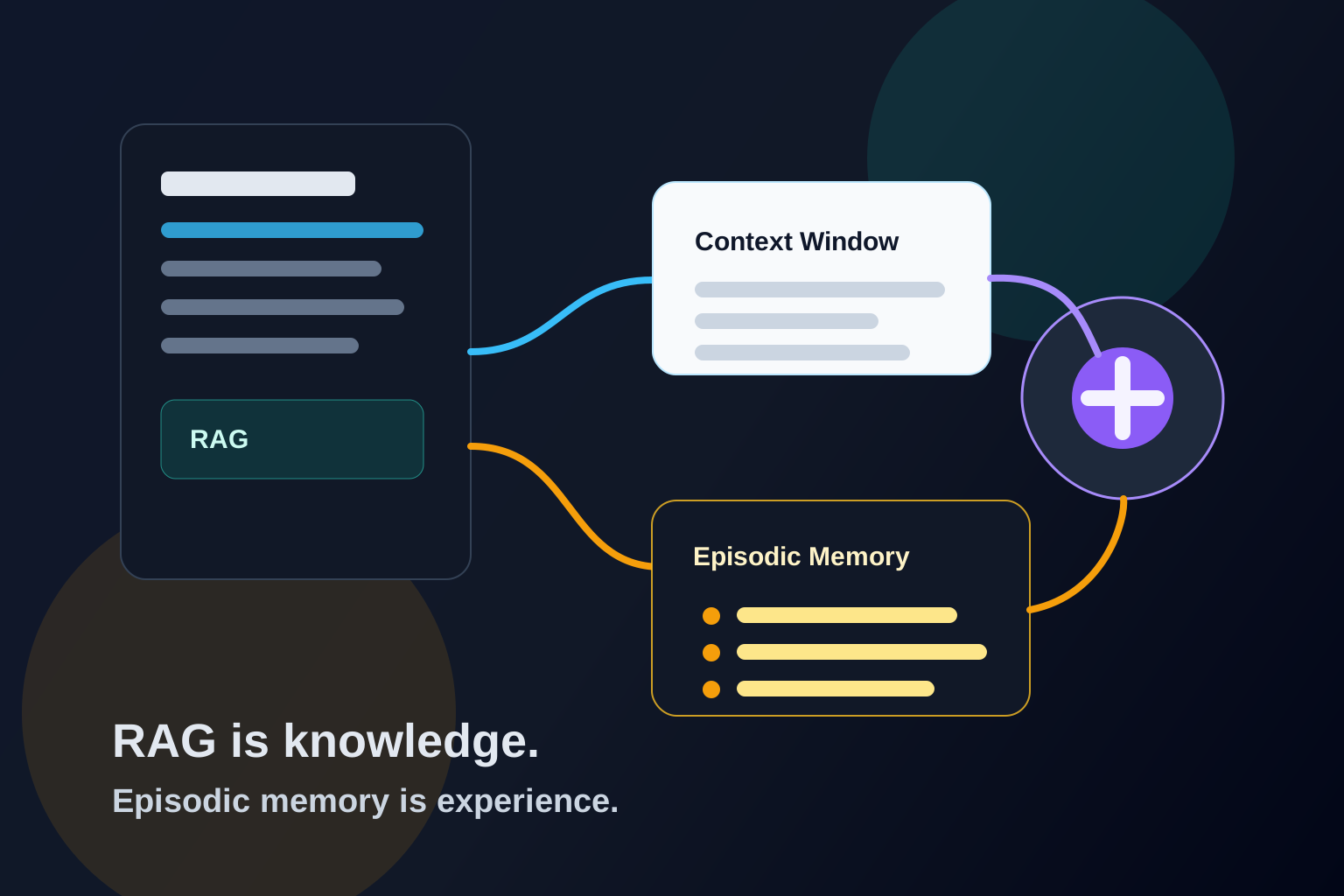
RAG gives an LLM access to outside knowledge. It does not give the model a life.
That difference matters. A retrieval-augmented generation system can search documents, pull relevant chunks, and answer with fresher or more grounded information than the model could produce from weights alone. But the model still has a limited context window, weak long-term continuity, and no built-in understanding of what happened across previous tasks unless the system records and retrieves those experiences.
This is where episodic memory becomes important. The best agents are not only good at finding facts. They remember what they tried, what worked, what failed, what the user prefers, and what should be done differently next time.
In plain terms:
- RAG is external knowledge.
- Context is short-term working memory.
- Episodic memory is the agent's experience log.
- A strong agent needs all three.
What RAG Actually Solves
Retrieval-augmented generation became popular because LLMs have two obvious weaknesses: they can be outdated, and they can hallucinate when asked about knowledge that is not reliably represented in their training data.
The original RAG idea, described by Lewis et al. in 2020, combines a neural retriever with a generator so the model can condition its answer on retrieved documents instead of relying only on parametric memory. In practical products, that usually means:
- Split documents into chunks.
- Embed those chunks into vectors.
- Store them in a vector database or search index.
- Retrieve relevant chunks for a user query.
- Put those chunks into the prompt.
- Ask the model to answer using that context.
That pattern is powerful. It makes chatbots useful over private docs, manuals, PDFs, source code, tickets, policies, and knowledge bases.
But RAG has a boundary that many teams miss: it retrieves information. It does not automatically create durable learning.
The Memory Limit of LLMs
People often say an LLM "remembers" things, but most of the time they mean one of three different mechanisms:
| Memory Type | What It Really Means | Main Limitation |
|---|---|---|
| Model weights | Patterns learned during training | Not easily updated per user or per task |
| Context window | Text currently visible in the prompt | Limited, expensive, and temporary |
| External memory | Data retrieved from storage | Only useful if recorded, indexed, retrieved, and trusted correctly |
Even long-context models do not remove the memory problem. They increase the size of the working desk, but they do not decide what deserves to be saved forever, what should be forgotten, what caused a previous failure, or which past experience is relevant to the current task.
That is why "just make the context window bigger" is not a full agent strategy.
A bigger context window can help with:
- reading longer documents
- comparing more files at once
- carrying more conversation history
- reducing retrieval pressure for medium-sized tasks
But it still struggles with:
- months of user history
- repeated project decisions
- long-running tasks across sessions
- preference changes over time
- learning from mistakes
- selecting only the most relevant past experience
An agent that keeps everything in context eventually becomes noisy. An agent that keeps nothing becomes forgetful.
Why RAG Is Not Enough for Agents
RAG answers the question: "What information should I consult?"
An agent needs to answer a different question: "What have I learned from acting in this environment before?"
Those are not the same.
Imagine a coding agent working inside a repository. RAG can retrieve documentation about a framework, a README, or a nearby file. That helps. But the agent also needs to remember:
- The user prefers small scoped patches.
- Full lint fails because of unrelated old files.
- The PDF editor route is intentionally noindex.
- A previous SEO fix changed metadata rules.
- A build failed last time because metadata was placed inside a client component.
- The correct workflow is to run targeted lint first, then build.
Those are episodes, not static facts from a manual. They come from experience.
RAG can retrieve a document called "project rules" if someone wrote it down. Episodic memory can record the actual sequence: what happened, what decision was made, what validation passed, and what should be remembered next time.
That is what makes an agent feel less like a search box and more like a collaborator.
What Episodic Memory Means in an AI Agent
In human cognition, episodic memory is memory of events: what happened, when it happened, where it happened, who was involved, and what the outcome was.
For an AI agent, episodic memory can be simpler and more engineered. It is a structured record of experiences:
- user request
- environment state
- actions taken
- files changed
- tools used
- errors encountered
- decisions made
- outcome
- follow-up instruction
The key is that the memory includes context and consequence. It is not just "the user likes TypeScript." It is "during a Next.js App Router task, metadata had to be moved into a server layout because the page was a client component, and the build passed after that change."
That kind of memory changes future behavior.
Why Episodic Memory Creates Better Agents
1. Agents learn from outcomes, not only documents
RAG lets an agent read. Episodic memory lets an agent learn from doing.
If an agent tries a fix and a test fails, the failure should not disappear after the chat ends. A good agent records the failed path, the final fix, and the verification result. Next time, it can avoid repeating the same mistake.
This is the idea behind agent reflection systems such as Reflexion, where language feedback about previous attempts can improve later behavior.
2. Agents become consistent across sessions
Without memory, every new session starts from zero. The user has to repeat preferences, project context, deployment rules, and past decisions.
With episodic memory, an agent can recall:
- "Last time we decided not to use repeated SEO filler."
- "The user wants ToolMintX fixes saved to persistent memory."
- "The site uses Next.js 16.2.4, React 19, and Tailwind v4."
- "Route metadata belongs in server components or layout files."
That continuity saves time and reduces frustration.
3. Agents can retrieve experience by situation
The best memory is not a giant transcript. It is searchable experience.
A good episodic memory system should support queries like:
- "Have we fixed this AdSense issue before?"
- "What broke the build last time?"
- "Which files control sitemap behavior?"
- "What did the user say about copy-paste SEO content?"
- "Which validation commands passed before deployment?"
That turns old work into reusable operational knowledge.
4. Agents can distinguish facts from preferences
RAG often treats retrieved text as content. An agent memory system can classify memory:
- Semantic memory: stable facts, such as project stack or API ports.
- Episodic memory: events and outcomes, such as a debugging session.
- Procedural memory: reusable workflows, such as release steps.
- Preference memory: user style and decision preferences.
This classification matters because each memory should be used differently. A user preference should guide behavior. A build failure should be checked against current code. A factual project rule should be trusted only if still current.
5. Agents can build trust through follow-through
Users trust agents that remember the right things and forget the wrong things.
An agent should remember project decisions, verification results, and user preferences. It should not casually expose sensitive content, preserve secrets, or overfit to a stale instruction.
Good episodic memory is not about hoarding every detail. It is about useful continuity with controlled recall.
A Practical Architecture for Agent Memory
A strong agent memory stack usually has four layers:
1. Working context
This is the current prompt, open files, tool outputs, and immediate task state. It is fast and temporary.
Use it for:
- current code edits
- live debugging
- active user instructions
- recent command output
Do not use it as permanent memory.
2. RAG knowledge base
This is the external knowledge layer: docs, source files, tickets, articles, manuals, policies, and indexed content.
Use it for:
- factual lookup
- grounding answers
- finding relevant files
- answering questions over large document sets
Do not confuse it with personal experience.
3. Episodic memory
This is the experience layer. It stores what happened and what the result was.
Use it for:
- past fixes
- user decisions
- debugging outcomes
- project-specific lessons
- deployment notes
- repeated workflows
This is where agents start becoming durable collaborators.
4. Reflection and consolidation
Raw episodes can become noisy. The agent needs a way to compress repeated episodes into cleaner rules.
For example:
- Episode: "On May 9, full lint failed because of unrelated old files."
- Episode: "On May 10, targeted lint passed but full lint still had old errors."
- Consolidated memory: "For ToolMintX, report targeted lint results for touched files and mention full lint only if relevant, because unrelated legacy lint failures exist."
This is how experience becomes reusable judgment.
RAG vs Episodic Memory
| Capability | RAG | Episodic Memory |
|---|---|---|
| Retrieves facts from documents | Yes | Sometimes |
| Remembers past agent actions | Not by default | Yes |
| Tracks user preferences | Only if written and indexed | Yes |
| Learns from failed attempts | Not by default | Yes |
| Supports citations | Strong fit | Possible, but different |
| Improves continuity across sessions | Limited | Strong |
| Best use | Knowledge grounding | Agent learning and personalization |
The cleanest mental model is this:
RAG helps the agent know more. Episodic memory helps the agent become better.
Common Mistakes Teams Make
Mistake 1: Treating vector search as memory
A vector database is storage plus retrieval. It is not memory by itself. Memory requires decisions about what to store, how to label it, when to retrieve it, and when to forget it.
Mistake 2: Saving everything
Saving every message creates clutter. The agent starts retrieving irrelevant memories and becomes less precise. Good memory needs filtering.
Mistake 3: Trusting old memory too much
Projects change. APIs change. User preferences change. Memory needs timestamps, confidence, and update behavior.
Mistake 4: Mixing private data with general memory
Agent memory should be designed with privacy boundaries. Secrets, credentials, private documents, and sensitive personal data should not be stored casually.
Mistake 5: Forgetting verification
The most useful agent memories include validation:
- build passed
- test failed
- deployment succeeded
- crawl found zero 404s
- user approved the direction
Outcome is what turns a note into experience.
What the Best Agent Looks Like
The best agent is not the one with the largest context window. It is the one with the best memory discipline.
It can:
- retrieve documents when it needs facts
- remember project history when it needs continuity
- reflect on failures when it needs improvement
- keep user preferences separate from general knowledge
- cite sources when it makes factual claims
- avoid storing sensitive data unnecessarily
- verify changes before claiming success
That is why episodic memory is a major step toward better agents. It gives the system a way to carry experience forward.
A Simple Agent Memory Loop
A practical loop looks like this:
- Observe: Read the user request, files, tool output, and relevant docs.
- Retrieve: Pull useful knowledge from RAG and relevant episodes from memory.
- Act: Make the change, answer the question, or run the workflow.
- Verify: Run tests, build, crawl, compare output, or ask for confirmation.
- Reflect: Summarize what happened and what mattered.
- Store: Save only durable lessons, decisions, preferences, and outcomes.
- Reuse: Recall the right memory in the next similar task.
That loop is what turns a stateless chatbot into a practical agent.
The Bottom Line
RAG is one of the most important patterns in modern AI engineering, but it is not the whole memory story.
LLMs still have limited working memory. Long-context models reduce pressure, but they do not automatically create durable experience. Vector databases retrieve related text, but they do not decide what an agent should learn.
Episodic memory fills that gap. It lets agents remember events, outcomes, decisions, and user-specific context. When combined with RAG, working context, reflection, and careful privacy rules, it creates agents that are more reliable, more personal, and more useful over time.
The future of strong agents is not only bigger models. It is better memory architecture.