By Jyoti Ranjan Swain · April 29, 2026
John Ternus and Apple's Next Era: Hardware, AI and Roadmap
What Apple's John Ternus leadership shift could mean for hardware discipline, Apple silicon, AI strategy, product roadmap, and developers.
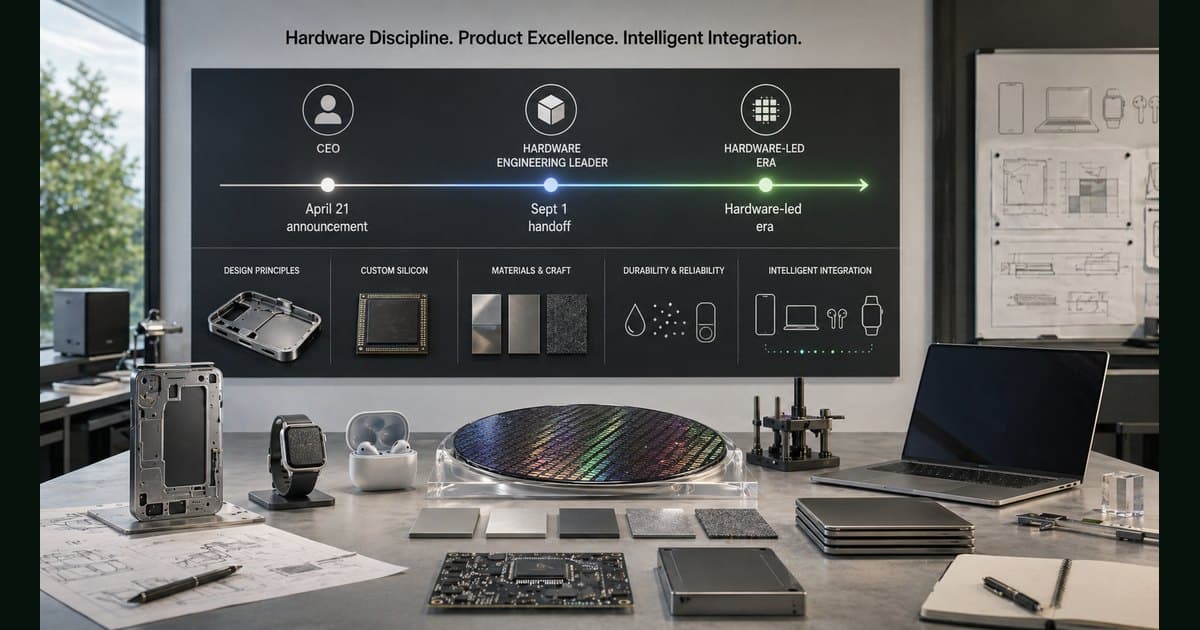
Apple made one of the biggest leadership announcements in modern tech on April 21, 2026. The company said Tim Cook will become executive chairman of Apple’s board and John Ternus, Apple’s senior vice president of Hardware Engineering, will become CEO effective September 1, 2026.
That is obviously major corporate news. But for technology readers, the more interesting question is what kind of signal this sends about Apple’s next chapter.
The easiest interpretation would be to frame this as an AI succession story. Apple is under constant pressure to prove it can compete more aggressively in artificial intelligence, and any CEO transition will naturally be read through that lens. But Apple’s own announcement points to a slightly different first conclusion: this looks like a bet on product execution, hardware depth, and long-cycle discipline.
What Apple actually announced
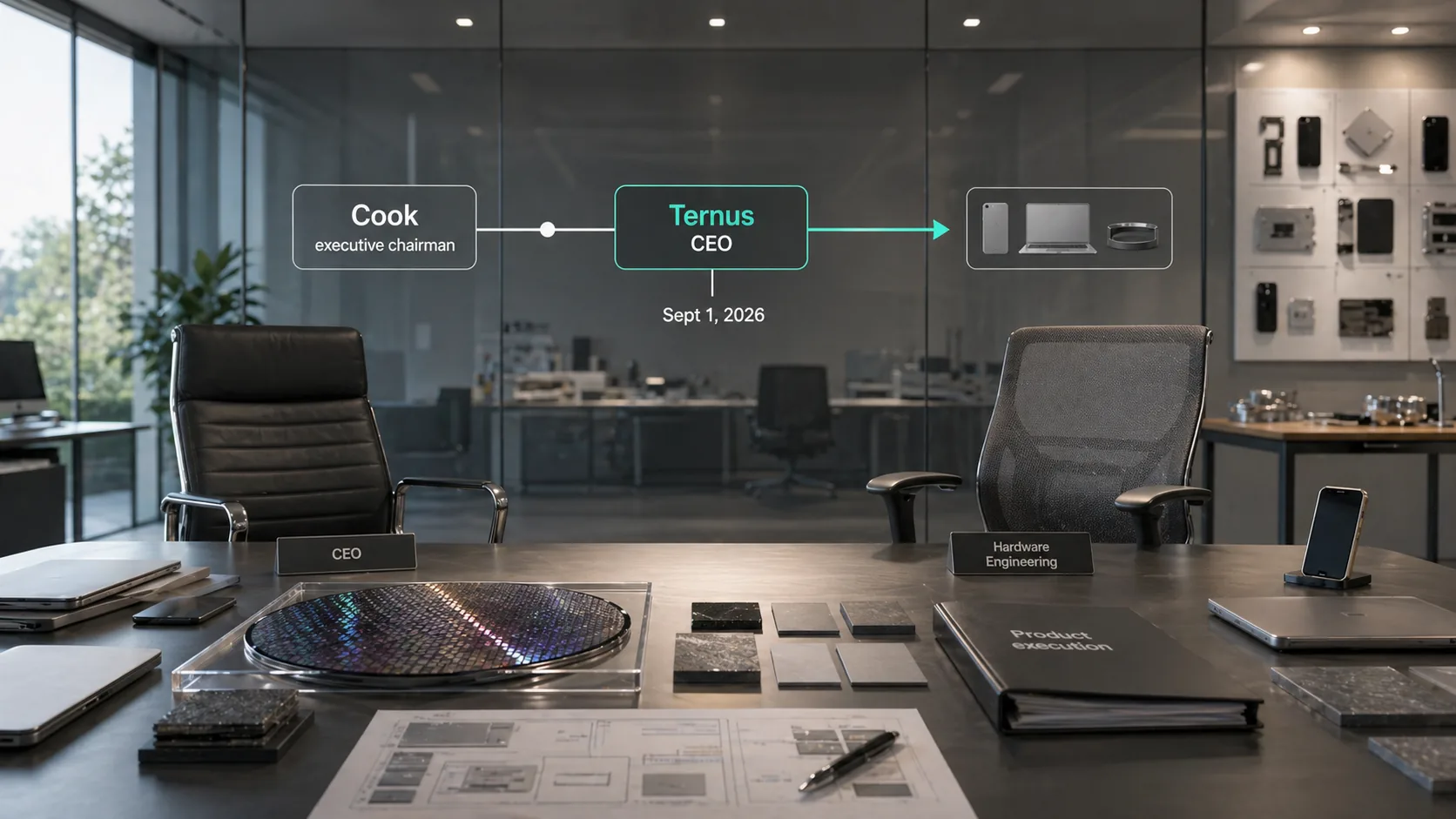
Apple’s statement was unusually clear. Tim Cook stays in the CEO role through the summer of 2026 and then moves into the executive chairman position on September 1, 2026. On the same date, John Ternus joins the board and becomes chief executive officer.
Apple also emphasized that this is the result of a long-term succession process rather than a sudden correction. That matters because it suggests continuity, not panic.
Cook is handing off one of the most operationally disciplined companies in the world. Under his leadership, Apple grew enormously in value, scale, global reach, services revenue, and installed base, while also expanding product lines like Apple Watch, AirPods, Vision Pro, and Apple silicon-powered Macs.
Why John Ternus is a meaningful choice
Ternus is not an outside fixer and not a celebrity-style product visionary imported from elsewhere. He is a deeply internal Apple leader with a hardware background.
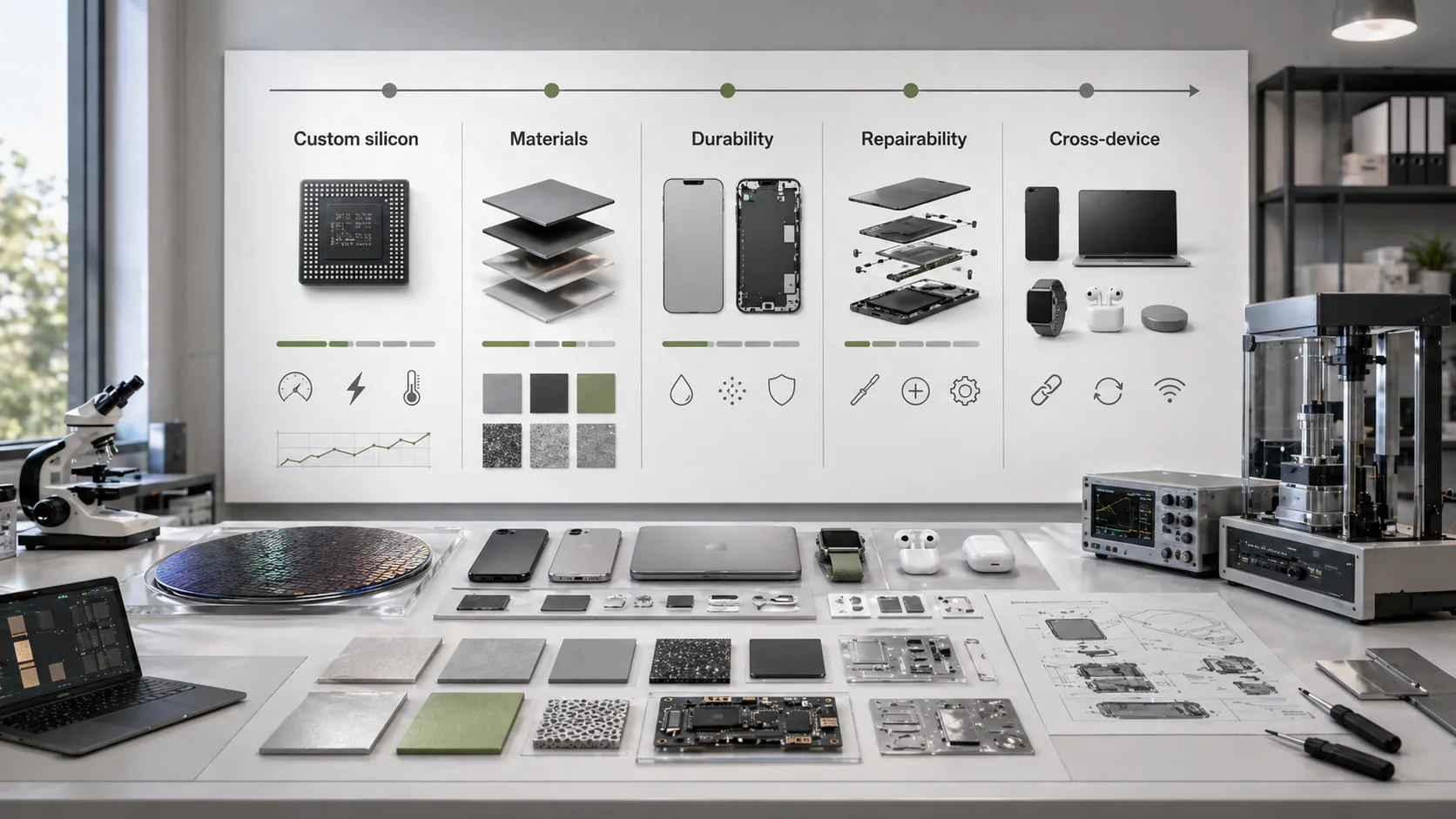
According to Apple, Ternus joined the product design team in 2001, became a vice president of Hardware Engineering in 2013, and joined the executive team in 2021. Apple credits him with leadership across iPhone, Mac, iPad, Apple Watch, AirPods, durability, materials, and repairability.
That profile is the clearest clue to what Apple’s board values most right now: a CEO who understands the company at the level of product development, supply-chain realism, manufacturing detail, and cross-device execution. It does not make AI less important — it signals that Apple is betting AI only matters if it ships well inside products people already use.
Why this does not look like a sudden AI lurch
Apple is not a company that usually telegraphs strategy by making dramatic executive moves. If the board had wanted to send a message that Apple needed a sharp break from its current identity, the profile of the successor likely would have looked very different.
Instead, Ternus represents continuity with a specific emphasis:
- tighter hardware and software integration
- dependable product cadence
- materials, efficiency, and durability
- deeper control over core technologies
- pragmatic evolution instead of loud repositioning
That last point is important. In the AI race, many companies are rewarded for announcing ambitious roadmaps early. Apple usually prefers to absorb new technology into finished products after the pieces are more mature. A hardware-led CEO choice fits that culture.
What this could mean for Apple’s AI strategy
The pressure on Apple to strengthen its AI story is real, but the Ternus appointment points to product integration over headline chasing. The tell is in Apple’s own press release: it spends far more time on his engineering leadership, hardware breadth, reliability work, and materials innovation than on any attempt to cast him as a radical AI strategist.
If that holds, Apple will be judged less on making the loudest AI announcement and more on delivering AI that feels native across iPhone, Mac, AirPods, wearables, and its silicon stack. For users, that means the familiar Apple pattern: slower narrative swings, but stronger emphasis on polish, battery-aware on-device intelligence, and features that arrive through devices and operating systems rather than as standalone AI brands.
What developers and industry watchers should watch next
The CEO title does not instantly rewrite Apple’s roadmap on September 1, 2026. But it changes how upcoming signals should be read.
1. Apple silicon becomes even more central
If Apple is putting a hardware engineering leader in the top job, then its custom silicon story becomes even more strategic. Performance per watt, on-device inference, memory architecture, and cross-device consistency are likely to stay at the center of the company’s competitive playbook.
2. Product quality may stay ahead of product drama
Ternus’s background suggests a bias toward engineering discipline. That could mean Apple continues favoring reliability, build quality, and integration over fast-moving experimentation that creates more noise than value.
3. AI will matter most where it disappears into the product
Apple’s real AI test is not whether it can dominate the discourse for a week. It is whether users can feel AI improving the products they already carry every day without turning those products into a confusing bundle of unfinished features.
Why this transition matters to the broader tech industry
This announcement is also a useful contrast with how much of the rest of tech is behaving in 2026. Many companies are reorganizing around AI in visibly urgent ways. Apple’s move looks different. It says that, at least for now, the company believes execution discipline is still the best foundation for its next era.
That is not a rejection of AI. It is a reminder that in consumer technology, the companies that win over time are not always the ones with the most aggressive narrative. They are often the ones that turn hard technology problems into dependable products at scale.
If Ternus can preserve Apple’s hardware strengths while helping the company tell a more credible AI story, the transition could look smart very quickly. If not, the pressure will intensify just as he takes the job.
Conclusion
Apple’s leadership transition is big news because it closes one of the most influential CEO runs in technology and opens a new chapter under an executive shaped by hardware engineering.
Based on what Apple announced on April 21, 2026, the first signal is continuity with a stronger engineering accent, not a sudden reinvention. For readers trying to understand what changes next, the smartest lens is probably this: watch the devices, the silicon, and the quality of integration. That is where the Ternus era is most likely to define itself first.
More From ToolMintX
Other Blog Posts
June 2, 2026
NVIDIA RTX Spark AI Laptops and Workstations: What Launched
NVIDIA RTX Spark brings Blackwell AI laptops and compact desktops to Windows, while DGX Spark and DGX Station define the local AI workstation tiers.
May 27, 2026
May 2026 AI Model Watch: Gemini 3.5 Flash, Gemini Omni, and GPT-Realtime
Compare the current AI model wave across fast agents, multimodal media generation, and realtime voice APIs for practical product choices.
May 27, 2026
AI on Android After I/O 2026: AppFunctions, Gemini Nano 4, and Hybrid Agents
Android AI updates now give developers AppFunctions, Gemini Nano 4, ML Kit GenAI, hybrid inference, A2UI, and ADK for app agents.